Tag Archives: Sunday

After Twenty Years by O. Henry — LitReading – Classic Short Stories

Twenty years after heading west to find his fortunes a man returns to meet a long lost friend. 5 to 15 minutes

Source: After Twenty Years by O. Henry — LitReading – Classic Short Stories

THE COP MOVED ALONG THE STREET, LOOKING strong and important. This was the way he always moved. He was not thinking of how he looked. There were few people on the street to see him. It was only about ten at night, but it was cold. And there was a wind with a little rain in it.

He stopped at doors as he walked along, trying each door to be sure that it was closed for the night. Now and then he turned and looked up and down the street. He was a fine-looking cop, watchful, guarding the peace.

People in this part of the city went home early. Now and then you might see the lights of a shop or of a small restaurant. But most of the doors belonged to business places that had been closed hours ago.Then the cop suddenly slowed his walk. Near the door of a darkened shop a man was standing. As the cop walked toward him, the man spoke quickly.

“It’s all right, officer,” he said. “I’m waiting for a friend. Twenty years ago we agreed to meet here tonight. It sounds strange to you, doesn’t it? I’ll explain if you want to be sure that everything’s all right. About twenty years ago there was a restaurant where this shop stands. ‘Big Joe’ Brady’s restaurant.”

“It was here until five years ago,” said the cop.

The man near the door had a colorless square face with bright eyes, and a little white mark near his right eye. He had a large jewel in his necktie.

“Twenty years ago tonight,” said the man, “I had dinner here with Jimmy Wells. He was my best friend and the best fellow in the world. He and I grew up together here in New York, like two brothers. I was eighteen and Jimmy was twenty. The next morning I was to start for the West. I was going to find a job and make a great success. You couldn’t have pulled Jimmy out of New York. He thought it was the only place on earth.

“We agreed that night that we would meet here again in twenty years. We thought that in twenty years we would know what kind of men we were, and what future waited for us.”

“It sounds interesting,” said the cop. “A long time between meet- ings, it seems to me. Have you heard from your friend since you went West?”

“Yes, for a time we did write to each other,” said the man. “But after a year or two, we stopped. The West is big. I moved around every- where, and I moved quickly. But I know that Jimmy will meet me here if he can. He was as true as any man in the world. He’ll never forget. I came a thousand miles to stand here tonight. But I’ll be glad about that, if my old friend comes too.”

The waiting man took out a fine watch, covered with small jewels.

“Three minutes before ten,” he said. “It was ten that night when we said goodbye here at the restaurant door.”

“You were successful in the West, weren’t you?” asked the cop.

“I surely was! I hope Jimmy has done half as well. He was a slow mover. I’ve had to fight for my success. In New York a man doesn’t change much. In the West you learn how to fight for what you get.”

The cop took a step or two.

“I’ll go on my way,” he said. “I hope your friend comes all right. If he isn’t here at ten, are you going to leave?”

“I am not!” said the other. “I’ll wait half an hour, at least. If Jimmy is alive on earth, he’ll be here by that time. Good night, officer.”

“Good night,” said the cop, and walked away, trying doors as he went.

There was now a cold rain falling and the wind was stronger. The few people walking along that street were hurrying, trying to keep warm. And at the door of the shop stood the man who had come a thousand miles to meet a friend. Such a meeting could not be certain. But he waited.

About twenty minutes he waited, and then a tall man in a long coat came hurrying across the street. He went directly to the waiting man.

“Is that you, Bob?” he asked, doubtfully.

“Is that you, Jimmy Wells?” cried the man at the door.

The new man took the other man’s hands in his. “It’s Bob! It sure-

ly is. I was certain I would find you here if you were still alive. Twenty years is a long time. The old restaurant is gone, Bob. I wish it were here, so that we could have another dinner in it. Has the West been good to you?”

“It gave me everything I asked for. You’ve changed, Jimmy. I never thought you were so tall.”

“Oh, I grew a little after I was twenty.”

“Are you doing well in New York, Jimmy?”

“Well enough. I work for the city. Come on, Bob, We’ll go to a

place I know, and have a good long talk about old times.”

The two men started along the street, arm in arm. The man from the West was beginning to tell the story of his life. The other, with his coat up to his ears, listened with interest.

At the corner stood a shop bright with electric lights. When they

came near, each turned to look at the other’s face.

The man from the West stopped suddenly and pulled his arm away. “You’re not Jimmy Wells,” he said. “Twenty years is a long time,

but not long enough to change the shape of a man’s nose.”

“It sometimes changes a good man into a bad one,” said the tall man. “You’ve been under arrest for ten minutes, Bob. Chicago cops thought you might be coming to New York. They told us to watch for you. Are you coming with me quietly? That’s wise. But first here is something I was asked to give you. You may read it here at the window.

It’s from a cop named Wells.”

The man from the West opened the little piece of paper. His hand

began to shake a little as he read.

“Bob: I was at the place on time. I saw the face of the man want- ed by Chicago cops. I didn’t want to arrest you myself. So I went and got another cop and sent him to do the job.

JIMMY.”

Leave a comment

Filed under 2019, author, short story

Announcing The Charles Frazier Cold… | Hub City Writers Project

Charles Frazier, Hub City Press Team Up for Brand New Book Series

Source: Announcing The Charles Frazier Cold… | Hub City Writers Project

SPARTANBURG, S.C.—National Book Award Winner Charles Frazier and Hub City Press are teaming up on a new series of books spotlighting extraordinary writers from the American South. Beginning in spring 2019, the Cold Mountain Fund Series will publish literary fiction in hardback.

Frazier, best-selling author of “Cold Mountain,” “Thirteen Moons,” “Nightwoods,” and “Varina,” will provide financial support through the Frazier family’s Cold Mountain Fund at the Community Foundation of Western North Carolina. Frazier also will assist in book promotion and make occasional appearances with the Cold Mountain Fund Series authors.

“I have long considered Hub City Press to be one of the very finest independent publishers in the country and am excited to help foster their already excellent offerings of literary fiction,” Frazier said.

Hub City Press, now in its 24th year, is the South’s premier independent literary press. Funded by the National Endowment for the Arts, Hub City is focused on finding and publishing new and extraordinary voices from the South. Among its recent successes are an NPR Book of the Year, a Kirkus Book of the Year, a book longlisted for the Center for Fiction First Novel Prize, and coverage in The Los Angeles Times and The New York Times.

“I couldn’t be more thrilled at this new partnership,” said Meg Reid, director of Hub City Press. “Charles Frazier has long been one of the South’s greatest writers, as well as one of Hub City’s most ardent supporters. This series will be vital in helping us continue our mission to find and champion the finest fiction the South has to offer.”

The first three books in the series will be “The Magnetic Girl” by Jessica Handler of Atlanta, GA (April 2019), “Watershed” by Mark Barr of Little Rock, AR (October 2019), and “The Prettiest Star” by Carter Sickels of Lexington, KY (April 2020).

“Finding an audience has never been easy for writers of literary fiction,” Frazier said, “so in working with Hub City, my hope is to help amplify distinctive Southern voices and connect them with curious readers.”

Cold Mountain funds primarily will be targeted for more substantial book advances and for book marketing.

Hub City Press titles are distributed by Publishers Group West. Among its published authors are Leesa Cross-Smith, Ron Rash, Michel Stone, Julia Franks, Ashley Jones and others. Hub City annually sponsors the $10,000 C. Michael Curtis Short Story Book Prize (judged this year by Lauren Groff), the biennial New Southern Voices Poetry Prize and the biennial South Carolina Novel Prize.

Leave a comment

Filed under 2019, announcement, author

Sunday writing prompt: “Happy Holidays”

Now, what kind of story can you make from that Christmas Tip? Happy Holidays fellow writers.

Leave a comment

Filed under 2018, Sunday silliness

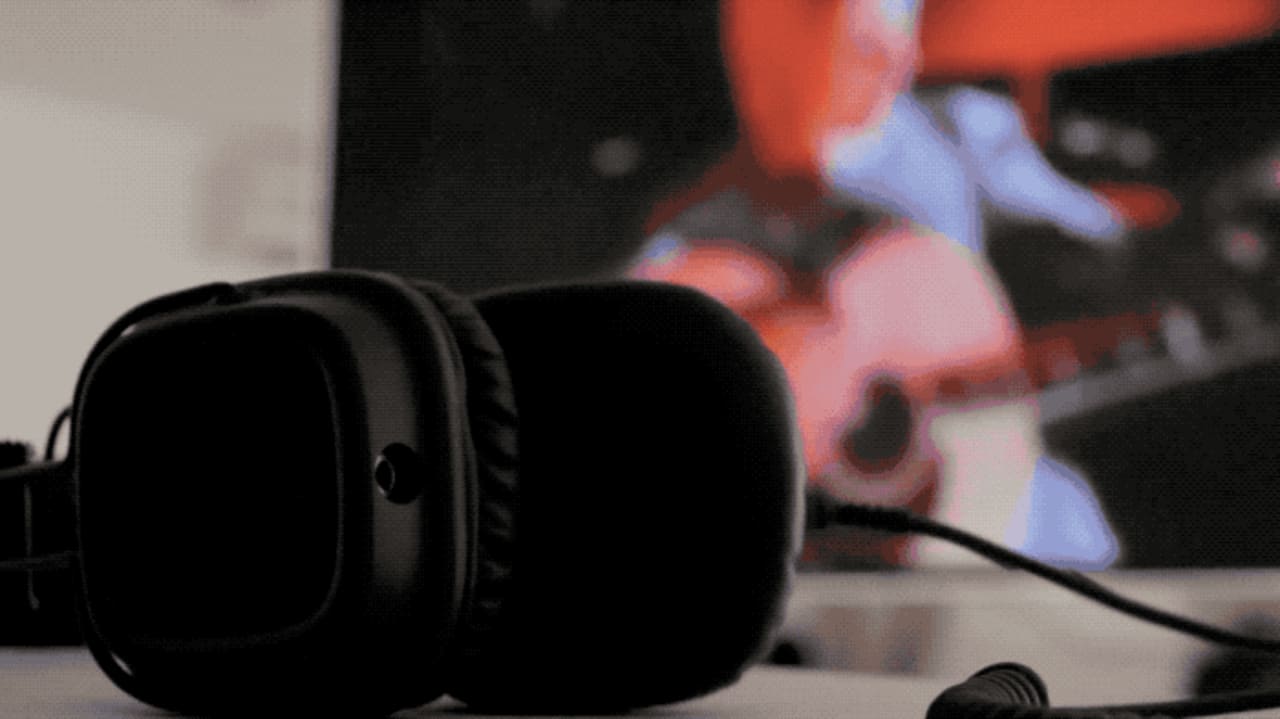
These 10 songs are scientifically guaranteed to chill you out

Feeling stress over your writing? Maybe a little relaxing will help. Sound therapies have long been used to help us cope.

Source: These 10 songs are scientifically guaranteed to chill you out

fastcompany.com

Neuroscience says listening to this song reduces anxiety by up to 65%

By Melanie Curtin

4 minutes

Everyone knows they need to manage their stress. When things get difficult at work, school, or in your personal life, you can use as many tips, tricks, and techniques as you can get to calm your nerves.

So, here’s a science-backed one: make a playlist of the 10 songs found to be the most relaxing on earth.

Sound therapies have long been popular as a way of relaxing and restoring one’s health. For centuries, indigenous cultures have used music to enhance well-being and improve health conditions.

Now, neuroscientists out of the UK have specified which tunes give you the most bang for your musical buck.

The study was conducted on participants who attempted to solve difficult puzzles as quickly as possible while connected to sensors. The puzzles induced a certain level of stress, and participants listened to different songs while researchers measured brain activity as well as physiological states that included heart rate, blood pressure, and rate of breathing.

Related: What Music Does To Our Brains

According to Dr. David Lewis-Hodgson of Mindlab International, which conducted the research, the top song produced a greater state of relaxation than any other music tested to date.

In fact, listening to that one song — “Weightless” — resulted in a striking 65 percent reduction in participants’ overall anxiety, and a 35 percent reduction in their usual physiological resting rates.

That is remarkable.

Equally remarkable is the fact the song was actually constructed to do so. The group that created “Weightless”, Marconi Union, did so in collaboration with sound therapists. Its carefully arranged harmonies, rhythms, and bass lines help slow a listener’s heart rate, reduce blood pressure and lower levels of the stress hormone cortisol.

When it comes to lowering anxiety, the stakes couldn’t be higher. Stress either exacerbates or increases the risk of health issues like heart disease, obesity, depression, gastrointestinal problems, asthma, and more. More troubling still, a recent paper out of Harvard and Stanford found health issues from job stress alone cause more deaths than diabetes, Alzheimer’s, or influenza.

In this age of constant bombardment, the science is clear: if you want your mind and body to last, you’ve got to prioritize giving them a rest. Music is an easy way to take some of the pressure off of all the pings, dings, apps, tags, texts, emails, appointments, meetings, and deadlines that can easily spike your stress level and leave you feeling drained and anxious.

Of the top track, Dr. David Lewis-Hodgson said, “‘Weightless’ was so effective, many women became drowsy and I would advise against driving while listening to the song because it could be dangerous.”

So, don’t drive while listening to these, but do take advantage of them:

  1. We Can Fly,” by Rue du Soleil (Café Del Mar)
  2. Canzonetta Sull’aria,” by Mozart
  3. Someone Like You,” by Adele
  4. Pure Shores,” by All Saints
  5. Please Don’t Go,” by Barcelona
  6. Strawberry Swing,” by Coldplay
  7. Watermark,” by Enya
  8. Mellomaniac (Chill Out Mix),” by DJ Shah
  9. Electra,” by Airstream
  10. Weightless,” by Marconi Union

I made a public playlist of all of them on Spotify that runs about 50 minutes (it’s also downloadable).

There’s also a free 10-hour version of “Weightless” available if you want a longer listening experience.

Leave a comment

Filed under 2018, abbreviations, Sunday story

New words to live by: “Tantrumony”

Time, once again, for New words to live by. This is a word or phrase not currently in use in the U.S. English lexicon, but might need to be considered. Other words, such as obsurd, crumpify, subsus, flib, congressed, and others, can be found by clicking on the tags below. Today’s New Word is created by taking two nouns and creating a new word. In this instance, the new word does not borrow from the names of the old words, but from their definitions.Without further waiting here is the new word: tantrumony.

OLD WORDS
Ego, n. There are several definitions for this word, but the one we are most interested in is: conceit, self-importance, egotism.

Attitude, n. There are several definitions for this word, but the one we are most interested in is: manner, disposition, feeling, position, etc., with regard to a person or thing; tendency or orientation, especially of the mind.

NEW WORD
Tantrumony, n. 1) The dysfunctional marriage of ego and attitude. 2) An attitude of extreme self-importance.

A person so showing this condition is called a tantrumonist.

Used in a sentence: Don was the perfect example of “always wrong, but never in doubt.” When challenged on this point, he had a perfect tantrumony, blaming those who challenged him with conspiring to see him fail.

Most recent new word: furture.

Leave a comment

Filed under 2018, New words to live by

Older British Accents Actually Sounded More Like Americans Speak Today – Comic Sands

Source: Older British Accents Actually Sounded More Like Americans Speak Today – Comic Sands

It’s no secret that English is a mutt language, originating from a mixture of the Germanic and romantic languages. But what’s less appreciated is why Americans and Brits sound so different from one another.

The most distinct difference between American English and British English is how each culture pronounces their “R”s, which is known as rhoticity.

A dropped or unemphasized “R” is a trademark of British speech, while a voiced, or rhotic “R,” is the typical American style.

Some regions of Northern England, Scotland and Ireland sound different because they kept the rhotic pronunciation. And some regions in the United States dropped it like Boston and New York and the American south, where “R”s tend to be nearly non-existent.

Would you believe that the American way is actually the older version of English?

Have you ever thought about why we don’t all sound the same?

The first English came to North America in 1607. English settlers in the 17th Century sounded closer to today’s Americans, according to the science website, Curiosity.

“…the modern American accent is a lot closer to how English used to be spoken than the [modern] British accent is.”

What then, you ask, did the Brits do with their “R”s?

Simply put, the wealth boom of the Industrial Revolution prompted well-to-do English people to drop their “Rs” because voicing them “instantly marked them as a commoner.”

“In order to distinguish themselves from their lowlier roots, this new class of Brit developed their own posh way of speaking. And eventually, it caught on throughout the country.”

“It’s called “received pronunciation,” and it even influenced the speech patterns of many other English dialects — the Cockney accent, for example, is just as non-rhotic but a lot less hoity-toity.”

This quirk developed by the English upper classes eventually found its way to the United States in the form of the Transatlantic Accent, which has been forever immortalized in recordings and films from the first half of the 20th Century.

However this time, the purpose was not to distinguish from the lower classes. The change had to do with changing technology, namely the rise of the “talkie” when silent films were phased out and motion pictures got voice tracks.

The Transatlantic or Mid-Atlantic Accent is the familiar, quasi-British sounding twang used by President Franklin Delano Roosevelt and many influential actors, such as Cary Grant, Katherine Hepburn, and Vincent Price, through the end of World War II.

Its popularity grew out of the clarity it provided on early audio recordings, on microphones and on the radio where rhotic speech could be difficult to understand.

For this speech evolution, the “R” is dropped and the “T” is highly articulated. All vowels are softened.

It was also a way to appeal to diverse English-speaking populations. It blended both the American and English accents of the time.

The accent fell out of favor after World War II however.

The Transatlantic or Mid-Atlantic Accent was a beautiful way of speaking and we should bring it back. Let’s make Transatlantic Accents Great Again!

You’re welcome.

Leave a comment

Filed under 2018, accent

7 Sci-Fi Novels for When You Want to Laugh

From not-so-super heroes to socially-anxious killer robots, here are seven humorous stories of people who are in over their heads.

Source: 7 Sci-Fi Novels for When You Want to Laugh

When characters discover new worlds, take on galactic invaders, time travel or gain extraordinary powers, it can lead to heroic, epic adventures—or everything going hilariously wrong. Or, even better, some combination of both. So from not-so-super heroes to socially-anxious killer robots, here are seven humorous stories of people who are in over their heads.

Gate Crashers by Patrick S. Tomlinson

When the crew of the exploration vessel Magellan discovers an alien artifact during humanity’s furthest trip into space, they decide to bring it back to Earth so they can study the technology. Unfortunately, the aliens happened to be rather fond of this artifact. As the people of Earth put themselves on a collision course with the rest of the potentially hostile galaxy, they find the only thing as infinite as the universe is humanity’s ability to mess up.

Super Extra Grande by Yoss

Bizarre, hilarious, and a scathing critique of Western politics, Cuban author Yoss’s satire follows Dr. Jan Amos Sangan Dongo, a veterinarian who specializes in treating large alien animals. When Earth faces colonial conflicts with the other intelligent species, Dr. Sangan is forced to embark on a mission to rescue two ambassadors from the belly of an enormous creature. It’s intergalactic road trip meets raunchy satire and you need it in your life.

All Systems Red by Martha Wells

In this first book in the Murderbot Diaries, a self-aware security android hacks its settings and dubs itself “Murderbot”… because it sort of killed several people. Now free of restraints and bugs that might send them on another killing spree, the introverted droid has discovered soap operas and just wants to be left alone. But when something goes wrong on a mission to protect scientists on an alien planet, Murderbot gets strangely attached to their pesky humans and decides to risk discovery to protect them all—even if humans are much more complicated than they look on TV.

Old Man’s War by John Scalzi

The good news is humans have made it to interplanetary space and discovered inhabitable planets. The bad news is that aliens want these planets too, and humans, led by the Colonial Defense Force, will have to fight for them. But the Defense Force doesn’t take young recruits—it enlists the elderly and transfers their experienced minds into younger bodies. John Perry joins the military on his 75th birthday. And while there’s plenty of drama and battle, there’s also a lot of old dudes making fart jokes and getting excited about their new abs. Old Man’s War is another one of the books on this list that show an outer space is full of sarcasm and witty rejoinders.

All Those Explosions Were Someone Else’s Fault by James Alan Gardner

When dark creatures start to offer immortality in exchange for money (and maybe your soul) and magic and science combine to create beings with extraordinary powers, a battle ensues between the Dark and the Light. Caught in the middle of it all are Kim Lam, our snarky, gender-fluid hero, and their three roommates, turned into the super-powered Sparks by a freak accident. Equipped with capes and costumes, the friends use their new-found abilities to seek truth and justice…for the most part. The explosions were definitely someone else’s fault.

To Say Nothing of the Dog by Connie Willis

This Hugo and Locus-award winning comedic novel begins in the year 2057, where they use time machines to study history. Ned Henry, suffering from time-lag due to jumping back and forth to often from the 1940s, is in desperate need of a rest. But when a historian takes something from Victorian times that could upset the results of World War II and destabilize the timeline, Ned is the only available man to go back and set things right. Hijinks, mischievous butlers, boating accidents and social snafus ensue as the historians of Oxford pop back and forth in time and search for a gaudy artifact of dubious proportions.

Hitchhiker’s Guide to the Galaxy by Douglas Adams

A classic when it comes to humorous science fiction, this story follows Arthur Dent and his best friend and actual alien Ford Prefect. They, and of course all the dolphins and mice, survive when Vogons destroy Earth to make way for an intergalactic highway. Joined by a two-headed alien, a human woman, a depressed robot, and a graduate student obsessed with the disappearance of his pens, they begin a journey full of wit and lunacy to discover the answer to some of life’s most important questions.


Leave a comment

Filed under 2018, science fiction

“Humans never learn”: the philosopher John Gray on New Atheism, the God Debate and why history repeats itself | The Sunday Times Magazine | The Sunday Times

Source: “Humans never learn”: the philosopher John Gray on New Atheism, the God Debate and why history repeats itself | The Sunday Times Magazine | The Sunday Times

Gray’s latest book, Seven Types of Atheism, targets the New Atheists

by Bryan Appleyard

Once upon a time an American writer called Sam Harris wrote a book called The End of Faith, about how silly it was to believe in God. The book sold many copies, so some other people — Richard Dawkins, Christopher Hitchens, Daniel Dennett, AC Grayling — wrote the same book. This made them all quite a bit richer and turned them into a movement called either Militant Atheism or the New Atheism. They were all fairly clever, but none of them was even half as clever as another philosopher called John Gray. (I would say he’s the greatest, but he’s a mate so you might think I’m biased.)

Gray became “bored and frustrated” with what came to be known as the God Debate, so he decided to put them in their place.

“They’ve not read very much of anything at all,” he explains, “and they don’t know anything very much.”

The New Atheists wanted to get rid of God because they thought he was the real problem. When communism collapsed in the late 1980s, people believed the West had won and soon everybody would be nice liberal democrats. It didn’t happen. Then along came 9/11, which was caused by God or, at least, bad religion. And it was this, the New Atheists concluded, that was stopping people becoming just like them.

So the New Atheists set up a new, godless religion of science. Science was the one human activity that shows constant progress, so letting science set the rules seemed the way to ensure constant progress in all things. This is, Gray believes, a fairy tale. In his view, there is no evidence whatsoever that human progress is inevitable and enduring. And there is plenty of evidence that it isn’t. The 20th century was a slaughterhouse from the trenches of the First World War to the Holocaust in the Second. The 21st is now heading that way with gas attacks on children in Syria, the genocide of the Rohingya in Burma and, most chilling of all, the recreation of the Cold War with the use of nuclear weapons now being discussed as an imminent reality. All civilisations, all human aspirations, eventually fail. The best we can do is sustain the good times. Humans can hope, but optimism — the belief in a fundamental change in our condition — is futile.

Gray’s new book, Seven Types of Atheism, is not just a demolition of the anti-God squad, it is also an assault on their strange religion. But who is John Gray?

Born in South Shields in 1948, Gray now lives in Bath with his Japanese wife, Mieko. They have been married for 30 years and have no children. They do, however, have a cat, Julian, a 21-year-old birman that is the hero of Gray’s next book, Feline Philosophy: Cats and the Meaning of Life. “Cats,” he says, “enjoy their lives without needing to turn them into stories.”

When he was growing up, cats “were a normal aspect of working-class life, everybody had cats”. He still has remnants of a Tyneside accent that becomes more pronounced when he tells funny stories, which he does a lot. From his upbringing and his parents — Nick, a joiner and, during the war, a docker, and Joan — he learnt most of the basics of his later thinking. He was born three years after the Second World War, in which our species decided to kill 85m of its members. There were too many such “hemoclysms” — bloodbaths — in the 20th century and I believe Gray is the only philosopher to have recognised their true import. “Secular meliorism — which is the religion of pretty much everybody who thinks they have no religion — says that what has been achieved in history in the way of improvements cannot be lost.” Gray, on the other hand, states that “they were repeatedly lost in the 20th century when whole peoples, whole forms of life were destroyed, so whatever improvements there were within them were gone. And that is normal.”

History, for Gray, is cyclical. There is no upward trend, we are stuck on the treadmill of our own inadequacies. The best that politicians can do is find “partial remedies to recurring human evils” and thereby sustain periods of improvement for a little longer. “I was a beneficiary of the Second World War. If it hadn’t happened, there would have been no welfare state and no opening up of opportunities and I probably wouldn’t have achieved anything. Of course, that improvement was itself a side effect of a catastrophic event … I do believe it was a just and necessary war, but with catastrophic suffering.”

Gray is hyperaware of fragility in all that we do, from the comical, small, daily failures to the life-changing disasters. His manner is, as a result, faintly nervous, but he survives all of this because of the stoicism he learnt from his parents. “I benefited from the inculcation of stoicism from my mother and the whole culture,” he says. “That’s disparaged now.” Stoics, however, can follow their best impulses and assert themselves against fate. Gray did this through books. He started going to the local library, and reading was a way out of Tyneside. Crucially, however, it was not a rejection of his terraced house community. “Doors were left open all the time. That I know because I lived that way. It’s not a romantic, nostalgic backward glance, it’s all true. But this is another lesson about how you can’t have the good without the bad. The downside was that those communities could be very repressive. If you were the son of a miner you were expected to go down the mines; if you were a woman, it was very patriarchal … So if you wanted to live in some other way, you had to leave.”

He went, via books and grammar school, to Oxford and a succession of academic posts in Britain and America. Latterly, he became professor of politics at Oxford and then professor of European thought at LSE. He retired in 2007.

Politically he had been on the left, then the right in the 1980s, then the left. In the 1980s and 1990s his books surveyed vast landscapes of political thought. His friend and Oxford mentor Isaiah Berlin’s analysis of the contradictions of liberalism was a vital inspiration. Gray’s book False Dawn: The Delusions of Global Capitalism, in 1998, was an assault on the right-wing ideology of neoliberalism and has achieved lasting authority because it foresaw the terms of the 2007 financial crash; this led to a new edition in 2009. His next book, Straw Dogs: Thoughts on Humans and Other Animals, however, began a new phase. “Straw Dogs marked a shift in subject matter, writing style and audience for my work. Rather than a treatise in academic political philosophy or a polemic like False Dawn, it was a text I hoped anyone interested in fundamental questions about what it means to be human could find stimulating. It was also a book I enjoyed writing.”

Straw Dogs trashed most modern pieties. For example: “As commonly practised, philosophy is the attempt to find good reasons for conventional beliefs.”

His books that followed — notably, The Immortalization Commission, The Silence of Animals and The Soul of the Marionette — seemed to dissolve all genres, even though they were trashed by many critics. They were philosophy, history, art and literature, economics and politics, all held together with funny stories. For instance, in Gray’s latest book we have the ludicrous atheist French philosopher Auguste Comte, who had clothes made with the buttons down the back so that you needed somebody else to help you dress — it was supposed to promote fraternal co-operation to compensate for the loss of God.

The main problem people seem to have with Gray’s late works is what they mistakenly see as their bleakness. They don’t know what to think or where to go when they put the books down, probably because they have lived their lives under the comfort blanket of the progressive, scientistic superstition. This is a misreading. It is true that, like Darwin, Gray sees humans as just one more species, a passing phenomenon — “The Earth will forget mankind. The play of life will go on.” It is also true that, as he keeps saying, he does not believe in anything. This led to the likes of Professor Terry Eagleton calling him a nihilist. Gray brushes this aside. “Nihilism in common parlance is anything that disrupts the pieties of the time. In 1890 if you said gay sex was OK you’d be a nihilist — ‘You mean buggery is OK! Only a moral nihilist, someone who believed there was no moral order in the cosmos, would say this!’ Well, the Greeks didn’t seem to mind.

“The local piety now is the belief in progress, the human spirit, uplift. In my view this is always dancing on the edge of depression. They need to stand up stiffly for fear of falling flat on their face.”

His latest, Seven Types of Atheism, is a provocation. Even the title itself is designed to rile the New Atheists as they seem to think theirs is the only type of atheism: a disbelief in God and a belief in science as the only road to salvation. This is a fairy tale that has so often had an unhappy ending — communism, Nazism — that it is hard to believe it is still being told. But it survives because of another incurable human attribute: forgetfulness. It is this that made the absurd “God Debate” possible. This debate, Gray says, is “ignorant and parochial and uninformed”. He’s tired of poking holes in Dawkins’s deficient learning and self-serving logic, but he still likes to stick the odd knife into Sam Harris, the American leader of the movement, accusing him of “a willed ignorance of the history of ideas”.

“The whole God Debate was a recycled and cheapened version of debates that went on in the 19th century, with not much that is genuinely new … There is nothing that wasn’t in Victorian atheism, which was often better expressed and certainly with more knowledge of Christianity and biblical texts.”

For Gray, to say you are an atheist is not to say that there is no God, but rather to say you don’t need a God. (In these terms, he is an atheist himself.) Historically, atheism has taken many forms — secular humanist, scientific, apocalyptic, God-hating and so on. The particular contemporary form, with its emphasis on a story of redemption through science, is, Gray claims, quite clearly religious — a version of the monotheistic belief in a linear history terminating with salvation. Also, the religion attacked by the New Atheists is only a small local sect.

“They talk as if all religion is a series of iterations of 20th-century American, Protestant, fundamentalist Christianity. Christianity is incomparably, almost inexhaustibly richer than that. They’re not really talking about religion or even atheism. They’re just prosecuting a local culture war. Why should anyone be interested in that?” Their parochialism, he says, makes them too hung up on belief, which they do not distinguish from faith. His wife, Mieko, for example, introduced him to Zen Buddhism, which requires no belief whatsoever and, like many other faiths, does not need a God. Now, for Gray, “the heart of religion is living in a particular way, it is a form of life”.

And as for science and technology — well, yes, they are the only human artefacts that do, in fact, progress. But that does not and cannot lead to ethical or political progress. Anaesthetic dentistry and, possibly, contraception are the only developments he acknowledges that did not come with a cost. And he goes back to South Shields when he talks about the well-meaning progressives who knocked down the terraced houses to build tower blocks. People were better housed, but communities were destroyed — “Everything comes with a shadow.”

Or, to put it another way, the best of us cohabits with the worst of us. “Human nature is shown by the high degree of constancy in human needs, desires, passions and reactions. It is why human history and events are so repetitive.”

If we weren’t mixed, fallen, incurable, we wouldn’t be human.

Seven Types of Atheism is published on Thursday (Allen Lane £18)

Leave a comment

Filed under 2018, author profile

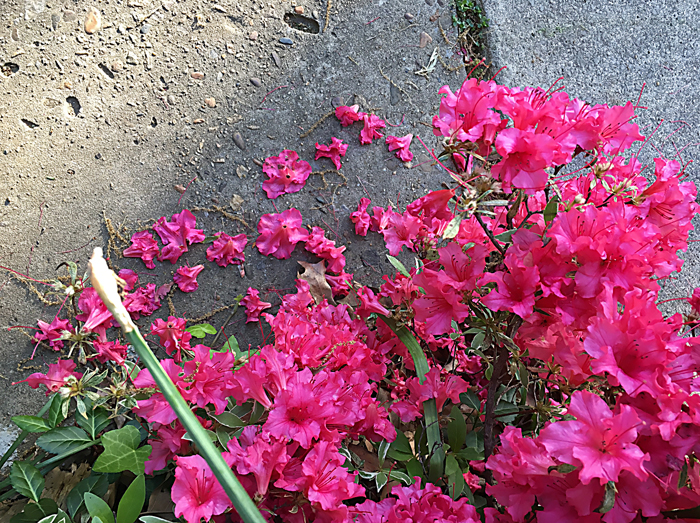
Earth Day: “Stars and Petals”

A billion trillion /
stars and azalea petals /
scatter life, sky and earth.

Azaela bush 100dpi_7x5_4c_5820 copy

Leave a comment

Filed under 2018, photo by David E. Booker, poetry by author

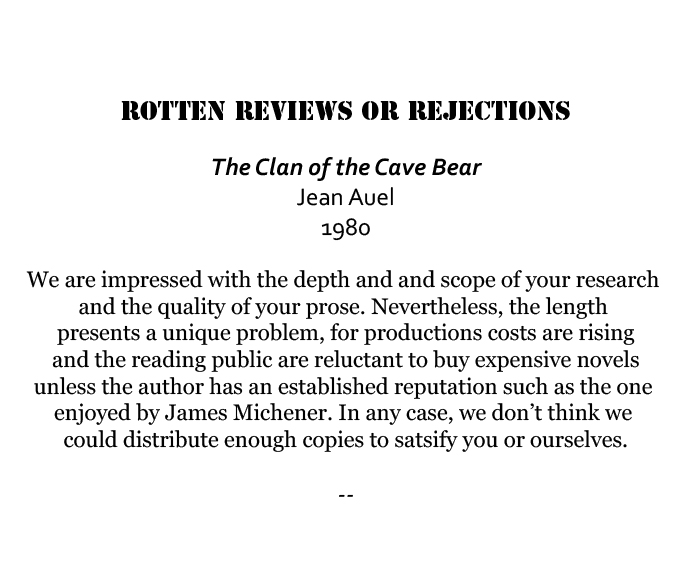
Rotten Reviews or Rejections

ClanofCaveBear_rejection_1980 copy

Leave a comment

April 15, 2018 · 4:48 pm