Tag Archives: Sunday

“Humans never learn”: the philosopher John Gray on New Atheism, the God Debate and why history repeats itself | The Sunday Times Magazine | The Sunday Times

Source: “Humans never learn”: the philosopher John Gray on New Atheism, the God Debate and why history repeats itself | The Sunday Times Magazine | The Sunday Times

Gray’s latest book, Seven Types of Atheism, targets the New Atheists

by Bryan Appleyard

Once upon a time an American writer called Sam Harris wrote a book called The End of Faith, about how silly it was to believe in God. The book sold many copies, so some other people — Richard Dawkins, Christopher Hitchens, Daniel Dennett, AC Grayling — wrote the same book. This made them all quite a bit richer and turned them into a movement called either Militant Atheism or the New Atheism. They were all fairly clever, but none of them was even half as clever as another philosopher called John Gray. (I would say he’s the greatest, but he’s a mate so you might think I’m biased.)

Gray became “bored and frustrated” with what came to be known as the God Debate, so he decided to put them in their place.

“They’ve not read very much of anything at all,” he explains, “and they don’t know anything very much.”

The New Atheists wanted to get rid of God because they thought he was the real problem. When communism collapsed in the late 1980s, people believed the West had won and soon everybody would be nice liberal democrats. It didn’t happen. Then along came 9/11, which was caused by God or, at least, bad religion. And it was this, the New Atheists concluded, that was stopping people becoming just like them.

So the New Atheists set up a new, godless religion of science. Science was the one human activity that shows constant progress, so letting science set the rules seemed the way to ensure constant progress in all things. This is, Gray believes, a fairy tale. In his view, there is no evidence whatsoever that human progress is inevitable and enduring. And there is plenty of evidence that it isn’t. The 20th century was a slaughterhouse from the trenches of the First World War to the Holocaust in the Second. The 21st is now heading that way with gas attacks on children in Syria, the genocide of the Rohingya in Burma and, most chilling of all, the recreation of the Cold War with the use of nuclear weapons now being discussed as an imminent reality. All civilisations, all human aspirations, eventually fail. The best we can do is sustain the good times. Humans can hope, but optimism — the belief in a fundamental change in our condition — is futile.

Gray’s new book, Seven Types of Atheism, is not just a demolition of the anti-God squad, it is also an assault on their strange religion. But who is John Gray?

Born in South Shields in 1948, Gray now lives in Bath with his Japanese wife, Mieko. They have been married for 30 years and have no children. They do, however, have a cat, Julian, a 21-year-old birman that is the hero of Gray’s next book, Feline Philosophy: Cats and the Meaning of Life. “Cats,” he says, “enjoy their lives without needing to turn them into stories.”

When he was growing up, cats “were a normal aspect of working-class life, everybody had cats”. He still has remnants of a Tyneside accent that becomes more pronounced when he tells funny stories, which he does a lot. From his upbringing and his parents — Nick, a joiner and, during the war, a docker, and Joan — he learnt most of the basics of his later thinking. He was born three years after the Second World War, in which our species decided to kill 85m of its members. There were too many such “hemoclysms” — bloodbaths — in the 20th century and I believe Gray is the only philosopher to have recognised their true import. “Secular meliorism — which is the religion of pretty much everybody who thinks they have no religion — says that what has been achieved in history in the way of improvements cannot be lost.” Gray, on the other hand, states that “they were repeatedly lost in the 20th century when whole peoples, whole forms of life were destroyed, so whatever improvements there were within them were gone. And that is normal.”

History, for Gray, is cyclical. There is no upward trend, we are stuck on the treadmill of our own inadequacies. The best that politicians can do is find “partial remedies to recurring human evils” and thereby sustain periods of improvement for a little longer. “I was a beneficiary of the Second World War. If it hadn’t happened, there would have been no welfare state and no opening up of opportunities and I probably wouldn’t have achieved anything. Of course, that improvement was itself a side effect of a catastrophic event … I do believe it was a just and necessary war, but with catastrophic suffering.”

Gray is hyperaware of fragility in all that we do, from the comical, small, daily failures to the life-changing disasters. His manner is, as a result, faintly nervous, but he survives all of this because of the stoicism he learnt from his parents. “I benefited from the inculcation of stoicism from my mother and the whole culture,” he says. “That’s disparaged now.” Stoics, however, can follow their best impulses and assert themselves against fate. Gray did this through books. He started going to the local library, and reading was a way out of Tyneside. Crucially, however, it was not a rejection of his terraced house community. “Doors were left open all the time. That I know because I lived that way. It’s not a romantic, nostalgic backward glance, it’s all true. But this is another lesson about how you can’t have the good without the bad. The downside was that those communities could be very repressive. If you were the son of a miner you were expected to go down the mines; if you were a woman, it was very patriarchal … So if you wanted to live in some other way, you had to leave.”

He went, via books and grammar school, to Oxford and a succession of academic posts in Britain and America. Latterly, he became professor of politics at Oxford and then professor of European thought at LSE. He retired in 2007.

Politically he had been on the left, then the right in the 1980s, then the left. In the 1980s and 1990s his books surveyed vast landscapes of political thought. His friend and Oxford mentor Isaiah Berlin’s analysis of the contradictions of liberalism was a vital inspiration. Gray’s book False Dawn: The Delusions of Global Capitalism, in 1998, was an assault on the right-wing ideology of neoliberalism and has achieved lasting authority because it foresaw the terms of the 2007 financial crash; this led to a new edition in 2009. His next book, Straw Dogs: Thoughts on Humans and Other Animals, however, began a new phase. “Straw Dogs marked a shift in subject matter, writing style and audience for my work. Rather than a treatise in academic political philosophy or a polemic like False Dawn, it was a text I hoped anyone interested in fundamental questions about what it means to be human could find stimulating. It was also a book I enjoyed writing.”

Straw Dogs trashed most modern pieties. For example: “As commonly practised, philosophy is the attempt to find good reasons for conventional beliefs.”

His books that followed — notably, The Immortalization Commission, The Silence of Animals and The Soul of the Marionette — seemed to dissolve all genres, even though they were trashed by many critics. They were philosophy, history, art and literature, economics and politics, all held together with funny stories. For instance, in Gray’s latest book we have the ludicrous atheist French philosopher Auguste Comte, who had clothes made with the buttons down the back so that you needed somebody else to help you dress — it was supposed to promote fraternal co-operation to compensate for the loss of God.

The main problem people seem to have with Gray’s late works is what they mistakenly see as their bleakness. They don’t know what to think or where to go when they put the books down, probably because they have lived their lives under the comfort blanket of the progressive, scientistic superstition. This is a misreading. It is true that, like Darwin, Gray sees humans as just one more species, a passing phenomenon — “The Earth will forget mankind. The play of life will go on.” It is also true that, as he keeps saying, he does not believe in anything. This led to the likes of Professor Terry Eagleton calling him a nihilist. Gray brushes this aside. “Nihilism in common parlance is anything that disrupts the pieties of the time. In 1890 if you said gay sex was OK you’d be a nihilist — ‘You mean buggery is OK! Only a moral nihilist, someone who believed there was no moral order in the cosmos, would say this!’ Well, the Greeks didn’t seem to mind.

“The local piety now is the belief in progress, the human spirit, uplift. In my view this is always dancing on the edge of depression. They need to stand up stiffly for fear of falling flat on their face.”

His latest, Seven Types of Atheism, is a provocation. Even the title itself is designed to rile the New Atheists as they seem to think theirs is the only type of atheism: a disbelief in God and a belief in science as the only road to salvation. This is a fairy tale that has so often had an unhappy ending — communism, Nazism — that it is hard to believe it is still being told. But it survives because of another incurable human attribute: forgetfulness. It is this that made the absurd “God Debate” possible. This debate, Gray says, is “ignorant and parochial and uninformed”. He’s tired of poking holes in Dawkins’s deficient learning and self-serving logic, but he still likes to stick the odd knife into Sam Harris, the American leader of the movement, accusing him of “a willed ignorance of the history of ideas”.

“The whole God Debate was a recycled and cheapened version of debates that went on in the 19th century, with not much that is genuinely new … There is nothing that wasn’t in Victorian atheism, which was often better expressed and certainly with more knowledge of Christianity and biblical texts.”

For Gray, to say you are an atheist is not to say that there is no God, but rather to say you don’t need a God. (In these terms, he is an atheist himself.) Historically, atheism has taken many forms — secular humanist, scientific, apocalyptic, God-hating and so on. The particular contemporary form, with its emphasis on a story of redemption through science, is, Gray claims, quite clearly religious — a version of the monotheistic belief in a linear history terminating with salvation. Also, the religion attacked by the New Atheists is only a small local sect.

“They talk as if all religion is a series of iterations of 20th-century American, Protestant, fundamentalist Christianity. Christianity is incomparably, almost inexhaustibly richer than that. They’re not really talking about religion or even atheism. They’re just prosecuting a local culture war. Why should anyone be interested in that?” Their parochialism, he says, makes them too hung up on belief, which they do not distinguish from faith. His wife, Mieko, for example, introduced him to Zen Buddhism, which requires no belief whatsoever and, like many other faiths, does not need a God. Now, for Gray, “the heart of religion is living in a particular way, it is a form of life”.

And as for science and technology — well, yes, they are the only human artefacts that do, in fact, progress. But that does not and cannot lead to ethical or political progress. Anaesthetic dentistry and, possibly, contraception are the only developments he acknowledges that did not come with a cost. And he goes back to South Shields when he talks about the well-meaning progressives who knocked down the terraced houses to build tower blocks. People were better housed, but communities were destroyed — “Everything comes with a shadow.”

Or, to put it another way, the best of us cohabits with the worst of us. “Human nature is shown by the high degree of constancy in human needs, desires, passions and reactions. It is why human history and events are so repetitive.”

If we weren’t mixed, fallen, incurable, we wouldn’t be human.

Seven Types of Atheism is published on Thursday (Allen Lane £18)

Leave a comment

Filed under 2018, author profile

Earth Day: “Stars and Petals”

A billion trillion /
stars and azalea petals /
scatter life, sky and earth.

Azaela bush 100dpi_7x5_4c_5820 copy

Leave a comment

Filed under 2018, photo by David E. Booker, poetry by author

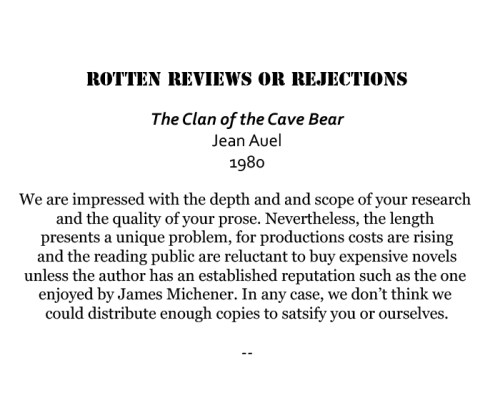
Rotten Reviews or Rejections

ClanofCaveBear_rejection_1980 copy

Leave a comment

April 15, 2018 · 4:48 pm

Why Reading Books Should be Your Priority, According to Science | Inc.com

You’re not doing yourself any favors if you’re in the 26 percent of American adults who haven’t read even part of a book within the past year.

Source: Why Reading Books Should be Your Priority, According to Science | Inc.com

More than a quarter–26 percent–of American adults admit to not having read even part of a book within the past year. That’s according to statistics coming out of the Pew Research Center. If you’re part of this group, know that science supports the idea that reading is good for you on several levels.

Reading fiction can help you be more open-minded and creative

According to research conducted at the University of Toronto, study participants who read short-story fiction experienced far less need for “cognitive closure” compared with counterparts who read nonfiction essays. Essentially, they tested as more open-minded, compared with the readers of essays. “Although nonfiction reading allows students to learn the subject matter, it may not always help them in thinking about it,” the authors write. “A physician may have an encyclopedic knowledge of his or her subject, but this may not prevent the physician from seizing and freezing on a diagnosis, when additional symptoms point to a different malady.”

People who read books live longer

That’s according to Yale researchers who studied 3,635 people older than 50 and found that those who read books for 30 minutes daily lived an average of 23 months longer than nonreaders or magazine readers. Apparently, the practice of reading books creates cognitive engagement that improves lots of things, including vocabulary, thinking skills, and concentration. It also can affect empathy, social perception, and emotional intelligence, the sum of which helps people stay on the planet longer.

Reading 50 books a year is something you can actually accomplish

While about a book a week might sound daunting, it’s probably doable by even the busiest of people. Writer Stephanie Huston says her thinking that she didn’t have enough time turned out to be a lame excuse. Now that she has made a goal to read 50 books in a year, she says that she has traded wasted time on her phone for flipping pages in bed, on trains, during meal breaks, and while waiting in line. Two months into her challenge, she reports having more peace and satisfaction and improved sleep, while learning more than she thought possible.

Successful people are readers

It’s because high achievers are keen on self-improvement. Hundreds of successful executives have shared with me the books that have helped them get where they are today. Need ideas on where to start? Titles that have repeatedly made their lists include: The Hard Thing About Hard Things by Ben Horowitz; Shoe Dog by Phil Knight; Good to Great by Jim Collins; and Losing My Virginity by Richard Branson.

Leave a comment

Filed under 2018

Unholy modernity and the shamanic powers of the detective | Aeon Essays

Shamanic powers of insight and the power to bring order out of chaos. Is the detective a priestly figure for our times?

There are many criteria by which to judge a society. Dostoyevsky recommended examining its prisons. Gandhi said to look at how it treats its weakest members. If you want to discover a society’s attitude towards authority, or to gauge the power of its official belief system, I suggest that you could do worse than look at its relationship with detective fiction.

Crime stories are one of the oldest literary genres, dating back at least as far as Cain and Abel. But the genre that concerns me here is the crime story’s modern descendant, in which a felony is committed in mysterious circumstances and then an individual follows clues and makes deductions to discover what happened. This is a relative innovation: the first modern detective novel is usually attributed either to William Godwin’s Caleb Williams (1794), or to Edgar Allan Poe’s The Murders in the Rue Morgue (1841). There is no doubt, however, that the 1860s saw the arrival of detective fiction as a whole. This was the decade that saw the publication of Wilkie Collins’s The Moonstone (1868), ‘the first, the longest and the best modern English detective novel’, in the opinion of T S Eliot. In France, Émile Gaboriau published his first roman judiciaire in 1866; L’affaire Lerouge was a big success and spawned a series of novels starring the detective Monsieur Lecoq. Methodical and smooth — certainly in his later cases — Lecoq was an inspiration for Sir Arthur Conan Doyle (although in A Study in Scarlet Sherlock Holmes dismisses him as a ‘bungler’).

Why should detective fiction have emerged at this time? There are some conspicuous material factors. Industrialisation and the growth of literacy meant that more people than ever before were able to read. To satisfy this new market, new machinery was developed that could produce cheap books in vast numbers. Booksellers in Britain set up stalls in stations. Their best-sellers were sensationalist, the kind of stories sneered at by literary types: ‘the tawdry novels which flare in the bookshelves of our railway stations,’ the poet and critic Matthew Arnold complained in 1880, ‘and which seem designed, as so much else that is produced for the use of our middle class, for people with a low standard of life’. Unabashed, ordinary readers were hungry for this kind of stuff; when the first detective novels came along, they lapped them up.

Source and the rest of the essay: Unholy modernity and the shamanic powers of the detective | Aeon Essays

Leave a comment

Filed under 2018, detective fiction

Sunday silliness: “That day”

Send away that day. /

That one! I don’t want it. /

It is called Monday.

Leave a comment

Filed under 2017, Sunday silliness

FutureScapes: Write your story, change the world

Novelist Robert A. Heinlein autographing one of his works.

FutureScapes is an annual writing competition that asks writers to envision a particular future, and tell us its story. We could run projections and publish reports, but there’s a reason why Oscar Wilde didn’t say, “Life imitates empirical studies.” We want to help writers of excellent potential find their voice while shaping tomorrow.

2017 Theme

For 2017, the Futurescapes Contest theme is “Blue Sky Cities.” We’re seeking stories set in a near-future city where significant strides have been made toward improving air quality, climate adaptation, or even net positive impacts on climate and air quality.

We want to see your vivid ideas and concepts, but don’t forget the basics of story: strong voice, compelling characters driven by real desires, facing serious obstacles that sum to an engaging plot and story.

You need not paint us a utopia – we don’t really believe in those. We believe that at any given time, depending on individual perspective, every city has dystopian and utopian aspects. The key is to show us a solution, but don’t strip it of realistic political, scientific, or logistical obstacles, and don’t neglect the possibility and ramifications of unintended consequences from even the best solution.

Source: http://www.futurescapescontest.com/

Contest Rules

-NO ENTRY FEE FOR SINGLE ENTRY, OPTION TO SUBMIT SECOND ENTRY FOR A FEE

-FINAL AWARDS DETERMINED BY PROFESSIONAL AUTHORS

-$2,000 PRIZE FOR FIRST PLACE

-5 RUNNERS UP EACH RECEIVE PRIZE OF $500

-PUBLICATION IN ANTHOLOGY DISTRIBUTED TO MAYORS, GOVERNORS & MEMBERS OF THE U.S. CONGRESS

  1. No entry fee is required to submit one (1) entry to the contest. However, an author may opt to submit a second story for consideration in the contest for a fee of twenty-four dollars ($24).
  2. By entering the contest, contestants acknowledge that they have read the instructions.
  3. Prize money constitutes compensation to the winning authors in exchange for the purchase by the contest of exclusive print and electronic rights of the story for a period of one (1) year following the first date of publication of the story.
  4. All entries must be original works written in English. Plagiarism of any kind will not be tolerated.
  5. Professional authors are not eligible to enter the contest. A professional author is defined as someone who has accepted payment and/or signed contracts for published fiction in the amount of either; a) four paid published works of short fiction at a minimum average compensation rate of 6 cents per word with a total compensation of at least $1,000; or b) a work of long fiction (40,000 words or greater) for which the author was paid at least $2,500 in compensation.
  6. Entries must be works of prose not to exceed 8,000 words in length.
  7. Excessive or gratuitous violence, language, or sexual content will not be tolerated.
  8. The story must be written on and conform to the official theme of the contest year. The theme for the 2017 contest year is: Blue Sky Cities.
  9. All entries must be submitted electronically through the submission form available on the contest website.
  10. Entries must be double-spaced, follow standard manuscript format, with the title and page number on each page. The entry should include a cover page listing the author’s name. The author’s name should appear nowhere else in the document.
  11. Each contestant may submit only one entry per contest year.
  12. The prizes for the contest shall consist of one (1) first place prize in the amount of $2,000, and five (5) runner up prizes in in the amount of $500 each. As noted, prize money is considered compensation in exchange for the purchase of story publication rights by the contest. As such, compensation will consist of a minimum amount of $.0625 (6.25 cents) per published word.
  13. Winners will be individually notified by contest staff.

Source: http://www.futurescapescontest.com/


Leave a comment

Filed under 2017, contest

The Devil’s Dictionary: “Insurance”

In our continuing quest to revisit a classic, or even a curiosity from the past and see how relevant it is, we continue with The Devil’s Dictionary by Ambrose Bierce. Originally published in newspaper installments from 1881 until 1906. You might be surprised how current many of the entries are.

A young Ambrose Bierce

For example, here is a definition for the word Insurance. The Old definitions are Bierce’s. The New definition is mine. From time to time, just as it was originally published, we will come back to The Devil’s Dictionary, for a look at it then and how it applies today. Click on Devil’s Dictionary in the tags below to bring up the other entries.

OLD DEFINITION
Insurance, n. An ingenious modern game of chance in which the player is permitted to enjoy the comfortable conviction that he is beating the man who keeps the table.


INSURANCE AGENT: My dear sir, that is a fine house – pray let me insure it.

HOUSE OWNER: With pleasure. Please make the annual premium so low that by the time when, according to the tables of your actuary, it will probably be destroyed by fire I will have paid you considerably less than the face of the policy.

INSURANCE AGENT: O dear, no – we could not afford to do that. We must fix the premium so that you will have paid more.

HOUSE OWNER: How, then, can _I_ afford _that_?

INSURANCE AGENT: Why, your house may burn down at any time. There was Smith’s house, for example, which —

HOUSE OWNER: Spare me – there were Brown’s house, on the contrary, and Jones’s house, and Robinson’s house, which—

INSURANCE AGENT: Spare _me_!

HOUSE OWNER: Let us understand each other. You want me to pay you money on the supposition that something will occur previously to the time set by yourself for its occurrence. In other words, you expect me to bet that my house will not last so long as you say that it will probably last.

INSURANCE AGENT: But if your house burns without insurance it will be a total loss.

HOUSE OWNER: Beg your pardon – by your own actuary’s tables I shall probably have saved, when it burns, all the premiums I would otherwise have paid to you – amounting to more than the face of the policy they would have bought. But suppose it to burn, uninsured, before the time upon which your figures are based. If I could not afford that, how could you if it were insured?

INSURANCE AGENT: O, we should make ourselves whole from our loss.

HOUSE OWNER: And virtually, then, don’t I help to pay their losses? Are not their houses as likely as mine to burn before they have paid you as much as you must pay them? The case stands this way: you expect to take more money from your clients than you pay to them, do you not?

INSURANCE AGENT: Certainly; if we did not—

HOUSE OWNER: I would not trust you with my money. Very well then. If it is _certain_, with reference to the whole body of your clients, that they lose money on you it is _probable_, with reference to any one of them, that _he_ will. It is these individual probabilities that make the aggregate certainty.

INSURANCE AGENT: I will not deny it – but look at the figures in this pamph—

HOUSE OWNER: Heaven forbid!

INSURANCE AGENT: You spoke of saving the premiums which you would otherwise pay to me. Will you not be more likely to squander them? We offer you an incentive to thrift.

HOUSE OWNER: The willingness of A to take care of B’s money is not peculiar to insurance, but as a charitable institution you command esteem. Deign to accept its expression from a Deserving Object.


NEW DEFINITION
Insurance, n. A broad term covering several versions of an ingenious and something disingenuous modern game of chance in which the player is permitted to enjoy the comfortable conviction person that he is getting what he paid his premiums for. This is especially true in health insurance and policies such as long term disability.

ACCOUNT MANAGER (now they call them account managers): Sir, I only received the files from the short term disability people. It will take us a week to input them into our system.

POLICY OWNER (though he or she actually owns nothing): I will call you back in a week, then.


A week later.

ACCOUNT MANAGER: Yes, the files are input, but we need something from your employer stating that you are eligible for long term disability. I have sent them an e-mail, but have heard nothing back. I can’t send your files on to the medical staff for review until I get that information.

POLICY OWNER: How long will the medical review take?

ACCOUNT MANAGER: At least a week.

POLICY OWNER: Then I will have long term disability?

ACCOUNT MANAGER: If they have enough information and if they agree, you will then qualify.


POLICY OWNER: (Dials his employer’s benefits number.) After pressing several buttons to get through the gauntlet of the automated menu, finally, after one or two transfers, reaches the “right” person and explains the situation.

LTD BENEFITS PERSON: Yes, I received the e-mail, but it was only on Friday and today is Tuesday. Besides, I need a current job description before I can send a response. (Pauses as if something is wrong, or she may have discovered something.) I will need to check into this.


On Friday of the same week.

ACCOUNT MANAGER: I received a response, but they did not include information when the policy was effective. Even if it was years ago that it first became active, we need to know that date.

POLICY OWNER: The date of the policy?

ACCOUNT MANAGER: Yes.

POLICY OWNER: I took out the policy when it was first offered to me over seven years ago. So, it’s over seven years.

ACCOUNT MANAGER: Yes.

POLICY OWNER: Yes?

ACCOUNT MANAGER: Yes, but they need to send me the date.

POLICY OWNER: Since your company is carrying the policy, don’t you have that date?

ACCOUNT MANAGER: Your employer needs to send me the date.

POLICY OWNER: Once you get the date, you can submit the files to the medical people?

ACCOUNT MANAGER: Yes, but once they take a look at, if they approve, it then goes to my supervisor, who send it up to the directors’ level.

POLICY OWNER: Why?

ACCOUNT MANAGER: Because this was a previously closed case, and to fully reopen it, the directors will have to approve.

POLICY OWNER: How long will that take?

ACCOUNT MANAGER: That can take up to two months.

POLICY HOLDER: Two months?

ACCOUNT MANAGER: Yes.

The sound of yes begins to sound very much like “No.” It is only used in response to delays and additional obstacles.

POLICY OWNER: (Dials his employer. Gets shoved into a voice mail que, where he leaves his name, who he wants to speak with, and what it is about. This is roughly at 10 AM. At 3 PM he calls back and after punching his way through several automated menus, he reaches the same voice mail que, but this time he is told it is full and the system hangs up on him.)

2 Comments

Filed under 2017, Ambrose Bierce, Devil's Dictionary

2017 Knoxville Writers’ Guild Contest

Preamble

“Home is where the heart is.” – Proverb

“After a good dinner one can forgive anybody, even one’s own relatives.”
– Oscar Wilde, A Woman of No Importance

As the shadows lengthen and the verdure of summer yellows and browns, thoughts turn to the approach of cooler weather, longer nights, and our families. For many of us the start of the new school year conjures gilded memories of childhood. Increasingly, Halloween kicks off the holiday season by letting our imaginations dabble in alternative realities: costumes, masks, hauntings, and mazes let us self-determine the constructs of our lives, at least for an evening. We disguise ourselves and play tricks on one another before the formalities and traditions of Thanksgiving and the winter holidays order our hours, days, and weeks. Throughout autumn the idea of family moves closer and closer to the center of our thoughts and activities. And as it does, we reflect on ourselves in relation to others with whom we share the moniker ‘family’.

With this in mind, the Knoxville Writers’ Guild is opening its first Autumn Writing Contest with ‘Family’ as the theme. We are inviting submissions that examine the complex nature of families and our relationships with those deemed closest to us by culture, society, and blood.

2017  Knoxville Writers’ Guild Autumn Contest

The Knoxville Writers Guild is accepting submissions for the its first Autumn Knoxville Writers Guild Contest beginning August 31, 2017 through midnight, October 31, 2017.

Contestants may enter their work in several categories including poetry, literary nonfiction and literary short fiction. There is also a Young Writers category in which student may submit in any of the previously mentioned genres. Judges will be announced shortly.

Please direct questions regarding the contest here.

Literary Short Fiction

Guidelines:
Entry consists of one short story totaling no more than 3,000 words. See General Guidelines for additional instructions.
Members: Free
Non-Members: $30

Poetry

Guidelines:
Entry consists of no more than three typed poems totaling 100 lines or fewer. If more than one poem is entered on the same submission, poems will be judged as a collection. There are no restrictions as far as style, content or spacing.
See General Guidelines.
Members: Free
Non-Members: $30

Literary Nonfiction

Guidelines:
Entry consists of one typed, double-spaced nonfiction essay of no more than 3,000 words.
See General Guidelines.
Members: Free
Non-Members: $30


Young Writers
Open to all students grades 7 through 12 of Knox and adjoining counties.

Guidelines:
Fiction: Entry consists of one short story or stand-alone novel excerpt totaling no more than 3,000 words, double-spaced.
Nonfiction: Entry consists of essay totaling no more than 3,000 words, double-spaced.
Poetry: Up to a maximum of three typed poems totaling 100 lines or fewer with no restrictions as far as style, content or spacing.  Poems should be submitted as a single document. Poems will be judged as a collection.

Do not include any identifying information on the submissions themselves.

If you are a teacher or school submitting entries on behalf of your students, please add the following information in addition to the information required by the General Guidelines:

  • School name
  • Teacher or school representative name
  • School Address
  • School phone number

Please contact us if your school or club needs any additional information for bookkeeping or payment purposes.
Students: Free

Complete guidelines for the entries can be found here.

Leave a comment

Filed under 2017, contest

Rotten Reviews or Rejections

Even well-known works at one time were unknown … and often rejected. Or if published, did not meet with universal praise. Here is an example of the later.

Save

Leave a comment

Filed under 2017, review