30 Essential Crime Reads Written by Women in the Last 100 Years | Literary Hub

Undisputed Queen of Crime Agatha Christie died on this day in 1976. Crime fiction is a genre that has traditionally been dominated by men—but on the other hand, Christie is the best-selling author …

Source: 30 Essential Crime Reads Written by Women in the Last 100 Years | Literary Hub

Undisputed Queen of Crime Agatha Christie died on this day in 1976. Crime fiction is a genre that has traditionally been dominated by men—but on the other hand, Christie is the best-selling author of all time, so that should tell you something. In honor of her life (and her prolific publishing career) I’ve picked out a few great crime novels written by women from each of the last ten decades. Now, of course, there are more than three crime novels from each decade that you should read (and probably more than three novels in every genre that you should read), but one has to stop somewhere, so add your own recommendations with abandon. NB: This is not a definitive list by any means; genre is necessarily a bit fluid here, privilege has gone to important, groundbreaking or otherwise historically notable works where I’ve noted them, but taste has, as ever, played a factor.

More at the link listed above.

Leave a comment

Filed under 2017, women writers

American Short(er) Fiction Contest –

The American Short(er) Fiction Contest is now open for submissions. This year we are honored to have Justin Torres as our guest judge. Submit your entry online between October 25, 2016 – February 1, 2017. The first-place winner will receive a $1,000 prize and publication in a future issue of ASF. One runner-up will receive $250 and publication, and all entries will be considered for publication.

Source: American Short(er) Fiction Contest –

The American Short(er) Fiction Contest is open for submissions. This year we are honored to have Justin Torres as our guest judge. Submit your stories of 1,000 words or fewer now!

General Guidelines
Submit your entry online between October 25, 2016 – February 1, 2017.
– The first-place winner will receive a $1,000 prize and publication in a future issue of ASF. One runner-up will receive $250 and publication, and all entries will be considered for publication.
– Please submit your $17 entry fee and your work through Submittable. We no longer accept submissions by post. International submissions in English are eligible.
– Stories must be 1,000 words or fewer. You are allowed to include up to three stories per entry. Please submit all stories in one document. Each story must begin on a new page and be clearly titled. For the title of your submission list the story titles, separated by a comma. Please DO NOT include any identifying information on the manuscript itself.
– You may submit multiple entries. We accept only previously unpublished work. We do allow simultaneous submissions, but we ask that you notify us promptly of publication elsewhere.

Conflicts of Interest
Staff and volunteers currently affiliated with American Short Fiction are ineligible for consideration or publication. Additionally, students, former students, and colleagues of the judge are not eligible to enter. We ask that previous winners wait three years after their winning entry is published before entering again.

Justin Torres is the author of the novel We the Animals, winner of an Indies Choice Book Award. His work has appeared in The New Yorker, Harper’s, Granta, and other prestigious publications. A graduate of the Iowa Writers’ Workshop, he has received numerous awards, including a Rolón Fellowship in Literature from United States Artists, a Wallace Stegner Fellowship at Stanford, and a Radcliffe Fellowship at Harvard.

On his taste in fiction, Mr. Torres has said:
“I love voice; a deeply imagined and inventive voice does more for me than a fantastic plot or vivid setting. For me, the magic of fiction lies in the words chosen and the structure of the sentences. I could write about men on Mars or about a childhood similar to my own, but my goal would be the same: get the words right, cast a spell.”

We can’t wait for your submissions to cast their spells on us. Good luck!

Leave a comment

Filed under 2017, contest

Haruki Murakami to release new novel titled ‘Killing Commendatore’ – The Mainichi

Source: Haruki Murakami to release new novel titled ‘Killing Commendatore’ – The Mainichi

TOKYO (Kyodo) — Japanese novelist Haruki Murakami will release a new novel titled “Killing Commendatore” on Feb. 24, its publisher Shinchosha Publishing Co. said Tuesday, his first multivolume novel in seven years.

The novel, comprising two books, is priced at 1,944 yen ($16.77), tax included, said Shinchosha, via which Murakami, 67, released in 2009 and 2010 a long excerpt from “Book 1” through “Book 3” of his novel “1Q84.”

Murakami, one of Japan’s best-known contemporary novelists and often touted as a candidate for the Nobel Prize in literature, released the novel “Colorless Tsukuru Tazaki and His Years of Pilgrimage” in April 2013, and a collection of short stories entitled “Onna no Inai Otokotachi” (Men Without Women) in April 2014. The two books were published by Bungeishunju Ltd.

Shinchosha had announced in late November that Murakami will release a new novel in February. At that time the publisher did not disclose details including the title.

Leave a comment

Filed under 2017, author

New words to live by: “Falsetto light”

Time, once again, for New words to live by. This is a word or phrase not currently in use in the U.S. English lexicon, but might need to be considered. Other words, such as obsurd, crumpify, subsus, flib, congressed, and others, can be found by clicking on the tags below. Today’s New Word is created by combing sound and light. Without further waiting, Falsetto light.

OLD WORDS
Falsetto, n. 1) an unnaturally or artificially high-pitched voice or register, especially in a man. 2) a person, especially a man, who sings with such a voice.

Light, n. 1) something that makes things visible or affords illumination: all colors depend on light.
2) Physics.
1. electromagnetic radiation to which the organs of sight react, ranging in wavelength from about 400 to 700 nm and propagated at a speed of 186,282 mi./sec (299,972 km/sec), considered variously as a wave, corpuscular, or quantum phenomenon.
2. a similar form of radiant energy that does not affect the retina, as ultraviolet or infrared rays.

NEW WORD
Falsetto light, n. 1) an unnaturally or artificially high-pitched light or focus shining obsessively on something trivial, unimportant, or misdirected at the expense of losing focus on more important. For example, focusing on missing car keys while the car is being stolen. 2) To loudly trumpet or lay claim to an accomplishment you had little to do with and have little right to claim.

In a sentence: By using falsetto light, the candidate was able to make the press the issue instead of the questions the press was asking that the candidate was not answering.

Leave a comment

Filed under 2017, new word, New words to live by

Sad chart: Book reading

reading-facts

Leave a comment

January 13, 2017 · 11:29 pm

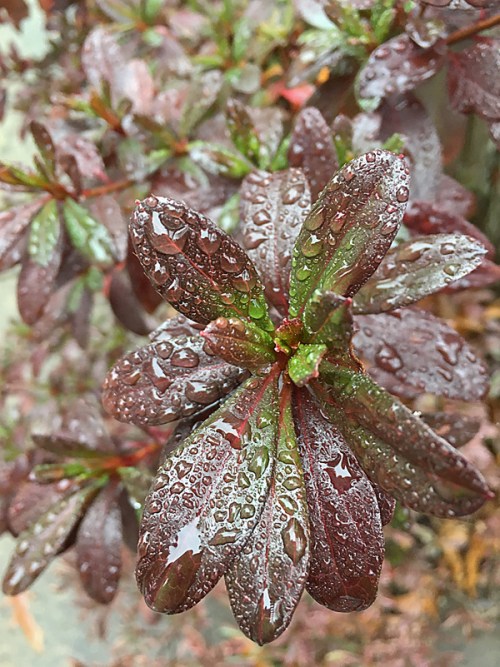
Photo finish Friday: “Azalea”

Fall colors; winter rain.

Fall colors; winter rain.

Leave a comment

Filed under 2017, photo by David E. Booker, Photo Finish Friday

Haiku to you Thursday: “Cheap soles”

Troubling questions /

crunched under trampling footsteps. /

Cheap soles speaking lies.

Leave a comment

Filed under 2017, Haiku to You Thursday, poetry by author

Writing tip Wednesday: Agent to consider

New Literary Agent Alert: Maximilian Ximenez of L. Perkins Agency

max_agent-72dpi_5x6_4c-copy

About Maximilian: Maximilian Ximenez grew up within the New York publishing industry. Prior to joining the L. Perkins Agency, he worked at Blizzard Entertainment, creators of the popular Warcraft, StarCraft, and Diablo video game franchises. He is a strong believer in publishing and narrative as a central pillar of franchise and transmedia development.

He is seeking: Maximilian is actively pursuing clients for both fiction and nonfiction works. In fiction, he is acquiring science fiction, fantasy, horror, and thrillers, particularly cyberpunk and neo-noir as well as books with a uniquely deconstructive bent. For nonfiction, Maximilian is seeking popular science, true crime, and books pertaining to arts and trends in developing fields and cultures.

How to submit: For submissions, please send an email to maximilian [at] lperkinsagency.com with your bio, a brief synopsis, and the first five pages of your book or novel in the body.

Leave a comment

Filed under 2017, writing tip, Writing Tip Wednesday

Monday (morning) writing joke: “Subject addressed”

There once was a quirky writer from Nice /
Who wore clothes only made from fleece. /
He visited friends around France /
In his polyester-type pants. /
Their plastic tongues wagged without cease.

Leave a comment

Filed under 2017, Monday morning writing joke, poetry by author

Diagramming Sentences

A Picture Of Language: The Fading Art Of Diagramming Sentences

Source: http://www.npr.org/sections/ed/2014/08/22/341898975/a-picture-of-language-the-fading-art-of-diagramming-sentences?utm_source=facebook.com&utm_medium=social&utm_campaign=npr&utm_term=nprnews&utm_content=20170101

by Juana Summers
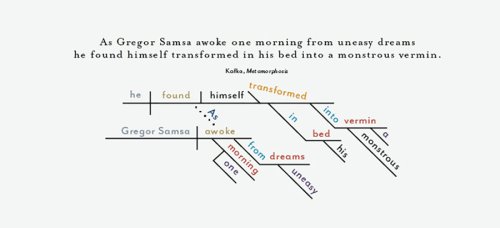
The design firm Pop Chart Lab has taken the first lines of famous novels and diagrammed those sentences. This one shows the opening of Franz Kafka's "Metamorphosis."

The design firm Pop Chart Lab has taken the first lines of famous novels and diagrammed those sentences. This one shows the opening of Franz Kafka’s “Metamorphosis.”

When you think about a sentence, you usually think about words — not lines. But sentence diagramming brings geometry into grammar.

If you weren’t taught to diagram a sentence, this might sound a little zany. But the practice has a long — and controversial — history in U.S. schools.

And while it was once commonplace, many people today don’t even know what it is.
So let’s start with the basics.

“It’s a fairly simple idea,” says Kitty Burns Florey, the author of Sister Bernadette’s Barking Dog: The Quirky History and Lost Art of Diagramming Sentences. “I like to call it a picture of language. It really does draw a picture of what language looks like.”

I asked her to show me, and for an example she used the first sentence she recalls diagramming: “The dog barked.”

“By drawing a line and writing ‘dog’ on the left side of the line and ‘barked’ on the right side of the line and separating them with a little vertical line, we could see that ‘dog’ was the subject of the sentence and ‘barked’ was the predicate or the verb,” she explains. “When you diagram a sentence, those things are always in that relation to each other. It always makes the same kind of picture. And supposedly, it makes it easier for kids who are learning to write, learning to use correct English.”

An Education ‘Phenomenon’

Burns Florey and other experts trace the origin of diagramming sentences back to 1877 and two professors at Brooklyn Polytechnic Institute. In their book, Higher Lessons in English, Alonzo Reed and Brainerd Kellogg made the case that students would learn better how to structure sentences if they could see them drawn as graphic structures.

After Reed and Kellogg published their book, the practice of diagramming sentences had something of a Golden Age in American schools.

“It was a purely American phenomenon,” Burns Florey says. “It was invented in Brooklyn, it swept across this country like crazy and became really popular for 50 or 60 years and then began to die away.”

By the 1960s, new research dumped criticism on the practice.

“Diagramming sentences … teaches nothing beyond the ability to diagram,” declared the 1960 Encyclopedia of Educational Research.

In 1985, the National Council of Teachers of English declared that “repetitive grammar drills and exercises” — like diagramming sentences — are “a deterrent to the improvement of students’ speaking and writing.”

Nevertheless, diagramming sentences is still taught — you can find it in textbooks and see it in lesson plans. My question is, why?

Burns Florey says it might still be a good tool for some students. “When you’re learning to write well, it helps to understand what the sentence is doing and why it’s doing it and how you can improve it.”

But does it deserve a place in English class today? (The Common Core doesn’t mention it.)

“There are two kinds of people in this world — the ones who loved diagramming, and the ones who hated it,” Burns Florey says.

She’s in the first camp. But she understands why, for some students, it never clicks.

“It’s like a middle man. You’ve got a sentence that you’re trying to write, so you have to learn to structure that, but also you have to learn to put it on these lines and angles and master that, on top of everything else.”

So many students ended up frustrated, viewing the technique “as an intrusion or as an absolutely confusing, crazy thing that they couldn’t understand.”

2 Comments

Filed under 2017, sentences