
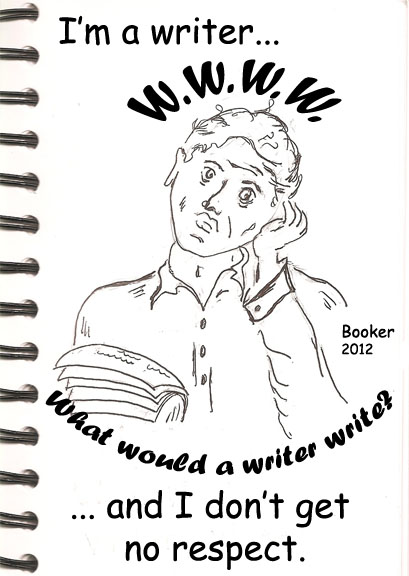
Getting less for more. Sometimes its hard to please any reader.
While at a book signing the other day, I overheard one person say to the other as they walked by my table: “He makes me wish I had a lower IQ so I could enjoy his book.”
Getting less for more. Sometimes its hard to please any reader.
While at a book signing the other day, I overheard one person say to the other as they walked by my table: “He makes me wish I had a lower IQ so I could enjoy his book.”
Filed under no respect
Sky touches nothing
yet still caresses the Earth’s
all-embracing beauty.
Filed under Haiku to You Thursday, poetry by author
“I write for the same reason I breathe — because if I didn’t, I would die.”
–Isaac Asimov
So, take a deep breath and plunge on into it. Even if you don’t know exactly what you’re doing, splash a few words around and see what happens. Think of the blank sheet of paper or the blank screen as a scene waiting to be discovered.
You might just have a masterpiece within you. Remember that Michelangelo took a block of marble rejected by his contemporaries and saw the statue ‘David’ within it. All he had to do, he said, was chip away the pieces not needed in order to create his masterpiece.
Many times a writer has to do the same thing. The block of marble is the first draft. The subsequent drafts are chipping away at that marble, removing the pieces you don’t need. Easy? No. But from a rejected pile of words can come your masterpiece. You have to be honest with yourself and hold true to your vision of the story and commit to it with confidence … and write as if you were breathing.

Even out of ruined or rejected scenes can come your masterpiece.
Filed under Photo by author, Writing Tip Wednesday
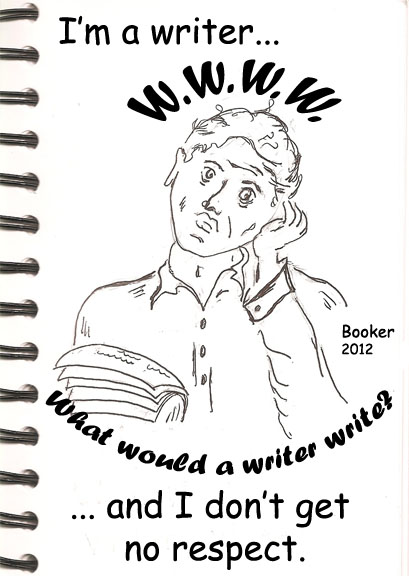
Sometimes the photocopied note is a dead give away.
As a writer, I don’t get no respect. Just the other day I received a note from a publishing company on my submission. It read: “As a mystery novel, it’s just run-of-the-morgue.”
Shows you how much they read. There’s no morgue in my novel.
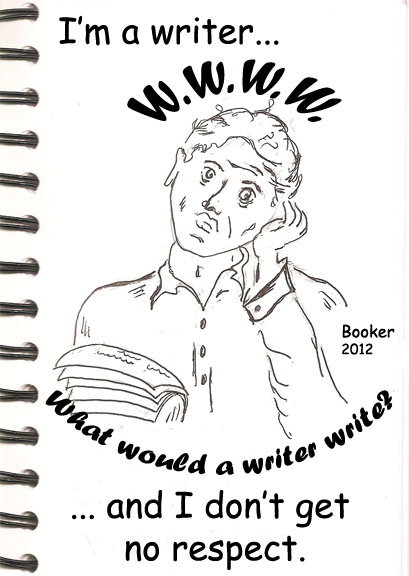
Writing tip: keeping tabs on your favorite writer can be surprising.
I’m a writer and I don’t get no respect. I went into a bar that caters to well-known writers.
I told the bar tender, “Give me what your best writer has most often in here.”
She promptly handed me the tab.
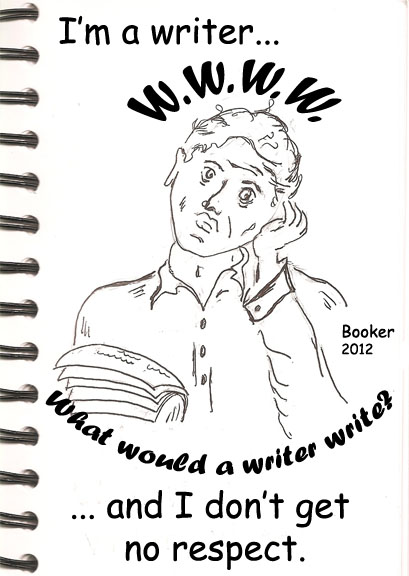
Let me just preface my remarks by saying I shouldn’t have prefaced my remarks.
My critique group can be rather direct. I turned in the first part of the novel, including the preface. One member said he doesn’t read prefaces or preludes or prologues of any kind.
Another one wrote this on in the margin of her critique: “Your preface states that the characters bear no resemblance to any person living or dead. That’s precisely what’s wrong with this story.”
I guess an epilogue is out of the question.

Some say a million monkeys at a million keyboards would eventually write something equal to Shakespeare’s works. Depends upon the monkeys. They might decide upon the million monkey march, or something a little more at play.
Filed under 2012, cartoon by author, CarToonsday
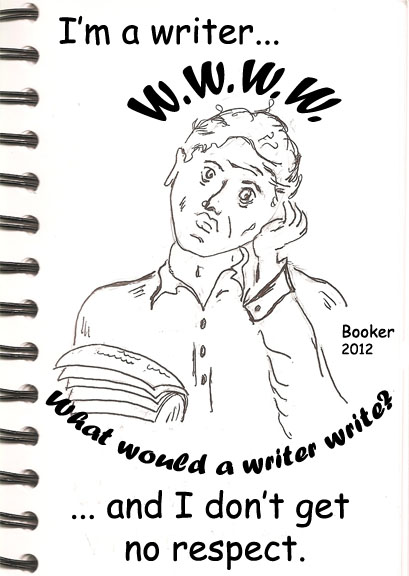
Giving short (story) shrift to a novel idea.
The other day I overheard two people in my writing workshop group talking about my work. One person said she wasn’t sure why, but she would prefer to read something else.
The other person said, “He’s putting everything he knows into his novel. It’s sure to be a short story.”
“And I probably still won’t like it,” the first person said.
By Dianne de Las Casas
When I am at book signings or doing school visits, I often hear the question, “What advice do you have for someone writing their first
picture book?” People are eager to learn the “secret” to writing a runaway best-selling picture book.
There IS a definite art to writing a picture book. For me, a perfect picture book is a seamless integration of pictures and
words. They fit together like peanut butter and jelly. The words and the pictures might be good alone but they are GREAT together.
1. A Universal Theme
Contrary to popular belief, picture books do not have to have a message although they often do. If there is a message in a picture book, it should be subtle and left for the reader to decipher. What is important is a universal theme, a theme that readers can relate to: love, bedtime, friendship, teamwork, etc. Even humor can work as a theme. THE DOT by Peter Reynolds landed in USA Today‘s Top 100 Children’s Books because of the book’s universal theme of creativity.
2. The Page Turn
Never underestimate the power of the page turn. Every good story needs to take a breath or have a moment of suspense. The page turn can be that quiet pause or that dramatic reveal. New York Times Bestselling book PETE THE CAT by Eric Litwin has an extremely successful use of the page turn, building the readers’ anticipation for the next moment in the story.
3. Think Visually
If you are not the illustrator, think (don’t write) visually. The story can be rich and full but there must still be room for the illustrator to work, stretching the confines of the story. Often, the subtext of the story can be found in the illustrations. Tell your story adroitly with an economy of words. Leslie Helakoski and Henry Cole demonstrate this perfectly with their book, BIG CHICKENS GO TO TOWN.
4. The Read-Aloud
Picture books are meant to be read aloud… in classrooms, in library story times, and at bedtime. Read your story aloud. Have others read your story aloud. Does the rhythm work? Is the story too long? Too short? How do others react to the read-aloud? Remember that you are writing for children and their keepers (parents, teachers, and librarians).
Your book must sound good to everyone hearing it. Maurice Sendak’s WHERE THE WILD THINGS ARE is one of the greatest children’s books of all time. Read it out loud and you’ll know why.
5. Jacket Flap Copy
Finally, write your jacket flap copy, that brief synopsis inside the dust jacket of the book. Even picture books, as short as they are, need to be summarized. Can you sum up your book in 1-2 sentences? Every author needs to be able to tell people what their book is about.
Okay, here’s a bonus tip. Have fun! Play with your words and have a ball. Remember that once in print, your picture book is forever. You are leaving a legacy. If even one reader is touched by your message, you are making a difference.
Dianne de Las Casas is an award-winning author, storyteller, and the Founder of Picture Book Month, an international literacy initiative that celebrates the print picture book during the month of November.
Visit Dianne’s website at http://clicks.aweber.com/y/ct/?l=O8uEK&m=IjnT4bn0sFLsQz&b=blYlm3YP2bSes8q3ckH7gg and
Picture Book Month’s website at http://clicks.aweber.com/y/ct/?l=O8uEK&m=IjnT4bn0sFLsQz&b=RXU9K3zNzvjYbP.bFLhkmQ.
Follow Dianne on Twitter: @storyconnection and Facebook: fanofdianne
Filed under 2012, Writing Tip Wednesday
“The true artist plays mad with his soul, labors at the very lip of the volcano, but remembers and clings to his purpose, which is as strong as the dream. He is not someone possessed, like Cassandra, but a passionate, easily tempted explorer who fully intends to get home again, like Odysseus.”
–John Gardner
Filed under Writers on writing


