Tag Archives: writer

Monday morning writing joke: “Greetings”

An older writer a bit down on his writing luck, takes a job as a greeter at Walmart to make ends meet. He tells himself that it is only for a little while, until freelance work picks back up, but even he is surprised when it only lasted one day.

The next day he walks into his favorite little dive and orders a tea. One of his writing friends is there.

“Hey,” his friend said, “I thought you’d be a work.”

“I should be,” the writer says, “but it didn’t work out.”

“What happened?

The writer hesitates, then shrugs his shoulders and says: “Yesterday was my first solo day. About halfway into my shift, a mean, loud woman, cigarette dangling from her mouth, barges into the store, hurling obscenities at the two kids she has in tow.

“I smile and try to calm down the situation by saying, ‘Good morning and welcome to Walmart. Nice children you have there. Are they twins?’

“I knew they weren’t just from the way one looked older than the other, but thought no harm in letting her to another subject.

“The woman stopped yell at them and turned her attention and mouth to me. ‘Hell no, moron, they ain’t twins. The oldest one’s 10 and the other one is seven. You blind or just plain stupid?’

“Now, I did my best to hold my tongue, but I just couldn’t help myself. I said, ‘Ma’am, I’m neither blind nor stupid. I just can’t believe that someone drank enough beer and was still able to keep it up twice to have sex with you. Have a good day and thank you for shopping at Walmart.’

“My supervisor told me I was probably in the wrong line of work.”

Leave a comment

Filed under 2016, Monday morning writing joke

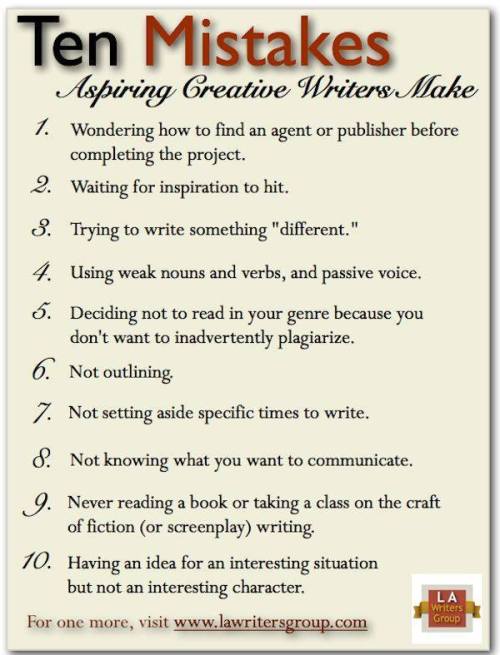
Writing tip Wednesday: “Ten to avoid”

Some may be easier to avoid than others. For more tips, go to www.lawritersgroup.com.

Some may be easier to avoid than others. For more tips, go to www.lawritersgroup.com.

Leave a comment

Filed under 2016, writing tip, Writing Tip Wednesday

Monday morning writing joke: “Four writers, two”

Four writers get in a car. It’s pouring rain. The car won’t start.

Horror writer scribbles: “Brad and Elaine were trapped. It was the worst night of their lives. The wind was howling and the monster was, too.”

Romance writer scribbles: “Brad had always hoped for a chance alone with Elaine. And now in the rain, in a broken car, he had that moment.”

Comedy writer scribbles: “Brad had always hoped for a chance alone with Elaine. And now in the rain, in a car whose engine wouldn’t turn over, he had that moment – until, unlike the engine, his indigestion turned over on him.”

Contemporary fiction writer scribbles: “Brad had always had trouble with two things in life: women and cars. Now he was trapped by a heavy rain in a broken car with a woman he barely knew, who was soaking wet and crying and blubbering about her life being ruined. Brad could not find the words to console her, but searching around for a rag for her to use to dry her eyes, he found a hammer, and considered using it on either the car or the woman. Was it a sign? Was it supposed to use it or try to figure out why in life when he was handed lemons, he wasn’t even able to make lemonade.”

1 Comment

Filed under 2016, Monday morning writing joke

Monday morning writing joke: “Four writers”

Four writers get in a car. It’s pouring rain. The car won’t start.

Technical writer: “Do you have the owner’s manual? Have you read it?”

Marketing writer: “Hey, look, the cup holder still works!”

Grant writer: “Maybe we can apply for funds to find out why the car doesn’t start.”

IT writer: “Hey guys, I have an idea. How about we all get out of the car and then get back in?”

1 Comment

Filed under 2016, Monday morning writing joke

Writing thought: “Fairy tales”

C. K. Chesterton quote on dragons

Leave a comment

February 7, 2016 · 10:55 pm

Heart of Darkness?

Darkness on the Edge of Town
Joe R. Lansdale is the toast of Italy, a hot property in Hollywood, and an inspiration to a generation of horror and thriller writers everywhere. And he owes it all to Nacogdoches.
by Eric Benson

Source: http://www.texasmonthly.com/the-culture/darkness-on-the-edge-of-town/

JoeRLansdale

Joe R. Lansdale

Joe R. Lansdale—author of more than 45 novels and 400 short stories, essays, comic books, and screenplays, ranging in genre from historical fiction to grind-house pulp—is a hell of a nice guy, maybe the nicest in East Texas. An avuncular 64-year-old with piercing blue eyes, a Matterhorn nose, and a slightly crooked grin, Lansdale is a big-hearted pillar of the Nacogdoches community, a still-smitten husband to his wife of four decades, and a proud-as-pie dad of two children. Lansdale rescues stray dogs. He has been known to house kids in need. He runs a local martial arts school at a loss. He offers advice to aspiring writers—on his Facebook page, in emails, in person. When he walks into any of his familiar haunts—the Starbucks on North Street, the Japanese restaurant Nijiya, the General Mercantile and Oldtime String Shop—he addresses employees by name, inquires about their lives, and leaves pretty much everyone smiling.

Tim Bryant, a Nacogdoches crime writer who studied screenwriting under Lansdale, swears that his former professor is the “friendliest, most down-to-earth” man that he’s ever known. This comes as a surprise to some, Bryant attests. “A lot of people think he must be the craziest, darkest, most twisted person.”

That’s because Lansdale is not only the nicest guy in East Texas, he’s also the man who wrote this: “Ellen stooped and grabbed the dead child by the ankle and struck Moon Face with it as if it were a club. Once in the face, once in the midsection. The rotting child burst into a spray of desiccated flesh and innards.” And this: “As they roared along, parts of the dog, like crumbs from a flaky loaf of bread, came off. A tooth here. Some hair there. A string of guts. A dew claw. And some unidentifiable pink stuff. The metal-studded collar and chain threw up sparks now and then like fiery crickets. Finally they hit seventy-five and the dog was swinging wider and wider on the chain.” And, just last year, this: “In the next instant Uncle Bob was dangling by a rope from a tree and had been set on fire by lighting his pants leg with a kitchen match. That was done after a nice churchgoing lady had opened his fly, sawed off his manhood with a pocketknife, and tossed it to a dog.”

When I first met Lansdale, I had a hard time fathoming where he found such darkness. It was a mid-November afternoon, and Lansdale was sitting with his family at their favorite Starbucks. They were a picture of suburban bliss: sipping lattes, making plans for dinner, and reminding one another not to forget the “puppaccino” for Lansdale’s one-year-old pit bull, Nicholas. (“He knows when we’ve been to Starbucks and expects it!” Lansdale laughed.) His daughter, Kasey, a 29-year-old country singer, was on her way to teach a yoga class, but she would soon be moving to Los Angeles. You could tell. She was wearing full makeup, movie-star shades, platform heels, and a pink T-shirt emblazoned with the words “La Di Da.” (A bracelet with tiny skulls on it was the only accessory that betrayed the macabre sensibility she had inherited from her dad.) Her brother, Keith, a 33-year-old 911 dispatcher and screenwriter with a laid-back surfer vibe, simply looked exhausted. He’d woken up from a nap after his graveyard shift and had stumbled into Starbucks to power up before another night fielding emergency calls. Their mother, Karen—the poised, flaxen-haired matriarch, who manages the business end of Lansdale’s creative pursuits—sat smiling at her husband and children. She injected the occasional quip as they bantered back and forth about film festivals in Italy, blues festivals in Norway, Kasey’s impending move, and the family’s decades-long collaborations.

“We did our first story together when they were kids,” Lansdale said happily. “Keith was twelve and Kasey was eight. It was for Random House, Great Writers & Kids Write Spooky Stories. Kasey wrote this hanging scene and it was really good, but they said we had to take it out. It was too intense for other eight-year-olds.”

I’d come to Nacogdoches to spend a few days with Lansdale, because after decades as an object of fan-boy adulation, he looked to be on the brink of the kind of above-the-title celebrity that rarely accrues to a writer, much less one who has spent his life behind the Pine Curtain. Starting in the late eighties, Lansdale made his reputation by leaping across genres (western, horror, crime, sci-fi), bounding through tones (from campy to bleak to tender and back again), and skewering bigots, Bible-thumpers, and plain old hypocrites along the way. That fearlessness had done more than earn Lansdale fans; as Steven L. Davis, the curator of the Southwestern Writers Collection at Texas State University, once wrote, it had established him as “the unabashed conscience of East Texas.” But even as he’s won an ardent following with works like Bubba Ho-Tep (in which JFK and Elvis, both still very much alive, battle a reanimated mummy in their nursing home), the Southern-fried noir Cold in July, and, especially, his sublime Hap and Leonard series, Lansdale’s stories and novels have remained niche products, his readers members of a devoted and select cadre.

Lately, though, Lansdale’s writing has attracted a broader audience. His recent novels Edge of Dark Water, The Thicket, and Paradise Sky—all published by Little, Brown’s Mulholland Books imprint—have balanced his penchant for absurdity and visceral horror with a style that’s a little more accessible, albeit still happily in-your-face. After decades of false starts, Cold in July was finally made into a movie, and Hollywood is pursuing other adaptations, with Bill Paxton planning to direct a screen version of Lansdale’s coming-of-age fable The Bottoms and Peter Dinklage’s production company developing a project based on The Thicket. And Hap and Leonard, Lansdale’s crime-fighting odd couple (Hap: white, liberal, straight; Leonard: black, Republican, gay), will soon swagger into the big time. Over the next two months, Lansdale will release a complete collection of Hap and Leonard short stories as well as the ninth Hap and Leonard novel, Honky Tonk Samurai. But the really big occasion arrives on March 2, when Sundance TV will air the first episode of its Hap and Leonard series, starring the classically trained English actor James Purefoy as Hap and Michael Kenneth Williams, best known for his work as Omar Little on HBO’s The Wire, as Leonard. (Christina Hendricks of Mad Men plays Hap’s bad-news ex-wife.)

– See more at: http://www.texasmonthly.com/the-culture/darkness-on-the-edge-of-town/#sthash.a2ejTQTO.poRQSpF0.dpuf

Leave a comment

Filed under 2016, author interview, authors, Uncategorized

Haiku to you Thursday: “Journal”

Too long, no entry: /

bad, bad writer, no doughnut. /

Sprinkles word this page.

Leave a comment

Filed under 2015, Haiku to You Thursday, poetry by author

Monday morning writing joke: “Dress up”

Q. What are a lazy writer’s favorite type of shoes?

A. Loafers.

Q. What are a poor, lazy writer’s type of shoes?

A. Penny loafers.

Q. Where do struggling writers get their feet coverings?

A. On the sock exchange.

Leave a comment

Filed under 2015, Monday morning writing joke

Author interview: Jonathan Lethem

Jonathan Lethem: “My intent to skewer is practically nonexistent”

He talks to Salon about his new book “Lucky Alan,” comics, fans and adoring his characters—even the difficult ones

Source: http://www.salon.com/2015/03/28/jonathan_lethem_my_intent_to_skewer_is_practically_nonexistent/

by MATT BELL

I started reading Jonathan Lethem with “Amnesia Moon,” maybe five or six years after it first came out. A teacher had suggested the book, after seeing me struggle with the more realist selections of the typical undergrad creative writing syllabus of the early 2000s, and almost immediately I was hooked, on both that book and Lethem’s writing in general. “Amnesia Moon” is an intoxicating but very strange novel — perhaps Lethem’s strangest, at least for me — and so I was surprised, in 2003, to find myself reading “The Fortress of Solitude,” with its much more grounded period setting beginning in 1970s Brooklyn.

I would soon immerse myself in the rest of Lethem’s books, and this range became one of the most exciting aspects of reading his novels and stories and essays: His interests are broad, his obsessions deep and his influences both announced and fully explored, engaged, built upon. If Lethem has topics or time periods or genres he returns to frequently, it feels to me less like a tic or a limitation and more like an indication that something is not yet finished, that his unshed obsessions return often to further provoke his imagination into new stories.

Jonathan Lethem’s “Lucky Alan” is his first short story collection since 2004’s “Men and Cartoons,” collecting the stories written in the decade that followed. In the years between, he’s published three novels, including 2013’s “Dissident Gardens,” and a slew of other projects in other genres, including penning a reboot of the comic book “Omega the Unknown”; collecting two books of essays, including “The Ecstasy of Influence,” titled after his provocative Harper’s essay of the same name; editing a volume of selections of Philip K. Dick’s journals; and another nonfiction book on The Talking Heads album “Fear of Music” for the popular 33 1/3 series. Our conversation with Lethem discusses how stories in “Lucky Alan” were written, as well as what changed (and what stayed the same) throughout this busy and productive decade.

Once I was a few stories into “Lucky Alan,” I started thinking about the book’s ordering, wondering if you’d consciously decided to start with two of the more realist stories — the title story and “The King of Sentences” — before moving on to stranger fare, like “Traveler Home,” where the protagonist is given a baby by a pack of wolves, or “Procedure in Plain Air,” with its surreal “installation” involving a man left in a hole outside a coffee shop, “an inverted phone booth of dirt and rubble.” But then a friend mentioned seeing you read “Procedure in Plain Air” at Skylight Books in Los Angeles a few weeks ago, where he reported that you’d said the stories appear here in the order they were written.

That answers one question but begs another: How do you chart the progress of your interests in the short story over that time? Does “Pending Vegan,” the last story, complete some line of artistic thought that began with the first, “Lucky Alan,” or is the book simply a method of collecting all the short work of a certain period in one place?

Q.: I’ve got at least 12 answers to this question, depending on whether I grab it by trunk or tail or some other appendage. Somewhere I once read a pragmatic assertion that the way to order a story collection is to put the best story first and the second-best last and the rest anywhere you like. I do think “Lucky Alan” and “Pending Vegan” are the two most satisfying and complete stories I’ve written, or at least that were uncollected. When I threw them into those positions, just to see what that looked like, I noticed immediately that one was the earliest piece in the book, and the other the most recent. Putting them in chronological sequence made for a quick solution to what probably wasn’t an important question in the first place: Does anybody typically read a story collection from beginning to end? (Of course many would say I could quit that rhetorical question sooner: Does anybody typically read a story collection?)

A.: Of course, I may have forgotten or been mistaken or be lying about the order of writing of some of the stories between those two. I jiggered the sequence at some point to make for what I thought would be a better alternation of the “more realist” with the “stranger fare” — though we might differ on what’s strange. In the experience of their maker, “The King of Sentences,” for instance, is stranger than “Procedure in Plain Air.” The first is an unrepeatable language pratfall, the second a pretty methodological fiction, putting two incommensurate things together and playing out the result. That one feels traditional to me. But that’s just the experience of the maker.

More at: http://www.salon.com/2015/03/28/jonathan_lethem_my_intent_to_skewer_is_practically_nonexistent/

Leave a comment

Filed under 2015, author interview

Monday morning writing joke: “Absent”

Two writers are sitting at a bar.

The first writer says to the other one, “I drink to forget. How about you?”

The second writer replies, “Me too. Why do you drink?”

Leave a comment

Filed under 2015, Monday morning writing joke