Tag Archives: writer

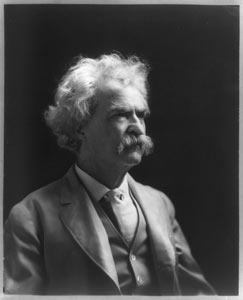
Guest Blogger Mark Twain on Words to be Wary of

Mark Twain photo

photo of Mark Twain

“Substitute ‘damn’ every time you’re inclined to write ‘very;’ your editor will delete it and the writing will be just as it should be.” —Mark Twain

Unfortunately, there are fewer editors around these days, the victims of corporate downsizing many of them, so you will probably have to do this yourself, but it might just work. Every time you want to write “very,” write “damn” instead, then read the story out loud. Just don’t do it at an open mike night.

To learn more about Mark Twain: Mark Twain.

2 Comments

Filed under advice, editor, humor, Mark Twain, words, words to be wary of, writer, writing, writing tip

Words to be Wary of

In an effort to help those who may have been hit by the onslaught of marketing slurry that passes through the English language, every now and then, I will post some words or phrases that are absurd, unless you are in marketing, sales, or some other line of work where junking up the language is simply a way of life. To start, I submit two:

Free Gift. By its definition, a gift is free, at least to the recipient. If somebody gives you a gift that’s not free, then it is not a gift.

Truly Unique. Can something be falsely unique? Unique means one of a kind. Doesn’t matter if it is a good one of a kind, or a bad one of a kind, it is a one of a kind. If it is unique, by its definition it is true to itself because it is one of a kind.

Leave a comment

Filed under absurdity, English, language, words, writer, writing, writing tip

Writing Tip: Drama is conflict

My writing is distinctly middle brow. Just ask anybody who has suffered through it. Still, I like to think that even in my middling way, I can offer some helpful advice when I stumble across it. Therefore, from time to time, I will post some writing advice, but not from me. The advice will come from established sources. I will endeavor not to make it overlong or overreaching, and sometimes it will simply be reminders of what we all probably already know, but it will be some tips I have picked up from reading, from attending writing conferences, or it may even come from you.

Writing with paperclips in ears and nose

Darma is conflict, sometimes even self-inflicted

The first bit of advice comes from a writing course the Knoxville Writers’ Guild sponsored way back in 1993. The teacher was Joseph Gunnels and the cost was $75. It was two-day event, May 15 and 16, and we spent part of a pleasant afternoon sitting on the grass outside the Candy Factory, on The 1982 World’s Fair site. I took over 30 pages of notes, but rather than bore you with details, here is the essence of what I took away from the seminar:

Drama is conflict;
Without conflict no action;
Without action no character;
Without character no story;
Without story, who cares?

In a future entry, I’ll give you a short, crisp definition for conflict that I learned at a more recent one-day writing seminar. It comes from a very highly regarded script doctor in Hollywood, but applies just as well to other forms of fiction writing. Stay turned.

Leave a comment

Filed under advice, building a better story, character, conflict, drama, story, tension, words, writing, writing conference, writing tip

Writing quote for the day

There’s nothing to writing. All you do is sit down at a typewriter and open a vein. –Walter Wellesley “Red” Smith

Leave a comment

Filed under quote, words, writer, writing

Definition: Saint

Saint, n. A dead sinner revised and edited. —Ambrose Bierce

To learn a little more about this American writer, humorist, and satirist, try The Ambrose Bierce Appreciation Society

Leave a comment

Filed under Ambrose Bierce, Definition, humor, saint, satire, word play, writer

Four Clues to Writing a Mystery

[This is taken from an e-newsletter sent out by the writer Bruce Hale. You can find more information at Bruce Hale Writing Tips.]

When I wrote my first mystery, I had no idea how to do it. I
actually had characters tell my detective riddles that would lead
him to the next thing he needed to discover. To be honest, I had
no clue how to construct a clue.

But after you write a few of these things, you start to see how the
mystery is made. Herewith, four helpful hints on writing a mystery:

1. Play fair with the reader
Mystery readers hope that you’ll surprise them, but that surprise
must be a fair one. You can’t tease readers with three suspects
throughout your story, and then suddenly reveal that a character
they’ve never met is responsible. That’s not playing fair.

A Typewriter

Don't forget the unwritten rule: write!

Many mystery readers try to figure things out as they go along. To
play fair with these people, you need to plant a clue or two that
points toward your real culprit. Make it subtle, a throwaway line
perhaps, but make sure it’s there.

2. Keep your reader’s age in mind
Obviously, the mystery in a Cam Jansen chapter book is going to be
just a tad simpler than that in a Raymond Chandler tale. You want
to keep your reader guessing, but you don’t want things to be so
convoluted that he or she gets completely lost — especially in a
children’s book.

Your story should be just a little trickier than readers think they
can handle. If you have any doubts, ask a reader in your target
age range to take a look at the story. If your story leaves her
completely clueless, it’s time to simplify.

3. Merrily misdirect
One of the keys to successful mystery writing is misdirection.
Your readers should suspect every possible culprit but the real
one.

How do you do this? Make your clues point strongly toward one
character, then show that he’s innocent. Make your suspects take
actions that can have two interpretations, and let the reader and
detective erroneously assume the worst.

4. Write from the ending
Most mystery writers I talk with say that they figure out the
ending first — what’s the crime, who’s the culprit, why’d they do
it? — before plotting the rest of the book. Once you’ve got that
sorted out, it’s a matter of concealing it.

You’ll want your detective to take a circuitous route, often
running into brick walls. You’ll want her to think she’s got it
all solved, only to have the rug pulled out from under her.

Mysteries are all about the progressive unraveling of the unknown.
But it’s the *way* you unravel it — using misdirection, considering
your reader, and playing fair — that makes for a satisfying read.

Leave a comment

Filed under mystery, mystery writing, words, writer, writing, writing tip

Writing Quote for the Day

“Don’t get it right, just get it written.” —James Thurber

And if you don’t know who James Thurber is, I suggest starting here: The Thurber House.

Leave a comment

Filed under advice, humor, James Thurber, words, writer, writing, writing tip