Tag Archives: Sunday

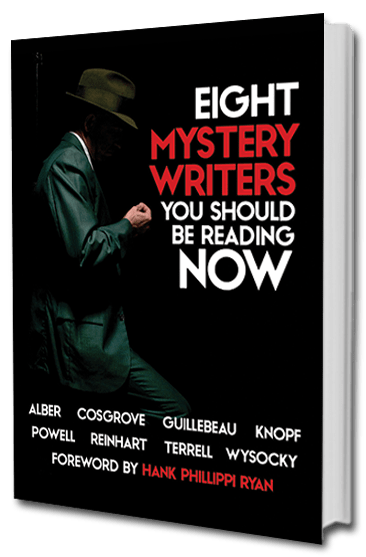
Eight Mystery Writers You Should Be Reading Now | Jaden Terrell

Eight Mystery Writers You Should Be Reading Now – if you don’t know who these mystery writers are, you should.

Source: Eight Mystery Writers You Should Be Reading Now | Jaden Terrell

If you don’t know who these mystery writers are, you’re missing out.

Now you can get it free when you subscribe to my email list.

My part in this book began on Halloween weekend at Killer Nashville 2015, when Michael Guillebeau asked me to be a part of a project he was working on—a sampler of eight mystery writers he admired, each of whom would contribute a short story, an interview, and a sample chapter from one of their novels.

To say I was honored would be an understatement. I’d read Michael’s work, and the guy has some serious writing chops. I mean, the guy can WRITE. Haven’t read him yet? Hie thee to his website and check out his novels right now. Seriously, I’ll wait.

Of course I said yes. And boy, am I glad I did. The other writers Michael lined up are all topnotch, and all a delight to work with. To top it off, bestselling author (and fabulous-in-every-way) Hank Phillippi Ryan came on board to write the introduction. If you don’t already know their work, I hope you’ll find enough in these pages to make you want to learn more.

The book isn’t a five-course meal. It’s more like the appetizer sampler you’d get at a good restaurant. Eight very different flavors. The hope is that you’ll find at least a few you love.

You can get a PDF or mobi copy of it for free by subscribing to my newsletter. The signup form is in the upper right corner of this page.

Since it would be hard to top Michael’s descriptions of the contributors, I’ll let him introduce us:

Lisa Alber – Mystery with a smattering of psychological suspense and tons of atmosphere. Beautifully written, complex stories set in the Irish countryside. Reminiscent of Erin Hart, Julia Spencer-Fleming, and Susan Hill. Rosebud Award and Pushcart Prize Nominee.

Kathleen Cosgrove – Florida weird with a middle-aged woman returning home. Kick-ass funny.

Michael Guillebeau – Broken war hero has to navigate the oddballs and save the girl to get back to the bar he’s been hiding in. Reminiscent of Elmore Leonard and Carl Hiaasen. Silver Falchion Finalist, and Library Journal Mystery Debut of the Month.

Chris Knopf – Hardboiled in the Hamptons. Ex-boxer Sam Acquillo is a noir descendent of Travis McGee and Spencer, and one of my favorite characters. Nero award winner. Chris was featured on my Crimereaders.com blog here.

Jessie Bishop Powell – Cozy noir mysteries that embrace the genre’s extremes. In The Marriage at the Rue Morgue, police suspect an orangutan of murder. Primatologists Noel Rue and Lance Lakeland have to save the ape and still find time to get married. Sounds light, but Powell’s stuff is as intense as it is funny.

Larissa Reinhart – If you like Janet Evanovich’s Stephanie Plum, you need to read Reinhart’s Cherry Tucker. A damaged artist with twice the depth, twice the funny of Plum and set in small-town Georgia. I dare you to put this down. Daphne du Maurier Finalist

Jaden Terrell – A “hardboiled hero with a soft-boiled heart,” Nashville PI Jared McKean has enough emotional issues to carry a book all by himself, and then Terrell throws him into big issues like human trafficking. Shamus Award Finalist.

Lisa Wysocky – Multiple awards for Lisa’s books about a horse trainer with a smart horse who helps her solve crimes. One of the most realistic and loving use of animals in mystery. Winner of American Horse Publication Awards, and the National Indie Excellence Awards.

“It’s easy to find a book. It’s hard to find the book, that new author, who sets your life on fire. That’s why we put this collection together.” – Michael Guillebeau, author of Josh Whoever, Silver Falchion finalist and Library Journal Mystery Debut of the Month

3 Comments

Filed under 2016, mystery

‘It’s All One Case’ is a revealing look at detective master Ross Macdonald – The Washington Post

The sprawling book includes previously unpublished interviews and hundreds of photos.

Source: ‘It’s All One Case’ is a revealing look at detective master Ross Macdonald – The Washington Post

“It’s All One Case” is a book that any devotee of American detective fiction would kill for. For fans of Ross Macdonald, the finest American detective novelist of the 1950s and ’60s, it’s an absolute essential.

First off, this huge album contains the transcript of 47 hours of talk between Kenneth Millar — Macdonald’s real name — and Rolling Stone reporter Paul Nelson. The conversations, which took place in 1976, were intended for an article that never got written. Soon after the interviews were over, Millar began to exhibit symptoms of Alzheimer’s disease and would never write another book. He died in 1983. Nelson’s life would gradually just fall apart. He died in 2006.

Largely because of Kevin Avery’s devotion and hard work this major work of mystery scholarship has finally appeared in print.

Yet there’s still another reason to covet this book — its pictures, hundreds of them. Virtually every page shows off Jeff Wong’s awe-inspiring collection of material relating to Millar.

Here one can see every Ross Macdonald novel in every hardcover and paperback edition and seemingly all the periodicals — from Ellery Queen’s Mystery Magazine to Cosmopolitan and Gallery — in which Millar published a story or article; reproductions of the writer’s handwritten letters, spiral notebooks and typed manuscripts; pages from Knopf galleys; and even VHS tapes and DVDs of the movies and TV series based on private eye Lew Archer.

In addition, “It’s All One Case” includes dozens of photographs of Millar, as a boy in Canada, at his longtime home in Santa Barbara, and with his wife, the comparably gifted mystery writer Margaret Millar (whose works Soho Press has recently reissued in several omnibus volumes).

Nearly all Lew Archer’s cases — “The Zebra-Striped Hearse ,” “The Chill ” and a half dozen others — deal, more or less, with the sins of an earlier generation wreaking havoc in the present. In the interviews here, Millar admits that he consciously worked and reworked variations on this theme because of its personal relevance: His father walked out on his mother when he wasn’t quite 4, and little Ken grew up being shunted among various relatives, so much so that he had lived in 50 different houses or apartments by the time he was 16.

At an early age, Millar decided to become a writer. He tells Nelson that important influences included Poe and Twain but that F. Scott Fitzgerald’s “The Great Gatsby” was, for him, “the central novel of the century.” He reveres Dashiell Hammett’s “The Maltese Falcon” and deeply admires the early work of James M. Cain: “Nothing has ever been done in its field better than ‘Double Indemnity.’ ” Among favorite contemporary writers, Millar names Nabokov, “who doesn’t really make mistakes.” He regards Dostoevsky “as probably the greatest of all fiction writers.”

To write his detective novels, Millar says he spends months scribbling plot details in notebooks and that he deliberately uses symbolic imagery as a structural element. His books are, consequently, both complicated and precisely engineered: “I don’t aim at simplicity.” He also stresses that it’s “the stories of the other people” — Archer’s clients rather than the detective himself — “that really interest me more. Archer is just a means of getting to them and showing them as they are.” Indeed, some of his books, he would argue, “are tragedy or at least aim at it.”

Nonetheless, Millar explains, “I don’t start out with a character. I start out with an idea, which is generally a moral situation. . . . The characters are just notations which together form the book. They do represent energies of course, various kinds of imaginative energy going in different directions, and all that has to be orchestrated and unified. That’s what really is so difficult: to get it all in a proper balance so that each of these energies represented by the twenty or so characters in a book gets its proper place, its proper presentation, and its final place in the structure.” He emphasizes that structure is “the one thing I can do better than my competition, so I spend a lot of time on it.”

Clearly Millar, who earned a Ph.D in English from the University of Michigan, isn’t your average pulp mystery hack. Instead his books honor the hard-boiled tradition, even as they complicate and slightly soften it. These days, however, I suspect that Millar’s novels —despite being reprinted in the Library of America — have fallen into literary limbo, remembered but not much read. Yet his mysteries still pack a wallop, as I discovered when, after many years, I again picked up my copy of “The Galton Case.” From the start, Archer’s voice exhibits the laconic factuality and low-keyed wit we associate with Hammett and Raymond Chandler:

“The law offices of Wellesley and Sable were over a savings bank on the main street of Santa Teresa. Their private elevator lifted you from a bare little lobby into an atmosphere of elegant simplicity. It created the impression that after years of struggle you were rising effortlessly to your natural level, one of the chosen.”

As Millar talks about his life and work in “It’s All One Case,” he does repeat some of the same points again and again. Nonetheless, he absolutely refuses to discuss his daughter Linda, who accidentally killed a young boy when driving drunk at the age of 16 and later died at 31. While Millar admits that his fiction is replete with troubled adolescents, he contends that any personal or autobiographical material has been sublimated, shaped and refracted. He is an artist, after all, and that’s what artists do.

Michael Dirda reviews books on Thursdays in Style.

Leave a comment

Filed under 2016, author tribute

Paul Beatty wins Man Booker prize 2016 | Books | The Guardian

Author wins for The Sellout, a satire of US racial politics, making him the first American writer to win award

Source: Paul Beatty wins Man Booker prize 2016 | Books | The Guardian

By Mark Brown

Paul Beatty has become the first American writer to win the Man Booker prize, for a caustic satire on US racial politics that judges said put him up there with Mark Twain and Jonathan Swift.

The 54-year-old Los Angeles-born writer won for The Sellout, a laugh-out-loud novel whose main character wants to assert his African American identity by, outrageously and transgressively, bringing back slavery and segregation.

Beatty has admitted readers might find it a difficult book to digest but the historian Amanda Foreman, who chaired this year’s judging panel, said that was no bad thing.

“Fiction should not be comfortable,” Foreman said. “The truth is rarely pretty and this is a book that nails the reader to the cross with cheerful abandon … that is why the novel works.

“While you’re being nailed, you’re being tickled. It is highwire act which he pulls off with tremendous verve and energy and confidence. He never once lets up or pulls his punches. This is somebody writing at the top of their game.”

Foreman called it a “novel for our times”, particularly in the context of the Black Lives Matter movement.

“The Sellout is one of those very rare books: which is able to take satire, which is a very difficult subject and not always done well, and plunges it into the heart of contemporary American society with a savage wit of the kind I haven’t seen since Swift or Twain.

“It manages to eviscerate every social taboo and politically correct nuance, every sacred cow. While making us laugh, it also makes us wince. It is both funny and painful at the same time.”

The £50,000 win, announced at a black tie dinner at London’s Guildhall, represented a particular success for Beatty’s publisher Oneworld, a small independent that also represented last year’s winner Marlon James and his novel A Brief History of Seven Killings.

Beatty was overcome by emotion as he accepted the award. He told the audience: “I don’t want to get all dramatic, like writing saved my life … but writing has given me a life.”

At a short press conference afterwards he said winning meant a lot, that he was as “happy as hell”. He did not call his book a satire, he said, but was happy for it be described that way.

The book may be set for success across the world, but Beatty, who said he was told by one of his college professors that he would never be a success as a writer, said it was not something he enjoyed. “I don’t like writing. It’s hard. You’ve got to sit down … I’m a perfectionist, I guess, and I get easily disgruntled and discouraged with what I’m doing. I am really hard with myself and I tend to sabotage myself, but when I’m writing I try not to do that, I try to be in the moment, to be confident.”
Anyone offended by early Richard Pryor might think twice about reading The Sellout. There is lots of swearing and frequent use of the n-word.
But Beatty says in the book that being offended is not an emotion.

“That’s his answer to the readers and I would say the same,” said Foreman.
Judges took almost four hours to reach what Foreman said was a unanimous decision. While it was something of a bookmakers’ outside bet – Ladbrokes offered odds of 6/1 – it had been tipped by many pundits and was adored by most critics with the Guardian’s critic calling it “daring and abrasive” and “a joy to read.”

The Wall Street Journal called it a “Swiftian satire of the highest order. Like someone shouting fire in a crowded theatre, Mr Beatty has whispered ‘Racism’ in a postracial world”.

The books losing out on the prize were Eileen by Ottessa Moshfegh (US), Do Not Say We Have Nothing by Madeleine Thien (Canada), All That Man Is by David Szalay (Canada-UK), His Bloody Project by Graeme Macrae Burnet (UK) and Hot Milk by Deborah Levy (UK).

Levy was arguably the best known writer on a list strikingly short of big literary names. She had also been shortlisted in 2012 for Swimming Home.

Beatty, who lives in New York, is the first American to win in the prize’s 48-year history and it comes three years after eligibility rules were changed to allow writers of any nationality writing in the English language and being published in the UK.

Sales for all six books have already increased significantly, particularly for His Bloody Project, published by the tiny Scottish crime imprint Contraband.

Frances Gertler, web editor at Foyles bookshops, said The Sellout was brave and funny. “It takes a bit of getting into but once there, you don’t want to leave. A smart satire with a memorable narrator.”

Foreman’s fellow judges this year, who have waded through 155 books over 10 months, were the critic and lecturer Jon Day, novelist and academic Abdulrazak Gurnah, poet and academic David Harsent and the actor Olivia Williams.

Foreman said the criteria used by judges in deciding the winner were: aesthetic, quality and depth of ideas, the craftsmanship of the writing and whether it transported the reader.

Beatty, the author of three previous novels and two books of poetry, was presented with his trophy by the Duchess of Cornwall.

Leave a comment

Filed under 2016, awards, novel

10 episodes that take viewers into the depths of The Twilight Zone · TV Club 10 · The A.V. Club

Rod Serling’s classic anthology series offers horror, sci-fi, and political subtext.

Source: 10 episodes that take viewers into the depths of The Twilight Zone · TV Club 10 · The A.V. Club

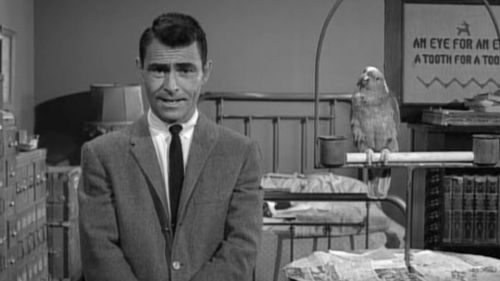
Rod Serling was a smart, skeptical man—smart enough to know where his talents lay and skeptical enough to doubt that those talents ever rose to the level of art. In the last few years of his life, before he died of a heart attack in 1975 at age 50, Serling gave college lectures in which he encouraged his students to rip his legacy apart. Serling had become a sensation at 30, thanks to his Emmy-winning teleplay “Patterns,” and he went on to win Emmys in successive years for his scripts “Requiem For A Heavyweight” and “The Comedian,” both of which are still considered among the highlights of live TV’s “golden age.” Serling then created the science-fiction anthology series The Twilight Zone, and won writing Emmys for its first two seasons. But throughout his rise, Serling battled with network executives and sponsors and worried that he capitulated too easily. Serling wrote some of the best-loved, most powerful television dramas in the history of the medium, but he also worked so quickly and so constantly that he failed to make the most of some of his best ideas. And he knew it. When Serling met with those college kids in the ’70s, he accepted their assessment that even his best scripts were moldy. “They’ve aged like bread,” he nodded.

It’s that awareness of his own human weakness that made Serling’s Twilight Zone so great so often. The idea for the show came to Serling after he got tired of seeing his most politically and socially conscious scripts get gutted by the network suits. Regarding his poorly received 1956 teleplay “The Arena,” Serling wrote, “To say a single thing germane to the current political scene was absolutely prohibited… In retrospect, I probably would have had a much more adult play had I made it science fiction, put it in the year 2057, and peopled the Senate with robots.” So after Serling had an unexpected hit with his sci-fi drama “The Time Element” on a 1958 installment of Desilu Playhouse, he sold CBS on a weekly dose of the uncanny, in freaky half-hour episodes shot on film, derived from original stories and adaptations of some of the best fantasy fiction on the pulp market at that time. The Twilight Zone’s format suited Serling’s purple prose and punchy moralizing, and with the help of some talented writers, directors, and character actors, the show quickly became the standard against which other science-fiction shows were measured.

Emmys and fan esteem aside, The Twilight Zone was never a huge hit during its original run, and Serling ultimately found himself fighting with his bosses again. The production briefly shifted from film to videotape to save money, and after a brief cancellation, Serling got The Twilight Zone back on the air by agreeing to fill an open one-hour time slot. Neither of those compromises served the show well. Neither did Serling’s habit of using a dictating machine to “write” whole scripts in mere hours, which encouraged him to be unsubtle and unoriginal. Serling swiped ideas from other writers—unconsciously, he always claimed—and sometimes, his Twilight Zone episodes had little more to offer than a crazy twist ending or a heavy-handed message.

Yet there’s a reason why The Twilight Zone is still a favorite in syndication, and why it inspired a hit-or-miss movie and pretty good revival series in the ’80s (plus another not-so-good revival in the ’00s). Even the worst Twilight Zones—and there are plenty of those to choose from—are rooted in Serling’s understanding that it doesn’t take much for the normal to shift just a bit and become abnormal. Serling turned small towns, suburban homes, and city streets into staging grounds for the nightmares his audience was already having, often suggesting that the human capacity for superstition and paranoia could be more powerful than any magic spell or alien invasion. The deep creepiness of The Twilight Zone sprung from Serling’s cynicism about institutions, human nature, and himself.

Eventually, entire generations would gorge on the Twilight Zone marathons that local UHF stations would broadcast throughout the ’70s and ’80s on Halloween, Friday the 13th, or New Year’s Eve, and these marathons were a major force in securing Serling’s reputation. In single doses, The Twilight Zone can offer a little eerie drama with a pleasant tingle at the end. Taken in bulk, it has the power to knock viewers off their moorings, pushing them to see irony in every uncanny twist—on the show, and in real life.

As our own Twilight Zone TV Club Classic reviews return February 23, here are 10 episodes designed to explore all the darkest corners of Serling’s show.

“Where Is Everybody?” (season one, episode one): In October 1959, Serling introduced The Twilight Zone to American TV audiences with “Where Is Everybody?,” an episode starring Earl Holliman as a man who wanders through a recently abandoned town until he flips out, driven mad by loneliness. The big climactic reveal of what exactly caused Earth’s population to vanish established a Twilight Zone tradition of starting with the bizarre and ending with the plausible. “Where Is Everybody?” ends with an unexpected but realistic—and poignant—explanation for how the world went topsy-turvy. (Another prime example of this approach comes in the Richard Matheson-penned second-season episode “Nick Of Time,” which stars William Shatner as a man who believes his destiny is being controlled by a roadside diner’s tabletop fortune-telling machine, until he realizes it’s really his own superstition and paranoia guiding his decisions.)

“Walking Distance” (season one, episode five): Serling was keen enough to realize that science fiction didn’t always have to involve rocket ships and rubber monsters. He won over less genre-friendly critics early in The Twilight Zone’s run with “Walking Distance,” starring Gig Young as a man who’s transported back to his own past and given the opportunity to talk to himself as a boy. As always, there’s a twist ending, born of the common Serling idea that time is a closed loop, unalterable. But what stands out more is the call of nostalgia in “Walking Distance,” as a grown-up walks through his childhood idyll—a town that Serling would acknowledge was inspired by his own hometown of Binghamton, New York. The Twilight Zone would continue to play with this notion of the past pulling characters back, most notably in Serling’s “A Stop At Willoughby,” in which a neurotic executive escapes in his mind to an imaginary turn-of-the-century small town, and Matheson’s “Young Man’s Fancy,” in which a mama’s boy visits the house of his late mother, and reverts to childhood right in front of his new wife’s eyes.

“Time Enough At Last” (season one, episode eight): Easily one of the top five most remembered Twilight Zone episodes, “Time Enough At Last” was adapted by Serling from Lynn Venable’s short story about a henpecked bookworm (played by Burgess Meredith) who survives an apocalypse and is finally left alone to do as much reading as he likes. This being The Twilight Zone, complications occur—because more often than not on this show, when people get what they think they want, they’re profoundly unhappy with the results. (See also: Serling’s cruel season-five episode “Uncle Simon,” in which a woman who’s been waiting her whole life for a mean, rich old relative to die gets a rude surprise when he finally passes.) “Time Enough At Last” is a classic not just because of its O. Henry ending, but because when the meek Meredith steps out onto a depopulated city street, his reaction encompasses all the loneliness—and paradoxical yearning for loneliness—that was one of the show’s recurring motifs.

“The Monsters Are Due On Maple Street” (season one, episode 22): One of the reasons Serling created The Twilight Zone was so he could tell stories about real-world social problems without calling those problems by name. “The Monsters Are Due On Maple Street” tackles foolish human prejudice, showing how neighbor turns against neighbor when a power outage leads some to suspect an alien invasion. The madness of crowds has long been a staple of thrillers, and it’s a premise that The Twilight Zone would tackle often—as in Serling’s more ham-fisted season-three episode “The Shelter,” in which neighbors come to blows over space in a friend’s fallout shelter. “The Monsters Are Due On Maple Street” is more pointed than most. From its location—a backlot that had previously been used for the wholesome Andy Hardy movie series—to its “just because you’re paranoid doesn’t mean they’re not after you” ending, this episode argues that even when there’s a real external threat, ordinary Americans will overreact and do the enemy’s job for it.

“The Eye Of The Beholder” (season two, episode six): It’s hard to describe some of the most famous Twilight Zone episodes to newcomers without revealing their endings, and since sometimes the ending is the best part of a Twilight Zone, it’d be unfair to spoil them. (Warning: The book To Serve Man in “To Serve Man” is… well, no, best not say.) But sometimes, even when the best Twilight Zone sucker-punches are fairly obvious, there are other redeeming qualities. In “The Eye Of The Beholder,” a woman awaits the results of a plastic surgery designed to make her look “normal”—a word that turns out to have a very different meaning in the place where she lives. Because all the characters’ faces are carefully hidden from the audience for nearly 20 minutes, it’s clear early on that some reversal is coming, but the expressionistic lighting and the meditation on the significance of “beauty” make “The Eye Of The Beholder” powerful regardless. It’s another one of the Twilight Zone episodes that often leaps to mind immediately when casual viewers talk about the show.

“The Invaders” (season two, episode 15): Though the Matheson-penned “The Invaders” has one of the most genuinely surprising twist endings in Twilight Zone history (albeit one that the show tried more than once), that’s not what makes it a series standout. No, what’s remarkable about “The Invaders” is how effectively stripped-down it is. Agnes Moorehead plays a mute woman who fights off a tiny flying saucer manned by creatures in bulbous space suits. And that’s it. There’s almost no dialogue and not much in the way of setup or story. It’s just one lone person fighting for her life for 20 minutes: an exercise in raw terror.

“Long Distance Call” (season two, episode 22): The Twilight Zone wasn’t cheap to produce, with new sets every week and often-fantastical makeup and special effects. To cut costs, CBS asked Serling to try shooting on video in the middle of the second season, and while Serling’s years of working in live TV had made him familiar with writing and staging for video, the show never really felt right with the constrictions that the medium demanded. Still, there are a few winners among the six video-shot Twilight Zones. The first of the batch, “The Lateness Of The Hour,” is another of Serling’s irony-filled examinations of prejudice, following the comeuppance of a young woman who resents her family’s android servants. And the last of the batch, “Long Distance Call,” is one of the show’s creepiest half-hours. Written by William Idelson and Charles Beaumont, “Long Distance Call” is about a toy telephone through which a child receives messages from his dead grandmother, urging him to join her in the afterlife. The limited setting pays off here, in an episode where drab reality contrasts with the imagination of people and places beyond.

“Person Or Persons Unknown” (season three, episode 27): One of the reasons why The Twilight Zone resonated as it did is because Serling and his writers touched so often on common anxieties. In the Beaumont-written “Person Or Persons Unknown,” an everyman played by Richard Long wakes up to discover that none of his friends or family members recognize him, and instead consider him a dangerous lunatic. It’s not just that there’s no record of the man’s existence; the hell of it all is that he has unshakeable emotional attachments to people who now regard him as a stranger. That’s what sets up this episode’s devastating twist ending, where circumstances are inverted and the protagonist becomes lonelier than ever.

“Miniature” (season four, episode eight): The Twilight Zone was effectively canceled at the end of its third season, when the show had trouble attracting a sponsor. CBS gave Serling a reprieve when he agreed to let The Twilight Zone be a mid-season replacement, taking over a timeslot vacated by an hourlong drama. By then, Serling’s co-producer, Buck Houghton, had decided to move on, and Serling himself was contributing fewer scripts. Generally speaking, the 18 hourlong episodes of season four are significantly hobbled by the extra screen time. The Twilight Zone was a show that relied on the simple idea and the quick hit, neither of which was suited to sprawl. But they’re not all losers in season four. Beaumont’s touching “Miniature” stars Robert Duvall as a social misfit who becomes obsessed with a doll he watches at a museum, convinced that the toy is leading a sad little life, just like him. Duvall’s performance is full of nuance, and Beaumont’s script is more like the film Marty than a typical Twilight Zone. The episode makes a nice companion piece to Serling’s season-one classic “The Lonely,” in which an isolated prisoner of the future has to choose between his robot companion and a full pardon. Here, Duvall has to decide whether to live in an ersatz world or commit to the real one.

“Living Doll” (season five, episode six): Though primarily a science-fiction series, The Twilight Zone developed a reputation as one of the scariest shows on TV, dating back to season one’s horrific ghost story “The Hitch-Hiker.” In its fifth and final season, The Twilight Zone went to the horror well more often, producing several of the series’ most memorable episodes (including “Nightmare At 20,000 Feet,” in which William Shatner plays a nervous flyer who sees a gremlin on the wing of a jet airliner). Among those memorably scary—and funny—season-five episodes is “Living Doll,” written by Beaumont and Jerry Sohl, and starring Telly Savalas as a crank who resents the money his wife spends on toys for his stepdaughter. When one of those toys—a talking doll voiced by the legendary June Foray—threatens to kill him, the stepdad initially laughs it off, and then learns that an inanimate object can be pretty dangerous. The Twilight Zone wasn’t as sharp in its final round of episodes as it had been over its first three years, but “Living Doll” is true to the show’s mission of taking the ordinary and making it seem alien.

And if you like those, here are 10 more: “Third From The Sun” (season one, episode 14), “A World Of Difference” (season one, episode 23), “People Are Alike All Over” (season one, episode 25), “A Penny For Your Thoughts” (season two, episode 16), “The Silence” (season two, episode 25), “It’s A Good Life” (season three, episode eight), “Five Characters In Search Of An Exit” (season three, episode 14), “The Changing Of The Guard” (season three, episode 37), “The Old Man In The Cave” (season five, episode seven), “The Masks” (season five, episode 25)

Leave a comment

Filed under 2016, Rod Serling

Binghamton, New York’s Rod Serling Gazebo remembers the creator of The Twilight Zone.

Source: Binghamton, New York’s Rod Serling Gazebo remembers the creator of The Twilight Zone.

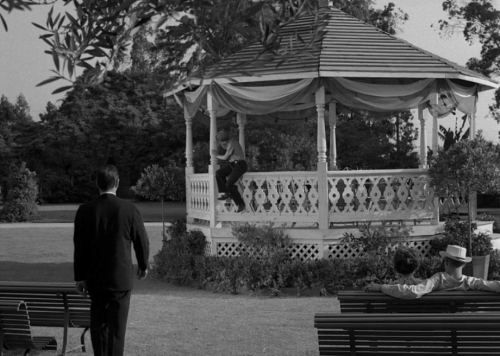
Martin Sloane realizes he has slipped back in time when he sees his younger self carving his name on a gazebo in a park containing an old carousel. Martin has accidentally returned to his childhood town after a 25-year absence and is astounded to discover nothing has changed.

So begins the plot of “Walking Distance,” the fifth episode of The Twilight Zone, which aired in 1959. The setting of the story is based on a real carousel that has been in continuous operation since 1925 in Recreation Park in Binghamton, New York, where the visionary creator of the famous television series grew up.

Many Twilight Zone locations are based on real places. “Mirror Image” takes place at the Greyhound station with a rider waiting for his bus to Cortland. The streets in “The Monsters are Due on Maple Street” eerily resemble Binghamton’s West Side. The carousel at Recreation Park is one of six built by George F. Johnson as a gift to the workers of the Endicott-Johnson company. All six are still running, and if you ride them all in one summer you will earn a pin to commemorate the effort. The Rec Park carousel has 60 mounts and runs all day in the warmer months.

Rod Serling is Binghamton’s favorite local boy–done-good, and his name and face adorn parks, stages, and festivals across Broome County. The moment where Martin Sloane realizes he has returned home has been commemorated as well. A large gazebo with titanic pillars was erected on the hill overlooking the carousel. A plaque in the center reads, “Rod Serling, Creator of The Twilight Zone, ‘Walking Distance.’ ”

Leave a comment

Filed under 2016

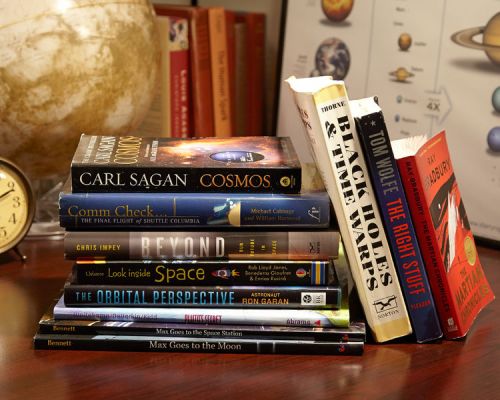
Best Space Books and Sci-Fi: A Space.com Reading List

Space.com’s editors present a reading list for space and sci-fi lovers, as well as children who are interested in astronomy and spaceflight.

Source: Best Space Books and Sci-Fi: A Space.com Reading List

There are plenty of great books out there about space — so many, in fact, that it can feel a little overwhelming to figure out where to start. So the editors and writers at Space.com have put together a list of their favorite books about the universe. These are the books that we love — the ones that informed us, entertained us and inspired us. We hope they’ll do the same for you.

We’ve divided the books into five categories, which each have their own dedicated pages. On this page, we feature books we’re reading now and books we’ve recently read, which we will update regularly. Click to see the best of:

  • Astronomy and Astrophysics
  • Spaceflight and Space History
  • Space Photography
  • Space Books for Kids
  • Science Fiction

We hope there’s something on the list for every reader of every age. We’re also eager to hear about your favorite space books, so please leave your suggestions in the comments, and let us know why you love them. You can see our ongoing Space Books coverage here.

Leave a comment

Filed under 2016, books

Sci-Fi & Fantasy Library Sweepstakes – Unbound Worlds

Source: Sci-Fi & Fantasy Library Sweepstakes – Unbound Worlds

A chance to build your science fiction and fantasy library.

Leave a comment

Filed under 2016, books

English in 100 years

Hear What Scholars Think English Will Sound Like In 100 Years

Today’s English is the result of hundreds of years of evolution, so why would we not expect it to keep changing? Here’s what it might become by the 22nd century.

http://audiblerange.com/categories/voice/hear-what-scholars-think-english-will-sound-like-in-100-years/

By Michael Erard

You might think of English, which is spoken by the largest number of people on the planet, as a mighty, never-ending river, full of life and always churning and changing. If you speak the language, it’s natural to wonder where this river is headed. And who will shape the sounds that bubble out of it in the future — 20, 50, or even 100 years from now?

Feeding the river are two tributaries that determine its direction. One of these carries the influence of the estimated two billion people who speak English as a non-native language. They are influential not just because of their number but also because the majority of interactions in English in the world occur between non-native speakers — as many as 80 percent, according to linguists. This is English playing its role as a global lingua franca, helping speakers of other languages connect with each other.

The other tributary carries the changes that English has been undergoing for hundreds of years. Between the 12th and 16th centuries, for example, English underwent the “great vowel shift,” which shortened some vowels, like “ee” to “aye,” and pushed others up and to the front of the mouth, so that the Middle English vowel pronounced “oh” is now pronounced “oo,” as in “boot.”

What will this sound like once I am done?

What will this sound like once I am done?

In the mid-20th century, linguist and English historian at the University of Michigan Albert Marckwardt argued that English wasn’t done changing and that the momentum of the past would carry on into the future. It’s true that some vowels seem durable; the pronunciation of “ship,” “bet,” “ox,” and “full” have been the same for centuries. But Marckwardt argued that some vowels are still going to shift. For example, the word “home” — pronounced “heim” in Germanic, “hahm” in Old English, and “hawm” in Middle English — might someday be “hoom.”

On the other hand, he predicted that English consonants would remain largely the same, although some have already changed. For instance, the “k” in “knife” was once pronounced, “nature” was “natoor,” and “special” was “spe-see-al.” But for the most part, Marckwardt said, we shouldn’t expect to see much change in English consonants.

The success of English — especially the fact that it is used by many non-native English speakers — means, among other things, that the history of the language is no longer a reliable map about how its pronunciation might change. Consider, for instance, that a number of distinct regional variations of English are emerging around the world.

While all of this research gives us some tantalizing ideas about how English might sound in the future, it doesn’t tell us very much about when we might expect those changes. It could happen within a generation, but it could take another century. It mostly depends on which regional version of English becomes dominant, says Jennifer Jenkins. “Beyond that, I’d need a crystal ball to be able to say more.”

All this assumes that English will remain as predominant as it has been, even as it diverges into multiple Englishes, each one carving its own meandering path toward the sea.

One of them is in Southeast Asia. More than 10 years ago, linguist David Deterding recorded English teachers from Singapore, Vietnam, Laos, and Myanmar in order to identify notable features of their English. The first sound from the word “thing” was a popping “t,” “maybe” sounded like “mebbe,” and “place” became “pless.” Deterding also noticed that speakers laid more stress at the end of sentences (in the UK and U.S., such heavy stress marks new information in a sentence).

These sound changes were influenced by those teachers’ mother tongues. To some people’s ears, particularly those who speak British or American English, these pronunciations might sound wrong, as if the speakers had simply not worked hard enough to get rid of their accents. However, as Deterding pointed out, the teachers could still understand each other. So in what sense are these non-native accents a problem, especially if the speakers are mainly going to be talking to other non-native speakers?

All over the world, this question is something that teachers of English are working out for themselves. Is it better practice to promote intelligibility or should learners reproduce American- or British-accented English? The direction that is taken will determine how the English of the future sounds.

Interestingly, where Albert Marckwardt predicted that English vowels would see the biggest changes, others think it will be certain consonants that are drastically altered.

Jennifer Jenkins, a linguist at Southhampton University in the UK, has studied the communication breakdown between non-native speakers of English to see what pronunciations they stumble over. These provide a clue as to how English may change. The aspects of English pronunciation that promote intelligibility would tend to spread, she has said, while those that promote misunderstanding would wither away.

In contrast to Marckwardt, Jenkins’ findings suggest some severe changes ahead for consonants. For instance, she says the “th” of “thus” and “thin” are often dropped and replaced with either “s” and “z” or “t” and “d.” (In Europe, it’s looking like the “s” and “z” may win out.) Another consonant that causes problems is the “l” of “hotel” and “rail,” which speakers replace with a vowel or what’s known as a “clear l,” as in “lady.” (This is a pronunciation change that Chinese speakers of English often make.)

Jenkins also predicts that some clusters of consonants will simplify. At the beginning of words, they will survive, but at the end of words they may vanish. This means you may hear “bess” for “best” and “assep” for “accept.”

In the short term, these new pronunciations could become part of how English sounds on the tongues of people who use it as a lingua franca. But in the long term, they could filter into standard English in other parts of the world — even its homelands — if the innovations seem worth adopting.

Barbara Seidlhofer, a linguist at the University of Vienna in Austria who studies verbal interactions between non-native English speakers, has made some predictions about how words formed in these regional English varieties will affect how they sound. She has noted that non-native speakers do not distinguish between mass and count nouns, so someday we might talk about “informations” and “furnitures.”

Also, the third person singular (such as “she runs” or “he writes”) is the only English verb form with an “s” at the end. Seidlhofer has found non-native speakers drop this. They also simplify verb phrases, saying “I look forward to see you tomorrow” instead of “I am looking forward to seeing you tomorrow.”

Leave a comment

Filed under 2016, language

19 Beautiful Bookstores You Need To Visit In America

Bookshop road trip, anyone?

Source: 19 Beautiful Bookstores You Need To Visit In America

The real question is: Can you ever have too many beautiful bookstores in your life? Yelp identified the best bookstores in the country by looking at both the number of reviews and the star-rating, then hand-selected the most dazzling stores from that list.

So here are 19 incredible bookstores you need to see for yourself, as told by the Yelp users who love books and ambiance just as much as the rest of us.

Leave a comment

Filed under 2016, bookstore

“Airship” for literature

Czech center builds giant ‘airship’ for literature

http://www.knoxnews.com/news/394430431.xhtml

 Leos Valka, a co-creator, sits on a rooftop overlooking a giant object resembling a zeppelin airship at an arts center in Prague, Czech Republic. The 42-meter long and 10-meter wide ship is planned to seat some 120 people on its cascade steps. It will be used for authors' reading and debates about literature to complement exhibitions at the DOX Centre for Contemporary Art, one of the most innovative and challenging galleries in the Czech capital. (AP Photo/Petr David Josek)

Leos Valka, a co-creator, sits on a rooftop overlooking a giant object resembling a zeppelin airship at an arts center in Prague, Czech Republic. The 42-meter long and 10-meter wide ship is planned to seat some 120 people on its cascade steps. It will be used for authors’ reading and debates about literature to complement exhibitions at the DOX Centre for Contemporary Art, one of the most innovative and challenging galleries in the Czech capital. (AP Photo/Petr David Josek)

By Karel Janicek, The Associated Press

PRAGUE (AP) – Is that a zeppelin on the roof?

The huge object appears to have landed on the roof of the DOX Centre for Contemporary Art in the Czech capital.

The wooden and metal structure, envisioned as a home for literature, is another project of the center known for its challenging exhibitions and installations.

The center’s founder and director, Leos Valka, joined forces with architect Martin Rajnis, who won the 2014 Global Award for Sustainable Architecture, to give the gallery another dimension.

“Our aim for the world of contemporary art is to spread and get partially interconnected with the world of literature,” Valka said at a preview this week.

The 42-meter (138-feet) long and 10-meter (33-feet) wide ship is planned to seat 120 people on its cascade steps inside for authors’ readings, performances, workshops and public debates to complement the exhibitions.

That’s all to be in line with the gallery’s mission “to create a space for research, presentation, and debate on important social issues, where visual arts, literature, performing arts, and other disciplines encourage a critical view of the so-called reality of today’s world.”

Numerous obstacles had to be overcome to get approval from authorities for the 55-metric-ton (60-ton) project.

The ship was finally qualified as a “watchtower” – a bit of absurdity which Prague native Franz Kafka might have appreciated.

The airship is named Gulliver, the hero of Jonathan Swift’s classic, who visited a flying island of Laputa during his adventurous travels.

“It’s a world of pure imagination,” Valka said about the project. “A children’s world.”

“You should get an impression that some 10-12-years-old boys escaped from the houses of parents to board their makeshift aircraft and by accident crash-landed in Holesovice,” the Prague district where the center is located.

“It’s an elegant intruder,” Valka said. “It’s a concrete, fully authentic, giant object whose message is that things can be done differently.”

The literature space is scheduled to open in late November or early December.

Leave a comment

Filed under 2016, books, literature