Tag Archives: LinkedIn

The Kibitzer and The Kidd, part 6

888888

It wasn’t fair. Not only did he have a nickname he didn’t like – Kibbey – but he was also sleeping in the stable with the horses. Horse and hay, flatulence and flies, though it seemed odd that there were so many flies at night. He wondered if a fly got zapped by lightning, would it be resurrected.

Even the popcorn they delivered to him was stale and a little soggy from the humidity it picked up from the air. He had a bag of his own, but it had started raining again, so he couldn’t pop it outside. He looked around to see if the blacksmith’s workshop was part of the stables or nearby.

There was not a blacksmith’s forge, so he was on his own to create a fire.

He understood that the Kidd was the hero, having shot the pistol out of the floor-faced man’s hand. He knew that kibitzers were not easily or fully accepted into society. They were witnesses and scribes, and they reported to an authority most didn’t know about or understand. He certainly wasn’t sure why he had been selected. His family were not kibitzers. Nor any of his friends. And when they came in the middle of the night and told him he was selected, they did not give him a chance to say goodbye to his wife and two sons. Only a short note, quickly scribbled. It read: I’ve been selected. Don’t wait up.

He wasn’t sure how long ago that was, what his wife was like now, if his sons even remembered him.

The Kibitzer piled some hay in one area of mostly dirt. It was turning cold. He’d need the fire for more than popcorn.

Popcorn was his only solace. Bags of it turned up at the oddest times in the oddest places. He took it as a sign he was doing a good job.

He kept a book of matches dry and buried deep in a saddle bag. They were hard to get and he usually sparked a fire with a piece of flint and a piece of steel he carried; but they were both wet from rain. He was also too tired to try.

He added a piece of dried horse manure to the hay pile.

He found the matches, walked back to the pile of straw and dried other things and selected one from the box.

It was then somebody, head draped in a hood, stepped into the stable and tossed a torch on a larger pile of hay nearby. As the man left, he said, “Don’t wait up.”

At least that’s what the Kibitzer thought he said. The words were muffled by the hood. The words stunned him. By the time the Kibitzer recovered, the fire had spread to other parts of the stable, and the culprit was gone, and the Kibitzer was trapped.

(To be continued.)

Leave a comment

Filed under humor, kibitzer, kidd, science fiction, story, storytelling, western, word play, words, writing

Thunder and snow

Madness leads my life.
Thunder and snow break my heart.
Tears ring with new ice.

2 Comments

Filed under haiku, heart, nature, poem, poetry, snow, Thunder

Super Tuesday Wrap Up

Super Tuesday Wrap Up cartoon

The Summation of Super Tuesday

Leave a comment

Filed under Cartoon, humor, political humor, satire, Super Tuesday

Found story: Frank and Ike

“Frank, what are we?”

“We’re pumpkins, Ike.”

“But if we’re pumpkins, how come we’re white?”

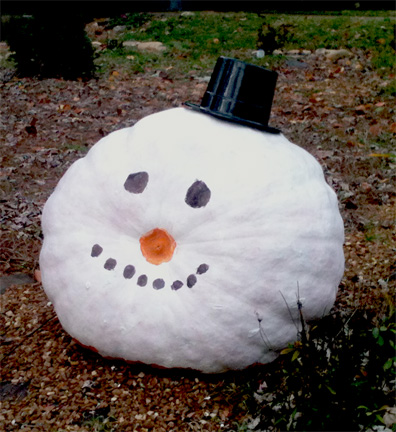
Frank and Ike

Frank (left) and Ike (right) discuss life as a pumpkin.

“Halloween came and went, and when Christmas came along, they decorated us up as snowmen. Or at least the heads of them.”

“Oh, nice, Frank.”

“If you say so.”

“What do you mean?”

“Ike, just wait and see.”

#

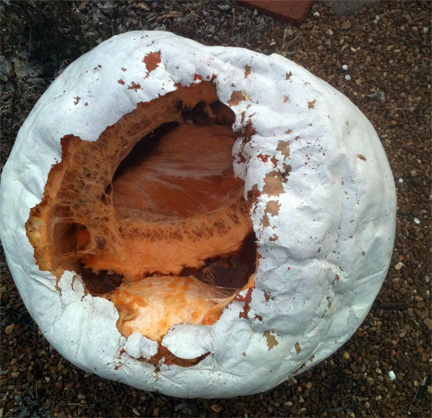
Ike Closeup

Ike tells Frank they're changing.

“Frank, are you still there?”

“Yes, Ike.”

“We’re changing. I feel it on the inside.”

“If you say so.”

#

“Frank, look at you.”

“I can’t see myself, Ike. I can’t even see you now.”

“Frank, I’m scared.”

“I know.”

Ike undone

Ike becoming undone.

“Frank, what are we?”

“We’re friends.”

“I mean, what are we? What are we becoming?”

“We’re pumpkins, Ike. We’ve been pumpkins. We are pumpkins. We will always be pumpkins.”

“Are you sure?”

“I’m sure.”

“That’s good to know, Frank. Good to know.”

“Good bye, Ike.”

“Frank, don’t leave me.”

“Frank … Frank ….”

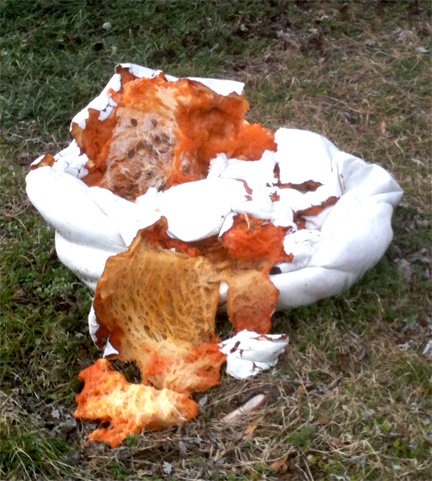
Frank undone

Frank undone.

4 Comments

Filed under Found story, pumpkins, story, storytelling, words, writing

Writing Tip: Successful Revision

[Editor’s note: the essay below is taken from an e-mail newsletter sent out by the writer Bruce Hale. you can find his web site at: http://www.brucehalewritingtips.com/. You can also sign up for his e-newsletter at that site. Each electronic newsletter comes with other information, including a writing joke.]

5 ELEMENTS OF A SUCCESSFUL REVISION

By Bruce Hale

So you’ve finished that first draft and let your story marinate in its own juices for a while, and now it’s time for revision. Only question is: where to start?

With a picture book, that’s not too terribly daunting. But with a longer novel, you’d be well served to devise a strategy before plunging into those narrative hickets that can swallow the unwary writer. I suspect everyone has his or her own favored approach to revision. Here’s the one I’ve found most useful…

1. FIRST READ
First time through, the hardest thing is to *just* read your story and take notes. No line edits, no grammar corrections, no paragraph revisions — just reading. But if you want to be able to see the whole forest, instead of the individual trees, this approach is vital.

By all means, take copious notes. “Tighten the opening on page 43;” “wonky sentence on page 12, first paragraph;” “fix the plot logic in Chapter 18.” These are all helpful. And they prepare the way for…

2. FIRST REVISION
Once you’ve waded through your story and taken copious notes, congratulate yourself. It’s not as bad as you thought, right? (We hope.) With this optimistic thought, it’s time to roll up the sleeves and plunge into wholehearted revision.

The first time through, work on larger issues: plot holes, character inconsistencies, gaps in story logic, slow scenes that need to be trimmed, and so forth. You can always do the fine polishing later.

Revise sequentially if you can, rather than skipping around. For any sections that require you to write new material, use the same method you would in a first draft: write it fast and sloppy. After all, you can always fix it in the NEXT revision.

3. READ-ALOUD REVISION
Taking the time to read your work aloud may seem redundant at this point, but it’s necessary. You won’t believe how many errors you’ll catch. Homonyms, awkward phrasing, missing words, echoes (unintentionally repeated words) — all these will pop out at you like Halloween skeletons at a haunted house.

This is the revision where you can really focus on the sound and rhythm of your writing. Listen for those areas that sound clunky and don’t really roll off the tongue — that’s your cue to break out the belt sander and make things smooooth.

4. DIALOG REVISION
Once the story is as good as you can make it, and you’ve read aloud to catch hidden glitches, it’s time to turn the microscope on your dialog. First, make sure each character speaks differently. Have them use different idioms, word choice and catch phrases — otherwise, they’ll all sound like each other (or like you).

Top-notch authors like Elmore Leonard vary their character dialog so deftly, they don’t even need attributions (he said/she said). It’s that clear who’s speaking. In real life, we all have our own ways of putting things. So just make sure your fictional characters possess that same distinction.

5. FINAL CHECK
Before I send my story off to agent or editor, I usually try to let it sit for a week or so, then do one last read-through, to make sure all my changes fit, and to smooth out any remaining rough edges. This is an ideal time to search for words you overuse. (And we *all* overuse certain pet words.)

For example, I know that I tend to drop in “just” and “only” too often, and I tend to have too many characters shrugging and nodding. A quick search for these words shows me where I’ve overdone it, and a quick fix guards against too much sameness in the manuscript.

And that’s about all I can bear to write on the subject of revision right now. I think you know why. Yes — time to get back to revising my latest story.

Leave a comment

Filed under advice column, Bruce Hale, revising, words, writer, writing, writing tip

The blathering idiot has more questions

Just the other day, the blathering idiot had some time to kill, though he wasn’t sure it was alive to begin with, and while pondering the philosophical depths of life, came across questions for which he could not find answers. Below are a few more of those questions.

How come you can beat the odds, but never the evens?

How come formatting something means to put it in some sort of structure, but to reformat something means to wipe away all the structure?

How come falling in love leads only to a broken heart?

How come you can take a turn, but never give one?

How come you can fancy something, but are always told to speak plainly?

How come you can give a damn, but never take one?

After you put on airs, how do you take them off?

How come you can go for broke, but have to stop on a dime?

This is too hard to think about

This may be too hard to think about

1 Comment

Filed under blathering idiot, Cartoon, humor, question of the day, questions, word play

The Devil’s Dictionary: miscreant

Every now and then, it is good to revisit a classic, or even a curiosity from the past. The Devil’s Dictionary by Ambrose Bierce was originally published in newspaper installments from 1881 until 1906. You might be surprised how current many of the entries are.

For example, here is a definition for the word miscreant The Old definition is Bierce’s. The New definition or comment are mine. From time to time, just as it was originally published, we will come back to The Devil’s Dictionary, for a look at it then and how it applies today. Click on Devil’s Dictionary in the tags below to bring up the other entries.

Old definition

Miscreant, n. A person of the highest degree of unworth. Etymologically, the word means unbeliever, and its present significance may be regard as theology’s noblest contribution to the development of our language.

New definition

Miscreant, n. A person of the highest degree of unworth, such as a politician or political pundit who wraps herself in the flag like swaddling clothes; proclaims “family values” as if they were a manger under siege, yet does nothing for families in dealing with the ravages of capitalism as the top 1 percent of the wealthiest people in the country control more wealth than the bottom 40 percent, and “wants to take my country back” as if somehow retreating into the past will deal with the future.

Etymologically, the word means unbeliever, holding an unorthodox or false religious belief. Again, see politician political pundit as described above. There is nothing more heterodoxical than living in a past that never was.

May want to see previous Devil’s Dictionary entries on politicians, politics, and orthodoxy.

Leave a comment

Filed under Ambrose Bierce, Devil's Dictionary, humor, miscreant, satire

Cartoon: Giving Your All

Giving Your All

Giving Your All is easier to give your all when somebody or some corporate entity has already taken it.

Leave a comment

Filed under Cartoon, Giving, humor, satire

Found story: the eyes have it

He was a small time thief. Never stealing more than what it took to get by. He’d been caught a couple of times, but managed to work his way out of any real time behind bars by turning snitch or offering some other piece of information the cops could use.

But this was one theft attempt he couldn’t believe. He was being paid to steal two pairs of eyeglasses: a mother’s and a daughter’s. He didn’t like the idea of stealing a young girl’s glasses. He had less than 20/20 vision himself, but because it wasn’t discovered until he was in high school, he had already been labeled difficult to teach, a problem student, and his grades had suffered, and so at sixteen, he dropped out of school and into a life of crime. He didn’t want that to happen to her, but eventually decided the money was too good to pass up. The guy who wanted the glasses, wanted both pairs. He wouldn’t settle for only one.

But he had to steal the glasses today, before 9 PM, or no money. It was already 4 PM when he got the job. It was 5:30 and storming when he found the mother and daughter.

He followed them and decided to strike when they walked into a building that had once housed a milling company. The banner on the awning of the renovated entryway said: “Amateur joke night: Everybody welcome.”

Certainly, there would be a chance here to steal the glasses. His only concern was he had not seen the glasses he was supposed to steal, at least not up close. Like most women he knew, they were probably vain about wearing them, unless they had to. Of course, he was a little vain about wearing his glasses, too, and he hated the idea of contacts. His poor eyesight has been one of the main reasons he had never been more than a petty thief.

He sat beside the mother and daughter, the mother’s big handbag on the floor between them.

The joke telling went on for too long. Most of the jokes were old, and most of the telling was enthusiastic but unpolished. Every now and then there was a good laugh. On top of that, the room was warm. Sweat ran down the back of the petty thief’s neck. The time was 8:37 PM. It would take him ten minutes to get to the meeting point.

The mother picked up the bag, took something out, laid the bag back down, and then turned away from the thief and was talking with her young daughter.

The petty thief glanced around to see if anybody was looking, then reached down and gently pulled the bag into this lap. He was looking down into it when the lightning cackled, the thunder boomed, and then the lights immediately went out.

When the lights winked back on, he was still holding the handbag. It was 8:46. The mother and daughter turned to look at him. He screamed, threw the bag down, and bolted from the room.

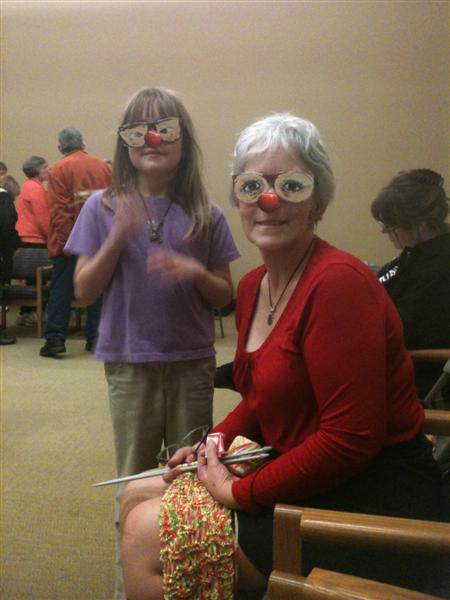
Mother and daughter in special glasses

Mother and daughter in special glasses

Everyone laughed.

It wasn’t until he was safely outside in the rain that the petty thief understood why the person he was stealing the glasses for was called “The Clown.”

Leave a comment

Filed under eye glasses, Found story, humor, story

The Kibitzer and The Kidd, part 5

[Editor’s note: Parts 1 – 4 on the blog. You can click on “Kibitzer or Kidd in the Tags below to reach he previous entries. I am working to make this a monthly feature on the blog. Hope you enjoy this science fiction western with a dash or two of humor set in a quirky time and place: not quite and not quite there.]

888888

The Kibitzer didn’t know what to make of the situation when he stumbled though the swinging saloon doors and everybody was staring at him. Normally, he was the one doing the staring.

Rain dripped off his hat and clothes.

He smiled. No one smiled back, not even the Kidd. As he stepped the rest of the way into the saloon, he heard a voice say, “Donut go there.”

He looked down at the floor, certain that’s where it came from. But how could the floor speak?

“Did you get them?” the Kidd asked.

“Wipe your feet,” the robust saloon woman said.

The Kibitzer pointed outside. He made a slash like lightning, raised his knee, and then spread his arms wide.

“Speak. You know I don’t read pantomime.”

“Maybe I can help,” Al Wayne said. “He probably saw one of our fair citizens zapped by lightning who then got up and walked away. The first time somebody witnesses it, it tends to leave them at a loss for words.”

The Kibitzer pointed at Wayne and nodded.

“I talk about it in my book, Global Warning. Though I’m not quite sure what the raised knee means.”

The Kibitzer turned slightly red.

The saloon doors swung open again. This time Bonnie came through, carrying a bag. She, too, dripped rain on the floor, but the Kibitzer didn’t hear anything from the floor, or what he thought was the floor, as she approached.

“You forgot these.” She held them out toward him holding the bag between her finger and thumb as if trying to be ladylike or as if what was inside was as foul as fresh dog poop.

The Kibitzer nodded toward the Kidd.

Bonnie didn’t move.

The Kibitzer nodded again. He wasn’t sure why he wasn’t speaking. He had been able to after she kneed him. Was the big guy with the bent sheriff’s star on his chest right? Was it the excitement of seeing somebody zapped by lightning, then being told he would rise from the dead, then begin to see the dead stir as he ran across the wide street of mud that left him, the Kibitzer dumbfounded? He had witnessed many things, even eaten some bad popcorn while witnesses them, but he had never been at a loss for words – until now.

“Don’t worry, Kibbey, I won’t knee you again.”

Kibbey? No one called him Kibbey!

The entire room broke out in laughter. Even the big guy with the bent star chuckled.

Nobody told Bonnie to wipe her feet.

(To Be Continued…)

Leave a comment

Filed under humor, kibitzer, kidd, science fiction, story, western, wit