
Gray clouds, ugly bumps,
misshapened moments of time.
Life in drops: yours, mine.
Tag Archives: LinkedIn
The blathering idiot and cornucopia’s delight
“Why don’t we have pet names for each other?” Zoey asked.
The blathering idiot’s on again, off again girl friend appeared very concerned with the answer to this question. Unfortunately, he did not have one: answer or pet name. He did know that Valentine’s Day was coming, and being short of cash, he proposed this idea: “What if we give each other pet names for Valentine’s Day?”
Zoey nodded, then added, “But I think we should make it a little more sporting. We each come up with a pet name for the other person and whoever comes up with the best one, gets to pick his or her own pet name, which the other one has to use in public.”
“No matter what?” he asked.
“No matter what.”
The blathering idiot felt acid pour into his stomach and forgot to ask who would be the judge.
It was 48 hours to Valentine’s Day and the blathering idiot had no idea how to begin. Where did people get “pet names” anyway? Didn’t they just make them up?
The blathering idiot tried making up a pet name. He filled up pages and pages of names he scratched down and then scratched out. But the ones he liked best: indigo eyes and violet lips would have forced him to get a new girl friend and he didn’t think that’s what Valentine’s Day was about.

Terms of endearment
Xenia, Zoey’s daughter, was at the library, and seeing the blathering idiot in such a lather, she took pity on him. She walked up to him and told she would give him the same list she had given her mother, a list she had printed off the Internet.
The list was in three columns, the first column with the names; the second column saying if was a female “term of endearment,” a male one, or both; the third column was for comment and usually had the word “caution” or words “explicitly suggestive” beside the terms that could be a problem. There were seven pages of these terms. The blathering idiot had no idea there were so many pet names (terms of endearment).
He immediately eliminated the terms cuddly wuddly, cutesy chick, cutesy pie, cutie pie (Did there really have to be two such ugly terms so closely related?), and cutie patootie. Anything that sounded like it might even remotely be referring to a body part would get him trouble.
He also eliminated sugar plum, sugar pie (What is it with pie?) sugar lips, sugar britches, sugar bun, and sugar booger because they all mentioned sugar, and Zoey had been complaining lately of being fat. Plus, to the blathering idiot, there was no way to make booger sound good.
Anything with baby in the phrase was also eliminated because she sometimes referred to Xenia as “her little baby,” which irritated Xenia no end. Of course, those terms with baby in them were the first ones Xenia suggested.
The blathering idiot also eliminated terms with flowers in them, especially buttercup, since it had both butter and was a flower. Zoey already had Xenia, and that was the only flower name she wanted in her life, unless they came in a bouquet.
The night before he was to meet with Zoey to decide who had the better “pet name,” the blathering idiot couldn’t sleep. He walked around his house saying all sorts of names out loud.
“Cherub?”
No. He wasn’t sure what that was, which probably meant he’d be in for it even before he got in to it.
“Bunny?”
No.
“Honey bunny?”
Definitely not.
“Love muffin?”
While he would love a muffin right about now, it being one of his favorite foods, it was still a food, and she knew muffins were one of his favorite foods, so he knew she’d be wondering if he was seeing her or a pumpkin chocolate chip muffin every time he said it. And truth be told, it was sometimes easier to picture himself with a muffin than with her.
Several hours later, in the wee hours of the morning, his voice hoarse and his thoughts a watercolor blur, he collapsed into a chair, the terms of endearment on the desk table beside him.
The next evening, dressed in a shirt, tie, and dress pants, he met Zoey at the appointed time in the appointed restaurant.
He wasn’t quite sure who should speak first, and he guessed neither did she.
Finally, she said, “Who should go first?”
The blathering idiot quickly took a sip of water, but then decided to get it over with. He first started off explaining everything he had gone through to get to his conclusion, but long before he was near his conclusion, Zoey was drumming her fingers on the table.
Finally, she said, “What did you decide?”
The blathering idiot quickly took another sip of water.
Unable to think of anything – he’d even left the list at home – he blurted out the first thing that came to mind: “Cornucopia’s delight.”
Except it didn’t come out quite that way. Instead it came out “Corn and peas deli.”
Stunned for a moment, Zoey then laughed and laughed and laughed, but in short order told him that if he didn’t take their relationship any more seriously than that, she never wanted to see him again.
Just then a tray of muffins came by the table, and the blathering idiot decided he’d think about those for a while.
Filed under blathering idiot, Cartoon, cornucopia, humor, pet names, Valentine's day
Half a life
The church on the hill
builds on an atomic pile:
the half-life of sins.
The Devil’s Dictionary: Love and Marriage
Every now and then, it is good to revisit a classic, or even a curiosity from the past. The Devil’s Dictionary by Ambrose Bierce was originally published in newspaper installments from 1881 until 1906. You might be surprised how current many of the entries are.
For example, in this as Valentine’s Day approaches, here is a definition for the words Love and Marriage. The Old definitions are Bierce’s. The New definitions or comments are mine. From time to time, just as it was originally published, we will come back to The Devil’s Dictionary, for a look at it then and how it applies today. Click on Devil’s Dictionary in the tags below to bring up the other entries.
Old definition
Love, n. A temporary insanity curable by marriage or by removal of the patient from the influences under which he incurred the disorder. This disease, like caries and many other aliments, is prevalent only among civilized races living under artificial conditions; barbarous nations breathing pure air and eating simple food enjoy immunity from its ravages. It is sometimes fatal, but more frequently to the physician than to the patient.
Marriage, n. The state or condition of a community consisting of a master, a mistress, and two slaves, making all, two.
New definition
Love, n. A state of insanity cured by death, taxes, divorce, children, or being told you have to. Being told you can’t only encourages it. You know you are under its influence when money is no object, but the object of your affection is. When hope has replaced reason, and longing is just one more step on the way to ecstasy, then it is love.
But remember, love and libido come from the same Latin root: libet, meaning “that is pleasing.” If love would only stop there, it might be okay, but it often does not, heading, instead, into marriage.
Marriage, n. Terminal state of love. An institutional condition at which point that which was pleasing no longer is. Especially so when defined by the state, and enshrined with all the solemnity the government can bestow.
Filed under Ambrose Bierce, Devil's Dictionary, humor, love, marriage, satire, Uncategorized
Ten Rules for Writing, and a bonus rule

Rules are like a pathway and can be helpful.
1) First, action, then reaction
Your protagonist needs to be taking action, not just reacting to the events of the story / novel / film / play. Of course, there is always one major exception to this. That is at the very beginning. At that point, the protagonist is usually reacting to what is referred to as the inciting incident. For example, think of the first Star Wars movie. Luke Skywalker is “stuck” on his uncle’s farm in an out-of-the-way part of the galaxy. He longs for something else, but feels like he will never get it. Then storm troopers arrive, ransack the farm, kill his uncle and aunt, and as it puts it: “There is nothing for me here now.” So, to borrow from another story about a young boy: he lights out for the territories. So, at the start of your story, it is usually the antagonist that takes the first action, to which the protagonist reacts, and then begins action to restore the balance upset by the antagonist.
2) Showing is better than telling
It usually works better if you show how a character feels about another one rather than telling. If boy loves his dog, how does he show it? By feeding the dog, playing with it, letting it sleep with him (especially if his parents object), or in spite of having allergies which the dog dander might aggravate.
3) Every scene has three senses

Every scene has three senses.
4) If you have two heroines, make one blond and the other brunette
Give your main characters distinguishing physical characteristics, or some sort of distinguishing characteristics. Certainly, hair color is a very easy characteristic, and can help you, the author, tell your characters apart, regardless of their sex.
5) Likeable protagonist
Readers want to at the very least empathize with your protagonist and her situation and the easiest way to do this is to make her likeable. That doesn’t meant she should be perfect. Perfection won’t help your character.
There are other ways to make your protagonist empathetic. One, make her the best at whatever she does. Two, put her in extreme peril early on in the story. This could be mental or physical, though physical might be easier to show. Three, make her the underdog. Almost everybody has a soft spot for the underdog, even a smart alecky one. Four, use humor. Nothing like humor to break the ice and break the barrier between protagonist and reader.
6) Dialogue is people talking
It is not, as it is sometimes referred to: “As you know, Fred” exchanging of information. It is not one chemist telling another chemist something they should both already know about chemical reactions.
It is also not rambling speech that goes nowhere, or tails off, or full of the “ahs” and “ohs” and other verbal ticks we all have.
Dialogue is not as easy as it sounds.
No real-life conversation would work verbatim in a story. Dialogue is “heighten” speech. It gives the impression of everyday speech, but with “half the fat” so to say.
Also, the best dialogue is often not about what the dialogue is about. Or, to quote Bob McKee, from his writing book Story: “If the scene is about what the scene is about, then the scene is dead.” In short, dialogue is often as much about what is NOT said as what is said.
All of the above is part of what makes dialogue tough to master.
7) Speech ties to speech acts
This can be overdone, both in the number of times used and as a way to sneak in adverbs and adjectives. Example: “Hey,” Bob said, waving his hand to get her attention. He straightened his tie as his date approached. This lets the reader know that Bob might be a little nervous, that this could be his first date with the woman. What you don’t want to do is go: “Hey,” Bob said, waving his hand excitedly to get her attention. He straightened his tie nervously as she approached.
Speech ties to speech acts is also the simple matter of if there is an action that follows somebody speaking, the action is that of the person speaking. Example: “Hey,” Bob said. She waved her hand to get his attention. Unless Bob is short for Bobbie is short for Roberta and “Bob” is how she is usually referred to and the reader knows this, the above is one person speaking followed by another person doing an action.
8) Paragraphs are for point of view
Within a paragraph, stick to one character’s point of view. If you need to switch points of view, start a new paragraph.
9) Scenes have a certain movement
Each scene or chapter has its own small arc to it. A chapter might have several small arcs to them. Within that arc, there is movement: physical, emotional, mental, spiritual. That movement is generally from a negatively charge beginning to a positively charged ending, or from a positive beginning to a negative ending.
Example, if in scene A, your protagonist is trying to get to a friend’s house, the end of that scene will be when he gets there or doesn’t. But along the way, he shouldn’t stop to buy a Mother’s Day card for his mother, a sweet role for his breakfast, stop and read the newspaper (whatever that is), or anything else that interrupts the flow. Certainly, the protagonist can run into obstacles, but the obstacles should be in importance to the scene and story. For example, if the protagonist getting to his friends house is a minor part of the story, it should not be weighed down with major obstacles. The only possible exception to this is if you are writing a humorous story, the obstacles can be out of proportion, but they should still be weighed against the overall flow of the story. After all, a humorous story with one scene that is much more funny than the rest of the story will only make the rest of the story seem flat.
10) Stick to the rules
If a character has a characteristic on page one, she should still have that characteristic on page 10 and throughout the story.
11) Upon occasion, don’t be afraid to break the rules
Know the rules, but also know when to bend or even break them. God won’t smite you and sometimes it’s necessary. But it should not be the first thing you try and like seasoning in a soup often works best when done in small amounts. A little salt can go a long.
Writing books to consider:
Stein on Writing by Sol Stein
Writing the Breakout Novel by Donald Maass
Story: Substance, Structure, Style, and the Principles of Screenwriting by Robert McKee.
Some novels by Glenn Meade:
The Second Messiah: a Thriller
Snow Wolf
Resurrection Day
Web of Deceit
The Devil’s Disciple.
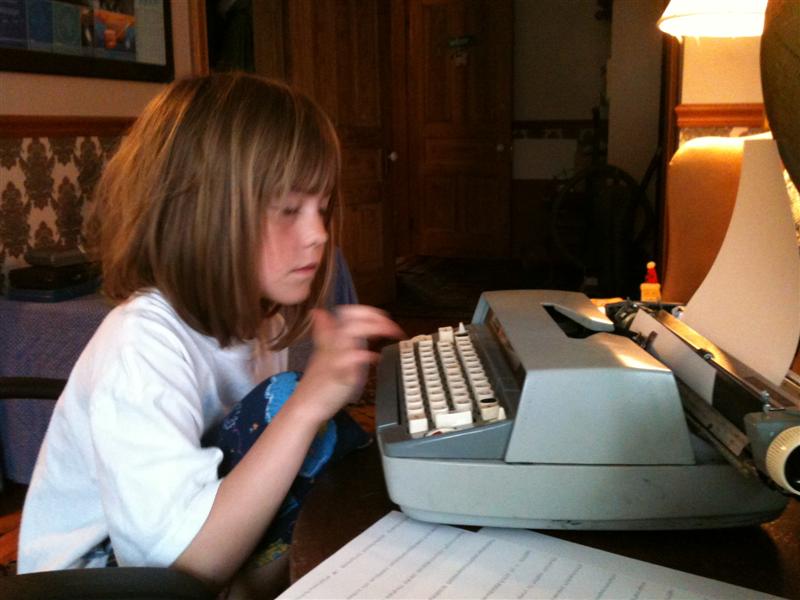
Young writer at work.
Some novels by the web log editor:
Not one. Not yet, anyway. Working on it.
Disclaimer: any errors are mine. Somebody has to own them.
Filed under Glenn Meade, Knoxville Writers' Guild, writer, writing, writing tip
Sky

Sky and clouds at sunset
Sky sings of circles.
Sun and moon dance politely.
Clouds clap another tune.
The blathering idiot has questions
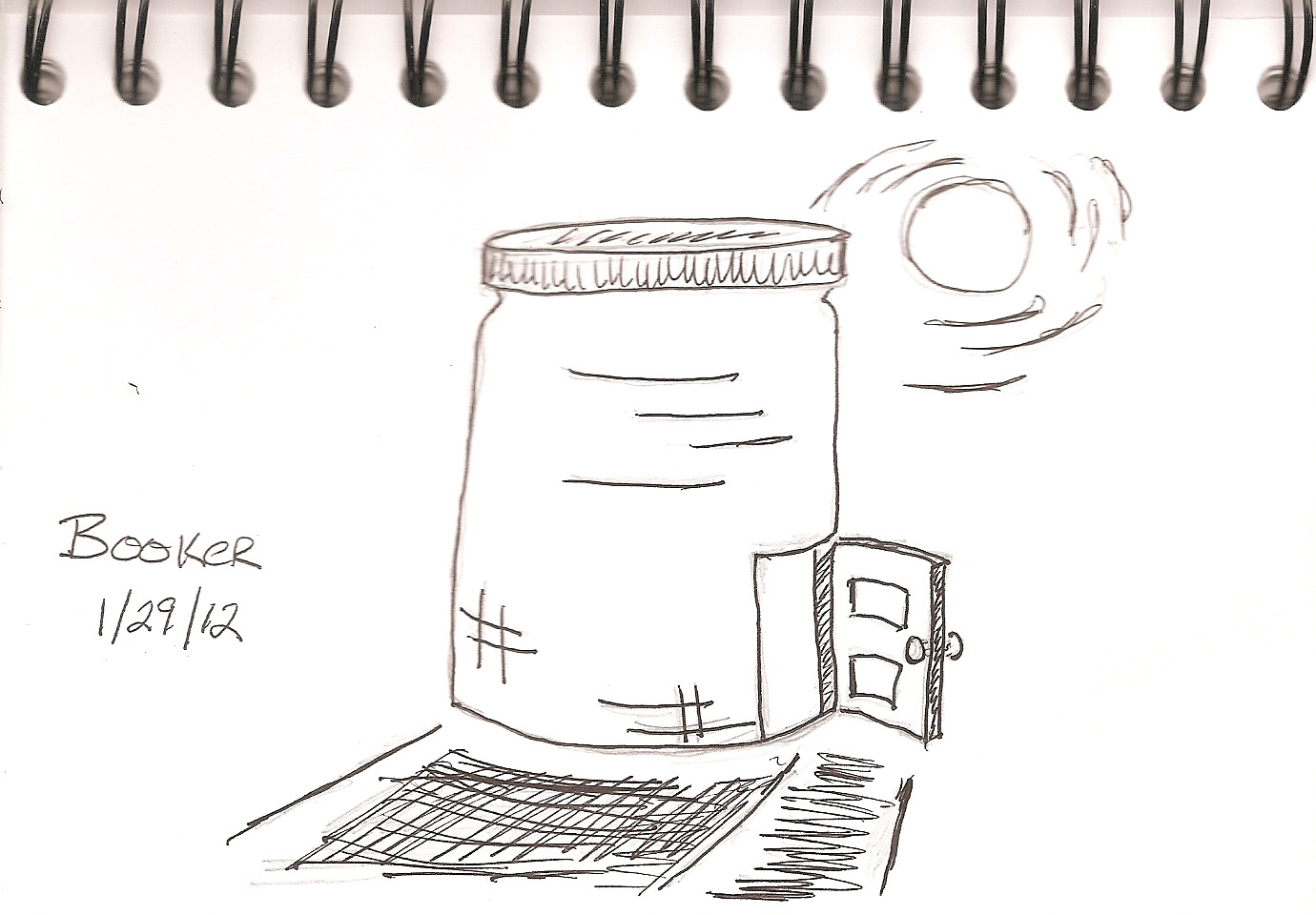
How can a door be a jar?
Just the other day, the blathering idiot had some time to kill, though he wasn’t sure it was alive to begin with, and while pondering the philosophical depths of life, came across questions for which he could not find answers. Below are a few of them.
How can a door be ajar?
How come left behind means you’ve lost it, but right behind means it is still with you?
How come you can be told to sit down and shut up, but never sit up and shut down?
How come you can give a nod, but never take one?
How come when you are taking a bow, you are giving it to somebody else?
How come a house warming doesn’t involve starting a fire?
How come you can give somebody the shirt off your back, but you have to beat the pants off him?
How come politicians run for office, but stand for re-election?
Found story: Santa takes on extra work

Santa hit man bounty hunter
Finding work in the off season hard to come by, Santa takes a job as a bounty hunter and hit man. Using his naughty list, he tracks down the not-so-nice folks and brings them to justice or brings them down.
Filed under Found story, humor, neighborhood, photo, photograph, Santa Claus, villains


