Epic fight to put awesome in its place

http://www.latimes.com/news/local/la-me-holland-20120106,0,2183189.column

Trying to drive a stake through a conversational staple

British-born poet and journalist John Tottenham says that saying ‘awesome’ in his presence is like ‘waving a crucifix in a vampire’s face.’

Gale Holland, Los Angeles Times

January 6, 2012

“Awesome,” according to one dictionary of slang, is “something Americans use to describe everything.”

The linguistic overkill horrifies John Tottenham. So the British-born L.A. poet, painter and journalist has launched what he calls the Campaign to Stamp Out Awesome, or CPSOA.

“Saying the word in my presence is like waving a crucifix in a vampire’s face,” Tottenham says. “It’s boiled down to one catchall superlative that’s completely meaningless.”

I met with Tottenham last week at CSPOA headquarters inside Stories, the Echo Park bookstore he is trying to turn into the world’s first awesome-free zone. “Ground zero for a quiet revolution,” Tottenham calls the cafe and shop, where he has a day job. The group’s manifesto is posted at the counter, and no-awesome stickers with the usual diagonal slash are on sale, with T-shirts to follow, Tottenham said.

“It’s a matter of semantic satiation,” Tottenham told me. “Sometimes I’m sitting in a crowd and I hold my breath until someone says it. Seldom do I die of asphyxiation as a result.”

There’s no arguing with Tottenham’s premise that “awesome” is seen and heard everywhere, from the sign on the tchotchke aisle at the 99-cent store to the lips of supermarket cashiers. UC Santa Barbara linguist Mary Bucholtz says that from its dusky origins, perhaps in 1970s surfer slang, it’s spread to Australia and English-speaking India.

But Tottenham failed to convince me it’s a bad thing. What’s wrong with bathing everything in the sunny light of superlativity? I asked him.

I admire the “awesome” generation’s ability to talk at all with only a few words at its disposal.

The economy of expression is poetic, I argued. The conversations go like this:

Caller 1: Dude?

Caller 2: Dude.

Caller 1: Whadup?

Caller 2: Chillin.

Caller 1: Awesome. Want to kick it?

Caller 2: I’m down.

Caller 1: Now?

Caller 2: Awesome. I’m out.

Caller 1: Peace.

Somewhere, DEA agents are holed up in a hotel room listening to this for hours on end and going out of their minds.

But there’s a subtle genius in language that has been wiped clean of almost all content. Nobody has to risk expressing a real thought or sentiment. Bland affirmation is an impenetrable defense. No one can object. As Syme, the language specialist in charge of shrinking the dictionary in George Orwell’s dystopian novel “1984” put it, “It’s a beautiful thing, the destruction of words.”

Tottenham was having none of it.

“The bogus sense of positivity has a demoralizing effect,” he said. “People resent it if you don’t say you’re doing great.”

Bucholtz, the linguist, pointed out that every generation thinks the next one is wrecking the English language. Tottenham, an old punk rocker who fled dreary old England for the Wild West, gave that point some consideration. But in the end, he rejected it.

“I hated it when I was young, ” Tottenham said. “It is the most irritating word.”

Tottenham said his linguistic cleansing movement has mostly been embraced, at least within “the two-block radius of Echo Park where I am a minor celebrity.” One Stories customer bristled when he tried to get her to honor the awesome ban, though.

“But I’m from California,” she said. “I can’t help it.”

As we chatted, a man in a cowboy shirt came up to congratulate Tottenham on his recent performance of an anti-awesome screed at a local gallery.

“That was awesome,” the man said, grinning widely.

Tottenham smiled back sourly.

“I know I’m setting myself up as a target to be churlishly bombarded by people who use the word to irritate me,” Tottenham said. “People who know about the campaign and want to further express their lack of verbal ingenuity….They do it because they think it’s witty, which it isn’t.”

“But I’m willing to take it on the nose in an honorable cause,” he said.

Tottenham already is looking toward other cliches to conquer.

“Other words will be addressed once we get rid of awesome,” Tottenham promises. “‘It’s all good.’ That’s definitely crying out to be done.”

But as with all social engineering movements, Tottenham has hit unexpected obstacles. As we chatted, we walked to a nearby cafe that had posted his no-awesome sticker in the window. The waitress stopped by to say the restaurant had been forced to take the sign down.

“The staff vetoed it,” she said. “They’re afraid people are going to think the restaurant is not awesome.”

gale.holland@latimes.com

Copyright © 2012, Los Angeles Times

[Blog editor’s note: The title of this blog entry is mine, and is done a bit tongue-in-cheek. I approve this poet’s efforts, as all writers should. Poor and inadequate as they are at times, words are all we have to build our stories, poems, essays, novels, and other word constructs for examining life and who we are. Words are our tools and they deserve our respect.]
1 Comment

Filed under awesome, words, writer, writing, writing tip

The Devil’s Dictionary: Politics, Politicians, and PACs

Every now and then, it is good to revisit a classic, or even a curiosity from the past. The Devil’s Dictionary by Ambrose Bierce was originally published in newspaper installments from 1881 until 1906. You might be surprised how current many of the entries are.

For example, here is a definition for the words politics and politician. The Old definitions are Bierce’s. The New definition is mine. From time to time, just as it was originally published, we will come back to The Devil’s Dictionary, for a look at it then and how it applies today. Click on Devil’s Dictionary in the tags below to bring up the other entries.

Old definition
Politics, n. A strife of interests masquerading as a contest of principles. The conduct of public affairs for private advantage.

Politician, n. An eel in the fundamental mud upon which the superstructure of organized society is reared. When he wriggles, he mistakes the agitation of his tail for the trembling of the edifice. As compared with the statesman, he suffers the disadvantage of being alive.

New definition
There is no need to update these old definitions. But to them, one could add (since they did not exist in Bierce’s time) these two words:

PAC, n. a gathering of money and people, like wolves, in pursuit of political prey to tear apart in the conduct of public affairs for private advantage. Unlike wolves, they don’t have to carry any sort of coloration to identify themselves. They have no natural enemies to keep them in check.

Super-PAC, n. an even larger gathering of a PAC. Bent on complete destruction in the name of conducting public affairs for private advantage. They have no natural enemies to keep them in check. One can only hope for a sufficiently large enough political meteor to crash into politics and kill them.

Leave a comment

Filed under Ambrose Bierce, Devil's Dictionary, political humor, politicians, politics, rocket scientist

New Year’s thoughts from the blathering idiot

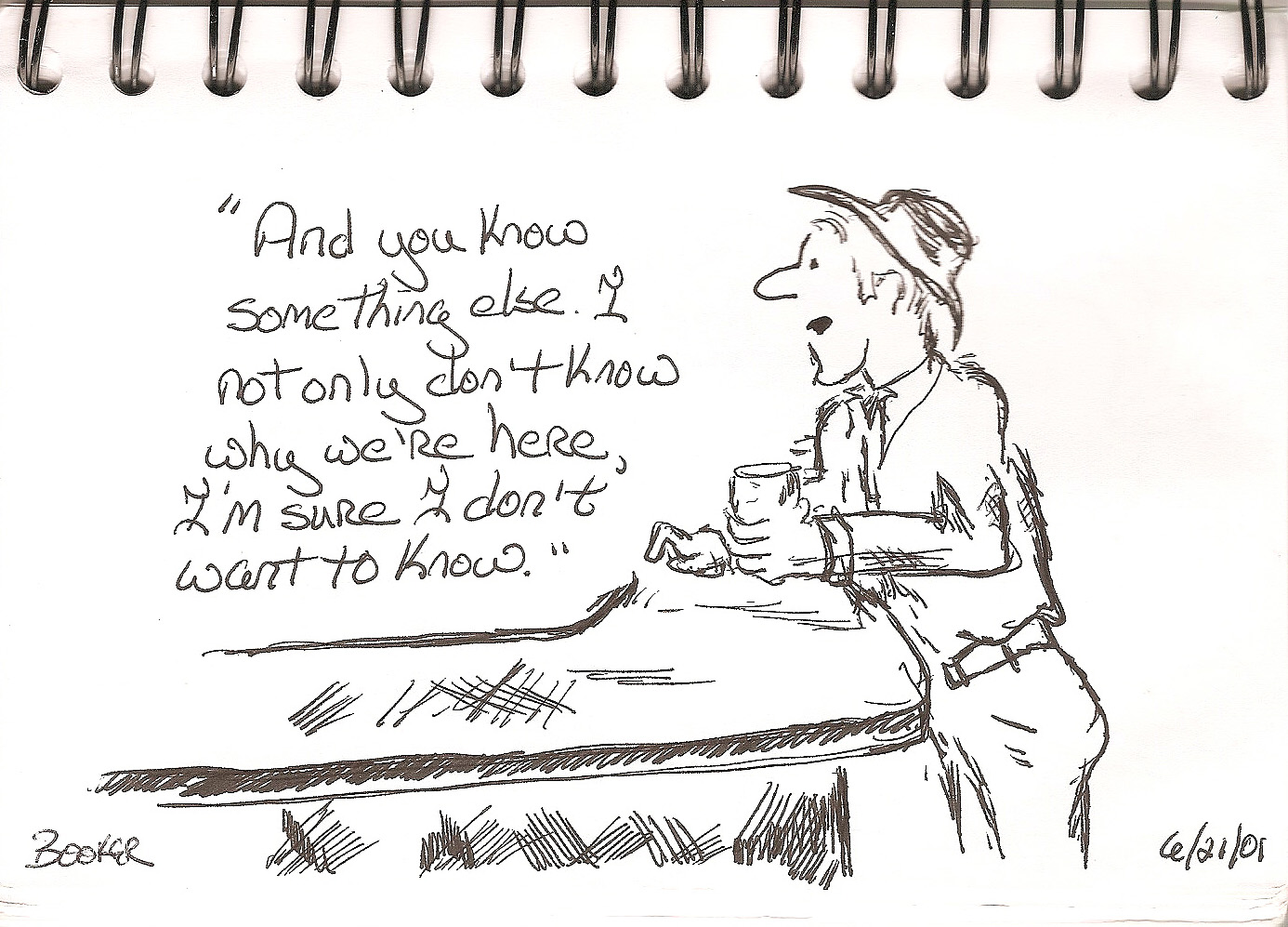
Blathering Idiot and why we are here

Don't know; don't want to know

If the universe was made for me, why doesn’t it fit better?

Or

If I was made for the universe, why do I feel like I was made from all the second-rate spare parts?

Leave a comment

Filed under blathering idiot, Cartoon, fun, humor, the universe, word play

Writer’s Block

Writer’s Block, n.: The place where a writer lives with his/her imaginary friends. Something like the neighborhood of make believe.

4 Comments

Filed under block, word play, writer, Writer's Block, writing, writing tip

Best writing advice you’ve received?

Below is some writing advice gathered by Chip MacGregor of MacGregor Literary. The listing below is from his blog. Website for the agency is http://macgregorliterary.com/.

http://chipmacgregor.typepad.com/main/2011/12/whats-the-best-writing-advice-you-ever-got-.html

December 30, 2011

What’s the best writing advice you ever got?

I’ve had several people write to share the best writing advice they’ve ever received.

Vince Zandri, who has done numerous novels and sold more than a quarter million books, wrote to me and said, “The best writing advice I ever got came from Ernest Hemingway in the form of his memoir, A Moveable Feast. If writers are worried about one thing, it’s the ability to keep a story moving from day to day. To avoid the ‘block,’ as some people call it. Papa wrote slowly and methodically in the early morning hours, and trained himself to stop at a point where he knew what was going to happen next. That way he could be sure of getting started the next day — and it left him the afternoons to play, exercise, fish, drink, or do whatever he wanted.”

Successful nonfiction writer Mel Lawrenz wrote to say, “The best advice? Take the long view. See the long process of publishing as an advantage — the stages of writing, editing, rewriting, and revising make for a more refined end product. Don’t miss the opportunity to rethink what you originally wrote.”

Harlequin author Dana Mentink sent this: “The best writing advice I got as a pre-pubbed author was that I should act like a professional. My mentor encouraged me to treat my writing like a business, not a hobby. Put in the hours, describe yourself to others as a writer, and really put yourself into the mindset of a professional. She explained to me that there’s a big difference between ‘I want to write a book’ and ‘I want to be an author.’ The latter requires professional dedication.”

Children’s author Kayleen Reusser noted, “Believe in yourself, even if no one else does. At my beginning I was the only one who believed I could write and get published. Even my mother told me I could not write — no money, no time, three small children to care for. But I swore I would die trying. (Thank goodness it has not come to that.)”

And novelist Dianne Price wrote to say, “Know your characters. LIve with them. Talk to them. Listen to their words and the cadence of their speech. Make them your constant companions. Argue with them. Commiserate with them. Ask them questions. You must know them to make them believable.”

What about you? What’s the best writing advice you’ve ever heard?

4 Comments

Filed under advice, agents, writing, writing tip

Parting shot: Mary Christmas

Mary Christmas

Mary Christmas, wherever you are.

Let us Harold in a New Year.

Commentary: in case you are wondering, this is an actual sign in the small city where I live. I could not win a spelling bee if thrown into one, but I do know that Merry can be Mary, and Mary Christmas could be the name of somebody, but usually it Merry before Christmas, and maybe after Christmas, too. I also know we all have our crosses to bare, and some of them can be more of a bear than others, but sometimes we bare our crosses in ways that might make Mary merry, especially with Harold around. Here’s hoping we can all find a dictionary in 2012 when we need one.

Leave a comment

Filed under 2012, Christmas, humor, New Year, puns, word play, words

Some things to do to celebrate the New Year

Bringing in the New Year

Some suggestions for bringing in the New Year

If you don’t already have plans, or looking for ways to try something new as the hour approaches midnight, consider these:

Japan: Omisko, New Year’s Eve, has been celebrated for several centuries, often with the ringing of a bell 108 times. This symbolizes repenting for each of the 108 bonno (moral desires) identified in Buddhism. (I didn’t know I had that many.)

Russia: In Moscow and probably other cities, many folks spend the final moments of the old year in silence. They write down wishes for the new year, burn them, pour the ashes into a wine glass, pour champagne in the glass, then drink the ash-infused wine, ensuring the wishes will come true. Bottoms up!

And if that is not enough of the grape for you, you can, as they do in Spain, eat twelve (12) grapes at midnight, one for each chime of the clock. This is supposed to bring good luck to each month of the coming year. There might still be time to go out and buy some grapes.

Then, when done with all your celebrating, be a mad Dane and take your plates to the homes of the people your love and break your dishes in their lawns. For full effect, you can recite some of Hamlet’s soliloquy: “To be a (broken dish) or not to be (a broken dish), that is the question….” Despite the apparent madness of this gesture, if you wake up and find a lot of broken dishes on your lawn, it is, in Denmark, a sign that you have many friends, or at least people who don’t want to do their dishes. This is, of course, hard to do with paper and plastic plates. But instead maybe you can set fire to them, after you write wishes on the bottoms, then drink to your friends’ health, and leave the empty plastic wine glass on their lawns. Toss in a dozen grapes for good measure, ring a bell 108 times outside their bedroom windows, and you might have all the bases covered for a wonder-filled 2012. After all, that’s the American Way.

Happy New Year!

2 Comments

Filed under 2012, celebration, humor, New Year

Literary resolutions

I pass these along, found on line in an article at the LA Times web site. I don’t generally make resolutions. In fact, the last resolution I made was to not make any resolutions, and thus far I have managed to keep that one. But for those who do, you might find some inspiration here.

Happy New Year Couple

Counting down the minutes to a new year of resolutions


Pen up.

Keyboards clacking.

Steady as she goes.

Happy New Year.

http://latimesblogs.latimes.com/jacketcopy/2011/12/25-literary-resolutions-for-2012.html

When 2012 arrives this weekend, there will be resolutions aplenty. Diets! Exercise! Get organized! Figure out Google+! Quit smoking! Jacket Copy asked
writers, editors and publishers what their literary resolutions will be. Join them and tell us yours.

Ben Ehrenreich, author of the novel “Ether” and winner of a 2011 National Magazine Award for his article “The End”: That’s an easy one: write, write, write and write some more.

Richard Lange, author of the 2013 novel “Gather Darkness” (Mulholland): I’m going to reread “Moby-Dick,” “Crime & Punishment,” and “The Scarlet Letter.” Every time I go back to books that I loved as a kid, I learn more about myself as a writer now.

Dana Spiotta, author of the novel “Stone Arabia”: I have many books I want to read this year. For example, I have this inviting stack of Hollywood biographies and memoirs: “Rosebud” by David Thomson, “Frank: The Voice” by James Kaplan, “Run-through” by John Houseman, “Memo” by David O. Selznick, “A Girl Like I” by Anita Loos, and “Vanity Will Get You Somewhere: An Autobiography” by Joseph Cotten.

Antoine Wilson, author of the 2012 novel “Panorama City” (Houghton Mifflin Harcourt): For 2012, I expect to be doing more interacting with strangers, thanks to the new book coming out, so my resolution is simple: To be able to clearly and concisely answer the following question: “What are you reading?” Jervey Tervalon, author of “Serving Monster” and founder of Literature for Life: Start working on a new novel that will amuse and consume me; and I will not allow myself, not even for a second, to dwell on the bleakness of the publishing industry.

Elizabeth Crane, author of the 2012 novel “We Only Know So Much” (HarperPerennial): I don’t know if this is exactly literary, but the only real resolution I’m considering, which I haven’t etched in stone yet, is to give up watching entertainment shows (ET, etc). This might or might not help my writing, if only insofar as it will free up an hour of my life every day, but the hope is that it will help my celebrities-and-celebrity-news-makes-me-want-to-pull-my-hair-out problem.

Rachel Kushner, author “Telex from Cuba,” a National Book Award finalist: This year I am inspired by my friend Marisa Silver’s resolution from last year, which was no internet (except e-mail and occasionally facebook). My resolution is exactly that. Perhaps that’s bookish, in that it might create more time in which actual books can be read. I feel better already, sensing the loss of this convenient form of self-sabotage–of time. Time is of a premium. I don’t want to waste any. I have a feeling I will miss out on very little without the internet. Whatever it is, if it’s important enough it will find me.

Marisa Silver, author of the short story collection “Alone With You”: Read more poetry. Use fewer commas.

Evan Ratliff, founding editor of the multimedia iPad magazine The Atavist: I’m not a big resolution maker, but I would say on the literary front mine is pretty simple and obvious. It’s building on something I started late this year, which is to carve out specific, disconnected, undistracted time to read every day. Sometimes it’s sitting outside with a paperback, having left the phone and all other devices back at the office. Sometimes it’s actually reading a book on the phone (as you might imagine, I’m a big fan of reading books on the phone!), but having turned off all the phone’s connections. It’s like exercise, for me: The whole day gets better if I set aside the time for it. And as much as I love reading digital texts, it’s not the same if I stop three times in the middle to deal with some seemingly-urgent-but-not-really email.

Elissa Schappell, author of the short story collection “Blueprints for Building Better Girls”: It’s the Russians. It’s always the Russians. Oh yes, I’ll read the Russians in the summer months. Two summers ago, I developed such a bad case of Tolstoy’s elbow from hauling around “War and Peace” I could barely flip through a magazine. The summer before “Crime and Punishment” doubled as a drinks tray at a lawn party, and when I got spooked staying alone at a friend’s summer house, I kept it by the door as a weapon. This year, however I’m more hopeful–I’m starting, more appropriately, in winter. Beginning tomorrow I’m going to make “Anna Karenina” my new BFF.

James Hannaham, author of the novel “God Says No”: This year I want to figure out why, when an author says the phrase “working on a story collection,” as in “I’m working on a story collection,” everyone in publishing reacts as if they have instead heard the phrase “molesting several children.” And I will continue to pray for the demise of e-books, or at least the demise of the stupid fear that they will replace printed books.

Ben Greenman, author of the short story collection “What He’s Poised to Do”: I want to reread all the Emily Dickinson poems, in order, at a slow enough rate that I understand them but a fast enough rate to keep it exciting. It’s not as easy at it sounds. And I also plan to think about why, in a time of reduced attention spans, short stories aren’t getting more traction.

Mark Haskell Smith, author of the 2012 nonfiction book “Heart of Dankness: Underground Botanists, Outlaw Farmers, and the Race to the Cannibas Cup” (Broadway): For 2012 I owe my editor a novel, so I’ll be working on that.

Patrick deWitt, author of the novel “The Sisters Brothers,” a 2011 Booker Prize finalist: My resolution is to further distance myself from the internet, and to use the time I would have spent re-re-rewatching that “screwing/puking dogs” GIF reading and writing.

Rob Spillman, editor of the literary magazine Tin House: Since I read contemporary work constantly for work, my resolution is to continue my recent streak of reading great older work that I missed or glossed over in my youth. I’m about to finish “House of Mirth,” which I can’t believe I never read before. Next up is “Moby-Dick,” which I half-read when I was twenty. On the horizon Waugh and more Wharton.

Janelle Brown, author of the novel “This is Where We Live”: Write a rough draft of a new novel. No pressure.

Johnny Temple, publisher of Akashic Books: 2012 marks the 50-year anniversary of the independence of both Jamaica and Trinidad & Tobago (both former British colonies), so my resolution for the coming year is to celebrate Caribbean-inspired independence.

Emma Straub, bookseller and author of the short-story collection “Other People We Married”: I think 2012 is going to be my year for one of the giant masterpieces: Anthony Powell’s “Dance to the Music of Time,” maybe, or Proust. Also, since no one answered my call for help and bought me all the NYRB classics in 2011, that resolution will have to shift onto the coming year.

Laila Lalami, author of the novel “Secret Son”: For the last couple of years, I’ve been working on my new novel and have been reading almost exclusively fiction and nonfiction that’s relevant to it in in some way. In 2012, I’d like to read some new fiction!

Chad Post, editor of Open Letter Books: In 2012, I’m going to read a ton of really long books. I’m going to start with Murakami’s “1Q84,” but also want to read Nadas’ “Parallel Lives,” the new translation of “War and Peace,” the whole Javier Marias “Your Face Tomorrow” trilogy, maybe “Bleak House” in honor of Dickens’ 200th birthday, and Pynchon’s “Against the Day” (the only book of his I have yet to finish). I feel like I’ve been putting off so many of these books for so long, because they’ll “take too long” to read. That’s ridiculous, and in a way, I think this little project will be a nice antidote to my normal state of being all ADD and jumping from one article or novella to the next.

Ned Vizzini, television writer and author of the young adult novel “It’s Kind of a Funny Story”: For 2012 I resolve to read 10 books for no other reason than because I want to — books (1) by people I don’t know (2) that I am not reviewing (3) that do not have any potential for film or TV.

Pamela Ribon, screenwriter and author of the 2012 novel “You Take It From Here” (Gallery Books): In 2012I resolve to get new curtains, because I believe my neighbors (and various passersby on the street) are watching me whenever I’m playing my XBox Kinect workout. The other day I’m pretty sure I saw one of them with a bowl of popcorn.

Tod Goldberg, director of the creative writing MFA program at UC Riverside, Palm Desert, and author of the short-story collection “Where You Lived,” resolved: My only real literary resolution for 2012 is to finish my new novel, which I then hope Salman Rushdie will read, on his Kindle.

Saïd Sayrafiezadeh, author of the memoir “When Skateboards Will Be Free”: Stop looking at so much porn.

Colin Robinson, co-publisher OR Books, which has just published “Occupying Wall Street: The Inside Story of an Action That Changed America”: My resolution for 2012 is for OR Books to develop further direct relationships with those who want to read our titles so as to bypass corporate retailers whose only significant role in the publishing process is taking all the money. Oh, and also to publish some great books.

Leave a comment

Filed under 2012, literary, literary resolutions, resolution, writing, writing tip

The Devil’s Dictionary: Trust

Every now and then, it is good to revisit a classic, or even a curiosity from the past. The Devil’s Dictionary by Ambrose Bierce was originally published in newspaper installments from 1881 until 1906. You might be surprised how current many of the entries are.

For example, here is a definition for the word abasement. The first definition is Bierce’s. The second one is mine. From time to time, just as it was originally published, we will come back to The Devil’s Dictionary, for a look at it then and how it applies today. Click on Devil’s Dictionary in the tags below to bring up the other entries.

Old definition
Trust, n. In American politics, a large corporation composed in greater part of thrifty working men, widows of small means, orphans in the care of guardians and the courts, with many similar malefactors and public enemies.

Updated definition
Trust, n. In American politics, trust is that which is used to cover up what the “truth” won’t hide. For example, U.S. Senators and Representatives who beat the drum and say don’t trust the government, but do trust them. Truth is, once elected, they are the government and very few want to leave, even those crying out for smaller government. Along the way, they wish to create widows and retirees of small means, orphans in the care of of somebody else, and similar malefactor and public enemies, such as the ever shrinking middle class.

Leave a comment

Filed under Ambrose Bierce, Definition, Devil's Dictionary, humor, satire

A modest proposal

First, the news:

Gov. Bill Haslam, Beth Harwell hesitant on drug-testing proposal

http://www.knoxnews.com/news/2011/dec/27/gov-bill-haslam-beth-harwell-hesitant-drug-testing/

Tennessee legislature Senate Speaker Ron Ramsey says he expects lawmakers will pass a bill requiring drug tests for Tennesseans who get government assistance or workers’ compensation.

Other high-ranking Republicans aren’t so confident.

Ramsey recently told the Nashville Chamber of Commerce that a similar proposal last legislative session carried a $12 million price tag but didn’t take into account the savings from cutting off benefits to drug users.

House Speaker Beth Harwell says that while she agrees with the aim of the drug-testing proposal, the state’s top priority is balancing its budget.

Gov. Bill Haslam has raised questions about whether the federal government’s rules for the benefits programs give the state enough flexibility to start drug-testing recipients.

Now, a bit of older news:

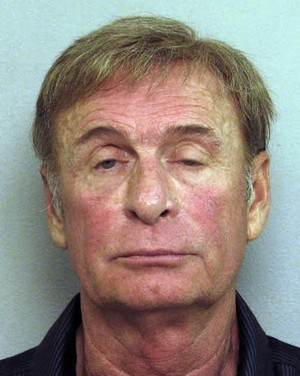
Would you trust this man?

Tennessee state representative mug shot

Would you trust this man?

Would you trust this man with a handgun?

Would you trust him if you knew he was an ex-Memphis police officer?

Would you trust him if you knew he was an ex-police officer with a .38-caliber handgun tucked between the driver’s seat and console of his SUV?

Would you trust him if you knew he refused to take a Breathalyzer test, after being stopped by Nashville police officers for driving 60 miles per hour in a 40 mph zone and weaving across the double yellow lines on a street near Vanderbilt University?

Would you trust him if you knew he was Tennessee state Representative, Republican from Collierville?

Would you trust him if you knew he was the House sponsor of the bill (later mad law) allowing handguns in bars?

If so, Curry Todd, the man in photo, is the person you would trust.

Your tax dollars at work.

It will be interesting see how the state Republicans protect one of their own who to the serve part of the motto “to Protect and Serve” to mean how many drinks he could serve himself and still drive.

Sources:
www.knoxnews.com/news/2011/oct/12/lawmaker-arrested-on-drunken-driving-gun-charges/

www.knoxnews.com/news/2011/oct/12/sponsor-of-tennessee-guns-in-bars-bill-charged/

Modest proposal

Given the existence of a possible drug problem within the Tennessee State legislature and since public officials are receiving public assistance, too, I propose that if they pass this law that the legislature have the moral rectitude to include themselves in the testing as well. And that any representative, senator, or governor that turns up with a positive drug test, including excessive use of alcohol, be automatically kicked out of office and that all pay and benefits end immediately. Furthermore, any state politician who has retired from office and is receiving any money or benefits from the state of Tennessee should also be subjected to this testing, with the same consequences. Furthermore, any positive results should be turned over to the proper authorities for potential criminal prosecution.

What do you think the chances of that are?

1 Comment

Filed under GOP, government, political humor, politicians, politics, Republicans, satire, state government