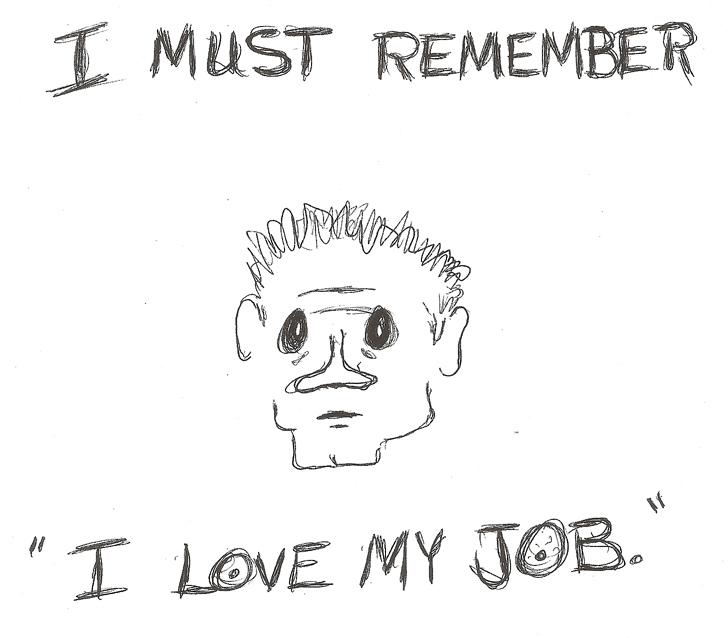
Another one for the bucket list.
Another one for the bucket list.
Filed under cartoon by author, CarToonsday, window
There once was a man named Zuckerberg
for whom listening to people seemed quite absurd.
So he took the word “face”
stuck it out in virtual space
and added “book,” because he was such a nerd.
Filed under limerick, poem, poetry by author

Critics are everywhere.
One reason the human race has such a low opinion of itself is that it gets so much of its wisdom from writers. –Wilfrid Sheed
All writing is garbage. People who come out of nowhere to try to put into words any part of what goes on in their minds are pigs. –Antonin Artaud
The noted writer Theodore Sturgeon was once asked why so much of science fiction writing was “crap.” He paused for a moment, nodded, and said, yes, 90 percent of science fiction was crap, but that “90 percent of everything is crap.” This is known as Sturgeon’s Law, and is just as true today as it was in the early 1950s when he first pronounced it.
Same is true for critics of writers and writing.
[Errata: I had originally and erroneously attributed this to Robert Heinlein, another noted writer of such classics as Stranger in a Strange Land. My apologies and thank to Tom Dupree for pointing out my error. It is good to have smarter readers dropping by to read your blog posts. May we all be so fortunate. Thank you to all who stop by, read, like, and comment. It is one of the advantages of this blog format. Thank you all. –Editor]
Filed under cartoon by author, no respect, writer
So many puddles. /
Each rain drop muddles the world. /
Liquid, dark mirror.
[Editor’s note: This Haiku was a response to one found on another blog. However, when I reblogged the original and my response. Neither one came out very well. Seems the reblogging technology doesn’t comprehend haiku. Anyway, here is my haiku.]
This haiku inspired a response from me.
So many puddles.
Each rain drop muddles the world.
Liquid, dark mirror.
Filed under Uncategorized
In our continuing quest to revisit a classic, or even a curiosity from the past and see how relevant it is, we continue with The Devil’s Dictionary by Ambrose Bierce. Originally published in newspaper installments from 1881 until 1906. You might be surprised how current many of the entries are.
For example, here is a definition for the words Conservative and Republican, which have become synonymous. The Old definitions are Bierce’s. The New definition is mine or somebody else contemporary. From time to time, just as it was originally published, we will come back to The Devil’s Dictionary, for a look at it then and how it applies today. Click on Devil’s Dictionary in the tags below to bring up the other entries.
OLD DEFINITION
Conservative, n. A statesman who is enamored of existing evils, as distinguished from the Liberal, who wishes to replace them with others.
NEW DEFINITION
Conservative, n. I don’t think anything has changed since Bierce first defined conservative as he did, and little can be done to improve on it, other than to say that Conservative and Republican have become so interconnected in U.S. politics as to become two wings of the same buzzard. See Republican(s).
Republicans, n. Republicans are the party that says government doesn’t work, and then they get elected and prove it. –P.J. O’Rourke
In this world of sin and sorrow there is always something to be thankful for; as for me, I rejoice that I am not a Republican. –H.L. Mencken
Final thoughts:
So, here we have a political party (Republican) that purports to be the party of Conservative, heterosexual, bedrock social/Christian values, in which in Tennessee, in the county of Knox a commissioner stands (an obviously appropriate word in this case) accused of indecent exposure with another man for lewd behavior; a former Knox County mayor gets a divorce because of an alleged affair — and maybe more than one. (At least he waited until toward the end of his time in office to get divorced.); a current Knox County mayor is getting a divorce (at the start of his administration and only four years after saying “I do.”); a Tennessee state representative and a former police officer gets arrested for driving drunk in Nashville, TN, with a loaded gun in his front seat; another Tennessee state representative carves her initials in her publicly owned seat in the state capital, dresses down a Tennessee Highway Patrol Officer for a ticket she got for speeding, and has “interesting” photos of herself on the Internet; a Tennessee state senator uses bogus science and bullying logic to advance a biased personal agenda, and when challenged claims he’s being discriminated against; a national presidential candidate has more affairs than another national presidential candidate has had wives (and that takes a little doing); and that same multi-wife presidential candidate’s current wife has a debt at Tiffany’s over 5 times (and maybe even 10 times) larger than the yearly average American family household income. So with all this moral rectitude and personal frugalness coming from the political party (Republican) claiming to defend Conservative, heterosexual, bedrock social/Christian values, what I want to know is this: When did Peyton Place become a family value?
Filed under Ambrose Bierce, Conservative, Devil's Dictionary, Republicans, satire

Why was the sign on the ground in front of the church and written on upside down?
Was Jesus mad?
Is that why the sign was on the ground in front of the church?
Were there not enough Christ Centered poses? Or did somebody in the church think Buddha was sneaking in to take over the bodies and then the souls of the yoga students?
But why was it written upside down on the white board to begin with? Was it done on purpose by the instructor or was it the work of Satan, who wanted the yoga session all to himself?
Filed under Found story, Jesus
by David E. Booker
1) It’s not conversation. In his book, On Writing: Advice to Those Who Write to Publish (Or Would Like to), George V. Higgins, known for his dialogue, advises developing an ear for dialogue, but that dialogue in stories is not simply conversation lifted from daily life and dropped into a story.
Normal speech is full of too many “uhs, ahs, and other sounds that are verbal place holders and don’t really have any place in fictional dialogue. Also, normal speech is full of “small talk.” Things like, “Hi, how are you? How’s the husband and kids? It sure looks like the team will have a good season this year.” All things meant to keep the lines of communication open, psychologists might say, but are of little use in furthering your story. In short, good dialogue moves the story forward. Asking about the family or saying the team will have a good year only keeps the story in place.
A corollary to this is the “As you know, Fred” dialogue, which is dialogue between two people who know the information being conveyed, but they are conveying it, anyway, for the sake of the reader, who doesn’t know. Science fiction can many times be guilty of this when two scientists of the same discipline, say particle physics, “converse” with each other about what a particle is.
2) It’s often what you don’t say. Subtext is the hidden force of any scene of a story or movie. As the noted script writer and teacher, Robert McKee says, “If a scene is about what a scene is about, then the scene is dead.”

Often, good dialogue is about what isn’t being said.
3) It’s okay to only use “said” and “asked.” Many writers learning their craft try to spice up a scene by having their characters express their dialogue with: he espoused, she guffawed, he trumpeted, she queried, etc. This will only slow down a scene. It should be: he said, or he asked, if it is a question. One exception might be: she yelled. But other than these, if the scene does not convey the right intensity with which your characters should be speaking, then there is something amiss in the scene, and it won’t be fixed by exchanging “she said” for “she espoused.”
In fact there are some writers, such as the late Robert B. Parker, who use only “he said” or “she said,” even where there was a question. He figured the use of the question mark at the end of the spoken sentence was clue enough.
And please note, by saying “he” or “she,” I am not saying never use the speaker’s name. particularly when somebody is speaking for the first time in a scene, it is often recommended that the text read, “Bob said” or “Alice asked.”
There are certainly other suggestions for creating good dialogue, but mastering these three will put you on your way to having dialogue that moves the story forward and adds a good boast to your writing.
Filed under article by author, dialogue, writing tip, Writing Tip Wednesday
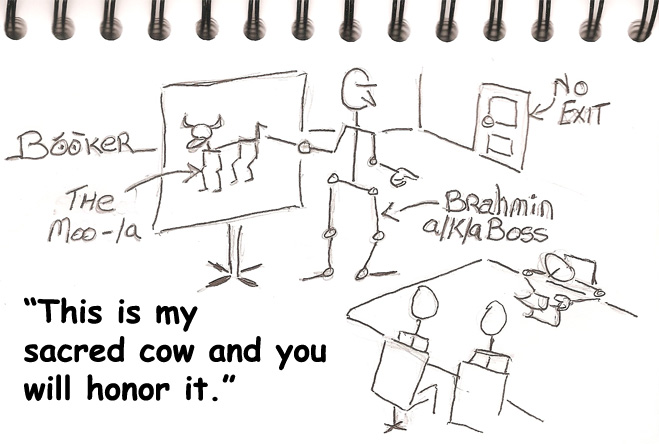
Sacred cow meeting notes: Sartre never attended a bored meeting.
In a meeting.
In a life.
Full of woe.
Full of strife.
Full of things
I do not know.
Not sure yet
which way to go.
In a meeting.
In a life.
Full of woe.
Full of strife.
Full of dimwits,
Full of “fun,”
I cannot wait
’til this day’s done.
In a meeting.
In a life.
Full of woe.
Full of strife.
But no angels
can save me now.
Nor a Brahmin,
nor sacred cow.
In a meeting.
In a life.
Full of woe.
Full of strife.
Come what may,
come what might,
this is my
gas inducing plight.
Filed under cartoon by author, Drawing conclusions, poetry by author