Photo finish Friday: “Molar, molar”

A neighborhood child asked to pose for a photo before going to his first day of first grade, decided to “Jaws” the camera as his mother, in vain, attempted to capture his good side. But, wait, maybe she did.

by DAVID E. BOOKER

Molar, molar
will destroy ya.
Eat your toys
I will annoy ya.
Molar, molar
I’m your boy, yo
Cast you about
to and fro, yo.
Molar, molar
where’d you go? Oh
I ate a fat crow
and now you know, oh
little’s bros a go
for eattin’ so slow, oh.
Molar, molar
will destroy ya.

Leave a comment

Filed under Photo Finish Friday, poetry by author

Haiku to you Thursday: “Tuesday”

If Tuesday were my /

lover, I’d breathe deep its scents, /

imbibing moments.

Leave a comment

Filed under Haiku to You Thursday, poetry by author

Writing tip Wednesday: “Perfection Sucks”

Save it for the angels.

Save it for the angels.

By DAVID E. BOOKER

Don’t get slowed down by the idea, notion, goal, belief that what you write has to be perfect. Perfection is an illusion and a way to subjectively enthrall yourself to a writer’s block from which you will never be free. That doesn’t mean you shouldn’t be working to improve your writing talent and skills. It just means that you can expend a nearly infinite amount of time and energy getting your story, poem, essay, novel, article perfect and never be there.

Here are three things to remember if you feel you have to have it perfect before you go on.

1) No matter how perfect your writing is, you may still face rejection. For example, Zen and the Art of Motorcycle Maintenance was turned down 121 times. In other words, perfect does not guarantee publication.

2) Study long, study wrong. Many years ago when my father was teaching me to play cribbage, if I took too long to decide which card to play next, he would say, “Study long, study wrong.” While this may have reflected some of his impatience with my timidity, it is also a good piece of advice to keep in mind. Often it is the after getting something on paper that you can adjust it to make it better, not before.

3) Resistance is futile. It is true that, as Mark Twain said, the difference between the right word and the almost right word is the difference between lightning and lightning bug. Yet, it is also true that rewriting is writing, too, and the resistance you put up into not moving forward because you don’t have the right word or words will often times lead more toward futility than fruition. Better to start with the lightning bug and work you up to the right flash than do nothing and continue to curse the darkness of having written nothing.

None of this is meant to say your first draft should be the one your rush to publication. Very, very few writers have that level of mastery. But if you don’t get it done, you will never get it better.

Leave a comment

Filed under Writing Tip Wednesday

cARtOONSDAY: “bOX OF wORDS”

Life is like a box of words....

Life is like a box of words….

Leave a comment

Filed under cartoon by author, CarToonsday

Monday morning writing joke: “Parable of punctuation”

Dear John,
I want a man who knows what love is all about. You are generous, kind, thoughtful. People who are not like you admit to being useless and inferior.

You have ruined me for other men. I yearn for you. I have no feelings whatsoever when we’re apart. I can be forever happy – will you let me be yours?
Gloria

_____

Dear John,
I want a man who knows what love is. All about you are generous, kind, thoughtful people, who are not like you. Admit to being useless and inferior.

You have ruined me. For other men, I yearn. For you, I have no feelings whatsoever. When we’re apart, I can be forever happy. Will you let me be?
Yours,
Gloria  

[Editor’s note: Which note would you prefer to receive?]

Leave a comment

Filed under Monday morning writing joke

Haiku to you Thursday: “Monday”

If Monday were my /

lover, I’d caress its clouds /

and dabble in light.

[Writer’s note: This is the first in a series of haiku involving the days of week. It may work out; it may only work out somewhat; it may not work out at all. Only way to find out and read them as they appear and decide.]

Leave a comment

Filed under Haiku to You Thursday, poetry by author

Writing tip Wednesday: “…try, try again.”

If at first you don’t succeed…

PenPal asks, Which is correct?
A. “I will try and schedule a dentist appointment for Tuesday.”
B. “I will try to schedule a dentist appointment for Tuesday.”

My excellent high school and college English instructors taught this well, along with the reasoning behind it, and I’ve never forgotten this grammar point. In fact, it has become a pet peeve of my editorial life!

Here is a somewhat simplified but completely adequate explanation:
In Example A, we have a compound predicate, which means we have two or more distinct actions (verbs or verb phrases). The sense of this is the following: the subject will both try [something] and schedule [a dentist appointment]. If we read it correctly, we are left wondering what the subject is going to try—it could be anything! In my case, it would be to avoid the dentist.

In Example B, we have a simple predicate, which means there is one distinct action (verb or verb phrase). The sense of this is as follows: the subject will try to schedule [a dentist appointment]. Example B contains correct verb usage and syntax; Example A is not correct.

More and more often, I see this phrasing [try and . . .] misused in publications. If you take a moment to think it through logically, it’s an easy and important error to correct in the quest for excellent, rather than mediocre, substandard, writing. Try the brief quiz below to see if you understand the distinction. There is one “trick” question; try to spot it and choose correctly.

Select the correct wording in each sample set below:
A.
1. My mother will try to attend my baby shower even though she lives in Tucson.
2. My mother will try and attend my baby shower even though she lives in Tucson.

B.
1. Mark’s dragon would try and fit into seven pairs of boots that morning before he’d find the perfect pair.
2. Mark’s dragon would try to fit into seven pairs of boots that morning before he’d find the perfect pair.

C.
1. If you don’t mind, Zelda, try and schedule our meeting before 2 p.m. Friday afternoon.
2. If you don’t mind, Zelda, try to schedule our meeting before 2 p.m. Friday afternoon.

D.
1. Try and fail; it’s better than never trying at all.
2. Try to fail; it’s better than never trying at all.

E.
1. Try to pay attention the first time I explain this proof, will you, Zachary?
2. Try and pay attention the first time I explain this proof, will you Zachary?

Answers:
A:1; B:2; C:2; D:1; E:1

[Explanation for D: This is clearly a different usage for “try.” In this sentence, two abstractions are presented. Rather than a subject trying something or failing at something, the author is discussing the broader concepts of effort and failure. We presumably don’t try to fail at anything. Always consider the context when applying grammar rules.]

________

Cathy Kodra a/k/a PenPal

Cathy Kodra a/k/a PenPal

About PenPal…
Cathy Kodra works as an independent editor in Knoxville, TN. Her poetry and short stories have appeared in numerous journals and anthologies including Roanoke Review, New Millennium Writings, Common Ground Review, Now & Then, Cavalier Literary Couture, Slow Trains, Still Crazy, The Medulla Review, Prime Mincer, Yemassee, and others. She is a contributing editor for New Millennium Writings and past guest poetry editor for The Medulla Review. She was first runner up in Prime Mincer’s 2011 Poetry Contest, judged by Rodney Jones, and took first place in the 2012 Old Gray Cemetery Poetry Contest. Cathy’s first poetry chapbook, Thin Ice, was published in 2011 by Medulla Publishing.

Cathy is a member of the Knoxville Writers’ Guild and of two local writing groups. An avid reader and writer, she is currently working on two poetry collections and a collection of short stories. Her hobbies include gardening and vegan cooking, and she lives happily with her husband Ron, two dogs, and a cat. She can be reached at www.cathykodra.com.

Leave a comment

Filed under Writing Tip Wednesday

Monday (morning) writing joke: “Dead again,” part 2

In honor of all the zombie movies over the past year, and books about zombies and other dead creatures, here is the second of two or three “dead” jokes, puns, bits of humor. Groan as you see fit.

Q.: What do you call…

…a race between zombies?

A.: A dead run.

…a warm day for zombies?

A.: A dead heat.

…a zombie who ate his girlfriend?

A.: A dead ‘n’ ate her.

…a zombie in an explosion?

A.: Dead bone air.

…somebody killed by a medieval zombie?

A.: Dead of knight.

…a zombie politician too long in office?

A.: A deadencated public servant.

.…a lobbyist?

A.: Dead weight.

…500 zombie lawyers at the bottom of the ocean?

A.: Habeas corpses.

Leave a comment

Filed under Monday morning writing humor, Monday morning writing joke

New Word to Live By: “Blankenstein”

First Saturday (or Sunday) of the month. Time for new words to live by. Once a month on the first Saturday (or Sunday) of each month, I will list a new word. This is NOT a word you are likely to find in the dictionary. It is a new word, often a portmanteau word, sometimes just a new word not made from merging two other words. Some of the previous words have included: obsurd, a combination of obscure and absurd, obscure absurdity means something obsurd. These new words might even be considered an exercise in obsurdity.

Here now is the new word.

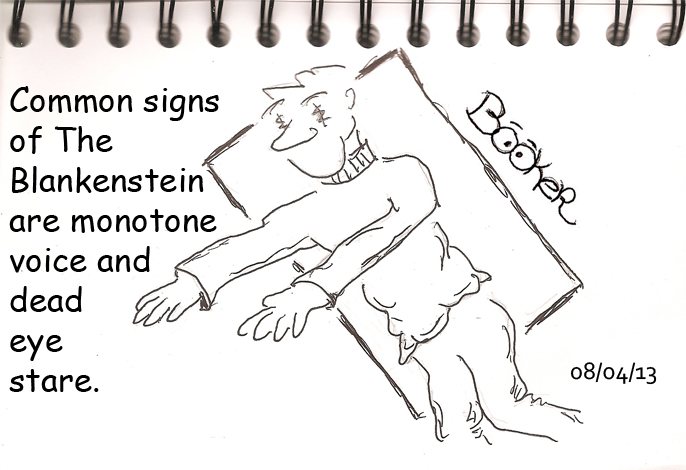
Blankenstein, n., 1) The blank look on your computer monitor when the hard drive has crashed and all your files are gone, the program has crashed and your important work is gone, or your computer won’t start up for some reason, such as the motherboard gone band, and you can’t access your folders and files. In some cases, also known as “The Blue Screen of Death.”

Beware the Blankenstein!

Beware the Blankenstein!

2) The blank look on a low level business or government functionary who, while claiming to help you, is actually doing nothing to aid your situation. The blank or dead eye look and the monotone voice are often signs of the Blankenstein in non-action. While this can sometimes be confused with being lost in thought, it is more the thought, on the part of the functionary, that you will get lost.

Leave a comment

Filed under new word, New words to live by

Photo Finish Friday: “One for the Ages”

She looked at the invitation and thought about joining. Even if the name was wrong, it was okay. She could be “Laura,” like Laura in the Little House on Prairie books she read. Yes, she could be Laura. And if she was going to be Laura, the free travel bag would be a help. Maybe then she could travel more, though she didn’t like to travel much. She thought about it some more. It cost $16 to join. Money was tight. She didn’t have a regular job and was on a fixed budget, but sometimes she could get help. All she had to do was ask. But there was only one really big problem she saw with accepting AARP’s offer to join — she was only ten years old. And even she waited and waited and replied at the last minute, just before the September 11th deadline, she still would only be ten years old. Maybe next year, when she was a little older, she could join the American Association of Retired Persons. After all, she was already retired — at least for the summer.

Maybe next year she could join.

Maybe next year she could join.

Leave a comment

Filed under Photo by author, Photo Finish Friday