

Contests deadline April 30th.
You don’t have to live in Knoxville, TN and you don’t have to be a member of the Knoxville Writers’ Guild in order to enter. But time is running out.
Contests deadline April 30th.
You don’t have to live in Knoxville, TN and you don’t have to be a member of the Knoxville Writers’ Guild in order to enter. But time is running out.
Filed under Knoxville Writers' Guild, writing contest
First yard work of Spring; /
muscles fight the bloom of work: /
Dandelion aches.
Filed under Haiku to You Thursday, poetry by author
WHAT STAR TREK TAUGHT ME ABOUT REVISING
by BRUCE HALE
http://www.brucehalewritingtips.com/
Captain Kirk and company taught me more about story revision than you would expect from the crew of a starship. Remember in those old Star Trek episodes, they were always switching their phasers back and forth between “stun” and “vaporize”? That’s the key. We
need to make the same kind of distinctions in our revision process.
Am I saying we should stun our readers? Well, yes, we want to knock them out with our awesome writing, but what I’m driving at is being able to switch up the speed/intensity of our revising to suit the phase of revision we’re in.
To put it another way, we need to know when to scan and when to nitpick.
A GOOD TIME TO SCAN
After you’ve finished that ugly-sloppy first draft and let it sit for awhile, it’s time to tackle the first revision. Although it’s tempting to dive in and fix every little grammatical error and awkward phrase you come across, this isn’t the time.
The first time you reread your first draft, set your phasers on “scan.” Resist the temptation to fix every little word and phrase. Instead, move quickly and focus on the big stuff, like:
– Does this plot make sense at all times?
– Are my characters’ actions properly motivated?
– Are there any gaps in logic or chunks of the story that need a major overhaul?
– Is anything missing – scenes that SHOULD be there but aren’t?
– Is anything extraneous – scenes that SHOULDN’T be there but are?
In my first revision, I do my best to concentrate on these major issues, while occasionally highlighting sections of text that need further attention — but not stopping to do the work right then. That effort is best left for the next stage.
GETTIN’ NITPICKY WITH IT
After you’ve identified and solved the major issues, it’s time to take your next revision more slowly. Really put your language under the microscope. Remember, not only the content of the story but also the way it’s told count with readers. In this revision I look for:
– Places to inject humor or emphasize some strong emotion.
– Places to use metaphor and simile to make the language come alive.
– Dead spots where the story’s momentum slows down too much.
– Consistency of dialog – does each character always sound like himself? Do they sound too much like each other?
Depending on your writing process, it may take one or several revisions at this nitpicky level to get your story in shape.
LAST MAN SCANNING
I like to finish up with one last scan before I send the manuscript out. This time I read the story out loud, and fairly quickly, looking for echoes (unintentionally repeated words) and any place where my tongue stumbles. While novels aren’t read aloud as often as picture books, this technique works on both. Guaranteed, you’ll learn a few things about your writing — like, I had no idea I used “just” so frequently — as well as making your story a smoother read.
And after all that revision, you may feel, in the words of Mr. Scott, that the “ship’s shields are buckling.” No need to fret. Just step away from the computer, have a seat in a comfy chair, and begin brainstorming the next book. And smile. You won’t have to revise again for awhile.
___________

Bruce Hale
Bruce has written and illustrated over 25 books for kids. His Underwhere series includes Prince of Underwhere and Pirates of Underwhere. His Chet Gecko Mysteries series includes: The Chameleon Wore Chartreuse, The Big Nap, The Malted Falcon, Hiss Me Deadly, and others. More at http://www.brucehale.com/
Filed under Writing Tip Wednesday

Part 16: The noir comes to Eleanor.
Filed under cartoon by author, Eleanor and Rose, Story by author, Uncategorized
A male romance novelist was hiking in the mountains, and he came upon a shepherd who was tending a large herd of sheep that were grazing in the alpine meadow. The writer took a fancy to the sheep, and asked the shepherd: “If I can guess how many sheep you have, can I have one?”
The shepherd thought this was an odd request, but thought that there was little chance that the man would guess the exact number of sheep, so he said, “Sure.”
The writer guessed, “You have 297 sheep.”
The shepherd was astonished, since this was exactly how many sheep he had.
The writer got excited and asked, “Can I pick out my sheep now?”
The shepherd grudgingly gave his permission. The writer selected his sheep, bent over, and swung the sheep over his shoulders, to carry home with him.
The shepherd then asked, “If I guess what your occupation is, can I have my sheep back?”
The novelist was a bit surprised by this, but figured that it was unlikely that the shepherd would be able to guess his occupation, and went along with the deal.
The shepherd then guessed “You’re a romance novelist, aren’t you?”
The writer was very surprised and asked, “How did you know?”
The shepherd responded, “Just put the dog down and we’ll talk about it.”
Filed under Monday morning writing joke
by David E. Booker
O’, Pause and let us now behold
the elected intelligence in all its mold.
Bills run amuck of mind and light:
Sufficient fright for a Halloween night.
And there was more, lest you forget
a bill to take away your right to vote yet
for the U.S. Senator of your choice
Enlightened legislators said, “That’s our voice.”
Only a call from fed Senator Corker
prevented that piece of legislative porker.
Many other state bills ceased to be
because big money donors were displeased.
So, say what you will about money buying votes.
It may not get bills passed; but it can get them smote.
________

Tennessee State flag: 0′ what trouble can they conceive when the state GOP is allowed to breathe.
NASHVILLE — On the state Senate floor last week, Sen. Brian Kelsey brought up a resolution that he explained as putting senators on record as declaring “if the federal government tries to infringe on our rights as American citizens, then we will intervene and fight for those rights.”
This prompted Senate Majority Leader Mark Norris to ask his fellow Republican how the resolution (SR17) differed from perhaps the most prominent of several bills introduced this year to nullify federal laws and subject federal officers to prosecution should they try to enforce them.
For the rest of the story, follow this link:
http://www.knoxnews.com/news/2013/apr/07/tennessee-gop-supermajority-eases-up-on-silly/
Filed under GOP, poetry by author, political humor
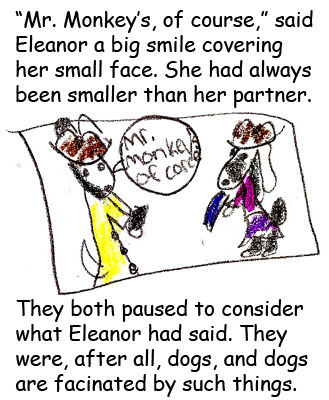
Part 15: The hat matters.
Filed under cartoon by author, Eleanor and Rose, Story by author
Flower bends to the wind; /
bee bends to the flower’s desires: /
pollen adventures.
Filed under Haiku to You Thursday, poetry by author
PenPal says:
Here is one of the quickest and easiest ways to strengthen your writing:
1. Take a page of prose (or several pages at a time) and find how many times you used the word “was.” To do this on your computer, hold down both Control and the F key for a moment until a search box pops up. In that box, type the word “was” and then click the search button. Your computer will then highlight the word each time it appears in your manuscript. If you are handwriting or have printed out your page(s), take a highlighter and manually highlight the word “was” each time you find it.
2. Read through and choose an active verb to replace the word “was” in as many cases as possible (aim for replacing at least 50%, preferably about 90%).
Sometimes “was” is the best verb choice, but more often a stronger verb will help elevate your writing to a higher interest level. If getting rid of an unnecessary, boring “was” requires minor rewording, do it!
Examples:
A. The muddy dog was on his master’s clean bed.
B. The muddy dog sprawled on his master’s clean bed.
A. Behind the barn, there was a pile a leaves the children were jumping in.
B. Behind the barn, the children jumped in a pile of leaves.
A. Two thousand twelve was a very good year.
B. Two thousand twelve was a very good year. (Sometimes “was” really does work best.)
Keep writing and revising!
________

Cathy Kodra a/k/a PenPal
Cathy is a member of the Knoxville Writers’ Guild and of two local writing groups. An avid reader and writer, she is currently working on two poetry collections and a collection of short stories. Her hobbies include gardening and vegan cooking, and she lives happily with her husband Ron, two dogs, and a cat. She can be reached at www.cathykodra.com.
Filed under Writing Tip Wednesday
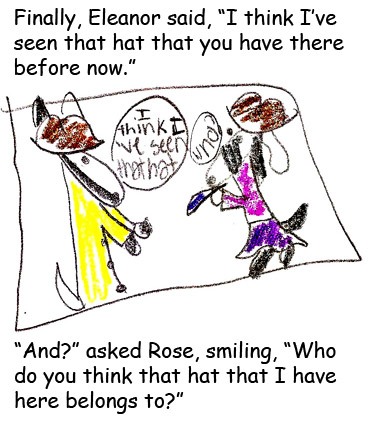
Part 14: The hat points the way, more or less.
Filed under cartoon by author, Eleanor and Rose, Story by author


 Booker's Blog