
A photon checks into a hotel.
The bell hop asks, “Any luggage?”
“Nope,” says the photon, “I’m traveling light.”
A photon checks into a hotel.
The bell hop asks, “Any luggage?”
“Nope,” says the photon, “I’m traveling light.”
Filed under Monday morning writing joke
Time for the monthly installment: New words to live by. This month’s word is an example of a portmanteau word in which two other words are combined to form a new, third word.
The two words used:
Cop, n. U.S. slang for police officer, starting in the 1840 – 50 time frame. Believed to be short for copper, which is also slang for police officer. Believed by some to refer to the copper buttons on police uniforms. More likely a formation of the verb cop (meaning to take or steal, and still in use in phrases such as “cop a plea”) and the suffix -er, turning a verb into a noun, and then later dropped.
Apocalypse, n. originally a prophetic revelation — particularly in Jewish or Christian writings — in which a cataclysm brings about the final clash of good and evil, in which good is supposed to win.
The new word:
Acopalypse, n. A condition in which the truth is never know and the facts are never revealed. This condition can apply to society, to politics, to religion, or to a general feeling is which the trappings of order are maintained, but the actions creating these trappings and even the results flowing from these trappings are absurd. Example: the recent federal government shutdown. Franz Kafka’s novel The Trial could be considered an example of an acopalyptic novel.
[Editor’s note: other new words to live by can be found by clicking on the tag “new word” or “new words.”]
Filed under new word, New words to live by

Elvira: a vixen for Halloween
What would you do with such a writing prompt?
Filed under Writing Prompt
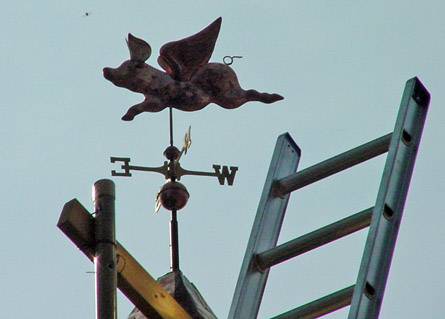
It’s not a matter of when, but weather pigs fly.
Filed under Photo by author, Photo Finish Friday
20 BRITISH WORDS THAT MEAN SOMETHING TOTALLY DIFFERENT IN THE U.S. — Bigstock Blog.
Cherri-o, ol’ chap.
Filed under words
GOP Congressman Makes Park Ranger Apologize for Shutdown.
GOP = God’s Openly Pompous
Filed under GOP
Uprooted words hurled /
Bitter and confused farewells /
Our tongues bloom with spikes.
Filed under Haiku to You Thursday, poetry by author
PenPal says:
A while or awhile? How do you know which to use?
I find that many writers often use these words incorrectly. There is an easy way to tell which you should use:
1. Awhile (one word) is an adverb; therefore, it modifies a verb.
Examples (corresponding verbs have been underlined):
2. A while (two words) contains both the article “a” and the noun “while.” The two-word version is a noun phrase, and it will be preceded by a preposition (for, after, in).
Examples (corresponding prepositions have been underlined):
Check your understanding:
A. Mary rode the bus for (awhile / a while).
B. The birds hung around my feeder (awhile / a while) before flying away.
C. Please be aware that the office manager will speak to us in (awhile / a while).
D. Mark searched his memory, and after (awhile / a while) he recalled the correct solution to the math problem.
Simple as that! More PenPal tips will be coming your way in a while.
[Answers: A. a while / B. awhile / C. a while / D. a while]
________

Cathy Kodra a/k/a PenPal
Cathy is a member of the Knoxville Writers’ Guild and of two local writing groups. An avid reader and writer, she is currently working on two poetry collections and a collection of short stories. Her hobbies include gardening and vegan cooking, and she lives happily with her husband Ron, two dogs, and a cat. She can be reached at www.cathykodra.com.
Filed under Writing Tip Wednesday

Looking for the next best thing.
Filed under cartoon by author, CarToonsday
What do you get when you cross a joke with a rhetorical question?
Filed under Monday morning writing joke


 Booker's Blog