

Tablet, tablet in my hand
are you the most frustrating thing in the land?
Tablet, tablet in my hand
are you the most frustrating thing in the land?
Filed under cartoon by author, CarToonsday
Two comedy writers sitting in a diner.
First writer: “I went to see a shrink yesterday for my writer’s block.”
Second writer nods between forkfuls of fried potatoes. “What did she say?”
First writer: “She asked me to spell money backwards.”
Second writer: “Did you?”
First writer nods as he puts his napkin down: “D-e-b-t.”
Filed under Monday morning writing joke

Are All Movie Heroes the Same Person? – Pacific Standard: The Science of Society.
Perhaps you’ve heard they’re making another Star Wars film. Perhaps you’ve read up on the backgrounds of the new cast members and heard that the Oscar-winning Lupita Nyong’o will also be joining the crew on their adventures in a galaxy far, far away. Maybe you delivered a furtive fist pump upon seeing the leaked production photos, which show actual physical buildings and creatures on set in Abu Dhabi, as opposed to studio rooms adorned with green screens. Whether you’re a fan of the nearly 40-year-old franchise or not, the hype surrounding its next installment—scheduled for release in December 2015—is pretty hard to ignore.
While several factors deserve credit for Star Wars’ ongoing popularity—the ballet-like lightsaber duels, the roguish charm of Harrison Ford’s Han Solo, the massive amounts of toy merchandising—it’s quite possible that the space opera’s greatest strength lies in its reliance upon the work of American mythologist Joseph Campbell.
Read the rest at: http://www.psmag.com/navigation/books-and-culture/movie-heroes-person-joseph-campbell-monomyth-83796/#.U6SbO7MNr_o.facebook
Filed under Joseph Campbell, mythology

This Is Your Brain on Metaphors – NYTimes.com.
Despite rumors to the contrary, there are many ways in which the human brain isn’t all that fancy. Let’s compare it to the nervous system of a fruit fly. Both are made up of cells, of course, with neurons playing particularly important roles. Now one might expect that a neuron from a human will differ dramatically from one from a fly. Maybe the human’s will have especially ornate ways of communicating with other neurons, making use of unique “neurotransmitter” messengers. Maybe compared to the lowly fly neuron, human neurons are bigger, more complex, in some way can run faster and jump higher.
But no. Look at neurons from the two species under a microscope and they look the same. They have the same electrical properties, many of the same neurotransmitters, the same protein channels that allow ions to flow in and out, as well as a remarkably high number of genes in common. Neurons are the same basic building blocks in both species.
So where’s the difference? It’s numbers — humans have roughly one million neurons for each one in a fly. And out of a human’s 100 billion neurons emerge some pretty remarkable things. With enough quantity, you generate quality.
The blathering idiot did not know what to do with his letter form the university. It was addressed to him, but it clearly stated on the envelope that inside were “Exciting Summer Programs for Children and Adults in Your Neighborhood.”
Really?
What about him, the blathering idiot? Was he not entitled to Exciting Summer Programs”?
But if he opened it, how disappointed would he be to find no Exciting Summer Programs for him? He could just not open it and his summer would be fine.
Then Xenia found it.
Xenia was the eleven-year-old daughter of the blathering idiot’s on-again, off-again girlfriend Zoey. Sometimes she came over to stay with the blathering idiot for a while.

“Exciting Summer Programs for Children and Adults in Your Neighborhood”
“I thought maybe you would,” he said.
“I am not child in your neighborhood.”
“Not even when you’re over here, like right now?”
“But it’s addressed to you,” Xenia said.
“But it says its material is not for me.”
“Let’s call the university and see what they say we should do.”
The blathering idiot wondered why he hadn’t thought of that.
The university passed them from person to person, even once transferring them to the Chinese language professor, who was no help at all. Finally they were transferred to a man in the little known department of the studies of lost tangential and self-reverential marketing ideas.
“Actually, it’s a graduate course I taught uhm oh three years ago. I am uhm oh hoping to bring back it.” He had a heavy accent, though the blathering idiot was not sure where. It was as if the man had sucked down a vowel or two from everywhere he went.
“This envelope holds the graduate course you once taught?” the blathering idiot asked.
“It doves?”
“Isn’t that what you said?”
“I said that was course I taught.”
“And that course is an ‘Exciting Summer Program for Children and Adults in my Neighborhood’?”
“Could may be.”
“But not for me?” the blathering idiot asked.
“Who said?”
“The envelope.”
“The envelope talks to you?” the professor asked.
“No. It doesn’t. But it says—”
“Says?”
“Yes.”
“As in talk?”
“No.”
“Then it’s not my course. Good day, blather one.”
The line went dead.
“Well?” Xenia asked?
“Well, it may or may not be a marketing course.”
With that, Xenia took the envelope and ripped it open. She looked inside, then she looked at the blathering idiot.
“What is it?” the blathering idiot asked.
“Reading.”
“Okay, tell me when you’re done.”
“No. It’s about reading. Summer courses for children and adults,” Xenia said.
“Oh,” the blathering said.
“Phonics, too.”
“Oh.”
None of that seemed quite as exciting as he had imagined. He almost wished he hadn’t asked.
Filed under blathering idiot
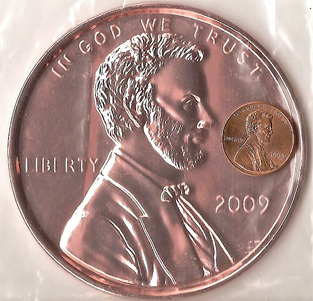
What did the big penny say to the little penny?
What did the little penny say to the big penny?
Big to little:
A.: A penny for your thoughts.
or
A.: And you thought there was no career advancement.
or
A.: I penny you.
Little to big:
A: Pass the buck.
or
A: So that’s what inflation does.
or
A.: Are you my penny, auntie?
Filed under Photo by author, Photo Finish Friday
Dew upon the grass /
Stars upon the nighttime sky /
Gas, light, water, life.
Filed under Haiku to You Thursday, poetry by author
Writing Fiction: 5 Tips to Get More Creative
Source: http://www.writersdigest.com/writing-fiction-5-tips-to-get-more-creative?et_mid=637949&rid=239626420
1. Start with tension
Time and time again you’ll hear fiction writers and instructors tell you to start with action. This is flawed advice. Why? What good is the action if it isn’t grounded in context that’s important to the story or draws you to the main character? It’s better to start with tension, like a character falling short on getting something he wants—can’t save the life of a loved one, can’t beat a rival in a race, etc.
2. Know what your characters’ wants are
Interesting stories come from characters who want something. Romeo and Juliet want each other. Harry Potter wants to beat Draco Malfoy and Slytherin in Quidditch. Hannah Baker wants the people who led her to commit suicide know how they hurt her. Writing a fiction book requires that you have compelling characters, and characters who have strong wants and desires are the most compelling kind there are.
3. End each chapter on a cliff
OK, you don’t have to end each chapter on an actual cliff, but you do need to leave them with unanswered questions. This doesn’t mean you can’t answer questions during the book, it just means you need to create new ones as you go along. Be creative. Fiction is built on the curiosity of readers. If you don’t spark their curiosity (especially at the end of a chapter), what incentive do they have to start the next one?
4. Give your characters obstacles and 5. Understand your audience Information on these is available at: http://www.writersdigest.com/writing-fiction-5-tips-to-get-more-creative?et_mid=637949&rid=239626420
Filed under writing tip, Writing Tip Wednesday, writing tips
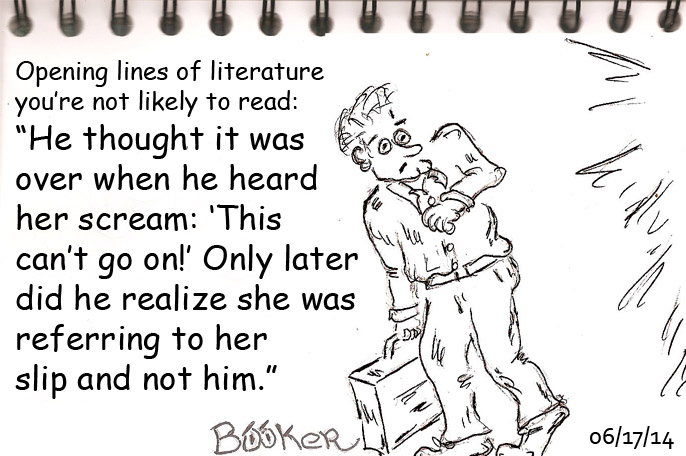
The slipp-ery slope of assumption.
Filed under cartoon by author, CarToonsday


 Booker's Blog