Writing tip Wednesday: “Flexible outline”

7 STEPS TO CREATING A FLEXIBLE OUTLINE FOR ANY STORY

Source: http://www.writersdigest.com/online-editor/7-steps-to-creating-a-flexible-outline-for-any-story?et_mid=682609&rid=239626420

The seven steps involve:
1. Craft your premise
2. Roughly sketch scene ideas
3. Interview your characters
4. Explore your settings
5. Write your complete outline
6. Condense your outline
7. Put your outline into action.

1. Craft your premise.

Your premise is the basic idea for your story. But it’s not enough to just have an idea. “Guy saves girl in an intergalactic setting” is a premise, but it’s also far too vague to offer much solid story guidance.

This is why your outline needs to begin with a tightly crafted premise sentence that can answer the following questions:

  • Who is the protagonist?
  • What is the situation? What is the hero’s personal condition at the beginning? How will that condition be changed, for better or worse, by the hero himself or by the antagonistic force?
  • What is the protagonist’s objective? At the beginning, what does the hero want? What moral (or immoral) choices will she have to make in her attempt to gain that objective?
  • Who is the opponent? Who or what stands in the way of the hero achieving his objective?
  • What will be the disaster? What misfortune will befall the hero as the result of her attempts to achieve her objective?
  • What’s the conflict? What conflict will result from the hero’s reaction to the disaster? And what is the logical flow of cause and effect that will allow this conflict to continue throughout the story?

Once you’ve answered these questions, combine them into one or two sentences:

Restless farm boy (situation) Luke Skywalker (protagonist) wants nothing more than to leave home and become a starfighter pilot, so he can live up to his mysterious father (objective). But when his aunt and uncle are murdered (disaster) after purchasing renegade droids, Luke must free the droids’ beautiful owner and discover a way to stop (conflict) the evil Empire (opponent) and its apocalyptic Death Star.

2. Roughly sketch scene ideas.

Armed with a solid premise, you can now begin sketching your ideas for this story. Write a list of everything you already know about your story. You’ll probably come to this step with a handful of scenes already in mind. Even if you have no idea how these scenes will play out in the story, go ahead and add them to the list. At this point, your primary goal is to remember and record every idea you’ve had in relation to this story.

Once you’ve finished, take a moment to review your list. Whenever you encounter an idea that raises questions, highlight it. If you don’t know why your character is fighting a duel in one scene, highlight it. If you don’t know how two scenes will connect, highlight them. If you can’t picture the setting for one of the scenes, highlight that, too. By pausing to identify possible plot holes now, you’ll be able to save yourself a ton of rewriting later on.

Your next step is to address each of the highlighted portions, one by one. Write out your ideas and let your thoughts flow without censoring yourself. Because this is the most unstructured step of your outline, this will be your best opportunity to unleash your creativity and plumb the depths of your story’s potential. Ask yourself questions on the page. Talk to yourself without worrying about punctuation or spelling.

Every time you think you’ve come up with a good idea, take a moment to ask yourself, “Will the reader expect this?” If the answer is yes, write a list of alternatives your readers won’t expect.

3. Interview your characters.

In order to craft a cast of characters that can help your plot reach its utmost potential, you’ll need to discover crucial details about them, not necessarily at the beginning of their lives but at the beginning of the story.

To do this for your protagonist, work backward from the moment in which he will become engaged in your plot (the “disaster” in your premise sentence). What events in your protagonist’s life have led him to this moment? Did something in his past cause the disaster? What events have shaped him to make him respond to the disaster in the way he does? What unresolved issues from his past can further complicate the plot’s spiral of events?

Once you have a basic idea of how your character will be invested in the main story, you can start unearthing the nitty-gritty details of his life with a character interview. You may choose to follow a preset list of questions (you can find a list of more than 100 such questions in my book Outlining Your Novel: Map Your Way to Success), or you may have better luck with a “freehand interview” in which you ask your protagonist a series of questions and allow him to answer in his own words.

For the rest, go to http://www.writersdigest.com/online-editor/7-steps-to-creating-a-flexible-outline-for-any-story?et_mid=682609&rid=239626420

Historical and speculative novelist K.M. Weiland writes the award-winning blog Helping Writers Become Authors (helping writersbecomeauthors.com). She is the author of Outlining Your Novel and Structuring Your Novel

1 Comment

Filed under writing tip, Writing Tip Wednesday, writing tips

Monday (morning) writing joke: “Enlightenment”

“Outside a dog, a book is man’s best friend. Inside a dog, it’s too dark to read.” –Groucho Marx

Groucho Marx

Groucho Marx

1 Comment

Filed under Monday morning writing joke

Limerick: “$catology”

There once was a woman in scatology /

who proceeded to take a class in tautology./

“$h!t, $h!t, $h!t,” she said./

She said shaking her head./

She passed the final test without apology.

1 Comment

Filed under poetry by author

Photo finish Friday: “Bizarre, Zany, Supernatural!”

And so the story goes....

And so the story goes….

Submitted for your approval, one used paperback found in one used book stall in one place specializing in the bizarre, zany, supernatural. Such a book stall may be miles away or it may be just around the corner from your where you live or it may be even closer, as close as your imagination, for you have just crossed over into… The Twilight Zone.

Act I: One More Pallbearer

A prop woman readied the coffin. At the behest of the director, she walked up and down the length of the three-foot deep grave, adjusting the bier’s position beside the hole and trying not to knock free any of the flat-black paint sprayed on the soil to give it depth.

“No, no. A little more to the right, babe. There you go, that’s it.” T. Xavier Gabriel glanced through the camera’s viewfinder and clapped his hands.

“Okay, people, places everybody. Time is on the short.” He checked the filter on one of the cameras as four banks of Klieg lights were turned on and three separate lights repositioned.

“Hey, dim the lights,” Gabriel said. “This is supposed to be a night scene: Night scene. See the stars.” He pointed skyward, but saw instead that it was overcast with lightning dancing among the clouds.

“Damn,” he muttered.

Several of the crew laughed lowly.

He shook his head. Another snafu in the making. “Damn. Goddamn.”

Gabriel glanced at his watch: 11:47 p.m. Post mortem. Pre migraine. Petty and mundane. He stomped his foot. It was a child-like gesture, but nothing adult-like was working now or for any part of 1985 that he’d directly had a hand in.

“Places everybody. Places. We shoot in fifteen minutes. Fifteen minutes. Places.” The assistant director loped around waving a flashlight and a clipboard. “Time is on the short.”

Gabriel smiled. It was a stiff, brittle, unsure smile: a guest at the funeral home smile. “Time is on the short” was his personal euphemism for running into overtime, something he had been crucified for more than once. He rubbed his forehead and wondered if he’d ever get back to Hollywood, or if he’d spend the rest of his life in commercials, talking to semi trained mammals and now mimics of a dead man.

He glanced at the crumpled note still wadded in his hand. His ex-wife could find him anywhere. Two hours earlier he’d made the mistake of answering the phone.

1 Comment

Filed under Photo by author, Photo Finish Friday

Haiku to you Thursday: “Sweet smell”

Thank you. The sweet smell /

of your perfume brightens my /

days behind the fence.

1 Comment

Filed under Haiku to You Thursday, poetry by author

Writing tip Wednesday: “Hero’s Adventure”

HOW TO MAP OUT YOUR HERO’S ADVENTURE IN YOUR MANUSCRIPT

Source: http://www.writersdigest.com/online-editor/how-to-map-out-your-heros-adventure-in-your-manuscript?et_mid=688770&rid=239626420

How do the most successful authors of our time construct their stories? If you read them, and if you also read some ancient myths, you will begin to see parallels. You will feel smacked upside the head with parallels. You’ll realize that the top authors of today use storytelling techniques that writers used back when plans were being drawn up for the pyramids.

An excellent book about ancient myths is The Hero With a Thousand Faces by Joseph Campbell. The title says it all. Across cultures and generations, some variation of a hero figures into every beloved story. And the typical story is about an individual who goes on a quest or a journey. By the end, the individual becomes a hero. This is called the Hero’s Adventure.

The Hero’s Adventure is the most archetypal story of all because it’s the basis for more novels than any other kind of story. Novels of all different genres, from romances to thrillers to sci-fi, are based on the Hero’s Adventure.

So what is the Hero’s Adventure? You know it already, and you may even have elements of it in the story you’re working on. But I suspect you haven’t yet methodically and thoroughly appropriated it for yourself.

The Hero’s Adventure Basic Recipe

Joseph Campbell

Joseph Campbell

Here is a basic recipe to demonstrate how the Hero’s Adventure plays out. This is a template you can apply to your own work-in-progress—you might be surprised by how closely it matches elements you already have in play.

  1. A messenger comes. The messenger might be human, or a message might come from an experience—like a brush with death or a dream. At any rate, something has gone wrong; the natural order of the world has been disturbed.
  2. A problem is presented. Perhaps something has been taken away from the tribe, or some misfortune or malfeasance has occurred.
  3. Someone is marked out as the person to solve this problem. She is chosen according to some past deed of her parents or by her own reputation or happenstance. This person, of course, emerges as the hero at the end.
  4. A challenge takes shape. The challenge may be refused, at first. “No way, I’m not going to risk my neck for that!”
  5. A refusal, often. But eventually the hero decides to accept the challenge. She might even be forced to accept it by circumstances.
  6. The challenge is accepted. The adventure begins.
  7. The hero leaves the familiar world. And she sets off into another world. It’s dangerous. The hero could use some help, and very often …
  8. Helpers materialize. A helper might have special skills the hero doesn’t have, or he might have special insights or wisdom, in which case he takes the form of a mentor.
  9. Setbacks occur. The hero is tested, she makes gains, she endures setbacks, she fights for what is right, she resists evil. The going’s tough!
  10. The hero regroups and gains some ground again. Maybe she needs another visit to a mentor, or maybe she makes a personal breakthrough and overcomes a great inner obstacle, perhaps her own fear.
  11. The foe is vanquished or the elixir is seized. Eventually she defeats the foe or comes into possession of something that will restore the natural order—a cure, or new knowledge that will bring justice or the return of prosperity.
  12. The hero returns to the familiar world. And the problem is fixed, or justice is done. The natural order is restored.

The person who accepts the challenge and prevails is elevated to a special position, somewhere above human, somewhere below god. She is the hero.

For examples of this in literature: http://www.writersdigest.com/online-editor/how-to-map-out-your-heros-adventure-in-your-manuscript?et_mid=688770&rid=239626420

Leave a comment

Filed under writing tip, Writing Tip Wednesday, writing tips

cARtOONSDAY:” sTORMY bEGINNING”

The difference between the right word and the almost right word sill won't save some beginnings.

The difference between the right word and the almost right word sill won’t save some beginnings.

Leave a comment

Filed under cartoon by author, CarToonsday

Monday morning writing joke: “Bark worse than his trick”

Q.: What do you call a dog that does magic tricks?

A.: Labracadabrador.

1 Comment

Filed under Monday morning writing joke

Don Pardo, 1918-2014

Little by little, like evolution in reverse, the things that make your world start to fall away.

Tom Dupree's avatarYou and Me, Dupree

pardoI was waiting for the Don Pardo obit like a horror-film audience member peeking through hisser fingers, but when it finally came it was still a shock. “A light just went out,” as they say when somebody important to you passes away. Well, one just did last Monday, an announcer so strong and true that he was still strappin’ on the cans at age 96.
Don Pardo had been active since the heyday of radio, but he was best known to those of a certain age for his work on tv game shows, especially THE PRICE IS RIGHT and the original JEOPARDY!, the network version hosted by Art Fleming. (The Alex Trebek JEOPARDY! is syndicated.) We knew his voice because it was rock-solid, and we knew his name because the hosts of those shows would often call out to him on the air: “Don Pardo, tell her what she’s won!”…

View original post 320 more words

Leave a comment

Filed under Uncategorized

The midnight swim of Grace

Recently, in my hometown of Knoxville, TN, a 23-year-old woman by the name of Evelyn Grace Radford, supposedly fortified by wine and fit of limb and wind, swam not the English Channel, but the more modest Fort Loudoun Lake (sometimes referred to as Fort Loudoun Embayment. Named for an Englishman of noble lineage who never saw it and probably cared not a whit about it).

To add daring to her do, she did so in the dark of night and in no more than her bra and panties. If you do not believe me, you can read the article below or follow the link for the full story, assuming you are not stopped by some pay wall. She successfully swam the Lake, Embayment (sometimes also called the Tennessee River because this were the River starts), but was greeted by police and rescue squad personnel who had been called to the scene for fear that she had fallen in and might be drowning.

The event inspired the following modest poetic verse:

There once was a lady named Grace /
Who did the breast stroke all out-of-place. /
She swam the river with flair /
Scantily in her underwear. /
Alas, the newspaper showed only her face.

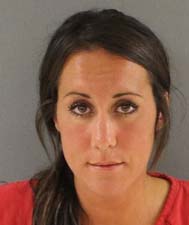
Grace's mug shot

Grace’s mug shot

KNOXVILLE — A 23-year-old Knoxville woman told police late Monday night she “just wanted to swim” after making her way across Fort Loudoun Lake wearing only a bra and panties.

Evelyn Grace Radford’s near-midnight jump into the water at Volunteer Landing, however, prompted calls of a drowning to authorities who launched boats to rescue the scantily clad woman.

Her actions also prompted charges of disorderly conduct and public intoxication, records show.

Authorities were alerted at 11:54 p.m. that an intoxicated woman had stripped down to her basic clothing and jumped into the water and was swimming to the south shore, according to Knoxville Police Department Sgt. Scott Coffey.

“She left her clothing with her boyfriend at Volunteer Landing and he abruptly left the area,” Coffey said. “The witnesses indicated they believed the couple were in an argument prior to her jumping in the water.”

For the rest of the story: http://www.knoxnews.com/news/watchful-eye/midnight-swim-nets-charges-against-scantily-clad-woman_69968857

Leave a comment

Filed under poetry by author, true story