Duck, duck, goose
trouble’s on the loose.
From Canada they came;
some honk like it’s a shame.
They’re looking for your bread.
They’ll take your buns instead.
Duck, duck goose
trouble’s on the loose.
You may stop and think —
but, yes, it’s going to stink.
And down at the Fellini,
they may even take your panini.
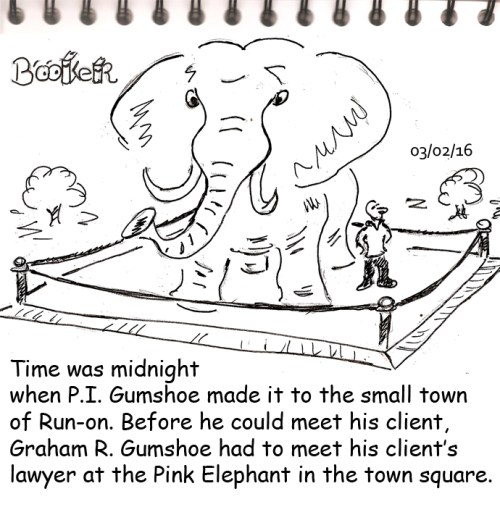
Photo finish Friday: “Duck, duck, goose”
Filed under 2016, Photo Finish Friday
Haiku to you Thursday: “Cloud crowd”
Far from the night crowd /
a sense of togetherness /
gathers in the clouds.
–David E. Booker
Filed under 2016, Haiku to You Thursday, poetry by author
Writing tip Wednesday: “Avoiding pitfalls on the way to publication”
Mistakes Writers Make When Submitting to Literary Magazines
by Eva Langston
1. Not reading literary magazines
This seems obvious, but if you want to get published in a journal, it’s helpful to read the types of pieces they publish. Most literary magazines suggest you read a few back issues first to get a sense of their aesthetic. In an ideal world, you should do this, but chances are you don’t have time to read multiple back issues of every single journal you’re going to submit to. Instead, make it your goal to simply read more literary magazines than you currently do. Subscribe to a few each year. Get your friends to subscribe to different publications and then trade. And of course, take advantage of free online journals, such as Carve. Read a story whenever you have a spare moment, even if it’s on your phone while waiting in line at the grocery store.
2. Not submitting your best work
Instead of finishing a story and submitting it immediately, let your piece rest for a few months then go back and revise. Workshop it, or let a trusted writer friend read it and give feedback. Print it out and triple-check for grammatical and spelling errors. Read your piece out loud at least once. Only submit when you think the piece is the best it can possibly be.
3. Not following guidelines
Double check all guidelines before submitting to a magazine. Is there a word count requirement? Should your name be removed from the piece? Should your document be in Word, PDF, or rich text format? If it’s an email submission, do they want the document attached, or pasted into the body of the email? Do they accept simultaneous submissions? Don’t risk getting your piece being tossed out because you didn’t follow the rules.
4. Making simultaneous submission goofs
Speaking of simultaneous submissions, if a journal says they don’t accept them you should respect that, or risk making an editor annoyed. Fortunately, a lot of magazines do accept simultaneous submissions, and if they don’t say either way, you can safely assume that they do. This is good because it means you can send the same story to multiple journals at the same time and increase your chances of getting an acceptance letter. But if your piece gets picked up by a journal, you must alert the other journals you submitted it to. If a reading committee debates over your story for a long time, decides to accept it, and then finds out it’s been published elsewhere, your name will be mud in the world of literary magazines.
5. Not keeping track of submissions
Use a spreadsheet or some other organizational method to keep track of your submissions (what you sent, to which journals, when, and the responses). Not only will this help with simultaneous submissions in case your piece is accepted (see No. 4), but it will also keep you from submitting the same piece to a magazine that has already rejected it, or not yet responded to your last submission. The online submission manager Duotrope offers this type of “tracker” as a feature for their paid subscribers.
Other tips include:
6. Making cover letter goofs
7. Not doing enough research
8. Ignoring online journals
9. Taking rejections too personally and not submitting enough
10. Not thanking the editor
For details, go to: http://www.aerogrammestudio.com/2016/02/03/mistakes-writers-make-when-submitting-to-literary-magazines/
Filed under 2016, writing tip, Writing Tip Wednesday
Famous punctuation
The Surprising Punctuation Habits Of Famous Authors, Visualized
Hemingway actually used denser punctuation than Jane Austen, William Faulkner, or Charles Dickens.
by John Brownlee
As writers, we’re endlessly fascinated by the idiosyncrasies of authors and the way they use punctuation. Yet how much can the way authors use punctuation really reveal about their style? Plenty, it turns out.
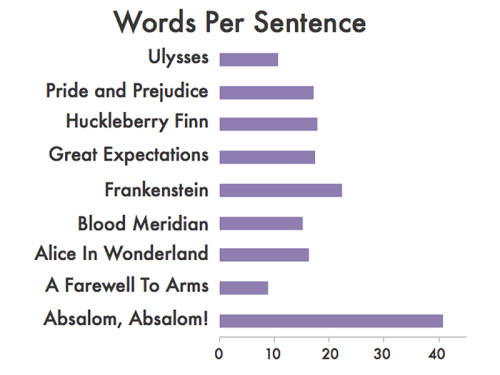
Over on Medium, Adam Calhoun decided to strip eight of his favorite novels down to just the punctuation. The novels he chose were James Joyce’s Ulysses, Jane Austen’s Pride and Prejudice, Mark Twain’s Huckleberry Finn, Charles Dickens’s Great Expectations, Mary Shelley’s Frankenstein, Cormac McCarthy’s Blood Meridian, Lewis Carroll’s Alice in Wonderland, Ernest Hemingway’s A Farewell to Arms, and William Faulkner’s Absalom! Absalom!.
Like previous efforts to cut away everything but punctuation from famous novels, this left just a stream-of-consciousness staccato of commas, periods, question marks, quotation marks, and the occasional semi-colon to represent each book. But instead of merely turning his efforts into pretty posters, Calhoun actually analyzed them, visualizing the punctuation of these novels in a way that put their punctuation use in perspective.
His resulting charts aren’t visually sophisticated, but they are informative. For example, in one chart, Calhoun visualizes punctuation density, or how many words (on average) an author puts in a row before he throws in a punctuation mark. Surprisingly, Hemingway actually uses punctuation more densely than Jane Austen, William Faulkner, or Charles Dickens, a finding that might have more to do with Hemingway’s short, crisp sentences than anything else.
Calhoun also breaks down each novel by most-used punctuation mark, highlighting each author’s favorite. Commas and periods tend universally to be the most used marks, but some authors have a fondness for apostrophes (Mark Twain), exclamation points (Lewis Carroll), and semi-colons (William Faulkner).
Filed under 2016, authors, punctuation
Some current mysteries to consider
The best recent crime novels – review roundup
by Laura Wilson
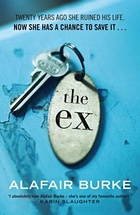
A pleasingly suspenseful mixture of legal thriller and whodunnit, Alafair Burke’s latest novel, The Ex (Faber, £12.99), introduces us to lippy, take-no‑prisoners New York City district attorney Olivia Randall, who receives a panicky phone call from the teenage daughter of her former fiance, Jack Harris, begging for help. Harris, whose wife was killed in a mass shooting three years earlier, has been charged with triple homicide, which the police are treating as a revenge attack because one of the victims is the father of the boy who shot his wife. For Olivia, representing Jack is a way to make up for the hurt she caused him in the past, but his alibi is flimsy and there is corroborating evidence, and she begins to wonder if he may, after all, be guilty. Burke’s writing has always been intelligent and often funny, and her female protagonists sharp and engaging – The Ex is her best yet.
Other books in the round-up include:
Icelandic author Ragnar Jonasson’s excellent debut novel, Snowblind, was widely praised for its distinctive blend of Nordic noir and golden age detective fiction. Nightblind (translated by Quentin Bates, Orenda Books, £8.99), also featuring police officer Ari Thor Arason and set in Siglufjörður, an isolated fishing village hard by the Arctic Circle, certainly lives up to the promise of its predecessor.
A Masterpiece of Corruption (Constable, £19.99) is the second of LC Tyler’s novels set during the Interregnum and featuring law student John Grey. The year is 1657, and a case of mistaken identity results in Grey, who has republican sympathies, finding himself in the middle of a plot by the Sealed Knot, a secret royalist association, to assassinate Oliver Cromwell in order that Charles Stuart may return from exile to take his place on the throne.
To see these and the other books being offered, go to http://www.theguardian.com/books/2016/feb/19/the-best-recent-crime-novels-review-roundup?CMP=share_btn_fb
Haiku to you Thursday: “Cold light”
Cold touches the light, /
sparkles in the ice cycles, /
glints against my eye.
–David E. Booker
Filed under 2016, Haiku to You Thursday, poetry by author
Writing tip Wednesday: “Find it here”
Poets and Writers tools for writers
Source: http://www.pw.org/conferences_and_residencies
The link takes you to a searchable database where you can find conferences and residences across the U.S. There are also links to those events, so you can investigate them further.
And don’t forget about this database to search for competitions: http://www.dystopianstories.com/writing-competitions-2016/
Filed under 2016, writing tip, Writing Tip Wednesday
Monday morning writing joke: “A writer walked in….”
A writer walks into a bar – it knocks him down.
A writer walks into a police station – she hasn’t a clue why she came.
A writer walks into a psychiatrist’s office wearing women’s clothes – including a Freudian slip.
A writer runs for political office – she figures she couldn’t be any more rejected and if she does get elected, the pay would be better and the hours easier.
Filed under 2016, Monday morning writing joke