
First writer: “My editor told me my flashbacks were so weak they needed new batteries.”
Second writer: “What did you say?”
First writer: “I said, ‘You know, that reminds me of the first time you….’”
First writer: “My editor told me my flashbacks were so weak they needed new batteries.”
Second writer: “What did you say?”
First writer: “I said, ‘You know, that reminds me of the first time you….’”
Filed under 2017, joke by author, Monday morning writing joke

The American Short Fiction Prize—a contest for stories between 2,000 and 6,500 words—is now open for submissions. This year we are honored to have Lauren Groff, author of Fates and Furies (Obama’s favorite book of 2015), as our guest judge. The first-place winner will receive a $1,000 prize and publication in our spring issue. One runner-up will receive $500 and all entries will be considered for publication. Submit your story through our online submission manager by June 15! More contest details after the jump.
Source: Deadline Extended: The American Short Fiction Prize –
– Submit your entry online between March 22, 2017 and June 1, 2017. The deadline has been extended to June 15, 2017!
– The first-place winner will receive a $1,000 prize and publication in our spring issue. One runner-up will receive $500 and all entries will be considered for publication.
– Please submit your $20 entry fee and your work through Submittable. We no longer accept submissions by post. International submissions in English are eligible. The entry fee covers one 6,500 word fiction submission.
– All entries must be single, self-contained works of fiction, between 2,000-6,500 words. Please DO NOT include any identifying information on the manuscript itself.
– You may submit multiple entries. We accept only previously unpublished work. We do allow simultaneous submissions, but we ask that you notify us promptly of publication elsewhere.
Conflicts of Interest
Staff and volunteers currently affiliated with American Short Fiction are ineligible for consideration or publication. Additionally, students, former students, and colleagues of the judge are not eligible to enter. We ask that previous winners wait three years after their winning entry is published before entering again.
Lauren Groff is the author of the novel The Monsters of Templeton, shortlisted for the Orange Prize for New Writers, Delicate Edible Birds, a collection of stories, and Arcadia, a New York Times Notable Book, winner of the Medici Book Club Prize, and finalist for the L.A. Times Book Award. Her third novel, Fates and Furies, was a finalist for the National Book Award in Fiction, the National Book Critics Circle Award, and the Kirkus Award. It won the 2015 American Booksellers’ Association Indies’ Choice Award for Fiction, was a New York Times Notable book and Bestseller, Amazon.com’s #1 book of 2015, and on over two dozen best-of 2015 lists. Her work has appeared in journals including the New Yorker, the Atlantic Monthly, Harper’s, Tin House, One Story, and Ploughshares, and in the anthologies 100 Years of the Best American Short Stories, The Pushcart Prize: Best of the Small Presses, PEN/O. Henry Prize Stories, and four editions of the Best American Short Stories. She lives in Gainesville, Florida with her husband and two sons.
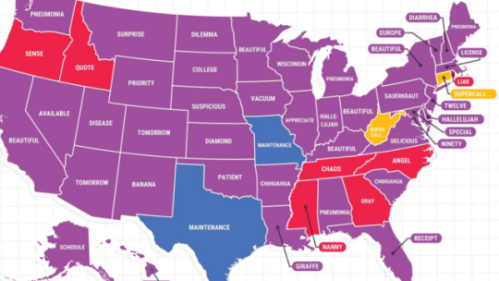
Bananas or banannas? These are the top misspelled words in each state
Where do you fit in?
Mary Bowerman , USA TODAY Network
EDITOR’S NOTE: A previous version of this story stated Wisconsin’s most misspelled word was “tomorrow” based on Google-provided data. A Google update with more current data found that the most misspelled word is actually Wisconsin.
Spelling champions from across the country are preparing to compete this week at the Scripps National Spelling Bee in Washington, D.C.
While we’ve all cringed after misspelling a word in a work email or a text, the National Spelling Bee competitors will be asked to spell words that make the word “chihuahua” look like a walk in the park.
In honor of those who aren’t as gifted as the National Spelling Bee champs, Google pulled the most misspelled words in each state so far this year.
Here’s a look at the most misspelled search words in each state:
Alabama: pneumonia
Alaska: schedule
Arizona: tomorrow
Arkansas: chihuahua
California: beautiful
Colorado: tomorrow
Connecticut: supercalifragilisticexpialidocious
Delaware: hallelujah
Washington, D.C. : ninety
Florida: receipt
Georgia: gray
Hawaii: people
Idaho: quote
Illinois: pneumonia
Indiana: hallelujah
Iowa: vacuum
Kansas: diamond
Kentucky: beautiful
Louisiana: giraffe
Maine: pneumonia
Maryland: special
Massachusetts: license
Michigan: pneumonia
Minnesota: beautiful
Mississippi: nanny
Missouri: maintenance
Montana: surprise
Nebraska: suspicious
Nevada: available
New Hampshire: difficult
New Jersey: twelve
New Mexico: bananas
New York: beautiful
North Carolina: angel
North Dakota: dilemma
Ohio: beautiful
Oklahoma: patient
Oregon: sense
Pennsylvania: sauerkraut
Rhode Island: liar
South Carolina: chihuahua
South Dakota: college
Tennessee: chaos
Texas: maintenance
Utah: disease
Vermont: Europe
Virginia: delicious
Washington: pneumonia
West Virginia: supercalifragilisticexpialidocious
Wisconsin: Wisconsin
Wyoming: priority
Filed under 2017

Reaching toward the future.
Reaching toward the future /
raindrops reflect the present /
while seeds crack the past.
Filed under 2017, photo by David E. Booker, Photo Finish Friday
Love is not defined /
except by the open heart /
and pain at parting.
Filed under 2017, Haiku to You Thursday, poetry by author
Love is not defined /
except by the open heart /
and pain at parting.
Filed under 2017, poetry by author, Uncategorized
“I’m sorry” and “I apologize” generally mean the same thing … except at a funeral.
[Editor’s note: I apologize for it being late, but I’m not sorry if you don’t get the joke.]
Filed under 2017, Monday morning writing joke

Poet and novelist, who described his work as a ‘zoo of wild utterances’, was the winner of the National Book Award and twice shortlisted for the Pulitzer prize
Source: Tree of Smoke author Denis Johnson dies aged 67 | Books | The Guardian
by Danuta Kean
The acclaimed author and poet Denis Johnson has died aged 67. Best known for his classic short-story collection Jesus’ Son, Johnson won the National Book Award for his novel Tree of Smoke in 2007 and was twice shortlisted for the Pulitzer prize for fiction. His work has been compared to that of Raymond Carver and William Burroughs.
Alex Bowler, his UK publisher at Granta, called him a “singular writer and author of at least two immortal masterpieces”.
“His writing was so vital and distinct,” Bowler said. “It never patronised the reader and was work of such sympathy and energy. He was a genius.”
According to Bowler, Johnson brought “the unseen to life”, whether addicts, labourers or CIA operatives. “But he didn’t just make them visible, he made them incandescent and gave the authentic voice of their experience. They were works of huge empathy.”
Born in Munich in 1949, the son of a US state department official who liaised with the CIA, he spent his childhood in Tokyo, Manila and Washington DC among diplomats and the military. John Updike said his writing had “the gleaming economy and aggressive minimalism of early Hemingway”.
A student of Carver’s at the University of Iowa, Johnson was 19 when he published his first poetry collection, The Man Among the Seals. His first novel, Angels, was published to critical acclaim in 1983, but it was his 1992 short-story collection, Jesus’ Son, that saw him break through to a wider audience. Taking its title from the refrain in the Velvet Underground song Heroin, it features 11 stories about a group of addicts living in rural America. It is written in a style that seems chaotic, to reflect the mental state of the characters, and was adapted into a 1999 film starring Dennis Hopper and Billy Crudup.
In 2003, he told an interviewer: “The stories of the fallen world, they excite us. That’s the interesting stuff.” He later went on to describe his work as a “zoo of wild utterances”.
Tree of Smoke was set in the Vietnam war and revived the character Bill Houston, who first appeared in Angels. In the Guardian, Geoff Dyer described it as a “whopping mega-ton” of a novel. Calling Johnson “an artist of strange diligence”, Dyer wrote: “Central to Johnson’s dramatised worldview is the belief that it is the mangled and damaged, the downtrodden, who are best placed to achieve – ‘withstand’ is probably a better verb – enlightenment.”
He published, among other work, nine novels, five poetry collections, a novella, three plays and two screenplays. His last published book was the 2014 novel The Laughing Monsters. A convoluted, cosmopolitan tale of espionage set in Africa, it is narrated by a Swiss-educated, Dutch-based Danish-American sent by Nato to Sierra Leone to spy on Michael Adriko, an Israeli-trained Ugandan mercenary gone awol while serving with the US army in the Democratic Republic of Congo after spells in Afghanistan and the Middle East. Johnson spent a month in Uganda researching the novel. In an interview during his time in Africa, he joked: “I’m not trying to be Graham Greene. I think I actually am Graham Greene.”
Filed under 2017, author, author obituary

“One for the money. Two for the show….”
From blue suede to persuade, Elvis is still singing to Marilyn down at the local pizza and sandwich shop. Four years

Elvis and Marilyn hanging out at the local pizzeria from May 25, 2013.
ago, almost to the day, Photo finish Friday featured these two. Not much has changed. Marilyn has gained a cap — which may or may not go with her dress — and she’s clutching her clutch in both hands now. You can never be too careful these days. But they are both still hanging around Harby’s.
Who do you know now that you knew four years ago that might be worth checking in with or writing about. Is he still living in the same place? Does she still have the same job? Do you still see each other and visit?
Filed under 2017, photo by David E. Booker, Photo Finish Friday


 Booker's Blog