Ron Rash talks about his latest novel and his attachment to the natural world.
by Kelly Crisp
Source: http://www.publishersweekly.com/pw/by-topic/authors/profiles/article/71271-not-just-a-southern-writer-ron-rash.html
Ron Rash has become established as a representative of Southern Literature, although after more than two decades writing poetry, stories, and novels, he transcends the notion of a southern writer. Rash’s works have embraced a universal humanism and naturalism: his characters are both sustained by and compromised by the unpredictable natural world.
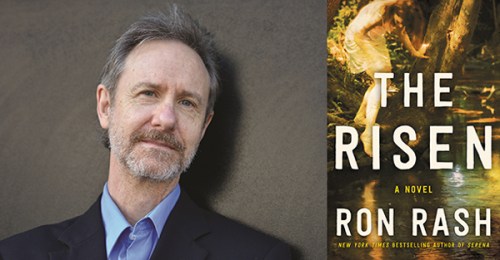 In his latest novel, The Risen (Ecco, Sept.), the narrator, Eugene, while fishing with his brother during the summer of 1969, sees a naked teenaged girl with flowing red hair in the creek, the vision of her so fleeting that he wonders if he’s seen a mermaid. Visiting from Florida, Ligeia is no mermaid, but she is an exotic and free-spirited creature who introduces the boys to the excitement of the 60s, experiences they keep secret from their small town, and the watchful eyes of their controlling grandfather.
Ligeia vanishes, as does the close relationship between the brothers as they move into adulthood. When her body surfaces 46 years later, so do the memories of that summer.
The mystery is central to this plot, and like many of Rash’s novels, the story is driven by suspense. But just under the surface, there are difficult questions involving poverty, child neglect sanctioned by religion, and abuse authorized by a self-righteous class system. These are challenging themes, and yet, there is nothing forced in Rash. His prose is clean and without affectation.
Describing fishing: “When a rod tip trembled, one of us got out to reel in what tugged the line. Often it was a knottyhead or catfish, but if a trout we gilled it onto our metal stringer.” And when Eugene’s brother would lift the string of fish from the cooling waters: “Through a gap in the canopy, the declining sun brightened the stringer’s silver sheen, flared the red slashes on the trout’s flanks.”
During our conversation on the eve of Rash’s trip to France for an Eco-Literature convention, where the theme was “Enchantment,” he tells me that “One thing that’s important for me in my work is to remind people that there is a natural world. It’s very easy to think we are not connected to it anymore, but we are, whether we want to be or not.”
His easy reverence is in direct opposition to the rendering of the natural world in TV and film as a creepy, possibly demonic, adversary—or at the very least a place to be wary if you wander too far without an iPhone. “It’s amazing,” Rash says. “When anyone goes out in the woods in a movie, you know something horrible is going to happen.”
While there is danger to irresponsible humans, and the body count can be intense in some of Rash’s more tragic works, often the most profoundly felt loss is that of a formerly protected, or undisturbed natural resource.
Family folklore, passed down from his older relatives, gave Rash the idea that the world is fundamentally enigmatic. “I want the world to be mysterious, I don’t want to know everything,” he says. “One of my great delights is when an animal, that is allegedly extinct, fools people. Jaguars have recently come back into the United States; I love those moments when the natural world surprises us, and reminds us maybe we don’t know as much as we think we do.”
To hear him describe childhood summers on his grandmother’s farm near the Blue Ridge Parkway in N.C., it’s clear why he’s a celebrated voice among the eco-engaged. “I was like Huck Finn,” he says. “My grandmother would let me go, let me wander. It was a gift. I was not afraid. I just reveled in it. The connections I made with the natural world stayed with me.”
Rash is aware that writing about the south brings the possibility, as he has said, of being softly dismissed as “just” a southern writer. Southern writing, he says, “is like any writing. It’s either good or it isn’t. It either transcends the region, or it doesn’t. The best writers from the south transcend the south. Ultimately Faulkner’s goal is not to show how exotic the south is. He has deeper concerns, and certainly Flannery O’Connor did too.”
That doesn’t mean the south is not Rash’s territory. His collection of poems entitled Eureka Mill, based on the mill where his grandparents and parents worked, draws attention to the suffering and loss of humanity that rural southerners felt (and feel) when they leave the farm for the mill. Narratives of southern exploitation are seamlessly woven into the poems, as in “The Stretch-Out,” when a girl of seventeen is exhausted from a brutal day at the mill, and miscarries a child during the night. She explains, “I cried but cried quietly/ and let the bed sheets clot and stain, so that my man and me might save/ what strength a full night’s sleep might give/ I closed my eyes and slept again.”
Constructions like “my man and me,” exhibit Rash’s ear for speech patterns. His stories are known for capturing the voice of a region, but, rendering that voice universally, so that it rings true to any ear, takes a great deal of care and modulation. To Rash, Richard Price is one of the best at translating regional voices onto the page. “In many ways I feel a much deeper connection to him than other writers in the United States,” Rash says. “He’s trying to capture the patois of New York cops and young people in the city, and at the same time, he is working toward the universal. People wouldn’t think that, because of what I write, I would connect with Richard Price, but I feel a real kinship with him.”
As exhibited in Eureka Mill and other collections, his finely honed craftsmanship is most salient in his poetry, which has a casual, addictive appeal. Often compared to Seamus Heaney, the association is especially apt considering the Celtic musical, oral, and folkways ties running deeply through the Appalachians. Palimpsest and layered possession are intrinsic realities for rural North Carolinians. Plowing a field in “The Vanquished” from this year’s Poems: New and Selected turns up “pottery and arrowheads/ bone-shards that spilled across rows/ like kindling, a once-presence/ keen as the light of dead stars.”
By situating himself as the faithful observer of the natural world, Rash makes land, and landscape, available to readers. His dramatizations aren’t driven by sentimentality, but rather complex dilemmas usually centered on a question of land exploitation, or the exploitation of former land-workers, like those stuck in North Carolina’s Eureka Mill, fleeced of their land and sense of purpose. With his latest novel, Rash again creates an irresistible conceit that transcends the South. But, of course, the importance of the South is undeniable.
Source: http://www.publishersweekly.com/pw/by-topic/authors/profiles/article/71271-not-just-a-southern-writer-ron-rash.html




 Booker's Blog