
Dark forest, empty trees /
Fog clamber over brown hills. /
Fall evening lives on.
Dark forest, empty trees /
Fog clamber over brown hills. /
Fall evening lives on.
Filed under 2016, Haiku to You Thursday, poetry by author
How the World’s Most Frequently Rejected Playwright Survives
written by Donald Drake
Source: http://www.pdc1.org/viewthisarticle.php?article=8
Several years ago, I made a profound discovery that has enabled me to weather the storm of criticism, rejection and inevitable, transient depression that is the lot of so many playwrights. What I discovered was how to make rejection work for me. Since playwrights spend far more time dealing with rejection than watching their plays being produced, every playwright should know about this.
I will explain how I made this discovery and what it has meant to me.
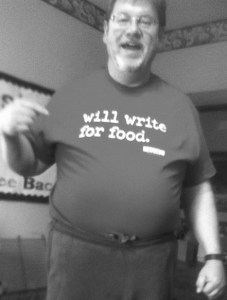
Might not be the best way to survive rejection, but it might work.
Finally I got a response, in the form of my self-addressed, stamped envelope, which contained my first script and a form letter saying the theater didn’t want my script.
Though this was disappointing, in a strange way I felt validated. At least someone had read the script. There was a living, breathing human being on the other end of the line, or so I assumed in my naiveté. Other experienced playwrights conceded that a living, breathing human being probably did put the script into the return envelope, but what proof did I have that anyone actually read it.
Two months later I received my second rejection. The letter attached to the script said “I enjoyed learning about the characters; they are multi-dimensional. Also, I enjoyed the dialogue and how it worked effectively and moved the plot along.” But the theater didn’t want to do my play. This rejection surely proved that the living breathing person had read the script before putting it into the return envelope, though my more cynical fellow playwrights pointed out that no specific characters or specific plot points were alluded to.
Then I got the best rejection ever. The letter said: “I want to let you know that I intend to give my whole-hearted support to your play as a potential candidate for our season. Thank you for a fascinating new play.” Again no specifics were mentioned, but could theater people be so sadistic to say this about a play they had never read? Yes, I was told. I never heard from the theater again.
I brushed the cynicism aside. “Thank you for a fascinating new play.” The phrase kept coming back to me several times during the next couple of months as I pounded away at my computer with renewed enthusiasm, working on my third play. My initial sadness over not getting a production was being replaced by the joy of knowing that my work was being appreciated, though, admittedly, not enough to be produced. Every day when the post lady arrived with my mail, I eagerly looked for the tell-tale, 11-by-13-inch manila envelope, which would contain my script and hopefully an encouraging rejection letter.
I had discovered that I could lift my spirits by simply changing focus. Instead of looking for a production, which rarely if ever happens, I started anticipating nice rejections, which were now happening fairly frequently. I decided to capitalize on the discovery by keeping detailed records of the rejections. And so the Drake Rejection Database (DRD) was born. Ultimately the DRD would show what theaters sent the best rejections (by far the best come from England), the elapsed time between submission and rejection, the number of plays or sample dialogue pending, the total number of rejections to date and many other facts.
I started attacking rejection with abandonment. I came up with a clever way to identify theaters that did not even open envelopes but just threw scripts onto a pile or even worse into the trash can (though I suppose the trash can is no worse than a stack of scripts that will never be looked at). Slyly, I included with the synopses and sample dialogue I sent to theaters a self-addressed postcard with three boxes the assistant, to the assistant, literary manager could check.
“Please send script ___”
“Please don’t send script ___”
“Don’t send any more scripts ___.”
Theaters that never sent back postcards could be assumed to never open envelopes that contained unsolicited scripts. This ploy identified the bad theaters, the ones to stay away from. But how could I identify the good theaters? The answer to this question was contained in the rejection letters I was receiving. Any theater that actually commented on one of my plays was by definition a good theater. I made use of this vital information by including in the DRD abbreviated comments from theaters. For instance, a DRD entry for my play Final Edition looked like this:
COMMENT-FINAL “We are interested in your writing and would be eager to read and consider any other new plays that you might have.”
By doing a computer search for just “COMMENT,” I could identify theaters that were actually reading plays and choose them as the first theaters for future submissions.
Though I didn’t realize it at the time, the DRD would turn out to be an invaluable tool in quantifying the way theaters handled scripts and treated playwrights.
A few of the discoveries:
I don’t want to give the impression that I have never succeeded with any of my plays. I have been a winner in 11 national competitions. One of my plays was done at the O’Neill. I’ve had four showcases, three of them in New York City, and seven productions. One of the productions was done in a theater where the literary manager was a best friend and another production was done in a theater where I was well known to the artistic director, which in itself says a lot about how to get a play produced.
In the 26 years I have been writing plays, I have made about $10,000 in grants, winnings from competitions and actual payment by a theater for a script. This is offset by the $8,876 I spent for script duplication, stationery and postage. Still I made a profit of $1,124. Having spent 34,000 hours writing plays during this period, my compensation comes to 3 cents an hour. (This doesn’t include the $3,000 or so I spent mailing scripts to competitions, so I guess I can’t even claim that meager profit.)
If I had achieved none of these things, would my philosophy and the DRD have been enough to sustain me? I would like to say yes, but I doubt it. I don’t think I could keep on writing if I cut out the middle man and threw all my scripts into the trash can myself after finishing them the way crossword puzzles are discarded once they’re completed. The distant hope that something could come from all this writing is probably necessary.
But this doesn’t change my take-home message. I have proven beyond doubt that any playwright who writes stage plays primarily to get produced or make money is delusional or masochistic. The joy must come from the writing itself, solving the myriad of problems that arise in creating a play, just as you enjoy fitting together the pieces of a puzzle to form a picture with no other reward expected.
I’m in particularly good spirits at this moment, which probably accounts for the fact that I am writing this, after thinking about doing it for several years. Much of the good feeling is coming from writing this essay and discovering that I have accomplished more than I thought. And one of my plays, written with another playwright for the Philadelphia Fringe, is currently in rehearsal. But even after the play closes and regardless of how the critics respond, or don’t respond, I’m sure I will continue to be a happy playwright.
I have scripts or sample dialogue pending in 78 theaters. And the DRD tells me that I will assuredly be receiving 15 letters of rejection with very encouraging comments in the coming months.
Filed under 2016, writing tip, Writing Tip Wednesday
Continuing the musical theme from yesterday’s joke:
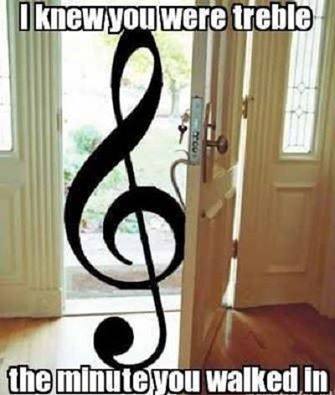
The moment you walked in, the mood turned sharply, then flat-out became annoying.
[Editor’s note: yeah, it’s not a cartoon in the sense of being hand drawn fun.]
Filed under 2016, CarToonsday
Source: TMR Submissions | Just another The Missouri Review Sites site
A chance to get published. You can submitted electronically or by mail.
Isn’t that nice
Two Southern ladies were conversing on the porch swing of a large white-pillared mansion.
The first woman said, “When my first child was born, my husband built this beautiful mansion for me.”
The second woman commented, “Well, isn’t that nice.”
The first woman continued “When my second child was born, my husband bought me that fine Cadillac automobile you see parked in the drive.”
Again, the second woman commented, “Well, isn’t that nice.”
The first woman boasted “Then, when my third child was born, my husband bought me this exquisite diamond bracelet.”
Yet again, the second woman commented “Well, isn’t that nice.”
The first woman then asked her companion, “What did your husband buy for you when you had your first child?”
The second woman replied “My husband sent me to charm school.”
“Charm school!” the first woman cried “land sakes, child, what on Earth for?”
The second woman responded, “So that instead of saying ‘who cares?’, I learned to say ‘Well, isn’t that nice.'”
Filed under 2016, Monday morning writing joke
Very few programs in television history can be easily identified by their sound effects alone. The original 1966-69 run of Gene Roddenberry’s Star Trek belongs in that select fraternity, thanks to the efforts of sound mixer Doug Grindstaff and other craftsmen who toiled on the classic science-fictio
In case you thought the genre wasn’t for you.
By Tobias Carroll
Source: http://www.readitforward.com/bookshelf/science-fiction-books-people-dont-read-science-fiction/
Science fiction can be an acquired taste. Some readers grew up on it; others never quite saw the appeal of stories involving time travel, alien contact, space exploration, or the ways in which these concepts can be used to explore moral and intellectual debates. But if you’re a reader who’d like to ease their way into the genre, there are a few great places to begin. Some provide a well-written introduction to key science fictional tropes and concepts, while others juxtapose intensely human stories with headier conceptual elements. Here’s a look at fourteen books that introduce big ideas in accessible ways and present readers with a host of directions they can go from there.
Example:
Use of Weapons
 Much of Iain M. Banks’s science fiction was set in the world of The Culture, a utopian society that encompasses massive amounts of space, and includes artificial intelligence, alien species, simulated afterlives, and more. But for all of that, Banks is also adept at writing memorable characters, and at the center of Use of Weapons, readers will find exactly that, in the person of the memorably-named Cheradenine Zakalwe—along with a structurally innovative method of telling the story.
Other books include:
Details: http://www.readitforward.com/bookshelf/science-fiction-books-people-dont-read-science-fiction/
The other day, an acquaintance on Facebook wrote about an “encounter” with a couple of mice that had invaded her second story writing office. She “inflated” the encounter here and there to give it a little fun.
Below is my response to her posting. The encounter told from the point of view of the mice.
Told all in dialogue. You can be the judge if it works.
I call it, Encounter in Fine Print.
“Brian. Hey, Brian, you think it’s workin’? Think we’re scaring her?”
“Yeah, Pink, I think if we stare at her long enough through this magnifying thing we found she’ll think we are four times our size with fangs and claws six inches long. Just keep staring at her.”
“But Brian….”
“Yes, Pink?”
“How do we eat and stare at the same time?”
“We don’t, Pink.”
“Why do you call me Pink? My name’s Gerald.”
“Gerald won’t get us anywhere.”
“Are we goin’ somewhere? I thought we came here for snacks. You know, cheese bits and stuff.”
“Never say ‘and stuff.’ Just say cheese bits.”
“Why?”
“Because I said so.”
“So, I have to be Pink because you said so, and I can’t say ‘and stuff’ because you said so.”
“That’s right.”
“I don’t think I like this game.”
“It’s not a game, Gerald. It’s … it’s … ah … okay, it is a game, but it is a game to make us famous.”
“I want snacks.”
“When we become famous, you will have all the snacks you can handle. I’ll even give you one of mine, Pink.”
“Really!” Pink said.
“Really.”
“Really?”
“Really,” Brian said.
“But when do we get snacks?”
“After we scare this woman. She’s a writer. We scare her, she will put us in one of her stories, her fantastical tales.”
“My tail is nice, but I wouldn’t call it fantastic.”
“It’s not about your tail.”
“If it’s not about snacks and it’s not about my tail. What is it about?”
“Gerald….”
“I thought it was Pink.”
“Pink, I will say it one last time. It’s about being famous. This lady writer writes a story about us in which we are monsters out to take over the world. We’re fifty foot—No, 100 foot rats with fangs like Mammoth tusks and we eat everything in sight. Men, women, children.”
“And they’re our snacks?”
“Yes, Pink, they are our snacks.”
“But I don’t want to eat children.”
“You don’t have to.”
“When do we eat? I’m starving.”
“Not yet, because we have to have to take the story to a Hollywood director, who will want to turn it into a screenplay with lots of special effects that he will use to splash the story across the big screen.”
“And we’ll be movie stars and get snacks?”
“Yes.”
“The Hundred Foot Rat starring Pink and Brian.”
“Brian and Pink”
“Pink and Brian.”
“I think you need a new name.”
“Brian’s a good name.”
“So’s Gerald. But you won’t let it be Gerald and Brian.”
“Okay. Maybe we can use an anagram.”
“Aunt Gram? I think your name would be silly. Aunt Gram.”
“Anagram. Anagram. You rearrange the letters to spell something else.”
“Oh, is that how you got Pink out of Gerald?”
“Ah … exactly.”
“Then what would your Aunt Gram be?”
“Brian … Brian … An rib? No. Hummm. Brian … Brian. Brain. That’s it – Brain.”
“So, we’ll be Pink and Brain.”
“Oh, okay. Your nom de guerre can be first.”
“Now it’s going to be Name the gear and Brain?”
“Pink for short.”
“So Pink for short and Brian?”
“Close enough.”
“Hey, where did the lady writer go? The one who was going to make us monsters?”
“Well, Pink for short, I think she went to get help.”
“You mean another writer to help her write our story, Brain? Our story with snacks in it?”
“Not exactly. I don’t think those footsteps sound friendly.”
“You mean no snacks, Brain.”
“I mean no snacks, Pink.”
“And I bet there ain’t no story, either.”
Filed under 2016, Random Access Thoughts, Silly Saturday, Story by author

It wasn’t a a really big shoe, but still the mystery remained. There was only one of it. What had happened to the left one? Apparently, it wasn’t left behind, and neither was the person who had been wearing this one, lonely shoe.
Filed under 2016, Photo by Lauren Booker, Photo Finish Friday
Lumpy, churlish clouds /
banging against the horizon, /
bloodied by the sun.
Filed under 2016, Haiku to You Thursday, poetry by author


