Tag Archives: writing

Are All Movie Heroes the Same Person? – Pacific Standard: The Science of Society

Are All Movie Heroes the Same Person? – Pacific Standard: The Science of Society.

Perhaps you’ve heard they’re making another Star Wars film. Perhaps you’ve read up on the backgrounds of the new cast members and heard that the Oscar-winning Lupita Nyong’o will also be joining the crew on their adventures in a galaxy far, far away. Maybe you delivered a furtive fist pump upon seeing the leaked production photos, which show actual physical buildings and creatures on set in Abu Dhabi, as opposed to studio rooms adorned with green screens. Whether you’re a fan of the nearly 40-year-old franchise or not, the hype surrounding its next installment—scheduled for release in December 2015—is pretty hard to ignore.

While several factors deserve credit for Star Wars’ ongoing popularity—the ballet-like lightsaber duels, the roguish charm of Harrison Ford’s Han Solo, the massive amounts of toy merchandising—it’s quite possible that the space opera’s greatest strength lies in its reliance upon the work of American mythologist Joseph Campbell.

Read the rest at: http://www.psmag.com/navigation/books-and-culture/movie-heroes-person-joseph-campbell-monomyth-83796/#.U6SbO7MNr_o.facebook

Leave a comment

Filed under Joseph Campbell, mythology

New Waves in Science Fiction: An Interview with Jonathan Lethem

Some thoughts on science fiction.

skepoet2's avatar Bangs, Whimpers, Arts, Culture, and Commentary

Interview by  Dinesh Raghavendra, Steven A. Michalkow, C. Derick Varn, Jayaprakash Sathyamurthy. Jake Waalk, and Joseph Brenner

Jonathan Lethem is an American novelist, essayist and short story writer. His first novel, Gun, with Occasional Music, a multi-genre work that mixed elements of science fiction and detective fiction, was published in 1994. It was followed by three more science fiction novels. In 1999, Lethem published Motherless Brooklyn, a National Book Critics Circle Award-winning novel that achieved him mainstream literary success. In 2003, he published The Fortress of Solitude, which became a New York Times Best Seller. In 2005, he received a MacArthur Fellowship. His most recent book is Dissident Gardens.  We decided to speak to him about New Wave science fiction, and its relationship to mainstream literary writing as well as other developments in a writer’s life.

Do movements like the new wave achieve any sort of…

View original post 2,256 more words

1 Comment

Filed under science fiction

Crime and Science Radio: The Art and Science of Law Enforcement: An Interview with Robin Burcell

Still a chance to listen, and links to additional information.

D.P. Lyle, MD's avatarThe Crime Fiction Writer's Blog

robinside

Saturday 6-14-14 at 10 a.m. PDT, join DP Lyle and Jan Burke in conversation with Robin Burcell, who is the author of award-winning crime fiction — including this year’s The Kill Order, featuring FBI Agent Sydney Fitzpatrick.  Robin also spent nearly three decades working in law enforcement: she has worked as a police officer, a forensic artist, a hostage negotiator, and a detective.

killorder

LISTEN: http://www.blogtalkradio.com/suspensemagazine/2014/05/09/crime-and-science-radio-with-robin-burcell

LINKS:

Robin Burcell’s Website: http://www.robinburcell.com

HOSTAGE NEGOTIATION:

How Stuff Works: Hostage Negotiation: http://people.howstuffworks.com/hostage-negotiation.htm

PoliceOne.com: Hostage negotiations: Psychological Strategies For Resolving Crises: http://www.policeone.com/standoff/articles/1247470-Hostage-negotiations-Psychological-strategies-for-resolving-crises/

International Association of Hostage Negotiators: http://www.hostagenegotiation.com

Time: 6 Hostage Negotiation Techniques That Will Get You What You Want: http://time.com/38796/6-hostage-negotiation-techniques-that-will-get-you-what-you-want/

Hostage Negotiation: Psychological Principles and Practices: https://www.psychceu.com/miller/Miller_Hostage_Neg.pdf

Psychology Today: Active Listening Techniques of Hostage & Crisis Negotiators: http://www.psychologytoday.com/blog/beyond-words/201311/active-listening-techniques-hostage-crisis-negotiators

FORENSIC ART:

International Association for Identification: https://theiai.org

ForensicArtist.com: http://www.forensicartist.com

Crime Library: Forensic Art: http://www.crimelibrary.com/criminal_mind/forensics/art/1.html

History of Forensic Art: http://www.forensicartist.com/history/

You Tube: Forensic Art: https://www.youtube.com/watch?v=4T_2YCpZMyA

View original post 4 more words

1 Comment

Filed under forensics, mystery

The American Scholar: Ten Best Sentences – Our Editors

The American Scholar: Ten Best Sentences – Our Editors.

Its vanished trees, the trees that had made way for Gatsby’s house, had once pandered in whispers to the last and greatest of all human dreams; for a transitory enchanted moment man must have held his breath in the presence of this continent, compelled into an aesthetic contemplation he neither understood nor desired, face to face for the last time in history with something commensurate to his capacity for wonder.

—F. Scott Fitzgerald, The Great Gatsby

I go to encounter for the millionth time the reality of experience and to forge in the smithy of my soul the uncreated conscience of my race.

—James Joyce, A Portrait of the Artist as a Young Man

This private estate was far enough away from the explosion so that its bamboos, pines, laurel, and maples were still alive, and the green place invited refugees—partly because they believed that if the Americans came back, they would bomb only buildings; partly because the foliage seemed a center of coolness and life, and the estate’s exquisitely precise rock gardens, with their quiet pools and arching bridges, were very Japanese, normal, secure; and also partly (according to some who were there) because of an irresistible, atavistic urge to hide under leaves.

—John Hersey, Hiroshima

Find the rest at: http://theamericanscholar.org/ten-best-sentences/#.U4K1USiootV

Leave a comment

Filed under Uncategorized

Crime Writer Michael Connelly Shares Secrets With Students | TheLedger.com

Crime Writer Michael Connelly Shares Secrets With Students | TheLedger.com.

Sample:
Bestselling crime novelist Michael Connelly had just returned from two weeks in New York, where he met with writers planning scripts for a new TV series adapted from his books about the Los Angeles Detective Harry Bosch.

He planned to take part in a conference call Thursday evening to help determine who would direct each episode for the first season of “Bosch.”

In between, Connelly stood in the Mini Theater at Harrison School for the Arts on Thursday afternoon, handing out copies of the script for the first episode of “Bosch” to a group of teenagers. Connelly, also author of “The Lincoln Lawyer,” spent nearly two hours talking to some 30 students in the Motion Picture Arts program at the Lakeland school.

Connelly, who lives in Tampa, talked about the writing process, the creation of characters and the challenges of adapting novels for TV and movies. He also treated Motion Pictures Arts instructor Rick Jansen’s class to the opening scene of the pilot for “Bosch,” which is still in production will be available for streaming on Amazon as early as next fall.

“I think that’s really nifty,” senior Eric Moots said afterward about Connelly’s visit to the school. “I don’t think this could happen anywhere besides Harrison.”

Continued at: http://www.theledger.com/article/20140419/NEWS/140419149/1002/sports?p=1&tc=pg

Leave a comment

Filed under Writers on writing

The Underrated, Universal Appeal of Science Fiction – Chris Beckett – The Atlantic

The Underrated, Universal Appeal of Science Fiction – Chris Beckett – The Atlantic.

Sample:
When I’m introduced to someone as a writer, a now familiar pattern of events often follows.

“Oh, really! How interesting!” the someone—let’s call her Jane—says, sounding quite enthusiastic. “What do you write?”

“Science fiction,” I say.

Jane instantly glazes over. “I’m afraid I never read science fiction.”

In other instances, people who know me have read a book of mine out of curiosity and then told me, in some surprise, that they liked it—“even though I don’t normally like science fiction.” Indeed, when a short story collection of mine won a non-genre prize, it was apparently a surprise to the judges themselves: According to the chair of the judging panel, “none of [them] knew they were science-fiction fans beforehand.” 

Source: http://www.theatlantic.com/entertainment/archive/2014/04/the-underrated-universal-appeal-of-science-fiction/360627/

Leave a comment

Filed under science fiction

Never Put Two Spaces After A Period – Business Insider

Never Put Two Spaces After A Period – Business Insider.

Can I let you in on a secret? Typing two spaces after a period is totally, completely, utterly, and inarguably wrong.

And yet people who use two spaces are everywhere, their ugly error crossing every social boundary of class, education, and taste.

You’d expect, for instance, that anyone savvy enough to read Slate would know the proper rules of typing, but you’d be wrong; every third e-mail I get from readers includes the two-space error. (In editing letters for “Dear Farhad,” my occasional tech-advice column, I’ve removed enough extra spaces to fill my forthcoming volume of melancholy epic poetry, The Emptiness Within.)

The public relations profession is similarly ignorant; I’ve received press releases and correspondence from the biggest companies in the world that are riddled with extra spaces. Some of my best friends are irredeemable two spacers, too, and even my wife has been known to use an unnecessary extra space every now and then (though she points out that she does so only when writing to other two-spacers, just to make them happy).

What galls me about two-spacers isn’t just their numbers. It’s their certainty that they’re right. Over Thanksgiving dinner last year, I asked people what they considered to be the “correct” number of spaces between sentences. The diners included doctors, computer programmers, and other highly accomplished professionals.

Everyone—everyone!—said it was proper to use two spaces. Some people admitted to slipping sometimes and using a single space—but when writing something formal, they were always careful to use two. Others explained they mostly used a single space but felt guilty for violating the two-space “rule.” Still others said they used two spaces all the time, and they were thrilled to be so proper.

Read more: http://www.slate.com/articles/technology/technology/2011/01/space_invaders.2.html#ixzz2sjI4n4vN

7 Comments

Filed under writing tip

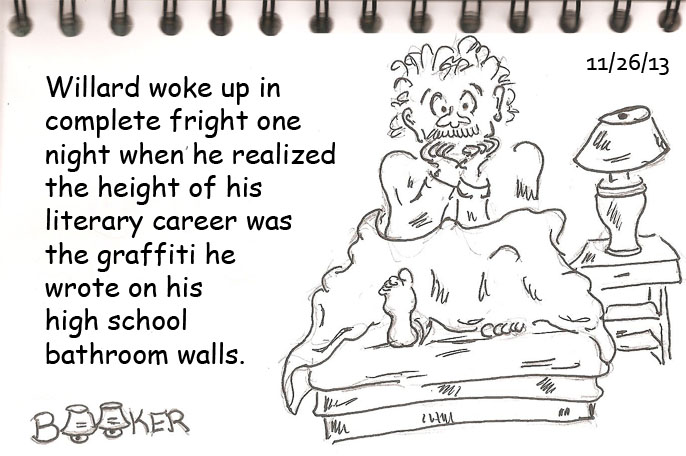
cARtOONSDAY: “lITERARY hEIGHTS”

The writing is sometimes on the wall.

The writing is sometimes on the wall.

3 Comments

Filed under cartoon by author, CarToonsday

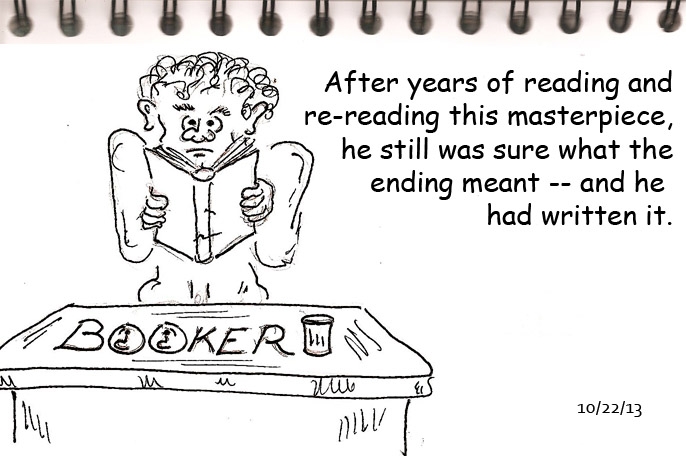
cARtOONSDAY: “eNDINGS”

Reading too much into it.

Reading too much into it.

Leave a comment

Filed under cartoon by author, CarToonsday

Writing tip Wednesday: “Bits of Wisdom”

Here’s a collection of wisdoms from the star-studded panels and sessions at ThrillerFest by way of Writer’s Digest.

“Protect your voice and your vision. If going on the Internet and reading Internet reviews is bad for you, don’t do it. … Do what gets you to write and not what blocks you. … Don’t take any guff off anybody.”
–Anne Rice

“I encourage every writer to write the book that only you can write.” It’s one thing to be respectful of trends but it’s another to express your unique viewpoint in your book. “Don’t be a copycat. … The last thing I want is to see something and feel, Didn’t I just read this someplace else?”
–Michaela Hamilton, editor-in-chief of Citadel/executive editor of Kensington

“The book has to deliver. … It isn’t a particular element that I’m looking for, but I want to be transported.”
–Lisa Gallagher, literary agent

“You may not think that you have an interesting story to tell and you may not think there’s something fascinating in your story, but there is.”
–Heather Drucker, publicist (HarperCollins), on how everyone has a unique personal publicity hook they can use to promote their book

“You can be as complex as you want as long as you’re clear about it.”
–David Morrell, bestselling author of First Blood

For more, go to http://www.writersdigest.com/online-editor/9-inspirational-thrillerfest?et_mid=628280&rid=3087253

Leave a comment

Filed under Writing Tip Wednesday