Source: TMR Submissions | Just another The Missouri Review Sites site
A chance to get published. You can submitted electronically or by mail.
Source: TMR Submissions | Just another The Missouri Review Sites site
A chance to get published. You can submitted electronically or by mail.
The other day, an acquaintance on Facebook wrote about an “encounter” with a couple of mice that had invaded her second story writing office. She “inflated” the encounter here and there to give it a little fun.
Below is my response to her posting. The encounter told from the point of view of the mice.
Told all in dialogue. You can be the judge if it works.
I call it, Encounter in Fine Print.
“Brian. Hey, Brian, you think it’s workin’? Think we’re scaring her?”
“Yeah, Pink, I think if we stare at her long enough through this magnifying thing we found she’ll think we are four times our size with fangs and claws six inches long. Just keep staring at her.”
“But Brian….”
“Yes, Pink?”
“How do we eat and stare at the same time?”
“We don’t, Pink.”
“Why do you call me Pink? My name’s Gerald.”
“Gerald won’t get us anywhere.”
“Are we goin’ somewhere? I thought we came here for snacks. You know, cheese bits and stuff.”
“Never say ‘and stuff.’ Just say cheese bits.”
“Why?”
“Because I said so.”
“So, I have to be Pink because you said so, and I can’t say ‘and stuff’ because you said so.”
“That’s right.”
“I don’t think I like this game.”
“It’s not a game, Gerald. It’s … it’s … ah … okay, it is a game, but it is a game to make us famous.”
“I want snacks.”
“When we become famous, you will have all the snacks you can handle. I’ll even give you one of mine, Pink.”
“Really!” Pink said.
“Really.”
“Really?”
“Really,” Brian said.
“But when do we get snacks?”
“After we scare this woman. She’s a writer. We scare her, she will put us in one of her stories, her fantastical tales.”
“My tail is nice, but I wouldn’t call it fantastic.”
“It’s not about your tail.”
“If it’s not about snacks and it’s not about my tail. What is it about?”
“Gerald….”
“I thought it was Pink.”
“Pink, I will say it one last time. It’s about being famous. This lady writer writes a story about us in which we are monsters out to take over the world. We’re fifty foot—No, 100 foot rats with fangs like Mammoth tusks and we eat everything in sight. Men, women, children.”
“And they’re our snacks?”
“Yes, Pink, they are our snacks.”
“But I don’t want to eat children.”
“You don’t have to.”
“When do we eat? I’m starving.”
“Not yet, because we have to have to take the story to a Hollywood director, who will want to turn it into a screenplay with lots of special effects that he will use to splash the story across the big screen.”
“And we’ll be movie stars and get snacks?”
“Yes.”
“The Hundred Foot Rat starring Pink and Brian.”
“Brian and Pink”
“Pink and Brian.”
“I think you need a new name.”
“Brian’s a good name.”
“So’s Gerald. But you won’t let it be Gerald and Brian.”
“Okay. Maybe we can use an anagram.”
“Aunt Gram? I think your name would be silly. Aunt Gram.”
“Anagram. Anagram. You rearrange the letters to spell something else.”
“Oh, is that how you got Pink out of Gerald?”
“Ah … exactly.”
“Then what would your Aunt Gram be?”
“Brian … Brian … An rib? No. Hummm. Brian … Brian. Brain. That’s it – Brain.”
“So, we’ll be Pink and Brain.”
“Oh, okay. Your nom de guerre can be first.”
“Now it’s going to be Name the gear and Brain?”
“Pink for short.”
“So Pink for short and Brian?”
“Close enough.”
“Hey, where did the lady writer go? The one who was going to make us monsters?”
“Well, Pink for short, I think she went to get help.”
“You mean another writer to help her write our story, Brain? Our story with snacks in it?”
“Not exactly. I don’t think those footsteps sound friendly.”
“You mean no snacks, Brain.”
“I mean no snacks, Pink.”
“And I bet there ain’t no story, either.”
Filed under 2016, Random Access Thoughts, Silly Saturday, Story by author
[Writer’s note: What began as a writing prompt — photo and first paragraph — has become at least the start of a story. I will endeavor to add short sections to it, at lest as long as there is some interest. It might be a little rough in parts, but that’s because it is coming “hot off the press,” which could be part of the fun of it. In the meantime, you are free to jump off from any part of this story thus far and write your own version. Click Holly’s Corner below to get Parts 1 – 12.]
by David E. Booker
“Tricia’s mom suspected my father of sleeping with a neighbor lady and one day while Dad and the woman were away, she broke into the woman’s house looking for evidence. She didn’t find any, but she found this recipe. According to the story Tricia’s mom told me once, this recipe was out on the counter and just for spite, she stole it. She didn’t even know what it was. She was just angry and looking for some way to let this woman know that if she was going to steal from her, she was going to steal from this neighbor lady.”
“Does this neighbor lady have a name?”Rachel shook her head. “She does, but I don’t remember it. ‘Neighbor lady’ was all my step-mom ever called her. I guess that’s all that stuck. Is it important?”
I shrugged. “Better to know than not.”
She smiled. “You sound like my dad, except he wasn’t saying it about knowledge, if you know what I mean.”
“Is your dad still living?”
Rachel shook her head. “He died in the arms of another woman, you might say.”
“Another woman he was have an affair with?”
“You could say that. Except this woman was a man … in woman’s clothing. He was one of those shemales, I guess they’re called. Disgusting is what they are. This one even had the gall to come to the funeral. Best fucking dressed bitch at the viewing. Had men slobbering after her until somebody pointed out the bump in the front of the skirt.”
“I bet that was you,” I said.
Rachel blushed slightly. It took the edge off her indignation and made her appear almost childlike – as if she’d been caught doing something she shouldn’t have, and while embarrassed, not fully repentant.
“Sure caused a titter or two at Dad’s send off.” She then started giggling. It was almost infectious. Even I smiled, but resisted the urge to join along.
“Would this transsexual have anything to do with the recipe?”
“Fuck no.”
I raised a hand. “Just thought I’d ask.”
“Though the bitch did try to get a piece of the pie, if you will, after Daddy died, claiming that he’d promised this he-thing several thousand dollars toward some final surgery.”
I wasn’t sure where to go. This still seemed more like some intra-family feud, and not one that would put food on my table.
“I think a family councilor would help you all better than a private cop.”
Rachel stared at me, and then nodded. “You’re probably right.” She gathered up her purse and her money, and then stood up from the booth. “Thank you for your time.”
She turned and marched out the front door of The Time Warp Tea Room. In the background, on the big TV screen, a black-and-white western played. A man dressed in a white hat and light-colored clothes was facing down a group of dark-dressed, black-hatted guys.
Bang, bang, you’re broke.
#
“A string of fools does not a strand of pearls make.”
I looked up from one of my bills and saw Father Brown standing across the desk from me. He had moved so quietly, I had not heard him.
“Some Bible passage I missed?” I asked.
Brown chuckled briefly. It was almost more of a snort. “I dare say not.”
“Not even ‘The Bible according to Father Brown’?”
“To do such a thing would be blasphemy.”
“Many of your brethren, especially on TV on Sunday mornings would disagree.”
“Barbarians and charlatans.”
“And for a modest donation, you, too, can receive this soiled section of cloth that I have put to my forehead as I prayed to God over your situation. He has shown me the truth and for only a few dollars more—”
“They wouldn’t use the word ‘soiled’ or the phrase ‘for only a few dollars more,” Brown said. “They wouldn’t be so crass.”
“But the intent would be just the same,” I said. “For a few dollars more, take you to the point of taking a few dollars more.”
“You are a cynical man,” Brown said. “I shall pray for the deliverance of your immortal soul.”
“While you’re at it, pray from some daily bread. If I don’t find paying work soon, your God may get his soul back sooner than he planned.”
“God is never surprised,” Brown said.
“Pity him.”
Brown smiled, and then shook his head. “If you don’t believe, then why’d you take me in?”
“Maybe I’m hedging my bets. Or maybe I like pissing off my neighbors.”
“I shall leave you to your ponderings.”
“And my immortal soul?”
“I shall leave you with that, too. At least for now.”
I thought about asking if it had any market value, but wasn’t sure I was ready to make any Faustian bargains with something I didn’t think I had.
Then my cell phone buzzed in its holster and I didn’t have to think about it any longer. “Gumshoe Detective Agency. We pound the pavement so you don’t have to.”
“You think you’re funny with that line? ‘We pound the pavement so you don’t have to.’” The guy’s falsetto wasn’t too grating, but I didn’t care of the mocking tone that went along with it. “I outa come over there and knock your block off.”
I hadn’t heard that phrase in a while. Nobody ever dictated that threats had to original. They might be more fun if they were.
“Come on over,” I said. “I’ll wait.”
There was silence on the wavelength. I don’t think he was expecting that. Maybe that was the reason he hung up … and then called back. I didn’t bother with my opening spiel. I already knew how he felt about that.
“You’re a real piece of work, you know that, refusing to take my wife’s case.”
“Which wife is that?” I was only half-joking. I didn’t know if Rachel was married and I didn’t know if Tricia was, either. Neither one had said and I hadn’t asked.
“Rachel, you jackass.”
“Whoever you are, if you are the husband, I think you should look after your wife, because she’ll probably have one hell of a headache. And tempting as it was to take the money she was flashing around like loose feathers from a down comforter, I try not to take money from drunk people wanting to hire me. They usually sober up and regret it.”
“She’s sobering up now, and she still wants you to take the case.” Then he said in a lower voice, “And if you don’t, I won’t hear the end of it.”
It may be sexist to say I felt sorry for the man when I heard him say it, but I did. I had spent a little time with Rachel and I could see how he might not hear the end of it. I took his address and told him I would be there in thirty minutes.
He hung up without saying thanks and that annoyed me. Manners have disappeared from the face of civility, leaving this unkempt mess of rules and political correctness. You fart in public now and you don’t say excuse me. Instead you fart and then you condescendingly sneer at anyone who looks your way as if to say, “How do you like me now, baby?”
(To be continued.)
Filed under 2016, photo by David E. Booker, Story by author
From Elmore Leonard’s Ten Rules of Writing.
http://www.elmoreleonard.com/index.php
My most important rule is one that sums up the 10: if it sounds like writing, rewrite it.
Filed under 2016, writing tip, Writing Tip Wednesday
Period. Full Stop. Point. Whatever It’s Called, It’s Going Out of Style
By DAN BILEFSKY
LONDON — One of the oldest forms of punctuation may be dying
The period — the full-stop signal we all learn as children, whose use stretches back at least to the Middle Ages — is gradually being felled in the barrage of instant messaging that has become synonymous with the digital age
So says David Crystal, who has written more than 100 books on language and is a former master of original pronunciation at Shakespeare’s Globe theater in London — a man who understands the power of tradition in languageThe conspicuous omission of the period in text messages and in instant messaging on social media, he says, is a product of the punctuation-free staccato sentences favored by millennials — and increasingly their elders — a trend fueled by the freewheeling style of Facebook, WhatsApp and Twitter
“We are at a momentous moment in the history of the full stop,” Professor Crystal, an honorary professor of linguistics at the University of Wales, Bangor, said in an interview after he expounded on his view recently at the Hay Festival in Wales
“In an instant message, it is pretty obvious a sentence has come to an end, and none will have a full stop,” he added “So why use it?”
In fact, the understated period — the punctuation equivalent of stagehands who dress in black to be less conspicuous — may have suddenly taken on meanings all its own
Increasingly, says Professor Crystal, whose books include “Making a Point: The Persnickety Story of English Punctuation,” the period is being deployed as a weapon to show irony, syntactic snark, insincerity, even aggression
If the love of your life just canceled the candlelit, six-course, home-cooked dinner you have prepared, you are best advised to include a period when you respond “Fine.” to show annoyance
“Fine” or “Fine!,” in contrast, could denote acquiescence or blithe acceptance
“The period now has an emotional charge and has become an emoticon of sorts,” Professor Crystal said “In the 1990s the internet created an ethos of linguistic free love where breaking the rules was encouraged and punctuation was one of the ways this could be done”
Social media sites have only intensified that sense of liberation
Professor Crystal’s observations on the fate of the period are driven in part by frequent visits to high schools across Britain, where he analyzes students’ text messages
Researchers at Binghamton University in New York and Rutgers University in New Jersey have also recently noted the period’s new semantic force
They asked 126 undergraduate students to review 16 exchanges, some in text messages, some in handwritten notes, that had one-word affirmative responses (Okay, Sure, Yeah, Yup) Some had periods, while others did not
Those text message with periods were rated as less sincere, the study found, whereas it made no difference in the notes penned by hand
Geoffrey Nunberg, a linguist who teaches at the University of California, Berkeley, noted that the 140-character limit imposed by Twitter and the reading of messages on a cellphone or hand-held device has repurposed the punctuation mark
“It is not necessary to use a period in a text message, so to make something explicit that is already implicit makes a point of it,” he said “It’s like when you say, ‘I am not going – period’ It’s a mark It can be aggressive It can be emphatic It can mean, ‘I have no more to say’
Can ardent fans of punctuation take heart in any part of the period’s decline? Perhaps.
The shunning of the period, Professor Crystal said, has paradoxically been accompanied by spasms of overpunctuation
“If someone texts, ‘Are you coming to the party?’ the response,” he noted, was increasingly, “Yes, fantastic!!!!!!!!!!!”
But, of course, that exuberance would never be tolerated in a classroom
At the same time, he said he found that British teenagers were increasingly eschewing emoticons and abbreviations such as “LOL” (laughing out loud) or “ROTF” (rolling on the floor) in text messages because they had been adopted by their parents and were therefore considered “uncool”
Now all we need to know is, what’s next to go? The question mark
10 Writing “Rules” We Wish More Science Fiction and Fantasy Authors Would Break
by Charlie Jane Anders
Science fiction and fantasy are genres where almost anything can happen — as long as the author can make it seem plausible, and as long as it’s part of a good story. But that doesn’t mean there are no rules. If anything, the fact that these genres are so wide open mean that there are tons of rules out there, some unspoken and some written in black and white.
And sometimes, breaking the rules is the only way to tell a really fascinating story. Here are 10 rules of SF and fantasy that more authors should consider breaking from time to time.
Note: We’re not saying you must break any of the rules below. You can craft a brilliant work of fiction while still following all of the rules below. And most of these rules exist for a reason — because if you break them without knowing what you’re doing, you can screw up horrendously. Some of the rules below represent things that may have been done to death in the past, so it’s best to make sure you have a fresh spin. But at the same time, too many rules can be a creativity-killer, and sometimes it’s good to bust out some illegal moves.
Third-person omniscient used to be the default mode for a lot of novelists — a lot of the classics of literary fiction as well as science fiction are written in third person omniscient. This means, in a nutshell, that the narrator can see what’s going through any character’s head, and can flit around as the story requires. But in recent years, fiction writers have opted for first person or limited third — in which only one person at a time gets to be a viewpoint character. The thing is, though, when you have tight third person with multiple viewpoint characters, it often feels like an omniscient narrator who’s choosing to play games.1) No third-person omniscient
An actual third-person omniscient can be fantastic — you need look no further than Douglas Adams’ Hitchhiker’s Guide to the Galaxy, which freely lets you know what Arthur Dent, Ford Prefect and assorted other characters are thinking at any given moment. Or countless classic SF writers, for that matter. But I also want to put in a plea: anyone who’s serious about writing genre fiction should read Henry Fielding, who makes third-person omniscient into an art form. In novels like Joseph Andrews and Tom Jones, Fielding draws these brilliant tableaux where he pauses to show what everyone’s thinking, and how much at cross-purposes everyone is. It helps him be a keen observer of people, and also creates these beautifully funny set pieces.
2) No prologues
This is one I’ve been hearing for years — some agents and editors say they stop reading immediately if they see that a book has a prologue. But prologues have their uses, especially if you want to set a mood or establish some crucial backstory before you start introducing your main characters. Like most of the other things on this list, prologues can be done well, or they can be done horrendously. Luckily, we don’t have to reach far to think of an example of prologues done well — George R.R. Martin starts every one of the Song of Ice and Fire books with one, and it’s clear why these prologues are there. They help set up the conflicts of each book, via the experiences of a throw-away character. (Literally, in fact.)
3) Avoid infodumps
Like its cousin, “show don’t tell,” this injunction can be a great idea but can also get you into trouble. Sometimes an infodump can be a horrendous load of backstory or technical schematics, rammed down your poor reader’s throat. But at other times, authors can go to huge, insane lengths to avoid having to come out and explain something. Like having contrived conversations, or weird “teachable moments” to convey a basic bit of worldbuilding to the reader, with the effect that the story grinds to a halt. We posted a collection of 20 well-done infodumps a while back, just to prove it can be done well. Perdido Street Station art by Les Daniels.
And you may have noticed that whenever literary writers tackle science fiction or fantasy, they include tons of infodumps? Maybe this is one of those instances where they’re not as familiar with the genre conventions, and thus fall into habits that many “real” SF and fantasy authors would avoid — but in this instance, they may just be right. Sometimes you just have to explain something, as painlessly as you can.
4) Fantasy novels have to be series instead of standalones
We love a good epic trilogy (or decalogy) as much as the next fantasy addict. But sometimes a nice done-in-one story is also exceedingly welcome. And this is one area where science fiction seems to have a slight advantage over fantasy — both genres have tons of sprawling series, but science fiction at least sometimes spawns one-off novels. And there’s something to be said for getting a satisfying story in one volume, without a cliffhanger or any loose ends afterwards. And sometimes, characters can actually be developed more fully if the author doesn’t have to hold anything back for future books. A character who gets a full arc in one book can be a richer character.
5) No portal fantasy
The “portal fantasy” is a mainstay in both science fiction and fantasy, even though it’s mostly used in the latter. (You could argue that Hitchhiker’s Guide is a “portal fantasy.”) In this type of book, someone from our world discovers a pathway to another world, where he or she is our relatable everyhuman explorer, and we discover this new world through his or her eyes. It’s a tried and true notion, and Lev Grossman gets a lot of mileage out of it in The Magicians — both Brakebills and Fillory, in different ways, are strange worlds that Quentin visits from the “real” world, and there’s a lot of portaling. But we’ve heard many people say that “portal fantasy” is over, and so is the neophyte who learns about the magical world over the course of a book. Now, everybody wants stories where the main character is already steeped in the magical (or science-fictional) world as the story begins.
But as we argued a while back, there’s still a lot of awesomeness lurking in the concept of an ordinary person traveling to a strange world. There are so many ways to tell that story, and so many metaphors buried in the notion of someone being thrust into a weird new world. Isn’t that what we all do when we start exploring genre fiction? I think to some extent, this is something that die-hard genre fans have seen too much of, but these sorts of stories could still have a lot of appeal to mainstream and newbie readers.
6) No FTL
Yes, our current understanding of physics tends to frown upon faster-than-light space travel — no matter what a few weird neutrinos may or may not have done. And there’s definitely a place for totally rigid, scientifically plausible fiction in which the very real difficulties of exploring our own solar system are explored. But then again, there’s something undeniably awesome about being able to jump to hyperspace, or warp speed, or whatever. And maybe a little bit less realism is needed sometimes, to amp up the excitement of space travel. Most of us grew up on big, bold space operas in which interstellar travel was unrealistically, thrillingly fast — and that’s still the portrayal of space that resonates with many people. Plus, FTL makes all sorts of other stuff possible, including space warfare and lots more first contact.
Additional rules are:
7) Women can’t write “hard” science fiction.
8) Magic has to be just a minor part of a fantasy world
9) No present tense
10) No “unsympathetic” characters
Details at: http://io9.gizmodo.com/5879434/10-writing-rules-we-wish-more-science-fiction-and-fantasy-authors-would-break
***
Charlie Jane Anders is the author of All The Birds in the Sky, coming in January from Tor Books.
Filed under 2016, writing tip, Writing Tip Wednesday
The award-winning novelist discusses the intersection of race, sexual identity, and science fiction.
by Cecilia D’Anastasio
Source: http://www.thenation.com/article/samuel-r-delany-speaks/
When he was 11, Samuel R. Delany stayed overnight at a Harlem hospital for observation. It was 1953, and nearly a decade before Delany would publish his first science-fiction novel. He had already realized he was gay. With trepidation, he asked the doctor, a white man, how many gays existed in America. The doctor laughed. “[He] told me it was an extremely rare disease,” Delany says. “No more than one out of 5,000 men carried it.” Rest assured, the doctor added, no medical records existed confirming the existence of black homosexuals. “Simply because I was black,” Delany says, “I didn’t need to worry!”
In his 2007 novel Dark Reflections, Delany’s experience at the hospital resurfaces. The protagonist, a gay black poet named Arnold, is having his tonsils removed when the doctor notes the improbability of his identity. Such recollections, particular to Delany’s upbringing and voice, surface throughout the body of his work and have taken his science fiction to heights unexplored by authors ignorant of marginality. In July, on the occasion of the publication of A, B, C: Three Short Novels (Vintage; paper $16.95), The Nation spoke with Delany, a four-time Nebula awardee, about intersectionality, growing up black in New York City, and placing his legacy as a gay sci-fi writer of color in perspective. — Cecilia D’AnastasioCD: You have said, “For better or for worse, I am often spoken of as the first African-American science-fiction writer.” What did you mean by that?
SD: What did I mean by “for better or for worse?” It’s a placeholder. It holds a place for ghosts—the ghosts around any such discussion as this, ghosts sometimes useful to evoke in discussions of any practice of narrative writing, science fiction or other.
In my 1998 essay “Racism and Science Fiction” that you quote, I mention some of those ghosts in the paragraphs following my sentence: M.P. Shiel, Martin Delany (no relation), Sutton E. Griggs, Edward A. Johnson, W.E.B. Du Bois (certainly the best known), and George Schuyler—black Americans (or, in Shiel’s case, Caribbean), who wrote books or stories that we can read as science fiction. Full disclosure: Before I started writing science fiction, I’d looked through a copy of Shiel’s The Purple Cloud but had not known he was black by the current laws that made me so.
Today, I want to amend the sentence, in that I am the first broadly known African-American science-fiction writer to come up through the commercial genre that coalesced before and after the term “science fiction” began to appear more and more frequently in Hugo Gernsback’s magazine Amazing Stories between 1929 and 1932. Octavia E. Butler was the second. She was briefly my student in the summer of 1970 and my friend until her death in Washington State in 2006. We read together at the Schomburg library in New York City or shared panels at the Franklin Institute in Philadelphia, at a book fair in Florida, twice in Atlanta; and once we presented together for the Smithsonian on a rainy DC night.
But another set of ghosts are needed to make our own discussion here make sense—ghosts who come from the genre (and I used the word advisedly) we call “the literary.” For an idea of how much literature has changed since I first entered the field as a writer in 1962, or perhaps when, in 1966, I attended my first science-fiction convention in Cleveland, consider first what the academy that gives us our sense of what literature is teaches today—and then consider how that differed from what it taught in 1967. In that year, there were no virtually black studies classes (much less programs or departments); there were no women’s studies classes or programs, and no gay studies or queer studies classes or programs.
CD: It may be fair to say, then, that few writers were using the genre of what Darko Suvin has called “cognitive estrangement” to address personal experiences of marginalization before you.
SD: Here’s one I’ve written about in a narrative contained in my book of stories Atlantis: Three Tales—the second story in the book. Though the story does not narrate the first time; nor does it tell the last.
The first person to call me a nigger was not some hostile white man or woman. (Though, before I’d gone to my first science-fiction convention, some had.) Like many, many, many blacks all through this country, certainly in those years, and even today, it was my dad—whenever he got really frustrated with me. He was a black man—and a black from the American South, born before World War I. We were not poor. But we were nobody’s rich, either. And when my dad got really riled, I was a “stubborn, thickheaded nigger.” I didn’t think much of it. It was one of the most common words on the streets on which I lived, and I knew perfectly well I wasn’t supposed to say it at all. So I didn’t. But it prepared me for the first time a white person did—which we’ll talk about later.
To say that literature—one of the several cultural products that supported this system—was a very different thing (as science fiction, hemmed around by it, was a different thing) is another way of saying the world itself was simply different. To me, it seems neither fair nor accurate [to say that no one was using science fiction to address personal experiences of anti-black racism before me]. The problem here is that I’m not sure how the personal experiences of marginalization and the personal experiences of blackness have to be related. Do both the experiences and the blackness have to be mine to be personal? Could they be observed by someone else? If they were, would they be less personal? Is personal there the same as subjective, and in what way? Or are they not?
Around us, here, I see all those literary ghosts, who I picture as pressing closer to see the outcome as to how we will handle those questions, the ghost of Dickens’s Oliver Twist, David Copperfield; Balzac’s Cousin Bette, le père Goriot; Becky Sharp, Jane Eyre, Heathcliff, Hawkeye, Chingachgook, Ishmael, Queequeg, Jean Valjean, and Raskolnikov, Huck Finn, Jim, the nameless hero of Hamsun’s Hunger, Steinbeck’s Tom Joad, and Fitzgerald’s James Gatz. These ghosts are pushed forward by the black characters behind them. In their own tales, all these ghosts, black and white, are marginalized characters, some clearly so, some only suggestively, in the societies their writers portray, for better or worse (still a placeholder for more emendations, more ghosts that can’t demand them but can explain why they are needed); poor boys who grow up to be poor men or got their money dishonorably or died; socially impoverished poor relations trapped in families who resented having them at all. All of them required their writers to create fictive strategies to present that marginalization.
The ghosts above have alerted their readers to the fundamental ways in which poverty, economics, the social blindness, and hypocrisy of others as well as small-mindedness and the way small-town propriety chastens and destroys.
CD: What other writers were doing this kind of work in ways that resonated with you?
SD: The first white writer who wrote a black character I personally found believable—and I read lots and lots, both inside and outside science fiction—was Thomas M. Disch, in his 1968 New Wave novel Camp Concentration, first serialized in the British science-fiction magazine New Worlds, whose first installment appeared in its first tabloid-style issue. The presentation of Mordecai is one reason I think it’s such an important book in science fiction’s history. Yes, that book passed my own Turing test in a way that, for me, Faulkner’s black characters did not—as, indeed, many of his white characters failed to do for me as well, though I always found his language exacting, when it wasn’t exhausting. Tom told me later that he’d modeled Mordecai on a black classmate of his in the Midwest. But, boy, did I recognize him from my memories of myself and my black friends on the Harlem streets.
Till that point, all of the white attempts to do this, in my experience, had failed. But that’s narration. That’s science fiction. That’s literature—or perhaps that’s a place where, sometimes, instead of trying to strangle one another, the three become congruent. But it also suggests that the way to succeed is a matter of a writer’s being observant, intelligent, and creative, with a sense that the more cliché the characters are, the more likely (but not certainly) they are to be unbelievable, while at the same time they can’t be so idiosyncratic as to be irrelevant, and that is more important than the race of the writer.
The novel [Camp Concentration] takes place only an indeterminate 10 or 15 years after it was written—in short, it has undergone the transition all science fiction is doomed to follow, from historical speculation to historical fantasy. The United States is fighting a war—which may be an extension of the war in Vietnam or another, in Malaysia. It’s purposely unclear. Our protagonist is a conscientious objector and a poet—and the book is his journal. In 1967, when I first read Camp Concentration in its New Worlds serialization, after it had failed to find a US publisher, I can think of two things that were then inconceivable: The first is that 50 years later, we would have a black president. But by 2005, it was very thinkable. Morgan Freeman had played the current president of the United States in Deep Impact, with at least two other black actors representing the POTUS on various running series—so that, if anything, when Obama got in in ’08, today hindsight makes it look more inevitable than surprising.
And in the early ’70s [in “Angouleme,” from 334, published in 1972], Disch was the first science-fiction writer to conceive of gay marriage as lying in a foreseeable future. I wasn’t. I’d already worked through all my interest in marrying anyone and was pretty sure it was not an institution for me. I still am.
CD: Could you tell me about another experience of yours, growing up in mid-century Harlem, that found its way into your fiction?
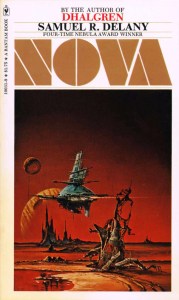
SD: All the experiences that were used in my own stories and books were black experiences—why? Because they were mine. In my books, sometimes the central characters were white—as in Trouble on Triton. Sometimes, as in The Fall of the Towers, Babel-17 (where the main character is Asian), or The Einstein Intersection, Dhalgren (where the main character has a white father and a Native American mother), or the Return to Nevèrÿon series, many or sometimes all were non-Caucasian.
Here is something that I think as an almost purely black experience (it is only that racial experiences are never pure that keeps such purity a metaphor), one that I’ve told many of my black friends, fewer of my white friends, and written about fairly indirectly in my Return to Nevèrÿon fantasy sequence.
All my life, one of the things people—white people in particular—had been telling me was that I looked white. I didn’t particularly believe them—though sometimes I wondered. My parents had told me that I was black and I should be proud of it, as both of them were, but one day in late September or among the first days of Indian summer (I was still in elementary school, so I was probably 10 or 11), I was sitting on a bench in Central Park, with my school notebook open, doing my math homework, when, with unkempt blond hair and steel-blue eyes, a kid about 20—today, from the state of his jeans and sneakers and T-shirt you would know immediately he was homeless, and, though “homeless” was not part of our vocabulary then, I realized it—walked up in front of me, his grin showing not very good teeth. “Hey,” he said with the thickest Southern accent I’d heard in a while, “you a nigga ain’ ya, there, huh?” I looked up, surprised. “Yeah, you a nigga. I can tell. Tha’s cause I’m from Alabama. See I can always tell. You ain’ gonna get nothin’ by me. I can see it, right in yo’ face there. The mouth, the nose. All that—naw, I can see it. You ain’t gonna fool somebody like me, get away with nothin’.” Then, still grinning, he turned and walked off, through the sunny park.
And that was the first time I was called a nigger by a white guy—a homeless Alabama drifter coming up to an urban black kid on a bench doing his math homework.
Frankly, I got less upset over that one than I did over my father’s. Because at least it taught me something. I mean, he was right. There’s nothing unpleasant for a black person to be recognized, especially when, I assume, they feel they are telling you something that for some reason they think you want to hear.
And sometimes it happened with black folk. Yet more stories. At this point, I don’t remember whether it was the fifth or sixth time [that happened], but after one of the men or women left, frowning after them, I said to myself: You thickheaded nigger, you better stop believing all these white assholes who keep telling you how white you are, because obviously there are a whole lot of white people in this city—in the country (by then, it had happened a couple of times outside New York)—who have nothing else to do but go around on the lookout for any black person they think might be racially passing, and remind them that they can’t. But this is one very small way in which a race gets constituted socially.
Rest of the article: http://www.thenation.com/article/samuel-r-delany-speaks/
Filed under 2015, author interview, authors
Technology has always had an effect on the form of the novel, but the story remains.
by Camilla Nelson
In This Will Destroy That, also known as Book V, Chapter 2 of Notre Dame de Paris, Victor Hugo presents his famous argument that it was the invention of the printing press that destroyed the edifice of the gothic cathedral. Stories, hopes and dreams had once been inscribed in stone and statutory, wrote Hugo. But with the arrival of new printing technologies, literature replaced architecture.
Today, “this” may well be destroying “that” again, as the Galaxy of the Internet replaces the Gutenberg Universe. If a book is becoming something that can be downloaded from the app store, texted to your mobile phone, read in 140-character installments on Twitter, or, indeed, watched on YouTube, what will that do to literature – and particularly Hugo’s favourite literary form, the novel?
Debates about the future of the book are invariably informed by conversations about the death of the novel. But as far as the digital novel is concerned, it often seems we’re in – dare I say it – the analogue phase. The publishing industry mostly focuses on digital technologies as a means for content delivery – that is, on wifi as a replacement for print, ink, and trucks. In terms of fictional works specifically created for a digital environment, publishers are mostly interested in digital shorts or eBook singles.At 10,000 words, these are longer than a short story and shorter than a printed novel, which, in every other respect, they continue to resemble.
Digital editions of classic novels are also common. Some, such as the Random House edition of Anthony Burgess’s A Clockwork Orange (1962), available from the App store, are innovatively designed, bringing the novel into dialogue with an encyclopedic array of archival materials, including Burgess’ annotated manuscript, old book covers, videos and photographs.
Also in this category is Faber’s digital edition of John Buchan’s 39 Steps (2013), in which the text unfolds within a digital landscape that you can actually explore, albeit to a limited degree, by opening a newspaper, or reading a letter.
But there is a strong sense in which novels of this sort, transplanted into what are essentially gaming-style environments for which the novel form was not designed, can be experienced as deeply frustrating. This is because the novel, and novel reading, is supported by a particular kind of consciousness that Marshall McLuhan memorably called the “Gutenberg mind”.
Novels are linear and sequential, and post-print culture is interactive and multidimensional. Novels draw the mind into deeply imagined worlds, digital culture draws the mind outward, assembling its stories in the interstices of a globally networked culture.
For the novel to become digital, writers and publishers need to think about digital media as something more than just an alternative publishing vehicle for the same old thing. The fact of being digital must eventually change the shape of the novel, and transform the language.
Far from destroying literature, or the novel genre, digital experimentation can be understood as perfectly in keeping with the history of the novel form. There have been novels in letters, novels in pictures, novels in poetry, and novels which, like Robinson Crusoe (1719), so successfully claimed to be factual accounts of actual events that they were reported in the contemporary papers as a news story. It is in the nature of the novel to constantly outrun the attempt to pin it down.
So too, technology has always transformed the novel. Take Dickens, for example, whose books were shaped by the logic of the industrial printing press and the monthly and weekly serial – comprising a long series of episodes strung together with a cliffhanger to mark the end of each installment.
So what does digital media do differently? Most obviously, digital technology is multimodal. It combines text, pictures, movement and sound. But this does not pose much of a conceptual challenge for writers, thanks, perhaps, to the extensive groundwork already laid by graphic novel.
Rather, the biggest challenge that digital technology poses to the novel is the fact that digital media isn’t linear – digital technology is multidimensional, allowing stories to expand, often wildly and unpredictably, in nonlinear patterns.
The bestselling SF writer talks about the rush to finish the Long Earth series, being the order to Terry Pratchett’s chaos and how maths helps him write
by Alison Flood
In the summer of 2013, Stephen Baxter and Terry Pratchett published The Long War, the second volume of their Long Earth science-fiction series, about parallel worlds that can be “stepped” into. By the end of that year, the two authors – both prolific by any standards – had completed drafts of the remaining three novels in the series. It was an astonishing rate of work, but there was a deadline that needed to be met: Pratchett had announced his diagnosis with a rare form of early onset Alzheimer’s in 2007. By the summer of 2014, he would pull out of a Discworld convention, citing “The Embuggerance”, which was “finally catching up with me”. He died in March this year.
“I think Terry was aware he was running out of time, and he wanted to do other things as well,” Baxter says. “So we rushed through it a little bit. Terry’s basic vision was the first step, but he also wanted to have a huge cosmic climax at the end, which would be book five … We had no idea how to get there but we knew where we were going.”
The Long Utopia, the fourth in the series, sees settlers on an Earth more than “a million steps” west of ours stumble across a disturbing, insectile form of alien life. Like its predecessors, the novel is compelling not only for its central storyline of exploration and danger and humans doing foolishly human things – and in this case a particularly cataclysmic finale – but also for its slow, unhurried laying out of the minute differences between these empty-of-humanity Earths.
The concept of a chain of parallel worlds, each a little different from its neighbour, was one Pratchett originally had, and set aside, in the 1980s. He told Baxter, a long-time friend and one of the UK’s most respected science-fiction authors, about it over dinner one night, and they decided to collaborate.
“It was a great idea but Terry’s strength did not lie in landscapes and things,” Baxter says. “He’d get a story by having a basic idea, get two people in a room talking and see where it went from there.”
This is not how Baxter works. His fiction, whether about the colonising mission sent to a planet orbiting a nearby red dwarf star, in Proxima, or the exploration of different evolutions of humanity in the Destiny’s Children series, is meticulously planned and pinned down, rooted in the scientific background from which he comes. He has a degree in maths from Cambridge and a PhD in aeronautical engineering; he is a fellow of the British Interplanetary Society and applied for a guest spot on the Mir space station in 1989, making it through a number of stages on his quest to be a cosmonaut but eventually missing out because of his lack of foreign languages.
Whether Baxter decides to submerge the world (Flood), or make humanity live in the centre of a neutron star (Flux), or keep the sea off Doggerland in an alternative prehistory (Stone Spring), there’s always a hook into something real. “I try to get it right. If you can get the maths right, I figure you’re most of the way there,” he says.
Baxter is fiercely intelligent, in a generous way, sharing his enthusiasms and knowledge on everything from recently discovered exoplanets to the Mars project (he’s not hopeful, because he doesn’t think enough has been done on long-term life support systems). At the British Interplanetary Society, he’s been part of study projects on everything from designing star ships to extraterrestrial liberty, an issue explored in Ark, his follow-up to Flood, in which the scraps of humanity flee their devastated planet in “generation ships” for an uncertain future outside the solar system.
“It’s all very well to plan a five-generation mission to Alpha Centauri, but if you’re one of the middle generations, you live out your life with very little room for manoeuvre,” he says. “So what right do you have to submit your children and grandchildren to a life of slavery like that? You get some interesting ethical issues – do you have rights over people who don’t yet exist, do they have rights?”
Rest of the article: http://www.theguardian.com/books/2015/jul/25/stephen-baxter-interview-why-science-fiction-is-like-therapy
Filed under 2015, author interview