George Saunders: what writers really do when they write
A series of instincts, thousands of tiny adjustments, hundreds of drafts … What is the mysterious process writers go through to get an idea on to the page?
https://www.theguardian.com/books/2017/mar/04/what-writers-really-do-when-they-write
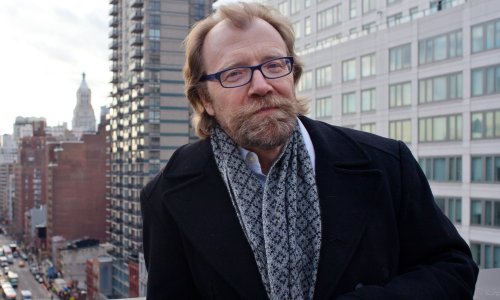
George Saunders
by George Saunders
1
Many years ago, during a visit to Washington DC, my wife’s cousin pointed out to us a crypt on a hill and mentioned that, in 1862, while Abraham Lincoln was president, his beloved son, Willie, died, and was temporarily interred in that crypt, and that the grief-stricken Lincoln had, according to the newspapers of the day, entered the crypt “on several occasions” to hold the boy’s body. An image spontaneously leapt into my mind – a melding of the Lincoln Memorial and the Pietà. I carried that image around for the next 20-odd years, too scared to try something that seemed so profound, and then finally, in 2012, noticing that I wasn’t getting any younger, not wanting to be the guy whose own gravestone would read “Afraid to Embark on Scary Artistic Project He Desperately Longed to Attempt”, decided to take a run at it, in exploratory fashion, no commitments. My novel, Lincoln in the Bardo, is the result of that attempt, and now I find myself in the familiar writerly fix of trying to talk about that process as if I were in control of it.
We often discuss art this way: the artist had something he “wanted to express”, and then he just, you know … expressed it. We buy into some version of the intentional fallacy: the notion that art is about having a clear-cut intention and then confidently executing same.
The actual process, in my experience, is much more mysterious and more of a pain in the ass to discuss truthfully.
2
A guy (Stan) constructs a model railroad town in his basement. Stan acquires a small hobo, places him under a plastic railroad bridge, near that fake campfire, then notices he’s arranged his hobo into a certain posture – the hobo seems to be gazing back at the town. Why is he looking over there? At that little blue Victorian house? Stan notes a plastic woman in the window, then turns her a little, so she’s gazing out. Over at the railroad bridge, actually. Huh. Suddenly, Stan has made a love story. Oh, why can’t they be together? If only “Little Jack” would just go home. To his wife. To Linda.
What did Stan (the artist) just do? Well, first, surveying his little domain, he noticed which way his hobo was looking. Then he chose to change that little universe, by turning the plastic woman. Now, Stan didn’t exactly decide to turn her. It might be more accurate to say that it occurred to him to do so; in a split-second, with no accompanying language, except maybe a very quiet internal “Yes.”
He just liked it better that way, for reasons he couldn’t articulate, and before he’d had the time or inclination to articulate them.
An artist works outside the realm of strict logic. Simply knowing one’s intention and then executing it does not make good art. Artists know this. According to Donald Barthelme: “The writer is that person who, embarking upon her task, does not know what to do.” Gerald Stern put it this way: “If you start out to write a poem about two dogs fucking, and you write a poem about two dogs fucking – then you wrote a poem about two dogs fucking.” Einstein, always the smarty-pants, outdid them both: “No worthy problem is ever solved in the plane of its original conception.”
How, then, to proceed? My method is: I imagine a meter mounted in my forehead, with “P” on this side (“Positive”) and “N” on this side (“Negative”). I try to read what I’ve written uninflectedly, the way a first-time reader might (“without hope and without despair”). Where’s the needle? Accept the result without whining. Then edit, so as to move the needle into the “P” zone. Enact a repetitive, obsessive, iterative application of preference: watch the needle, adjust the prose, watch the needle, adjust the prose (rinse, lather, repeat), through (sometimes) hundreds of drafts. Like a cruise ship slowly turning, the story will start to alter course via those thousands of incremental adjustments.
The artist, in this model, is like the optometrist, always asking: Is it better like this? Or like this?
The interesting thing, in my experience, is that the result of this laborious and slightly obsessive process is a story that is better than I am in “real life” – funnier, kinder, less full of crap, more empathetic, with a clearer sense of virtue, both wiser and more entertaining.
And what a pleasure that is; to be, on the page, less of a dope than usual.
3
Revising by the method described is a form of increasing the ambient intelligence of a piece of writing. This, in turn, communicates a sense of respect for your reader. As text is revised, it becomes more specific and embodied in the particular. It becomes more sane. It becomes less hyperbolic, sentimental, and misleading. It loses its ability to create a propagandistic fog. Falsehoods get squeezed out of it, lazy assertions stand up, naked and blushing, and rush out of the room.
Is any of this relevant to our current political moment?
Hoo, boy.
When I write, “Bob was an asshole,” and then, feeling this perhaps somewhat lacking in specificity, revise it to read, “Bob snapped impatiently at the barista,” then ask myself, seeking yet more specificity, why Bob might have done that, and revise to, “Bob snapped impatiently at the young barista, who reminded him of his dead wife,” and then pause and add, “who he missed so much, especially now, at Christmas,” – I didn’t make that series of changes because I wanted the story to be more compassionate. I did it because I wanted it to be less lame.
But it is more compassionate. Bob has gone from “pure asshole” to “grieving widower, so overcome with grief that he has behaved ungraciously to a young person, to whom, normally, he would have been nice”. Bob has changed. He started out a cartoon, on which we could heap scorn, but now he is closer to “me, on a different day”.
How was this done? Via pursuit of specificity. I turned my attention to Bob and, under the pressure of trying not to suck, my prose moved in the direction of specificity, and in the process my gaze became more loving toward him (ie, more gentle, nuanced, complex), and you, dear reader, witnessing my gaze become more loving, might have found your own gaze becoming slightly more loving, and together (the two of us, assisted by that imaginary grouch) reminded ourselves that it is possible for one’s gaze to become more loving.
Or we could just stick with “Bob was an asshole,” and post it, and wait for the “likes”, and for the pro-Bob forces to rally, and the anti-barista trolls to anonymously weigh in – but, meanwhile, there’s poor Bob, grieving and misunderstood, and there’s our poor abused barista, feeling crappy and not exactly knowing why, incrementally more convinced that the world is irrationally cruel.
4
What does an artist do, mostly? She tweaks that which she’s already done. There are those moments when we sit before a blank page, but mostly we’re adjusting that which is already there. The writer revises, the painter touches up, the director edits, the musician overdubs. I write, “Jane came into the room and sat down on the blue couch,” read that, wince, cross out “came into the room” and “down” and “blue” (Why does she have to come into the room? Can someone sit UP on a couch? Why do we care if it’s blue?) and the sentence becomes “Jane sat on the couch – ” and suddenly, it’s better (Hemingwayesque, even!), although … why is it meaningful for Jane to sit on a couch? Do we really need that? And soon we have arrived, simply, at “Jane”, which at least doesn’t suck, and has the virtue of brevity.
But why did I make those changes? On what basis?
On the basis that, if it’s better this new way for me, over here, now, it will be better for you, later, over there, when you read it. When I pull on this rope here, you lurch forward over there.
This is a hopeful notion, because it implies that our minds are built on common architecture – that whatever is present in me might also be present in you. “I” might be a 19th-century Russian count, “you” a part-time Walmart clerk in 2017, in Boise, Idaho, but when you start crying at the end of my (Tolstoy’s) story “Master and Man”, you have proved that we have something in common, communicable across language and miles and time, and despite the fact that one of us is dead.
Another reason you’re crying: you’ve just realised that Tolstoy thought well of you – he believed that his own notions about life here on earth would be discernible to you, and would move you.
Tolstoy imagined you generously, you rose to the occasion.
We often think that the empathetic function in fiction is accomplished via the writer’s relation to his characters, but it’s also accomplished via the writer’s relation to his reader. You make a rarefied place (rarefied in language, in form; perfected in many inarticulable beauties – the way two scenes abut; a certain formal device that self-escalates; the perfect place at which a chapter cuts off); and then welcome the reader in. She can’t believe that you believe in her that much; that you are so confident that the subtle nuances of the place will speak to her; she is flattered. And they do speak to her. This mode of revision, then, is ultimately about imagining that your reader is as humane, bright, witty, experienced and well intentioned as you, and that, to communicate intimately with her, you have to maintain the state, through revision, of generously imagining her. You revise your reader up, in your imagination, with every pass. You keep saying to yourself: “No, she’s smarter than that. Don’t dishonour her with that lazy prose or that easy notion.”
And in revising your reader up, you revise yourself up too.
5
I had written short stories by this method for the last 20 years, always assuming that an entirely new method (more planning, more overt intention, big messy charts, elaborate systems of numerology underlying the letters in the characters’ names, say) would be required for a novel. But, no. My novel proceeded by essentially the same principles as my stories always have: somehow get to the writing desk, read what you’ve got so far, watch that forehead needle, adjust accordingly. The whole thing was being done on a slightly larger frame, admittedly, but there was a moment when I finally realised that, if one is going to do something artistically intense at 55 years old, he is probably going to use the same skills he’s been obsessively honing all of those years; the trick might be to destabilise oneself enough that the skills come to the table fresh-eyed and a little confused. A bandleader used to working with three accordionists is granted a symphony orchestra; what he’s been developing all of those years, he may find, runs deeper than mere instrumentation – his take on melody and harmony should be transferable to this new group, and he might even find himself looking anew at himself, so to speak: reinvigorated by his own sudden strangeness in that new domain.
It was as if, over the years, I’d become adept at setting up tents and then a very large tent showed up: bigger frame, more fabric, same procedure. Or, to be more precise (yet stay within my “temporary housing” motif): it was as if I’d spent my life designing custom yurts and then got a commission to build a mansion. At first I thought “Not sure I can do that.” But then it occurred to me that a mansion of sorts might be constructed from a series of connected yurts – each small unit built by the usual rules of construction, their interconnection creating new opportunities for beauty.
6
Any work of art quickly reveals itself to be a linked system of problems. A book has personality, and personality, as anyone burdened with one will attest, is a mixed blessing. This guy has great energy – but never sits still. This girl is sensitive – maybe too much; she weeps when the wrong type of pasta is served. Almost from the first paragraph, the writer becomes aware that a work’s strengths and weaknesses are bound together, and that, sadly, his great idea has baggage.
For example: I loved the idea of Lincoln, alone at night in the graveyard. But how is a novel made from one guy in a graveyard at night? Unless we want to write a 300-page monologue in the voice of Lincoln (“Four score and seven minutes ago, I did enter this ghastly place”) or inject a really long-winded and omniscient gravedigger into the book (we don’t, trust me, I tried), we need some other presences there in the graveyard. Is this a problem? Well, it sure felt like one, back in 2012. But, as new age gurus are always assuring us, a “problem” is actually an “opportunity”. In art, this is true. The reader will sense the impending problem at about the same moment the writer does, and part of what we call artistic satisfaction is the reader’s feeling that just the right cavalry has arrived, at just the right moment. Another wave of artistic satisfaction occurs if she feels that the cavalry is not only arriving efficiently, but is a cool, interesting cavalry, ie, is an opportunity for added fun/beauty – a broadening-out of the aesthetic terms.
In this case, the solution was pretty simple – contained, joke-like, in the very statement of the problem (“Who else might be in a graveyard late at night?”).
I remembered an earlier, abandoned novel, set in a New York State graveyard that featured – wait for it – talking ghosts. I also remembered a conversation with a brilliant former student of mine, who said that if I ever wrote a novel, it should be a series of monologues, as in a story of mine called “Four Institutional Monologues”.
So: the book would be narrated by a group of monologuing ghosts stuck in that graveyard.
And suddenly what was a problem really did become an opportunity: someone who loves doing voices, and thinking about death, now had the opportunity to spend four years trying to make a group of talking ghosts be charming, spooky, substantial, moving, and, well, human.
7
A work of fiction can be understood as a three-beat movement: a juggler gathers bowling pins; throws them in the air; catches them. This intuitive approach I’ve been discussing is most essential, I think, during the first phase: the gathering of the pins. This gathering phase really is: conjuring up the pins. Somehow the best pins are the ones made inadvertently, through this system of radical, iterative preference I’ve described. Concentrating on the line-to-line sound of the prose, or some matter of internal logic, or describing a certain swath of nature in the most evocative way (that is, by doing whatever gives us delight, and about which we have a strong opinion), we suddenly find that we’ve made a pin. Which pin? Better not to name it. To name it is to reduce it. Often “pin” exists simply as some form of imperative, or a thing about which we’re curious; a threat, a promise, a pattern, a vow we feel must soon be broken. Scrooge says it would be best if Tiny Tim died and eliminated the surplus population; Romeo loves Juliet; Akaky Akakievich needs a new overcoat; Gatsby really wants Daisy. (The colour grey keeps showing up; everything that occurs in the story does so in pairs.)
Then: up go the pins. The reader knows they are up there and waits for them to come down and be caught. If they don’t come down (Romeo decides not to date Juliet after all, but to go to law school; the weather in St Petersburg suddenly gets tropical, and the overcoat will not be needed; Gatsby sours on Daisy, falls for Betty; the writer seems to have forgotten about his grey motif) the reader cries foul, and her forehead needle plummets into the “N” zone and she throws down the book and wanders away to get on to Facebook, or rob a store.
The writer, having tossed up some suitably interesting pins, knows they have to come down, and, in my experience, the greatest pleasure in writing fiction is when they come down in a surprising way that conveys more and better meaning than you’d had any idea was possible. One of the new pleasures I experienced writing this, my first novel, was simply that the pins were more numerous, stayed in the air longer, and landed in ways that were more unforeseen and complexly instructive to me than has happened in shorter works.
Without giving anything away, let me say this: I made a bunch of ghosts. They were sort of cynical; they were stuck in this realm, called the bardo (from the Tibetan notion of a sort of transitional purgatory between rebirths), stuck because they’d been unhappy or unsatisfied in life. The greatest part of their penance is that they feel utterly inessential – incapable of influencing the living. Enter Willie Lincoln, just dead, in imminent danger (children don’t fare well in that realm). In the last third of the book, the bowling pins started raining down. Certain decisions I’d made early on forced certain actions to fulfilment. The rules of the universe created certain compulsions, as did the formal and structural conventions I’d put in motion. Slowly, without any volition from me (I was, always, focused on my forehead needle), the characters started to do certain things, each on his or her own, the sum total of which resulted, in the end, in a broad, cooperative pattern that seemed to be arguing for what I’d call a viral theory of goodness. All of these imaginary beings started working together, without me having decided they should do so (each simply doing that which produced the best prose), and they were, it seemed, working together to save young Willie Lincoln, in a complex pattern seemingly being dictated from … elsewhere. (It wasn’t me, it was them.)
Something like this had happened in stories before, but never on this scale, and never so unrelated to my intention. It was a beautiful, mysterious experience and I find myself craving it while, at the same time, flinching at the thousands of hours of work it will take to set such a machine in motion again.
Why do I feel this to be a hopeful thing? The way this pattern thrillingly completed itself? It may just be – almost surely is – a feature of the brain, the byproduct of any rigorous, iterative engagement in a thought system. But there is something wonderful in watching a figure emerge from the stone unsummoned, feeling the presence of something within you, the writer, and also beyond you – something consistent, wilful, and benevolent, that seems to have a plan, which seems to be: to lead you to your own higher ground.







 Booker's Blog