Tag Archives: writing

Workshop Weekend: Roadmap for this blog

In case you’re wondering, and even if you aren’t, I would like to take a few moments and explain the new layout I am adopting for this blog. I have decided to make at least every work day specific to something. For example, Monday morning writing joke will be a joke focused on writing or about writing. It might also be a limerick (though nothing too naughty) or pun, which is something I have a weakness for.

Next: CarToonsday will be a cartoon, usually based in some way around writing, but not always.

Writing Tip Wednesday will have writing tips. It could also have recommendations of writing books to try, or information about writing conferences, or agents looking for new clients.

Haiku to you Thursday will be a haiku. At least for as long as I can write what I consider to be good quality ones. Sometimes I’m sure I’ll spit out a clunker, but sometimes you have to fail in order to succeed.
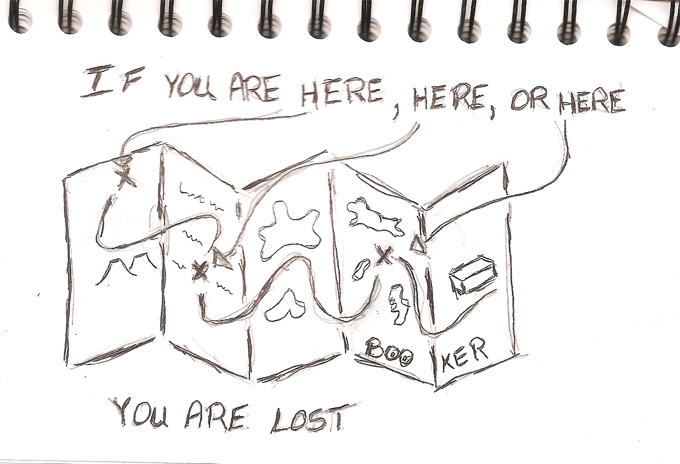
Map

At times, the roadmap might be under construction.

Freeform Friday will be another poem, maybe not a haiku but something else, or writing such as a Blathering idiot installment, The Devil’s Dictionary, an essay. Maybe even something I haven’t tried before. Could even be another cartoon. (As if one a week is not enough.)

Story Saturday will be a part of a story. Something I am working on. Could also be a Found Story (photo with piece of writing about the photo). Could even be a whole story, if short enough. Or I may write something about my struggles to write stories, though I am sure that would get old and boring quickly.

Sunday? I may just take off. Or take off Saturday and make it Story Sunday. Or the whole weekend could be titled Workshop Weekend.

I have noticed on weekends there are usually fewer visitors to my blog. People are off doing other things, I assume. Plus a day off won’t hurt. I have a regular job, family obligations, and am working on a novel and short stories as well. On my days off, I aim for between 300 and 400 words of new writing on my stories or novel. So doing that and a blog entry can be tough. I might also skip a day here and there if I don’t have something that fits that day’s theme.

Certainly, comments and suggestions are welcome. And visits, too. The more the better. I aim to keep humor and wit of one stripe or another going on this blog. You may not be rolling in the floor laughing and sometimes you might even be rolling your eyes and groaning at the puns, but at least you’re not having to pay for the self-inflicted humor wound.

Last, but not least, thank you to all who have visited my blog and especially so to those who have linked up to receive notification when I post something new. I do appreciate it. Very much. Part of the reason for trying to more regularize the format is so that you know what’s coming.

3 Comments

Filed under blog, Workshop weekend, writing

Writing a novel…

Writing a novel is …

Simple.

Deceptive.

Seductive.

And an Act of Defiance.

That’s why so many feel they can do it, and why so few do it successfully.

2 Comments

Filed under writing, writing tip

Writing tip: Setting

Using Setting as a Character: a Tip for Novelists

Source: http://www.rachellegardner.com/2012/06/using-setting-as-a-character-a-tip-for-novelists/

Guest Blogger: MaryLu Tyndall @MaryLuTyndall

Choosing the right setting is just as important as choosing the right characters, plot, and dialogue. Setting grounds your readers, helping them to experience the action and drama more effectively. But it does so much more than that! A setting can be so vibrant and alive that it becomes one of the characters in your story, assisting or hindering your protagonist in achieving his/her goals.

Setting as Friend

A beach at sunset or a hike to a tranquil waterfall can provide nearly as much comfort and encouragement as any good friend. If your hero has just defeated a dragon, don’t send him to a lively night club or a bull fight. Turn his setting into a place where he can recuperate and reflect, where he can hear the voice of God in the breeze.

Setting can also aid the hero in his quest. A jungle or a crowded bus station can hide the hero from his enemies just as easily as quicksand can devour them.

Setting as Antagonist

Just like a villain, the proper setting can introduce conflict, cause trouble, or thwart the hero’s plans. Consider a vicious storm, a flood, a moonless night that blinds the hero, a jungle where he gets lost, bumper-to-bumper traffic that keeps him gridlocked, an earthquake, rock slide, etc. These settings take on a life of their own, and do everything in their power to keep your hero from succeeding. You’ve heard it said that if your scene is falling flat, have someone pull out a gun. I say transport your scene to a setting filled with conflict.

Setting as Mentor

Like a wise old sage, setting can also be a mentor. Perhaps your hero must learn something before he can move on. Have him wander into a library, an old book store, a cave with ancient, mysterious writings on the walls, an archeological dig, a museum. Or perhaps your hero must survive some ordeal in order to move forward such as climb a mountain or cross a river to overcome his fears and gain the confidence he needs to achieve his goals.

Setting as a Shadow for Your Protagonist

A shadow is anything or anyone that reflects your hero’s deepest flaws. If your hero has an alcohol problem, put him in a bar where he can watch what alcohol does to others. If he’s a control freak, put him in prison. If he’s selfish, put him in a homeless shelter or soup kitchen. If he’s greedy, place him at the New York Stock Exchange. Use the appropriate setting to open his eyes to his own flaws.

Setting as a Model of What the Protagonist Wants to Be

A church, a mission trip, a charitable foundation, free medical clinic, the palace of a wise king, the courtroom of a just judge, and a loving home are all settings that can provide an atmosphere that fosters qualities to which the hero aspires.

How about using setting as a shapeshifter, a joker, a symbol of the hero’s past, a guardian? Choosing setting as a character is only limited by your imagination!

As an example: Let’s say you’re writing a breakup scene between two of your characters. Now, imagine the difference if that scene were set: at home in the living room, in a crowded restaurant, on a ship out at sea, on a ski slope, a shooting range, a fencing match. Each setting becomes a third character that determines how the scene will play out.

Setting can be a dynamic, breathing character that can either assist or hinder your hero. So, choose wisely, and you’ll add an entirely new dimension to your story.

Can you think of any favorite scenes in books you’ve read where setting is an important character? What about your own writing—how have you incorporated setting this way?

MaryLu Tyndall’s latest novel, Veil of Pearls, releases July 1 and is available for pre-order at Amazon, Barnes & Noble, and ChristianBook.com.

Leave a comment

Filed under MaryLu Tyndall, setting, writing tip

I’m a writer and I don’t get no respect

I'm a writer and I don't get no respect

Next time, I’ll just say E = mc2.

I’m a writer and I don’t get no respect. Just the other day I attended a party, and when somebody asked me what I did, I said I was a writer. He immediately began telling me his story that would “make a wonderful novel. So, I’ll tell it to you, you writer it up, and we’ll split the profits.”

Next time I go to a party and somebody asks me what I do for a living, I’ll say I’m a physicist. Nobody goes up to a physicist and says, “I have a wonderful theory. I’ll tell it to you, you write it down and put in all that math, and we’ll split the profits and the Nobel Prize.”

Leave a comment

Filed under cartoon by author, no respect, writer, writing humor

13 Things You May Not Know About Agents

By Rachelle Gardner

Source: http://www.rachellegardner.com/2012/06/13-things-you-may-not-know-about-agents/

1. We really hate getting bad news and we hate sharing it with you, but we trust you’re adult enough to handle it.

2. If we say we don’t want to submit a particular project to editors, we’re probably trying to protect both of our reputations (the writer’s and the agent’s).

3. While many of us do a great deal of editing and polishing of your manuscripts and/or proposals, the bottom line is that it’s the writer’s job to provide a marketable book. Agents shouldn’t be counted on to make it sales-ready.

4. We are very invested in your book and often feel like it’s “our baby” too (even though we KNOW it’s yours!)

5. If it seems like we’re too busy, it’s because the economics of this industry demand we carry a certain amount of volume to make a living wage.

6. We prioritize taking care of current clients above the search for new clients. So typically, queries and writer’s conferences take a back seat.

7. We really are interested in your long-term career, not just the size of the next advance.

8. We hate the slowness of publishing just as much as you do!

9. We want to set you up with the publisher and editor who will be best for you, not just the one who’s offering the most money.

10. When we’ve tried to sell your book but we’re not successful, we’re probably almost as disappointed as you. Not only are we often emotionally invested, we’ve put in a lot of time for no paycheck.

11. When you send us a manuscript to read, we don’t do it during the work day. We read in the evenings (our “free time”) and on the weekends. With Kindles and iPads, we may even be reading your manuscript on the treadmill at the gym.

12. We’re aware of all the new options for writers these days, and we’re doing our best to help steer each client in the right direction.

13. If your writing career keeps you awake at night, there’s a good chance it has kept us awake on occasion, too.

Leave a comment

Filed under agents, Rachelle Gardner, writing tip

New words to live by: Obsurd

New word for consideration in the next release of the Oxford English Dictionary or Webster’s Dictionary, or even the old tattered-edge dictionary your grandma uses to hold open the screen door.

New word:
Obsurd. This word is combination of:

Obscure: inconspicuous or unnoticeable. Maybe indistinct to the sight or any of the other senses; not easily felt, heard, seen, etc.

and

Absurd: obviously senseless or existing in an irrational or meaningless world.

So, Obsurd, n. inconspicuous or unnoticed senselessness. Sometimes also referred to as obsurdity, as in the obsurdity of life.

To use in context: As Henry David Thoreau said: The mass of men lead lives of quiet desperation.

Modern corollary: The mass of men lead lives of quiet desperation, toiling endlessly and in obsurdity.

Or, go forth and do obsurd things.

2 Comments

Filed under words, Words to live by

Writing quotes: Asimov, Bradbury

Writing, to me, is simply thinking through my fingers. –Isaac Asimov

You must stay drunk on writing, so reality doesn’t destroy you. –Ray Bradbury

Leave a comment

Filed under writing quotes

Writing Tip Wednesday: 15 minutes

By David E. Booker

So, how much time to do you have a day to write? How much time a day do you spend?

I read about a noted short story writer who started out writing 15 minutes a day, between 11:45 PM and midnight. As a single mom of several kids, working very hard just to hold her family together, that was the only time she had after all her kids were in bed and before she went to bed.

I wish I could remember her name, but the point is not so much her name or even that she won awards for her short stories. It is that she wrote regularly, even if all she had was 15 minutes.

Fifteen (15) minutes.

If there is one piece of advice that I have heard over and over and over again, it is to develop a routine and stick to it. Show up for your writing just like you would for your job that you work to hold body and soul together so you can write. If all you have is 15 minutes a day, use it wisely and use it well. If you can spare more, or if you operate better by setting yourself a word quota, then do it that way.

The writer James Scott Bell doesn’t have a daily quota, but a weekly one, which he then breaks down into daily installments. He says having a weekly quota works better for him because it misses a day or doesn’t write the full amount one day, he can work to make it up on the other days and still hit his weekly quota.

Certainly, if having a daily quota, then set one. I believe the writer Graham Greene had a daily quota of 500 words a day. He would write 500 words and then stop.

The writer Harry Crews often rose at 4 AM to write before going to work as a professor. One of his students, the New York Times bestselling crime novelist Michael Connelly said recently of Crews, “The singular lesson I took from him was his simple adage that if you are going to be a writer then you must write every day, even if only for 15 minutes. The last part about the 15 minutes has served me well. I’m going on 30-plus years of writing every day, even sometimes for only 15 minutes.”

So, where are your 15 minutes?

[Editor’s note: Connelly quote taken from LA Times obituary article on Harry Crews, who died earlier this year. He was known to write from 4 AM to 9 AM and to begin each session with the same plea: “God, I’m not greedy. Just give me the next 500 words.”]

Leave a comment

Filed under fifteen minutes, writing tip, Writing Tip Wednesday

I’m a writer and I don’t get no respect

Writer Gets No Respect

Critics are everywhere.

One reason the human race has such a low opinion of itself is that it gets so much of its wisdom from writers. –Wilfrid Sheed

All writing is garbage. People who come out of nowhere to try to put into words any part of what goes on in their minds are pigs. –Antonin Artaud

The noted writer Theodore Sturgeon was once asked why so much of science fiction writing was “crap.” He paused for a moment, nodded, and said, yes, 90 percent of science fiction was crap, but that “90 percent of everything is crap.” This is known as Sturgeon’s Law, and is just as true today as it was in the early 1950s when he first pronounced it.

Same is true for critics of writers and writing.

[Errata: I had originally and erroneously attributed this to Robert Heinlein, another noted writer of such classics as Stranger in a Strange Land. My apologies and thank to Tom Dupree for pointing out my error. It is good to have smarter readers dropping by to read your blog posts. May we all be so fortunate. Thank you to all who stop by, read, like, and comment. It is one of the advantages of this blog format. Thank you all. –Editor]

4 Comments

Filed under cartoon by author, no respect, writer

Writing tip Wednesday: three keys to dialogue

by David E. Booker

1) It’s not conversation. In his book, On Writing: Advice to Those Who Write to Publish (Or Would Like to), George V. Higgins, known for his dialogue, advises developing an ear for dialogue, but that dialogue in stories is not simply conversation lifted from daily life and dropped into a story.

Normal speech is full of too many “uhs, ahs, and other sounds that are verbal place holders and don’t really have any place in fictional dialogue. Also, normal speech is full of “small talk.” Things like, “Hi, how are you? How’s the husband and kids? It sure looks like the team will have a good season this year.” All things meant to keep the lines of communication open, psychologists might say, but are of little use in furthering your story. In short, good dialogue moves the story forward. Asking about the family or saying the team will have a good year only keeps the story in place.

A corollary to this is the “As you know, Fred” dialogue, which is dialogue between two people who know the information being conveyed, but they are conveying it, anyway, for the sake of the reader, who doesn’t know. Science fiction can many times be guilty of this when two scientists of the same discipline, say particle physics, “converse” with each other about what a particle is.

2) It’s often what you don’t say. Subtext is the hidden force of any scene of a story or movie. As the noted script writer and teacher, Robert McKee says, “If a scene is about what a scene is about, then the scene is dead.”

Good dialogue

Often, good dialogue is about what isn’t being said.

For example, if two people are engaged in changing a tire and all they talk about is tire changing, then the scene is dead. However, if during that scene, one member is gruff to the other one and eventually says the flat was his fault for not checking the tires to begin with, then you have an emotional charge running through the scene and dialogue is then used to convey that emotional charge, the subtext is the tug of war of one person trying to blame another and how the person being blamed reacts or handles the accusation.

3) It’s okay to only use “said” and “asked.” Many writers learning their craft try to spice up a scene by having their characters express their dialogue with: he espoused, she guffawed, he trumpeted, she queried, etc. This will only slow down a scene. It should be: he said, or he asked, if it is a question. One exception might be: she yelled. But other than these, if the scene does not convey the right intensity with which your characters should be speaking, then there is something amiss in the scene, and it won’t be fixed by exchanging “she said” for “she espoused.”

In fact there are some writers, such as the late Robert B. Parker, who use only “he said” or “she said,” even where there was a question. He figured the use of the question mark at the end of the spoken sentence was clue enough.

And please note, by saying “he” or “she,” I am not saying never use the speaker’s name. particularly when somebody is speaking for the first time in a scene, it is often recommended that the text read, “Bob said” or “Alice asked.”

There are certainly other suggestions for creating good dialogue, but mastering these three will put you on your way to having dialogue that moves the story forward and adds a good boast to your writing.

2 Comments

Filed under article by author, dialogue, writing tip, Writing Tip Wednesday