
“I do not rewrite unless I am absolutely sure that I can express the material better if I do rewrite it.”
—William Faulkner
Tag Archives: writing
Writers on writing
Filed under William Faulkner, Writers on writing
Writing Tip Wednesday: Writing as a Transformational Tool
WRITING AS A TRANSFORMATIONAL TOOL
by BRUCE HALE
source: http://www.brucehalewritingtips.com/
When we tell stories, we hope we are touching the lives of our readers, making them laugh, cry, wonder, or ponder. But what if, by your writing, you could also touch your own life, help your own emotional or psychological growth?
To some extent, this happens organically. We’re drawn to subjects that have a certain resonance for us, after all. And if you write about topics that touch on your own traumas and past challenges, you’ll sometimes find that you feel better. But if you want to take it further, here are a couple of ways to go about this process more deliberately.
PROBING PAST PAIN
Ever had a sore tooth that you just couldn’t leave alone, even though it hurt when you touched it? Same principle here. Look back at your life, at those incidents that make you cringe even now — the time you embarrassed yourself in front of the classroom, the death of a friend, your first painful breakup. That’s your raw material for story.
Now spend some time writing about the memory that has the biggest charge on it. See if you can recall specific sensory details that make the experience come alive. After setting it aside for awhile, rewrite the incident from a fictional perspective, changing or inventing details to suit your story.
Voila — you’ve just created the seed for a powerful scene (or at least some potent backstory for your character). Now, this incident may not even directly appear in your story — you may use just the emotional tone — but you’ve managed to come to grips with something from your past while adding emotional depth to your tale.
Want an example? Growing up, I had a frequently challenging relationship with my stepdad; we rarely saw eye to eye. In my new book, SCHOOL FOR S.P.I.E.S.: Playing With Fire, I gave the hero, Max, a difficult relationship with his dad. Did I borrow actual incidents from my own life? No. But I used the feeling tone, that love-hate vibe, to deepen my story, and in some ways it has helped me feel more peaceful about my past relationship with my dad.
THE PENNEBAKER METHOD
If you want to get more directly therapeutic, you can also write in a directed way about what’s bugging you today.
For nearly 20 years, Dr. James Pennebaker has been asking people to write down their deepest feelings about an emotional upheaval in their lives for 15-20 minutes a day, four days running. In his book, WRITING TO HEAL, he states that many who have followed his instructions have had their immune systems strengthened, grades improved, or even lives changed.
The 4-day writing process, he says, helps us translate an experience into language, and in doing so, we essentially make that experience graspable. “Emotional upheavals touch every part of our lives,” Pennebaker explains. “These things affect all aspects of who we are, and writing helps us focus and organize the experience. When people are given the opportunity to write about emotional upheavals, they often experience improved health.”
Sound intriguing? Give it a try. You may find it improves your life as well. Or at least your stories.
Filed under Bruce Hale, writing tip, Writing Tip Wednesday
cARtOONSDAY: jUST A gIGOLO pOET, take 2

Sometimes it’s hard to do a good cartoon.
Thought I would try this version. You can decide which one you prefer, if either. The earlier one appeared on Tuesday, July 17, 2012. You can also click on CarToonsday in the links below and it will bring up that CarToonsday cartoon as well as others.
Filed under cartoon by author, CarToonsday, writing
Monday morning writing joke: Let there be light
Q.: How many mystery writers does it take to change a light bulb?
A.: Two – one to do most of the turning and the other to give it a final twist at the end.

The mystery began in the most unlikely of places, and it was a shock to hear about.
[Editor’s note: Okay, so this one is a riddle. What would you expect for a mystery?]
Filed under Monday morning writing joke
Workshop weekend: Saturday story: “The Kibitzer and the Kidd, part 9”
[Editor’s note: Parts 1 – 8 of The Kibitzer and the Kidd are available by clicking on “Kidd” or “Kibitzer” in the tag section. This is science fiction western with more than dollop of humor and satire.]
888888
“The Boss wants to see you,” said one of the men blocking the Kidd’s way.
They were both tall, thick, and none too brightly dress. In other words, they fit the typical definition of goons.
“Tell him I have an opening next Tuesday and I’ll pencil him in.”
One goon looked at the other one as if they were seriously considering this offer, and that’s when the Kidd made his move. He ran toward then, feinted to the right and then to the left, and then charged right toward them, intending to split the space between them. But a loose board sprang up from the floor, tripped the Kidd, and he tumbled into one of the goons, almost knocking the goon backwards.
Soon the second goon was behind the Kidd, pinning his arms to his side with the first goon pulled a dark hood over the Kidd’s head and tied his hands.
Then they started jerking him across the floor.
The Kidd thought he heard a floor plank say, “Had to do it to keep the plot going.”
It was then the Kidd realized he was looking at the plank with his right eye. The left one was covered. Soon they were both covered and he was lifted up and shoved outside.
The air felt noticeably cooler, as if the evening were sighing at the folly of humans. But there were also sounds: clanging and banging, voices raised and footsteps running along the wooden sidewalk. Somebody bumped into the Kidd, slumped by him, and continued running without even saying “excuse me.”
The Kidd thought he heard someone shout “Fire!” and “Spreading!” but he wasn’t sure from which direction.
Were they headed toward the fire? Were these goons going to throw him into the flames?
“There’s somebody trapped inside.”
“It’s only that Kidd fella.”
Two voices, both soon gone.
He was being lifted again. One goon on each side.
“Open the door,” the goon on his right said.
“You open it.” the other one said.
“The Boss is waiting.”
“Then open it.”
The Kidd kicked his legs around until he felt his boot hit something.
The goon on his left groaned.
The Kidd kicked again, aiming as best he could.
The goon let go and cursed.
The Kidd turned and kicked at the other goon while he worked his hands free. They had not tied them well. He then reached up for the hood.
He was free of the hood and the other goon at the same time. He turned to run and immediately bumped into a third person, who looked uncomfortable and displeased.
“You have come all this way to see me and now you want to leave so soon.” It was a statement and not a question.
“I came here for cough drops,” the Kidd said, “and a hot toddy. Whatever festering range war you have is none of my concern.”
“Global warming is everybody’s concern.”
The Kidd stared at the man. He was tall, stocky, and looked very much like Al Wayne. A step-brother maybe? Or was this some sort of joke with the same guy pretending to be two different people? That way, he got all the good lines.
“Let me introduce myself.”
“You are Al Wayne’s evil twin, John Gore.” It was a statement and not a question.
“Don’t interrupt the Boss!” one of the goons said and shoved the Kidd toward the surrey’s open door.
The Kidd tripped and fell to the street. The air was clearer down by the dirt, not as much smoke and burning odor, though it stank of the shit recently dropped by the horse pulling the surrey.
“Goon!” Gore said. He then reached out and helped the Kidd back up. “Please excuse the manners of my aides. Sometimes their enthusiasm exceeds my expectations.”
Gore brushed some of the dust off the Kidd’s upper arm. He then climbed inside the surrey.
The goon’s nudged the Kidd toward the surrey’s door.
“Let me go so I can help a friend who might be trapped in that fire. Then I promise I’ll come back and we can talk all you want.”
The goons kept the Kidd boxed in. He nudged away from the door, but the goons clamped hands on him, lifted him up and threw him inside. They then slammed the door shut.
The Kidd scrambled around the tight quarters until he was up on the seat opposite Gore.
“I will send my aides,” Gore said. “They can handle the situation better than you or I.”
Everybody wants to talk to me, the Kidd thought, but nobody says very much.
Reluctantly, he agreed. If nothing else, once the goons were gone, he could escape, albeit, without his sidearms. No plan was perfect.
888888
(To be continued….)
Writing tip Wednesday: Getting lost in a good story
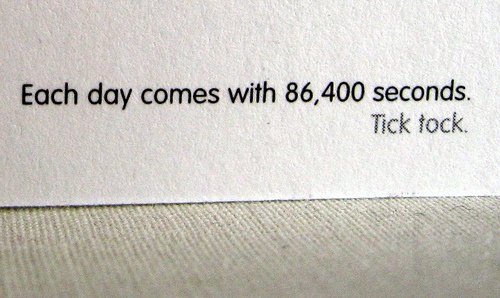
What are you writing with your seconds of each day of your life?
Each second a moment you can get lost in a good story or poem, writing or reading it.
Filed under Writing Tip Wednesday
Writing tip Wednesday: writerly thinking
How a writer thinks—elementary my dear
by DON WILLIAMS
During a holiday sometime back, the Williams clan, including in-laws, outlaws and assorted friends, gathered to play Trivial Pursuit.
A competitive lot, we turn such games into raucous entertainment. Lots of praise, derision and laughter pertain, not necessarily in that order.
The games were close and the questions difficult, prompting snorts and catcalls, and three of the teams had flamed out by the time my friend the writer’s turn came to answer a question.
My sister Rebecca drew a card and read:
Sherlock Holmes turned into the gate at 221 Baker St, stepped inside the door and climbed ___ steps to his second story flat. How many steps did he climb?
There was a collective groan.
“Bury that one,” a brother-in-law said, even as Rebecca was discarding the question. “He’ll never get that.”
“Hold on!” My friend held up his right hand. “I’ve only read one Arthur Conan Doyle book, and it wasn’t Sherlock Holmes, but I’ll take a shot at that.”
“No way. How are you going to guess that one?”
“Elementary my dear Watson,” my friend replied. “In the time-honored Holmes-ian way. Deductive Reasoning.”
“That’ll be the day,” my brother Tim said.
“Listen up,” said my friend. “It has to be at least 10 steps to Sherlock’s apartment, even if the risers are relatively high, say, 10 inches, because they have to clear that first-floor apartment’s ceiling. And the answer likely won’t be more than, say, 20 steps, even if the risers are short, because that would put the esteemed detective’s pad more than ten or twelve feet above street level. See? Already I’ve reduced the universe of possible answers to 10.”
“Yeah, yeah,” my brother Rodney said.
“So,” my friend continued, “the answer lies somewhere between 10 and 20. Let’s take them one by one.”
“Better hurry,” said my sister Kathleen, eyeing the sandglass.
“OK. Ten is a lazy number that would make the author appear lazy too, so a writer like Doyle would never use it. Not here. Nor can it be 11, because that’s a lucky number, mildly distracting and therefore intrusive. More importantly, Sherlock’s a deductive thinker, so the author wouldn’t suggest, even subliminally, that his detective’s success owes anything to a lucky number. Number 12? Again, distracting. Sir Doyle wouldn’t want his readers to be thinking, even subconsciously, about Twelve Apostles or even 12 months. Unlucky thirteen? Similary distracting.”
“Time’s almost up,” said Kathleen.

Step by step deduction led to the right conclusion.
I could see my friend faintly flush, but he continued in a calm if faster voice. “Fourteen? Now there’s a Plain Jane. No writer worth his salt would dull down a book with such tasteless seasoning, even if it is red.”
“Red?”
“See? That could be a subjective thing. And 15? Again, like 10, it’s too pat and pregnant. Makes the author appear lazy.”
“Sixteen?” a brother-in-law asked, eyeing the fleeting sands.
“Like 14, another Plain Jane, even if it is black,” my friend added.
“Seventeen?”
My friend smiled. You could almost hear bells going off. “Seventeen seems random,” he said, savoring the moment, “but it’s actually quite sexy. That unobtrusive 7, peeking from behind the place-holding 1, is subtly mystical, alluring even, hardly rising even to the level of the subliminal, yet there it is.”
Rebecca rolled her eyes. “So, is that your final answer?” she asked in a bored voice, as she glanced at the card, but we knew her attitude was all bluff.
“Yesssss,” my friend whispered aloud, calmly assured. “Seventeen it is. By far the most interesting number between 10 and 20.”
Her eyes widened. “You’re right. How did you do that?” she asked as she flashed the card, answer-side up, on the table.
“Elementary, my dear. I’m a writer.”
8888
Don Williams is a prize-winning columnist, short story writer, sometime TV commentator and the founding editor and publisher of New Millennium Writings, an annual anthology of stories, essays and poems. His awards include a National Endowment for the Humanities Journalism Fellowship at the University of Michigan, a Golden Presscard Award, the Malcolm Law Journalism Prize and many others. He was recently inducted into the East Tennessee Writers Hall of Fame. He is at work on a novel and a book of journalism..
Need a speaker, panelist, tv commentator or teacher for your group or to lead a writing workshop in your town? E-mail donwilliams7@charter.net, or visit www.NewMillenniumWritings.com. New Millennium Writings is holding a writing contest for fiction, non-fiction, and poetry that you can still enter. Deadline is July 31, 2012.
Writing Tip Wednesday: Analyze Your Book Idea
HOW TO ANALYZE YOUR BOOK IDEA
By BRUCE HALE
Source: http://www.brucehalewritingtips.com/
Say you’ve got a great idea for a book (and judging from my barber, the guy at the YMCA, and my cousin’s neighbor, nearly everyone does). How do you judge whether it’s worth spending the time and effort to take your notion from idea to finished story?
Well, yes, I suppose you could pass it by your agent. But if you happen to be one of the many writers who don’t have an agent on speed-dial (and even if you do), you might also try running your idea through this quick test before you launch into writing…
CONFLICT-O-METER
First, does your cool idea contain plenty of potential for conflict, the engine that drives all story? Does your character face loads of opposition, whether internal, external, or both? Some ideas have conflict naturally built into them — a tale about fighting to the death on live TV in the Hunger Games, for example, is bound to have a wee bit of struggle involved. Does yours?
CHARACTER COUNTS
Next, how much of a grip do you have on your hero? If your idea is all concept and no character, spend some time mulling over your main character before you take things further. Do you know what makes her tick, what drives him? Is this hero someone that you’d want to spend a lot of time with? Guaranteed, if YOU aren’t keen on spending months with your character, readers won’t want to spend hours with her.
UNIQUE OR NOT?
If your idea involves another brooding vampire lover, or another kickass dystopian heroine, you might want to think it through again. Not that you can’t execute those themes in a fresh way, just that the market is so glutted with supernatural and dystopian tales, it’s harder to put your own stamp on the topic.
I’m not saying don’t be true to your story instincts or don’t fall in love with your idea. But before you invest time writing, it’s worth surveying the market. If there’s already been a Teenage Mutant Ninja Turtles book, pursuing your Teenage Mutant Ninja Squirrels idea might not be the best use of your time. Remember that you have to SELL the story after writing it. And if you’re going to accomplish this task, it helps to have at least a general idea of whether your type of story has been done before, and how well.
JUICINESS FACTOR
When you get right down to it, does your idea feel like fun? Is there plenty of juice in it, enough to sustain your enthusiasm through the inevitable challenging bits? Are you excited to tell the story or is it just one of those “this might make a cute book” ideas that you’re not emotionally drawn to? If it’s the latter, shelve it and spend your energy on an idea that’s really got some juice to it.
The more excited you are to write your story, the more readers will enjoy it. Or, to adapt a phrase from computer science: juiciness in, juiciness out.
Want to know more? This subject was covered in much greater depth in the teleseminar “Turning Your Idea Into a Story That Sells,” and you’ll find the recording here:
http://clicks.aweber.com/y/ct/?l=O8uEK&m=JvxVObrEjFLsQz&b=WF_CK_xaXIG.p4elEtaXjg
Filed under Analyze Your Book Idea, Writing Tip Wednesday
Workshop Weekend: Sunday silliness: limerick
Spent yesterday preparing a short story, a novella, and three poems for writing contests. Deadline for entry was midnight. I had the last of them turned in by 9 PM. Now it is up to the judges, the skill of the writing, some luck, and whether or not I scared off enough other potential entrants. Yes, I am kidding about the last part. I have no idea who else entered. I wanted to enter a non-fiction writing contest, but did not have my entry ready in time. Oh, well, maybe another time.
So, here is a bit of silliness for a Sunday morning (at least morning where I am right now), a limerick inspired by someone who suggested they should be naughty.
There once was a woman from Port Townsend
who traveled quite far and came home again.
Now by day she styles hair
and by night styles with care
words about her “new” life with family and friends.
I know, it’s not naughty. Maybe the next one.
Filed under limerick, poetry by author, Sunday silliness, Workshop weekend


 Booker's Blog