Tag Archives: writing tips

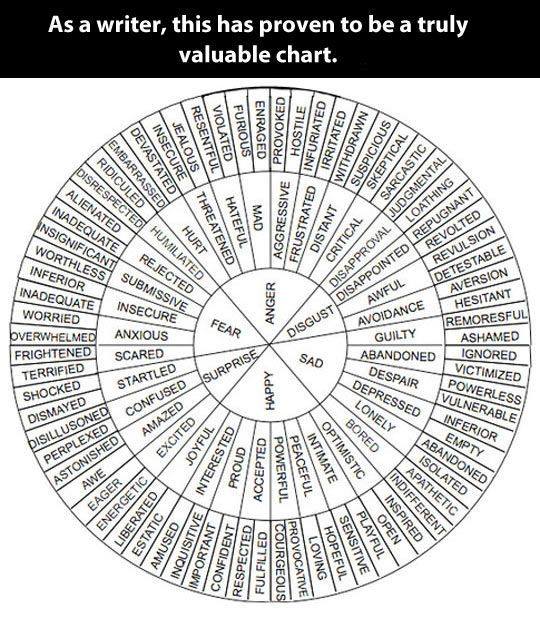
Writing tip Wednesday: “Wheel of Words”

A quick chart that might help if you get stuck.

A quick chart that might help if you get stuck.

Leave a comment

Filed under 2015, writing tip, Writing Tip Wednesday

Writing tip Wednesday: “Passion”

Five Tips to Keep You Passionate About Your Writing

by M. SHANNON HERNANDEZ

Source: http://www.huffingtonpost.com/m-shannon-hernandez/five-tips-to-keep-you-pas_b_7537224.html

Tap, tap, tap — that is the sound of your creative fingertips hitting the keyboard.

As writers, we spend our days and nights hovering over our keyboards, pouring our ideas into a machine that will hopefully make sense of all that is going on in our brains. And don’t get me wrong — it is a wonderful life — but sometimes we look up to see that we have veered off track. Or perhaps we have worked so hard on a piece that maybe we aren’t quite so passionate about it anymore. I’ve been there before, and I am sure you have, too.

How can we stay on track, writing about those things which keep us passionate, when we must write for a living, day in and day out? Below you will find five tips to keep you passionate in your writing.

  1. Stay in your lane: To stay passionate throughout your writing career, it’s important that you know the topics you enjoy writing about, and you stick to those topics. When we venture off into writing about things that don’t fully interest us, we risk losing our luster for our craft.
  2. Define your writing qualities: What formats of writing do you enjoy most? Blog posts, email marketing campaigns, fictional short stories? Be sure you have a clear definition of the types of writing you are willing to take on, and stick to your standards!
  3. Create a mission statement: Now that you know what topics you are passionate about, and what forms of writing you will spend your time crafting, it’s time to connect to your bigger vision and mission in life. Why do you spend your time writing this stuff? Craft a mission statement that will help you pull it all together and keep you going strong when you begin to waiver.
  4. Remove the roadblocks:
  5. Weed out negativity:

Arm yourself with these five strategies so you can continue living and writing passionately. Tap, tap, tap… your keyboard is waiting on you.

Details: http://www.huffingtonpost.com/m-shannon-hernandez/five-tips-to-keep-you-pas_b_7537224.html

Leave a comment

Filed under 2015, writing tip, Writing Tip Wednesday

Writing tip Wednesday: “Writer’s Voice”

Don’t Muzzle (or Muffle) Your Writing Voice

By TOM BENTLEY

Source: http://www.writersdigest.com/online-editor/dont-muzzle-or-muffle-your-writing-voice?et_mid=758567&rid=239626420

I think about the issue of voice in writing quite often. You know, your writing voice, that whiff of brimstone or reverberant cello note or cracked teeth and swollen tongue that stamps your writing as having been issued from you alone. Many writers, particularly younger ones, struggle to find their voice: the word choice, the cadence, the tone, the very punctuation—the stuff that slyly suggests or that screams that you wrote it.

You’d never mistake Donald Barthelme for Ernest Hemingway; the word blossoms gathered in Virginia Woolf’s garden would have flowers not found in the window-box plantings of Joan Didion. So your writing and your writing voice shouldn’t be confused with Schlomo Bierbaum’s—it should be yours alone.

One of the things that made me think of a person’s voice was a literal voice: a few years ago I saw Ricki Lee Jones in concert, and was so struck by her uniqueness as a performer (and possibly as a person). She was cuckoo and mesmerizing in the best of ways on stage: banging on the roof of the piano, exhorting the other players, talking to them in asides during some songs. She played a lunatic version of Don’t Fear the Reaper(!), beating out a slapclap on the top of her piano. The performance was so Rikki Lee Jones: singular, eccentric, passionate, moody. You wanted to be around her just to see what she might do or say (or sing) next. Her voice was hers and hers alone.

Your Writing Voice Is There for the Singing

When you’re developing your writing voice, you might be so painstakingly wrapped up in expressing yourself JUST SO that you drain the blood out of your writing, or pull the plug on the electricity of your ideas. You might have read an essay by Pico Iyer or a story by Alice Munro or a novel by Cormac McCarthy and you might be trying so hard to source and employ the rhythms, humors and tics of those gifted writers that you spill onto the page a fridge full of half-opened condiments that cancel each other’s flavors.

Be yourself behind the pen, be the channel between what cooks in your brain and what courses through the keyboard. Even if that self is one day the grinning jester and another the sentimental fool, be fully that person, unmasked, on the page. Maybe you grew up in a slum in Mumbai or have a pied-à-terre in every European capital, maybe your adolescence was a thing of constant pain, maybe you never made a wrong move, maybe you never moved at all—it should be in your writing, whether in its proclamations or its subtext. Your voice is all the Crayons in your box.

For instance, if you’re inclined to the confessional (like all us old Catholics), turn to your sins: I was a very enterprising shoplifter in high school, running a cottage resale business on the side. While I don’t recommend they teach my techniques in business school, I later forged my history of happy hands into an award-winning short story, and then turned the account of having won that short story contest into a published article in a Writer’s Market volume. Ahh, the just desserts of an empire of crime.

A Voice, and Its Chorus

Of course it’s no monotone: Sometimes I might write about Sisyphus and sometimes I might write about drool (and sometimes I might speculate whether Sisyphus drooled while pushing the rock up that endless hill). By that I mean your short stories might have a female narrators, male narrators, be set in a tiny town one time and in a howling metropolis the next. But you still must find the voice—your voice—for that story.

I like to write essays that often take a humorous slant, but at the same time, that isn’t the limit or restriction I put on my own expression. I published a piece on not actually knowing my father despite my years with him, and another that discusses never finding out what happened to my high school girlfriend after she vanished in Colombia. Both had a tone of pathos. That pensive tone is also one of my voices, and its sobriety doesn’t cancel the chiming of my comic voice. So your voice might be part of a choir.

Rest of the article: http://www.writersdigest.com/online-editor/dont-muzzle-or-muffle-your-writing-voice?et_mid=758567&rid=239626420

Leave a comment

Filed under 2015, writing tip, Writing Tip Wednesday

Writing tip Wednesday: “Supermentors One-Day Class”

Industry Landmines — And How to Avoid Them

One-day class: Sunday, June 7th
10:00 AM – 5:00 PM (Pacific time)
1:00 PM – 8:00 PM (Eastern time)

Learn what pitfalls to avoid.

Learn what pitfalls to avoid.

Hollywood is full of rules – only nobody tells you what they are!

Award-winning writer-producer-directors Elaine and Marc Zicree have written hundreds of hours of produced TV shows and movies for most of the major studios and networks – and now have their own studio! Let them share what they know with you!

In this eye-opening day-long class, Hollywood Insiders Marc and Elaine Zicree guide you through the soul-crushing, career destroying mistakes that many beginners and even long-term pros often make – and which YOU can now avoid:

Some of the many career disasters covered (and super-solutions given) include:

Representation:

  • How to waste time seeking it out – and make sure they’re lacking a pulse.
  • How to provide inadequate evidence and be sure to fail.
  • How to hand over power to folks who don’t give a damn.
  • How to mangle a potentially good relationship.
  • How to confuse the roles of agents, managers and attorneys.

The Script:

  • Sure-fire ways to make the script you write fail!
  • Great ways to find bad scripts by writers who will give you grief.
  • How actors can create characters ranging from invisible to actively annoying.

Cold Calls, Meetings, Pitches and Auditions:

  • How to come off like an amateur.
  • How to bore and confuse.
  • How to blow a meeting – or, better still, trample one that’s going well.
  • How to be under-prepared
  • How to bring in the wrong allies
  • How to alienate potential, long-term connections
  • Stuff you can do wrong in a pitch.
  • Auditioning so you lose you the role and any possibility of ever being invited back.
  • Failing to sell a series using great material.
  • Having no clue how the system works.

Teams:

  • How to be sure you mismatch your director to your script.
  • Creating a budget that assures your project will never sell – or is never finished.
  • How to cast to assure the above.
  • How to staff up with terrible people.
  • How to staff up with wonderful people – and then alienate every one of them.
  • How to write up agreements that you will regret to your grave.
  • Presenting yourself & your project in ways that send alliances running for the hills.

Money:

  • How to solicit funds in ways that will get you into really big trouble.
  • How to do a crowd funding campaign – that will sink!
  • How to be so grasping about credits and points you have nothing to deal with.
  • How to be so generous about the above you end up with zip.
  • Ways to rationalize not thinking about complex stuff like in-kind, trade agreements, incentives, banks and pre-sales (or other methods that may otherwise save your project).

The Sale:

  • How to fail at festivals.
  • How to never find a distributor.
  • How to find a distributor who will rob you blind and bury your project.
  • How to sign a contract that will allow you no recourse for the above.
  • How to burn through resources to not only deny promotional materials, but the deliverables which would allow the sale.
  • How to convince yourself the benefit of avoiding alternate platforms which may result in more money, larger audiences and an actual career.

Strategy:

  • How to embrace the defeatist and the negative.
  • Being sure your mentors have failed at what you’re attempting.
  • How to suck all the energy out of a room.
  • How to stand around waiting to be picked until you die.

Class is JUST $25 and SEATING IS LIMITED – but you can also listen to the entire class via live streaming and downloadable content!

To sign up, log onto www.paypal.com and indicate you want to pay marc@zicree.com

Feel free to email us at Send me an email marczicree@gmail.com or call (323) 363-1259 with any questions.

Don’t wait to be picked — it can all happen NOW.

1 Comment

Filed under 2015, Writing Tip Wednesday, writing tips

Writing tip Wednesday: “Ten tips for SEO”

Ten tips on good SEO writing

Source: http://www.geeksnack.com/2015/04/22/ten-tips-good-seo-writing/

Good SEO writing is much about writing skills and writing techniques. As a blogger, you need to know how to structure your text in subheadings and paragraphs. If your text is appealing and clear, you will attract the interest of your readers. They will gladly like, tweet, share and comment your content if they like it.

1. Think before writing – Good SEO writing tips

n order for your article to be highly ranked in Google search, you need to have writing skills. This means you need to think before you write. To think about what your readers will say after they read your article, what actions and reactions your article can cause. You should write down these answers before starting writing.

2. Arrange your ideas – Good SEO writing tips

You need to arrange your ideas in a logical manner, in every post you write. Some sorts of short introduction, a body where you will write the main ideas and a conclusion text, this structure is a very good and stable one, that normally attracts most readers. After that, you could start the real writing process.

3. Structure your paragraphs – Good SEO writing tips

You should be able to start new paragraphs according to some rules, not just because you consider it looks nicer for your text. Every paragraph should contain one main idea or subject. Paragraphs are important, so do not abuse their usage but also do not forget about them. Paragraphs are the most basic design for the text and readers can enjoy them or not.

4. Use subheadings – Good SEO writing tips

Your article should be organized in subheadings. They will lead your reader in a very quick and efficient way. Readers will be able to scan your text and to find more easily the necessary information for them.

5. Use signal words – Good SEO writing tips

Using signal words is also indicated, because they make readers to focus over the most important things. Words like also, first of all, nevertheless, indeed etc. are good choices in this respect.

Other tips include:

6. Proofread and test your article – Good SEO writing tips

7. Write longer posts – Good SEO writing tips

8. Update content – Good SEO writing tips

9. Inlink – Good SEO writing tips

10. Content is key – Good SEO writing tips

Read the rest: http://www.geeksnack.com/2015/04/22/ten-tips-good-seo-writing/

If you don’t know, SEO stands for Search Engine Optimization.

1 Comment

Filed under 2015, Writing Tip Wednesday, writing tips

Writing tip Wednesday: Grammar Gremlins

Humor and Grammar Gremlins -- from 1979

Humor and Grammar Gremlins — from 1979

1 Comment

Filed under 2015, Writing Tip Wednesday

Writing tip Wednesday: “Top ten….”

The Top 10 Elements of a Book People Want to Read

by Helga Schier, PhD

Source: http://www.writersdigest.com/online-editor/the-top-10-elements-of-a-book-people-want-to-read?et_mid=733701&rid=239626420

Aim for High Readability

Helga Schier

Helga Schier

People enjoy books with a high level of readability—books with a captivating story and memorable characters, books we can’t put down, books that stick with us long after we’ve read the last word.

As an independent editor, I’ve come across my fair share of readable books, and all of them are well crafted on three distinct but intricately connected levels.

  1. The surface structure of the words on the page, which includes grammar, punctuation, and spelling.
  2. The level of style and voice, which is defined by the choice of words, the sentence rhythm, the use of literary techniques and images, and the tone or approach
  3. The content level, where the fictional world comes to life.

Highly readable books are polished, refined, sophisticated, and mature on all three levels. To fulfill the potential of your book, develop and sharpen the following top ten elements.

1. Your Words Are Your tools; Make Sure They Are in Working Order.
Avoid typos, sort out commonly mistaken words such as die/dye or there/their/they’re. Watch your grammar—make sure your nouns agree with your verbs and the personal pronouns fit. If a paragraph begins in the past tense, it likely ought to end in the past tense, too. Figure out where those commas go to help your readers make sense of your sentences. Sounds basic? It is. So run that spell-check and get it right.

2. Check for Inconsistencies.
Writers revise their work constantly. As a result, characters may appear or disappear at random, because chapters were rearranged; subplots remain unresolved, because chapters were cut; and timeline issues may tiptoe in. Looking for inconsistencies and holes in your story is an integral part of polishing your work.

3. Avoid Overwriting.
Your style or voice should step into the background to serve your story. No need for a clever metaphor in every sentence, or for an adjective before every noun. Avoid complicated sentences if a simple sentence will get your point across. Avoid inflated sentences and unnecessary introductory or summarizing phrases. Don’t be verbose—every sentence has a point; get to it.

4. Avoid Underwriting.
Allow your language to adapt to its context. Using the same words and/or sentence structures repeatedly makes a novel repetitive and monotonous. If the teenage girl and the CEO of a multibillion dollar company have the same voice, we’ll learn more about the writer than about the characters and their relationships. Avoid clichés and create your own personal images instead. Or use clichés and stereotypes to your advantage—say, to define a character.

5. Make Sure Your Characters Are More Than a Name.
As a reader, I want to be able to relate to your characters. I don’t have to always like them or agree with their choices, but I want to understand why they say and do whatever it is they say and do. I want to care for them, fear and worry with them. Therefore, your characters need to be recognizable and unique at the same time. They need to be complex rather than cardboard cutouts, and dynamic rather than passive. Even a bad guy deserves a redeeming quality.

The other five recommendations are:

6. Show, Don’t Tell.

7. Sharpen that Dialogue…

8. …And Expose that Subtext.

9. Drive the Plot Towards Your Reader’s Aha-Moment.

10. Build Your World.

Details at: http://www.writersdigest.com/online-editor/the-top-10-elements-of-a-book-people-want-to-read?et_mid=733701&rid=239626420

Leave a comment

Filed under 2015, writing tip, Writing Tip Wednesday

Writing tip Wednesday: “Five from on high”

Writers Can Learn A Lot From Writing Tips Offered By Stephen King

Source: http://www.learnu.org/writers-can-learn-a-lot-from-writing-tips-offered-by-stephen-king/

Author offers advice.

Author offers advice.

Horror writer extraordinaire, Stephen King, has been around the proverbial block more than enough times to know what it takes, what works and what doesn’t when it comes to being a writer. He was kind enough to share some of his experience and insight into the profession in his 2010 memoir, On Writing.

There are a ton of invaluable tips and tid bits of advice for writers and it was nearly impossible to pick just a select few to cover today. After much consideration we were able to narrow down what we found to be incredibly useful information for our writer readers.

In his book, King said “I can’t lie and say there are no bad writers. Sorry, but there are lots of bad writers.” Well, he has a point…a blunt point, but a point all the same. So, with that in mind, here are some of our favorite tips from the “King of Horror”:

1. Put down the remote and pick up a book.
King calls television the “poison to creativity” and he’s pretty much spot on. TV is known to suck out the imagination and dull the senses, which are two very important things to writers. He suggests doing away with the TV and picking up a book instead.Reading allows you to constantly learn and challenge your brain.

2. Don’t shy away from editing.
Cutting out bits and pieces of your writing is a rather hard part of the job, but an unavoidable one. King tells writers to, “Kill your darlings, kill your darlings, even when it breaks your egocentric little scribbler’s heart, kill your darlings.” You heard him, folks! Don’t be afraid of the delete and backspace keys.

3. Cut yourself off from external distractions when writing.
“Write with the door closed; rewrite with the door open,” King says. That sounds about right to us, too. Nothing can jam a writers creative flow quite like a heap of distractions. Writing is an internal activity that often requires the writer to sink into a zone that needs to be maintained.The best way to stay in the zone is to tuck yourself away in a corner without your phone, access to any social media sites and a note on your door asking for privacy.

4. Adverbs and long paragraphs should be avoided like the plague.
And, by the way, so should cliches.

5. Perfect the art of description, but don’t give away too much.

Read more: http://www.learnu.org/writers-can-learn-a-lot-from-writing-tips-offered-by-stephen-king/

Leave a comment

Filed under 2015, Writers on writing, writing tip, Writing Tip Wednesday

Writing tip Wednesday: “No excuses”

Read and write and do both regularly

by Joe R. Lansdale

Source: https://www.facebook.com/JoeRLansdale/posts/753873058055046

Joe R. Lansdale

Joe R. Lansdale

A major rule of writing. Stop making excuses. You do have time if you want to do it. Sure, there are those rare exceptions. But nearly everyone has time. I worked two jobs and had time. Not a lot of time, but enough to get something done daily. If you have time to plop down in front of the TV to watch a Star Trek rerun, or what have you, you have time. If you can go to a job you hate, or at best tolerate, be on time and do it right, you should be able to find a few minutes a day to do something you really want to do. Even if you love your job and want to write, you can find time.

If you are going to take time off, read. That’s the most important tool to a writer. If you read you put fuel in the tank and you begin to better understand how stories are constructed. Once you lean how it works, or as best as anyone can learn how it works, then you can lose the rule book and do it anyway you like. You can make something new best when you understand something old. In other words, don’t mess with the structure of storytelling until you understand how it works, then you can successfully subvert it if you need to. A hard thing to grasp, but it’s true.

Put your ass in a chair in front of the world processor, typewriter, writing tablet, papyrus pages, what have you, and write.

Finish what you start. Sure, you can switch over and work on other things from time to time, but don’t end up with partials of this and pieces of that. Have a major project and finish it. When that’s done, start something new. While you’re marketing a novel, or if you’re far enough along to have an agent do it for you, start a new project to keep you from waiting by the telephone, mail box, email, for a response.

Work daily and at the same time if possible. If not, work when you can, but make it a habit. It takes a lot of hours before something kicks in as a habit. Set a time each day when you can work, and do it. It can be for whatever length of time you have available. If you can’t work every day of the week, try and work as many days as possible. Plan on four or five days at the least, seven if you can. Get up early on holidays and write a bit as a gift to yourself. Don’t let holidays spoil your momentum. Okay, you can take holidays off if you must, but be careful to stay in the zone.

Having a word count or page count can be useful.

Read the rest at: https://www.facebook.com/JoeRLansdale/posts/753873058055046

Or https://www.facebook.com/JoeRLansdale

Leave a comment

Filed under Writers on writing, writing tip, Writing Tip Wednesday

Writing tip Wednesday: “New Year, new start”

6 Tips for (Really) Finishing Your First Book in 2015

Source: http://www.huffingtonpost.com/carrie-visintainer/6-tips-for-really-finishi_b_6392358.html

by Carrie Visintainer

It’s that time of year for New Year’s Resolutions. Love ’em or hate ’em, they come up in all kinds of conversations. Maybe one of your big goals is to publish a book. (Possibly, this has been a resolution of yours for several years, and you just keep transferring it forward.) So in 2015, why not commit? Make it a priority and knock out that first novel, memoir, or story collection. Here are six tips for making your book happen this year.

1. Choose a writing space: This doesn’t have to be an entire room of your own, but it does help to have a designated area just for you, just for writing.

2. Carve out time: This is a challenge for pretty much everyone, no matter your life circumstances. … But you can control this, and you can start by setting realistic goals. Maybe you shoot for an hour every day, or ten pages, or 1,000 words. Do this for a month, and you’ll be amazed: The pages will begin to add up.

3. Turn off your inner censor: We all want to write things that sound beautiful and intelligent; rivaling literary greats and authors we admire. … Be easy on yourself (which is very hard). Commit to the task of putting words on a page without judgment. There’s plenty of time to go back and revise later.

4. Stop at an energetic place: During each writing session, it might take you a while to get warmed up, but then words will begin to flow. Keep going with this, and then do something key: Stop writing for the day when you’re still feeling energized.

5. Join a writers’ group: Critique groups are useful for several reasons. Accountability and camaraderie are but two reasons. … If you don’t know of any critique groups in your area, try posting an ad in a coffee shop or café and see who replies.

6. Reward yourself: Because the act of writing isn’t particularly glamorous — it might even be the hardest thing you’ve ever done — it’s important to celebrate.

Rest of the article at: http://www.huffingtonpost.com/carrie-visintainer/6-tips-for-really-finishi_b_6392358.html

Leave a comment

Filed under writing tip, Writing Tip Wednesday