Tag Archives: writing tips

Isaac Asimov: How to Never Run Out of Ideas Again – Personal Growth – Medium

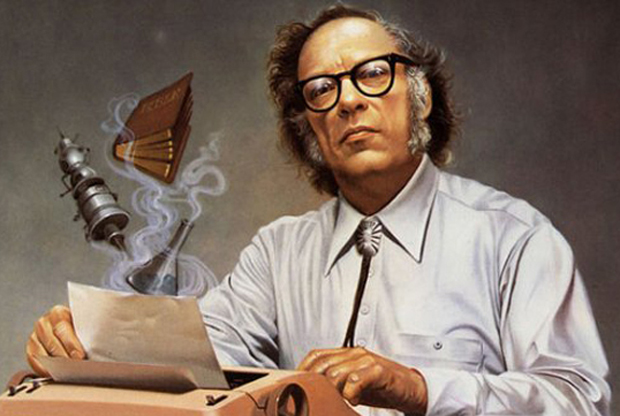
If there’s one word to describe Isaac Asimov, it’s “prolific”.

Source: Isaac Asimov: How to Never Run Out of Ideas Again – Personal Growth – Medium

by Charles Chu

If there’s one word to describe Isaac Asimov, it’s “prolific.”
To match the number of novels, letters, essays and other scribblings Asimov produced in his lifetime, you would have to write a full-length novel every two weeks for 25 years.

Why was Asimov able to have so many good ideas when the rest of us seem to only have 1 or 2 in a lifetime? To find out, I looked into Asimov’s autobiography, It’s Been a Good Life.

Asimov wasn’t born writing 8 hours a day 7 days a week. He tore up pages, he got frustrated and he failed over and over and over again. In his autobiography, Asimov shares the tactics and strategies he developed to never run out of ideas again.

Let’s steal everything we can.
________________________________________
1. Never Stop Learning
Asimov wasn’t just a science fiction writer. He had a PhD in chemistry from Columbia. He wrote on physics. He wrote on ancient history. Hell, he even wrote a book on the Bible.

Why was he able to write so widely in an age of myopic specialization?
Unlike modern day “professionals”, Asimov’s learning didn’t end with a degree—

“I couldn’t possibly write the variety of books I manage to do out of the knowledge I had gained in school alone. I had to keep a program of self-education in process. My library of reference books grew and I found I had to sweat over them in my constant fear that I might misunderstand a point that to someone knowledgeable in the subject would be a ludicrously simple one.”

To have good ideas, we need to consume good ideas too. The diploma isn’t the end. If anything, it’s the beginning.

Growing up, Asimov read everything —
“All this incredibly miscellaneous reading, the result of lack of guidance, left its indelible mark. My interest was aroused in twenty different directions and all those interests remained. I have written books on mythology, on the Bible, on Shakespeare, on history, on science, and so on.”
Read widely. Follow your curiosity. Never stop investing in yourself.
________________________________________
2. Don’t Fight the Stuck
It’s refreshing to know that, like myself, Asimov often got stuck —
Frequently, when I am at work on a science-fiction novel, I find myself heartily sick of it and unable to write another word.

Getting stuck is normal. It’s what happens next, our reaction, that separates the professional from the amateur.

Asimov didn’t let getting stuck stop him. Over the years, he developed a strategy…

I don’t stare at blank sheets of paper. I don’t spend days and nights cudgeling a head that is empty of ideas. Instead, I simply leave the novel and go on to any of the dozen other projects that are on tap. I write an editorial, or an essay, or a short story, or work on one of my nonfiction books. By the time I’ve grown tired of these things, my mind has been able to do its proper work and fill up again. I return to my novel and find myself able to write easily once more.

When writing this article, I got so frustrated that I dropped it and worked on other projects for 2 weeks. Now that I’ve created space, everything feels much, much easier.

The brain works in mysterious ways. By stepping aside, finding other projects and actively ignoring something, our subconscious creates space for ideas to grow.
________________________________________
3. Beware the Resistance
All creatives — be they entrepreneurs, writers or artists — know the fear of giving shape to ideas. Once we bring something into the world, it’s forever naked to rejection and criticism by millions of angry eyes.

Sometimes, after publishing an article, I am so afraid that I will actively avoid all comments and email correspondence…

This fear is the creative’s greatest enemy. In the The War of Art, Steven Pressfield gives the fear a name.

He calls it Resistance.

Asimov knows the Resistance too —
The ordinary writer is bound to be assailed by insecurities as he writes. Is the sentence he has just created a sensible one? Is it expressed as well as it might be? Would it sound better if it were written differently? The ordinary writer is therefore always revising, always chopping and changing, always trying on different ways of expressing himself, and, for all I know, never being entirely satisfied.

Self-doubt is the mind-killer.

I am a relentless editor. I’ve probably tweaked and re-tweaked this article a dozen times. It still looks like shit. But I must stop now, or I’ll never publish at all.

The fear of rejection makes us into “perfectionists”. But that perfectionism is just a shell. We draw into it when times are hard. It gives us safety… The safety of a lie.

The truth is, all of us have ideas. Little seeds of creativity waft in through the windowsills of the mind. The difference between Asimov and the rest of us is that we reject our ideas before giving them a chance.

After all, never having ideas means never having to fail.
________________________________________
4. Lower Your Standards
Asimov was fully against the pursuit of perfectionism. Trying to get everything right the first time, he says, is a big mistake.

Instead, get the basics down first —
Think of yourself as an artist making a sketch to get the composition clear in his mind, the blocks of color, the balance, and the rest. With that done, you can worry about the fine points.

Don’t try to paint the Mona Lisa on round one. Lower your standards. Make a test product, a temporary sketch or a rough draft.

At the same time, Asimov stresses self-assurance —
[A writer] can’t sit around doubting the quality of his writing. Rather, he has to love his own writing. I do.

Believe in your creations. This doesn’t mean you have to make the best in the world on every try. True confidence is about pushing boundaries, failing miserably, and having the strength to stand back up again.

We fail. We struggle. And that is why we succeed.
________________________________________
5. Make MORE Stuff
Interestingly, Asimov also recommends making MORE things as a cure for perfectionism —

By the time a particular book is published, the [writer] hasn’t much time to worry about how it will be received or how it will sell. By then he has already sold several others and is working on still others and it is these that concern him. This intensifies the peace and calm of his life.

If you have a new product coming out every few weeks, you simply don’t have time to dwell on failure.

This is why I try to write multiple articles a week instead of focusing on one “perfect” piece. It hurts less when something flops. Diversity is insurance of the mind.
________________________________________
6. The Secret Sauce
A struggling writer friend of Asimov’s once asked him, “Where do you get your ideas?”

Asimov replied, “By thinking and thinking and thinking till I’m ready to kill myself. […] Did you ever think it was easy to get a good idea?”
Many of his nights were spent alone with his mind —

I couldn’t sleep last night so I lay awake thinking of an article to write and I’d think and think and cry at the sad parts. I had a wonderful night.
Nobody ever said having ideas was going to be easy.
If it were, it wouldn’t be worth doing.
________________________________________
Leave a comment

Filed under 2016, Writing Tip Wednesday, writing tips

National Novel Writing Month 2016: 10 Tips For NaNoWriMo Writers

So you’re thinking about writing a novel for National Novel Writing Month. Here are some tips to help you get started and to stay the course.

Source: National Novel Writing Month 2016: 10 Tips For NaNoWriMo Writers

As the Ernest Hemmingway quote goes, “There is nothing to writing. All you do is sit down at a typewriter and bleed.” The quote illuminates a truth for writers everywhere: Writing a novel is much easier said than done.

That fact is one of the reasons why the founder of National Novel Writing Month, which begins Tuesday, launched the NaNoWriMo community in 1999. That led to the month of November being known as NaNoWriMo, which encourages writers to bear down and get serious about writing their next novel.

From Tuesday through 11:59 p.m. Nov. 30, participating writers are tasked with penning a 50,000-word novel. If they finish early they are encouraged to keep writing. One of the main points of NaNoWriMo is to set writing goals and reach them, as opposed to shooting for a Pulitzer-winning novel (although aiming to write the book of a generation is an admirable endeavor).

Below are 10 tips for getting started writing a novel and staying on-task. Grab your typewriter (fine, computer) and a box of Band-Aids for your fingers, sit down and write with these tips.

  1. First, sign up for NaNoWriMo and create your profile. You will be able to receive help from esteemed authors and connect with fellow writers. Committing to the program will hold you accountable for your writing.
  2. Decide how you want to plan your novel. Yes, there’s even a step before the big steps. The NaNoWriMo website’s places writers into two categories: a “planner” and a “pantser.” The first believes in solid preparation and will likely have their stories fleshed out before Nov. 1. That means if you’re your reading up on these tips, you’re probably in the latter group of those who let their spontaneity take the reins. The latter also prefers to dive right in and see what unfolds along the way.
  3. Prep your novel! If you don’t have somewhat of a story idea already, it’s time to get going. The NaNo website has published videos and tips on how to properly plan for your story for the month ahead.
  4. Check out the literature the site also publishes on tips for character building, fiction writing, story building and more. Plan ahead, but don’t let the planning process keep you from this next step…
  5. WRITE. There’s no avoiding it. The best thing to do is just write.
  6. Once you’ve started, plan your pace for the month and commit to completing a certain amount of words every day. The goal is to write 50,000 words, so the word count is a tangible goal that needs to be met.
  7. Try to write at the same time every day. This doesn’t necessarily work for everyone, but by committing to the same time, you’ll be less likely to push aside the time for socializing or doing chores. Some people prefer writing first thing in the morning, while others prefer the late-night grind. Find your “time” and stick to it.
  8. Reach out to others. The community through NaNoWriMo is meant to help you get the resources and support you need to complete your story. Contrary to popular belief, writing does not just have to be a solitary experience that you share with you and yourself in a cold, damp garret – your writing is meant to be shared. So seek out friends, family members, fellow writers or mentors who might offer you feedback on your writing or even just moral support.
  9. Don’t give up! This might not be the most original tip, but it’s impossible to keep going if you don’t believe in yourself or your story. Keep at it, and keep at it some more. Some days the words will fly, while other days will feel tedious and awful (remember the part about the proverbial “bleeding” – grab those Band-Aids and get back to work).
  10. Have fun. You’re writing a novel, not fighting a war. Have fun and enjoy the process. Nothing beats the beauty of when the human mind and imagination coming together to create something completely original and unique.

Leave a comment

Filed under 2016, writing tip, Writing Tip Wednesday

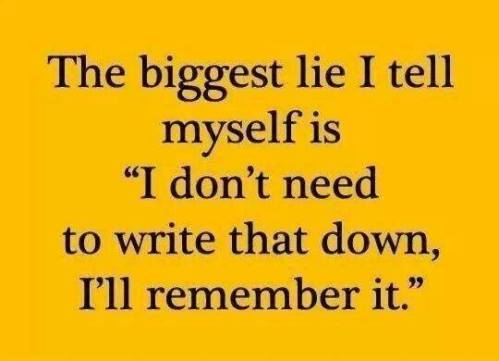
Writing tip Wednesday: “Get it write”

biggest-lie

One of the easiest things to do is also one of the hardest, and that is to write down that piece of dialogue, turn of phrase, descriptive passage, ear catching name for a character, or any other part of writing.

Granted, it can be hard to write something down when you are driving or in the middle of shopping for food for that big holiday meal, or even in the dark watching a movie. I’m sure you can fill in the line, I had a great idea, but I couldn’t write it down because….

The only thing I can say is I have kicked myself too many times over things I have forgotten when I told myself I would remember them until I could write them.

Sometimes, it helps me to remember the first letter of each word in a phrase I am trying to remember until I can write it down. But I always, or at least almost always, have a pen and paper with me, even a scrap piece of paper. And though I still fail, I try to write it down as soon as I can after the idea has come to me.

It’s not always easy, but nobody said writing should be. Sometimes it is. Often it isn’t, so don’t make it harder on yourself by not having pen and paper or some other way of recording that bit of inspiration when it comes your way. Even if I don’t end up using it, I have acknowledged it, and I have found that acknowledging inspiration helps bring forth more inspiration, while ignoring it or being lazy about it only causes it to go elsewhere, to someone else who will appreciate it.

–David E. Booker

Leave a comment

Filed under 2016, writing tip, Writing Tip Wednesday

Writing tip Wednesday: “Evolving into a writing schedule”

Struggling to write? Take some tips from Charles Darwin

charles-darwin-100pdi_7x9

Darwin’s magnum opus, On the Origin of Species, is a masterclass in how to structure research and craft your arguments

By Rosalind White

After his voyage on HMS Beagle, Charles Darwin relocated to the English countryside near Orpington in 1842. There, he would spend the next 17 years working on his magnum opus, On the Origin of Species.

He adopted a surprisingly relaxed routine. A schedule was kept by his son, Francis Darwin, summarising a typical day in his father’s life.

  • 7am: Rose and took a short walk, followed by breakfast.
  • 8am: Worked in his study; he considered this his best working time.
  • 9.30am: Went to drawing room and read his letters, followed by reading aloud of family letters.
  • 10.30am: Returned to study for more research.
  • Noon: Walk, starting with visit to greenhouse, then down his gravel path known as the “sandwalk”, sometimes accompanied by his dog.
  • 12.45pm: Lunch with whole family, which was his main meal of the day.
  • 3pm: Rested in his bedroom on the sofa and smoked a cigarette, listened to a novel or other light literature read by Emma Darwin, his wife.
  • 4pm: Walked around the sandwalk again.
  • 4.30pm: Worked in study, clearing up matters of the day.
  • 6pm: Rested again in bedroom with Emma reading aloud.
  • 7.30pm: Light high tea while the family dined. In late years he never stayed in the dining room with the men, but retired to the drawing-room with the ladies.
  • 10pm: Left the drawing room and usually in bed by 10.30, but slept badly.

Make an emotional connection

Darwin’s strategy was one of crafted self-possession. He prioritised domestic comfort, time with his family and rambles in the country, rather than intellectual endurance. As a method for writing, it fostered a deep emotional connection with his research – and this intimacy resonates in the lucid flow and appreciative tone of his arguments:

“It is interesting to contemplate an entangled bank, clothed with many plants of many kinds,” he writes. “With birds singing on the bushes, with various insects flitting about, and with worms crawling through the damp earth, and to reflect that these elaborately constructed forms, so different from each other, and dependent on each other in so complex a manner, have all been produced by laws acting around us.”

Darwin resisted an automatic, or breakneck approach. The pleasure he took in both his writing and his research is tied up with his ability to take a moment, breathe and witness the world in a wider dimension. This consciousness of place is a method that can be applied to both natural history and to writing. If your writing is made up of frantic action, with no breathing space, you will spawn a confusing muddle of disparate ideas.

In a letter written to HW Bates in 1861 he provides an outline for effective working. Lamenting the sting of labouring “very hard and slowly at every sentence”, he admits that he sometimes finds style “a great difficulty”.

Find your imaginary person

His advice to fellow floundering writers is: “I find it a very good plan, when I cannot get a difficult discussion to please me, to fancy that someone comes into the room and asks me what I am doing, then try at once and explain to the imaginary person what it is all about.”

He also suggests that a writer should power through their piece briskly to construct a kind of skeleton argument. Equally, however, he is cautious to prepare for counter-arguments without appearing too dogmatic. On the Origin of Species has been described as “one long provocation in the guise of being none”.

US writer Adam Gopnik, who wrote a book on Darwin, notes that the habit of “sympathetic summary” is essential to his rhetorical power.

“All of what remain today as the chief objections to his theory are introduced by Darwin himself, fairly and accurately, and in a spirit of almost panicked anxiety — and then rejected not by bullying insistence but by specific example, drawn from the reservoir of his minute experience of life… [On the Origin of Species] is not only a statement of a thesis; it is a book of answers to questions that no one had yet asked.”

The survival of his thesis was won partly because of intellectual empathy, rather than an ugly fight to the death played out in the public arena. Darwin teaches us that – in an effort to make sure that your work does not go the way of the dodo – it’s essential to adjust your methodology and anticipate arguments in order to survive.

But in the spirit of this philosophy, it is important to remember that such advice is worthless if you lack the tenacity to actually write the thing in the first place. So write. But be patient. After all, Darwin himself took more than two decades to finish his book.

Leave a comment

Filed under 2016, writing tip, Writing Tip Wednesday

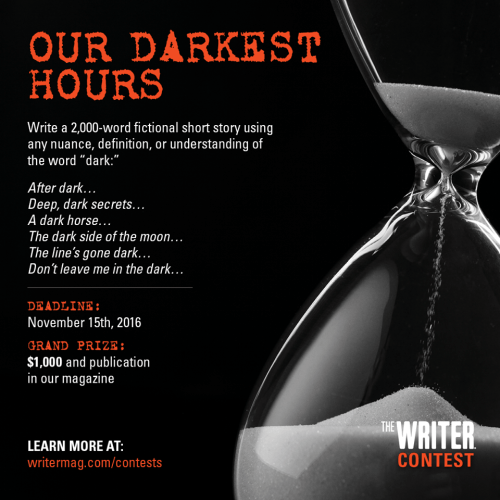
Writing tip Wednesday: “Dark and stormy contest”

our-darkest-hour-contest

Details at: Writermag.com/contests

Leave a comment

Filed under 2016, writing tip, Writing Tip Wednesday

Writing tip Wednesday: “Locked Room Challenge”

Stuck in your story and don’t know where to go? Maybe this will help.

by David E. Booker

Locked Room Challenge

Among some science fiction writers there is a challenge known as the shortest story. Someone once said the shortest science fiction story was: “Last man on Earth sat alone in a room. There was a knock on the door.” Then somebody else made it shorter by writing: “Last man on Earth sat alone in a room. There was a lock on the door.” Ernest Hemingway reportedly wrote the shortest story that went something like this: “Newspaper ad. For sale. Brand new baby shoes. Never used.”

What does this have to do with being struck?

Ernest Hemingway at typewriter

Ernest Hemingway at typewriter

Maybe nothing, but maybe when you are, take your protagonist or even your antagonist and make him or her the last person on Earth. In a locked room. Then there is a knock on the door. What does he do? How does she react? Maybe it is a very small room and your character is already feeling very anxious because he hates being in confined spaces. Write out what your character would do. A few hundred words. Five hundred at most.

Or maybe your character reads the ad or has to place the ad. Why did he have to place the ad? Did he lose a child? Did she break up with a man who had a child and she can’t return the shoes because they are a discontinued brand, but she has to do something with them. Does she need the money? Maybe they were expensive shoes. Or maybe they were bought years ago and she forgot she had them still and is now moving and can’t take them with her.

Or think of a scene of your own. But it has to be a scene where an important decision has to be made and one that affects the character emotionally, physically, mentally, spiritually – at least two of the three.

Often a writer is stuck because he doesn’t understand something about at least one of his characters, and doing this can help uncover a layer of the character that is important to the story. Who knows, what you write might even become a scene in the story or novel you are working on.

Leave a comment

Filed under 2016, writing tip, Writing Tip Wednesday

Writing tip Wednesday: “Ten Mistakes”

10-mistakes-of-aspiring-writers-100dpi_6x8_4c

Leave a comment

September 14, 2016 · 9:33 pm

Writing tip Wednesday: “Surviving rejection”

How the World’s Most Frequently Rejected Playwright Survives

written by Donald Drake

Source: http://www.pdc1.org/viewthisarticle.php?article=8

Several years ago, I made a profound discovery that has enabled me to weather the storm of criticism, rejection and inevitable, transient depression that is the lot of so many playwrights. What I discovered was how to make rejection work for me. Since playwrights spend far more time dealing with rejection than watching their plays being produced, every playwright should know about this.

I will explain how I made this discovery and what it has meant to me.

Might not be the best way to survive rejection, but it might work.

Might not be the best way to survive rejection, but it might work.

Might not be the best way to survive rejection, but it might work.[/caption]When I started writing plays 26 years ago and finished my first script, I mailed it out to several theaters and waited. And I waited. And I waited some more. I was still waiting as I finished my second play six months later. I sent my second script out to several theaters. And I waited. I was not enjoying playwriting.

Finally I got a response, in the form of my self-addressed, stamped envelope, which contained my first script and a form letter saying the theater didn’t want my script.

Though this was disappointing, in a strange way I felt validated. At least someone had read the script. There was a living, breathing human being on the other end of the line, or so I assumed in my naiveté. Other experienced playwrights conceded that a living, breathing human being probably did put the script into the return envelope, but what proof did I have that anyone actually read it.

Two months later I received my second rejection. The letter attached to the script said “I enjoyed learning about the characters; they are multi-dimensional. Also, I enjoyed the dialogue and how it worked effectively and moved the plot along.” But the theater didn’t want to do my play. This rejection surely proved that the living breathing person had read the script before putting it into the return envelope, though my more cynical fellow playwrights pointed out that no specific characters or specific plot points were alluded to.

Then I got the best rejection ever. The letter said: “I want to let you know that I intend to give my whole-hearted support to your play as a potential candidate for our season. Thank you for a fascinating new play.” Again no specifics were mentioned, but could theater people be so sadistic to say this about a play they had never read? Yes, I was told. I never heard from the theater again.

I brushed the cynicism aside. “Thank you for a fascinating new play.” The phrase kept coming back to me several times during the next couple of months as I pounded away at my computer with renewed enthusiasm, working on my third play. My initial sadness over not getting a production was being replaced by the joy of knowing that my work was being appreciated, though, admittedly, not enough to be produced. Every day when the post lady arrived with my mail, I eagerly looked for the tell-tale, 11-by-13-inch manila envelope, which would contain my script and hopefully an encouraging rejection letter.

I had discovered that I could lift my spirits by simply changing focus. Instead of looking for a production, which rarely if ever happens, I started anticipating nice rejections, which were now happening fairly frequently. I decided to capitalize on the discovery by keeping detailed records of the rejections. And so the Drake Rejection Database (DRD) was born. Ultimately the DRD would show what theaters sent the best rejections (by far the best come from England), the elapsed time between submission and rejection, the number of plays or sample dialogue pending, the total number of rejections to date and many other facts.

I started attacking rejection with abandonment. I came up with a clever way to identify theaters that did not even open envelopes but just threw scripts onto a pile or even worse into the trash can (though I suppose the trash can is no worse than a stack of scripts that will never be looked at). Slyly, I included with the synopses and sample dialogue I sent to theaters a self-addressed postcard with three boxes the assistant, to the assistant, literary manager could check.

“Please send script ___”

“Please don’t send script ___”

“Don’t send any more scripts ___.”

Theaters that never sent back postcards could be assumed to never open envelopes that contained unsolicited scripts. This ploy identified the bad theaters, the ones to stay away from. But how could I identify the good theaters? The answer to this question was contained in the rejection letters I was receiving. Any theater that actually commented on one of my plays was by definition a good theater. I made use of this vital information by including in the DRD abbreviated comments from theaters. For instance, a DRD entry for my play Final Edition looked like this:

COMMENT-FINAL “We are interested in your writing and would be eager to read and consider any other new plays that you might have.”

By doing a computer search for just “COMMENT,” I could identify theaters that were actually reading plays and choose them as the first theaters for future submissions.

Though I didn’t realize it at the time, the DRD would turn out to be an invaluable tool in quantifying the way theaters handled scripts and treated playwrights.

A few of the discoveries:

  • The likelihood that your unsolicited script will be rejected or totally ignored by a theater is 99.57 percent. That means no production, no showcase, no staged readings. Zip.
  • A little more than 41 percent of your scripts won’t even be read. I base this on the fact that 597 of my submissions prompted no return postcard or any other response. It was as if I had thrown the scripts into the trash bin on the way to the Post Office.
  • The chances of winning a competition are much better than having an unsolicited script done by a theater. Four percent of the 300 plays I submitted to contests won first or second prize.
  • Four hundred and thirty-five theaters in the U.S., Canada and Great Britain (and this includes the tiniest of the tiniest) claim to produce unsolicited scripts, but you can’t prove it by me. I sent 22 different plays, mostly full-lengths, to these theaters and got no productions. My reward was 835 rejection letters, mostly form letters. If you assume that the 597 submissions that were totally ignored constituted rejections, that would bring my rejection total to 1,432. The grand total rises to 1,720 if you include competitions that I didn’t win. Surely that entitles me to the title “The World’s Most Frequently Rejected Playwright.” So much rejection is not necessarily bad. In writing about a hugely successful playwright who had had experienced much rejection in his career, a Philadelphia Inquirer columnist wrote: “The irony of it, of course, is that the people who succeed the most are the people who have failed the most, because they are people who have tried the most.” (I have that quote enlarged and in a frame next to my computer, just below the framed manila envelope a theater returned to me with the words “REFUSED Return to Sender” scrawled in filter-tip blue across the front of it.)
  • There is a thin, silver lining to this growing dark cloud that I am presenting. Twenty percent of your rejection letters will include encouraging comments. The comments contain such words and phrases as: “promising,” “exciting,” “well crafted” “thought provoking,” “eager to read any other new play you might have,” “much to admire,” “remain interested in your work,” “compelled by your writing,” “moved by the brave way you handled such a delicate situation.” I’ve received 167 such rejections but none of the theaters offered to do anything with the plays they were commenting on.
  • The chance of getting an agent, if you haven’t had a major production, is about zero, though I don’t have large figures to support this. Just for the hell of it, I sent letters, CV and sample dialogue to 10 agents listed in the Dramatists Sourcebook asking to be represented by them. Only three bothered to reply and none of them wanted to represent me. One of the three replies was from a playwright, working as an agent, I had met in a competition where our two plays were being done. She said she wasn’t taking on new playwrights but she would pass my script on to other agents in her firm. I never heard from anyone.

I don’t want to give the impression that I have never succeeded with any of my plays. I have been a winner in 11 national competitions. One of my plays was done at the O’Neill. I’ve had four showcases, three of them in New York City, and seven productions. One of the productions was done in a theater where the literary manager was a best friend and another production was done in a theater where I was well known to the artistic director, which in itself says a lot about how to get a play produced.

In the 26 years I have been writing plays, I have made about $10,000 in grants, winnings from competitions and actual payment by a theater for a script. This is offset by the $8,876 I spent for script duplication, stationery and postage. Still I made a profit of $1,124. Having spent 34,000 hours writing plays during this period, my compensation comes to 3 cents an hour. (This doesn’t include the $3,000 or so I spent mailing scripts to competitions, so I guess I can’t even claim that meager profit.)

If I had achieved none of these things, would my philosophy and the DRD have been enough to sustain me? I would like to say yes, but I doubt it. I don’t think I could keep on writing if I cut out the middle man and threw all my scripts into the trash can myself after finishing them the way crossword puzzles are discarded once they’re completed. The distant hope that something could come from all this writing is probably necessary.

But this doesn’t change my take-home message. I have proven beyond doubt that any playwright who writes stage plays primarily to get produced or make money is delusional or masochistic. The joy must come from the writing itself, solving the myriad of problems that arise in creating a play, just as you enjoy fitting together the pieces of a puzzle to form a picture with no other reward expected.

I’m in particularly good spirits at this moment, which probably accounts for the fact that I am writing this, after thinking about doing it for several years. Much of the good feeling is coming from writing this essay and discovering that I have accomplished more than I thought. And one of my plays, written with another playwright for the Philadelphia Fringe, is currently in rehearsal. But even after the play closes and regardless of how the critics respond, or don’t respond, I’m sure I will continue to be a happy playwright.

I have scripts or sample dialogue pending in 78 theaters. And the DRD tells me that I will assuredly be receiving 15 letters of rejection with very encouraging comments in the coming months.

Leave a comment

Filed under 2016, writing tip, Writing Tip Wednesday

Writing tip Wednesday: “Idioms, you idiot”

7 idioms almost everyone gets wrong

http://m.prdaily.com/Main/Articles/7_idioms_almost_everyone_gets_wrong_15805.aspx

by Matt Wilson

The English language is old. Like, really old.

Getting to the heart of the matter.

Getting to the heart of the matter.

It’s old enough that its speakers use a good many idiomatic sayings that were thought up decades or even centuries ago, and that use words people don’t really say much anymore.

That can turn into a problem when those out-of-date words sound like other, much more common words. Especially if the sound-alike word makes a certain sort of sense in the context. Here’s the thing, though: It’s still wrong, even if it seems right.

Take a look at these eight examples of often-misused idioms and be sure to use the right word in your own writing.

Wrong: “She hung in there like a trooper.”

Right: “She hung in there like a trouper.”

Groups of actors and dancers still travel around in troupes today, but not nearly as much as they once did. Far more commonly discussed nowadays are military troops or police troopers. It makes some degree of sense to think that a saying that describes fortitude would refer to a tough cop or soldier, but it’s actually about the “show must go on” mentality of an actor.

Wrong: “Let’s give him free reign.”

Right: “Let’s give him free rein.”

We’re talking about offering someone full independence to make a decision, so it’s understandable that someone might think this saying would be about royal authority. It’s really about horses, though. When someone is riding, “free rein” means they’re allowing the horse to move about as it wishes. This is simply applying that horse lingo to a person.

Wrong: “We’ll tow the line.”

Right: “We’ll toe the line.”

Folks are used to talking about boats or trucks towing other vehicles using a rope or a chain. It’s easy to make the connection to this saying. The correct word is toe. The origin of this phrase is cause for some debate. We might be talking about the digits of a foot. Some say it’s about kids lining up for the roll call at school, others say it’s about barefoot sailors lining up to stand at attention. Still others say “toe” means to draw, as in a boundary line.

Wrong: “She was chomping at the bit.”

Right: “She was champing at the bit.”

Once again, we can thank horses for this idiom. It’s got a pretty cut-and-dried meaning, in that it’s about figuratively chewing away on a metal mouthpiece, which would be showing impatience or eagerness. In fact, “chomp” is a sort of variant of the older “champ.” They both mean noisily chewing on something, but “champ” is the term that has long been associated with this idiom.

Wrong: “Wrack your brain about it.”

Right: “Rack your brain about it.”

To “wrack” something is to wreck or destroy it. Sometimes, when you’re pounding your head against a wall to come up with an idea, it can definitely feel like you’re doing some damage to the old noodle. But the correct term here is “rack,” which isn’t related to the noun form of the word. The verb form literally means “to strain.”

Wrong: “He’ll get his just desserts.”

Right: “He’ll get his just deserts.”

Sayings such as, “Revenge is a dish best served cold,” have created a sort of connection between food and someone’s getting their comeuppance. A lot of people think this saying extends that connection, but it doesn’t. The problem is that “desert,” which is a wholly separate word from the one that describes big, dry, sandy places, is a homophone for “desserts.” Here, “deserts” means “what one deserves.” That meaning has almost entirely fallen out of use, except in this phrase.

Wrong: “I’m waiting with baited breath.”

Right: “I’m waiting with bated breath.”

Let’s get past the very confusing notion of how someone would bait his or her breath to begin with and simply say that “bated” here is actually a contraction, despite the lack of an apostrophe. The full word would be “abated.” The person is holding his or her breath, not attracting something with it.

What are some other idiomatic phrases you see people often getting wrong in their writing?

Leave a comment

Filed under 2016, writing tip, Writing Tip Wednesday

Writing tip Wednesday: “Inspiration”

10 Tips For Finding Inspiration When You Don’t Feel Like Writing

http://culturedvultures.com/tips-writing-inspiration/

by Eileen Cook

Some days the writing comes easy. The words spill onto the page as fast as you can get them down. Ideas drop out of the sky and every direction you turn unearths new inspiration. Those are good days.

Then there are the other days.

Young writer at work

Young writer at work.


Days when you’re pretty sure that your muse hates you, that she’s turned mute, and also possibly homicidal. The blinking cursor on the blank page starts to feel like a dental drill to your head.

Those of us that make a living from our writing, and those who aspire to, don’t have the luxury of writing only when it flows. There are deadlines. Reader expectations. So what can you do to jump start your creativity? Here are ten tips to get you writing when your muse is on vacation.

1. Show Up
There are times when showing up is half the battle. You can tell a procrastinating writer because they have a really clean house. No one is better at avoiding writing than a writer. Turn off the internet and sit down in your writing space for a set period of time. If it helps, try setting a timer. Tell yourself when the thirty minutes, or hour is up, you can do anything else you want, but for that time you will write.

2. Permission to Write Badly
Often writers get stuck because the shiny wonderful idea in our head bears no resemblance to the misshapen creature that showed up on the page. We’re frustrated and it can be easy to quit. The writing advice of Nora Roberts applies here: you can’t fix a blank page. Get it down. Even if it is not what you wanted you can fix it.

3. Give Ideas Room to Breathe
At times you may be stuck because you are trying to force an idea into the world that is not fully formed. Ideas, like people, need space and time to figure out what they really want to be. If an idea isn’t working, consider putting it on a back burner and give yourself permission to work on something else.

4. Surround Yourself with Interesting Stuff
Ideas come from a range of places so bring in lots of stimulants into your life. Who knows what may spark an idea or expand one? Read widely, watch movies, have conversations, do crafts, check out magazines, blogs, and newspapers, look at art, or take time to travel.

5. Music
Music taps into the emotional center of the brain. Consider creating playlists for different emotions and play these when working on different scenes. Movie soundtracks can be great for this. If the theme from Indiana Jones doesn’t make you want to write action, then I don’t understand you. You can also create playlists for the book you’re writing and when you hear the music it becomes your cue that it’s time to write.

6. Switch it up
Jump starting your creativity might be as simple as changing up your normal routine. If you normally write in the mornings, try at night. Write longhand instead of on the computer. Try changing your physical space by writing in a different room, or the beach, library, or coffee shop.

7. Give Yourself Permission to Play
Writing is supposed to be fun. It can be easy to get caught into the idea that the only writing that matters is that which moves your book forward by a set number of words per day. Instead try playing with your world. While you may not be writing anything that shows up directly in your project, it may inspire you in a direction you hadn’t considered. Write diary entries from a character’s point of view, take a scene and write it from the point of view of a different character, brainstorm ideas by asking yourself what if? See where it leads you.

8. Writing Groups
Sometimes what you need to move forward is a good kick in the rear and a supportive writing group can offer that. Writing groups can inspire you by helping you set, and stick, to deadlines. They can also provide objective feedback which may help you get direction.

9. Take a Class/Go to a Conference/Listen to a Podcast
I gain a lot of inspiration by listening to the podcast Writing Excuses on a regular basis. Their way of breaking down various writing issues often gives me ways to look at my book in a new way. Conferences or classes give you inspiration in workshops with practical how-to exercises, as well as helping you connect to a wider group of writers. There is power in knowing you aren’t alone in this crazy desire to make stuff up for others.

10. Move/Exercise
There are studies that show physical activity activates different parts of the brain. A healthy body helps create a healthy mind. This doesn’t mean you have to enter a triathlon, but if you’re finding the words aren’t flowing, take a walk, go for a swim, or do a yoga class.

Your muse works for you, but she may require some training. Using some (or all) of the ten tips here will hopefully have you writing on a regular basis, and instead of waiting for inspiration- creating it.

Leave a comment

Filed under 2016, writing tip, Writing Tip Wednesday