Tag Archives: writing tips

Writing tip Wednesday: “Character Dimensions and Sketch”

On Saturday, February 1, 2014, I took a workshop sponsored by the Knoxville Writers’ Guild (www.knoxvillewritersguild.org) and led by nationally published author Pamela Schoenewaldt (www.PamelaSchoenewaldt.com and on Facebook at https://www.facebook.com/pages/Pamela-Schoenewaldt/158580547517755?ref=tn_tnmn).

Answering questions beforehand could save you heartburn later.

Answering questions beforehand could save you heartburn later.

The workshop was on character development. What you have below is the third of the three handout exercises from the workshop. The first one, “Who are you?” was posted two Wednesdays ago. The second one, “Conflict Worksheet” was posted last Wednesday.

Each previous worksheet / exercise could be done in ten minutes or less, and oftentimes not pondering too long is best. This worksheet may take a little longer, but like the others can be used for the both the protagonist and antagonist of the story or novel you are working on, or just about any character you want to use it on. It might also be helpful if writing a memoir or biography.

CHARACTER SKETCH EXERCISE

Answer without worrying about grammar or logic.
• NAME your character

• LEARN your character by considering these dimension (writing notes on each or most is ideal)

• REMEMBER that your goal is a rounded character (not all good or bad) with a capacity for moving action.

• SKIP dimensions which repeat information.

• BEWARE of main characters who are very young, psychotics, or whose condition severely restricts their capacity for change.

• KNOW everything about this person.

CHARACTER DIMENSIONS

1. Age, physical appearance and attitude to body.

2. Significant health issues.

3. Distinctive physical signs: scars, handicaps, beauties, tics, tattoos, gestures.

4. Manner of speaking (level of language, accent, peculiarities). Manner of dress.

5. Living situation (where, with whom, how living space reflects character).

6. Socio-economic level and attitude to this level (satisfied, indifferent, ambitious?).

7. Work/ profession/ main activity.

8. Performance in Work/ profession/ main activity.

9. Sexuality and relationship to it (fears, doubts, longings, obsessions).

10. Quality of childhood.

11. Current relationship with family – how does it affect the person?

12. Significant intimate relationships and how they reflect the person.

13. What friends does character have? Attitude to friends, their attitudes to him/her.

14. Significant interests, hobbies, passions, obsessions.

15. Religious/spiritual practice and faith.

16. Fundamental belief about life/self (“The most important thing is . . . “)

17. How does the way the character sees him/her self compare to others’ views of him/her?

18. Major strength (include hidden strengths which could be mobilized).

19. Major success/failure or secret of past. (Any significant patterns?)

20. Typical way of dealing with stress or crisis… (Does it work? Should it change?)

21. Major weakness and fear.

22. Ambitions and blocks to achievement.

23. Shaping force/person/event of past.

24. What is not working for your character now?

25. What would your character sacrifice or fight for?

26. Where does your character experience a major conflict in values?

27. Where does your character draw the line: s/he wouldn’t do this….

28. What might push your character up to the line?

29. What conflict, choice or crisis faces the character now?
Leave a comment

Filed under Photo by author, writing tip, Writing Tip Wednesday, writing tips

Writing tip Wednesday: “Conflict”

On Saturday, February 1, 2014, I took a workshop sponsored by the Knoxville Writers’ Guild (www.knoxvillewritersguild.org) and led by nationally published author Pamela Schoenewaldt (www.PamelaSchoenewaldt.com and on Facebook at https://www.facebook.com/pages/Pamela-Schoenewaldt/158580547517755?ref=tn_tnmn).

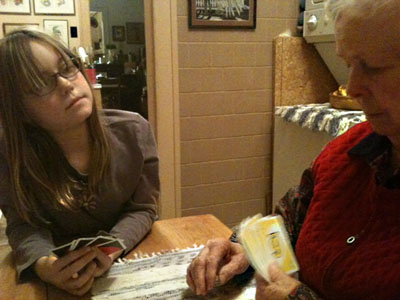
Even a friendly game of cards might harbor some conflict.

Even a friendly game of cards might harbor some conflict.

The workshop was on character development. What you have below is the second of the three handout exercises from the workshop. The first one, “Who are you?” was posted last Wednesday. Each handout can be done in ten minutes or less, and oftentimes not pondering too long is best. The first exercise was called “Who are you?” The you refers to the character. This worksheet can be used for the both the protagonist and antagonist of the story or novel you are working on, or just about any character you want to use it on. It might even be helpful if writing a memoir or biography.

CONFLICT WORKSHEET

Answer without worrying about grammar or logic. Emotions can be messy and illogical. The point is that they MATTER.

1. More than anything, my character wants. . .

2. Getting it matters so much because . . .

3. But the problem/obstacle is . . .

4. My character feels (use 4+ adjectives)

5. Giving up would mean . . .

6. To “win” the character must overcome . . .

7. Who will help and how?

8. Name 3 possible LOCATIONS where this conflict will play out. What OBJECTS will be important?

9. The outcome/ resolution will change the character. Now s/he will . . .

Leave a comment

Filed under writing tip, Writing Tip Wednesday, writing tips

Sting tells TED audience of the only way he could overcome writer’s block – The Globe and Mail

Sting tells TED audience of the only way he could overcome writer’s block – The Globe and Mail.

Sample:

Sting is a prolific songwriter, author of a decades-long career first with the Police and then on his own, filled with pop-chart toppers, platinum records and music industry trophies to show for it.

Then came the drought.

Sting explained at the TED Conference in Vancouver how he fought his way back to his art after a prolonged period of creative darkness, when the songs stopped coming. Hint: it took him back to his hometown, and ends where the neon lights are bright.

Leave a comment

Filed under TED talks, writing tip, writing tips

4 Things Science Fiction Needs to Bring Back | Cracked.com

4 Things Science Fiction Needs to Bring Back | Cracked.com.

Sample:
It’s tempting to look around at today’s literary scene, with its Twilight and its Fifty Shades of Grey, and wonder if we shouldn’t just flush the whole goddamn concept of written language down the toilet — maybe start again with some sort of hybrid colorwheel/odor system for communicating thoughts. Strangely, the one genre thriving in the swamp of modern literature seems to be science fiction. It’s kind of appropriate, actually: All of our crazy high technology has made publishing and distributing books about crazy high technology much more approachable and widespread than ever. But even the best works could stand to learn a little something from the past, so here are a few things that I miss about old science fiction, and would like to see come back.

Read more: http://www.cracked.com/blog/4-things-science-fiction-needs-to-bring-back/#ixzz2whMw9XfP

Leave a comment

Filed under science fiction, writing tip, writing tips

Writing tip Wednesday: “Who are you?”

On Saturday, February 1, 2014, I took a workshop sponsored by the Knoxville Writers’ Guild (www.knoxvillewritersguild.org) and led by nationally published author Pamela Schoenewaldt (www.PamelaSchoenewaldt.com and on Facebook at https://www.facebook.com/pages/Pamela-Schoenewaldt/158580547517755?ref=tn_tnmn).

The workshop was on character development. What you have below is one of the three handout exercises from the workshop. I will be posting the others over time. Each handout can be done in ten minutes or less, and oftentimes not pondering too long is best. The first exercise is called “Who are you?” The you refers to the character. This worksheet can be used for the both the protagonist and antagonist of the story or novel you are working on, or just about any character you want to use it on. It might even be helpful if writing a memoir or biography.

WHO ARE YOU?

Your name is . . .

Your age is . . .

I can see that you are . . . (location)

And you’re looking at . . .

And you’re feeling . . . .

Your great strength is . . . .

Your fear or weakness is . . . .

It’s too bad that . . . .

You’d really laugh if . . . .

Most people don’t know that you . . .

Very soon you must . . . .

The challenge will be . . . .

You will get strength from . . . .

Looking in your eyes, I know that . . .

Leave a comment

Filed under writing tip, Writing Tip Wednesday

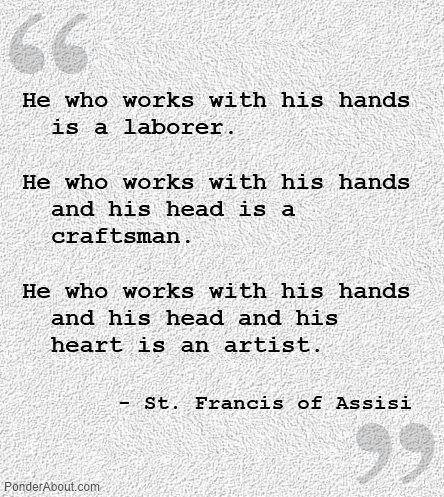
Writing tip Wednesday: “Artist”

What it takes to be the best.

What it takes to be the best.

Leave a comment

Filed under writing quotes, writing tip, Writing Tip Wednesday

Lauren Oliver’s Writing Secrets – 5 Secrets To Writing The Next Great American Novel – Cosmopolitan

Lauren Oliver's Writing Secrets – 5 Secrets To Writing The Next Great American Novel – Cosmopolitan.

Sample:

Lauren Oliver, who wrote the addictive-as-crack Delirium novels, has a new, bursting-with-intense-teen-romance novel out, Panic, about desperate kids competing for coveted prize, living not in an alternative future dystopia, but in a small town in upstate New York. Oliver herself lives in New York City and is a 31 year old badass who has written 7 novels and already had four New York Times bestsellers. Hello, impressive. She shares some secrets behind all that mad productivity. (Hey, put her tips to good work and enter the Cosmo Fiction contest, here.)

1. Make it part of your routine.
When I started writing, I had to force myself to do it everyday. Now, it’s a habit like brushing my teeth. Can you imagine how gross you would feel if you didn’t brush your teeth for a whole day? That’s how I feel now when I don’t write.

2. Figure out what works for you and your life and stick to it.
I kind of write all over the place, since I’m often traveling or bouncing around between commitments and meetings. The funniest place I do writing is on my phone. I’ve stayed loyal to BlackBerry for years because of the keyboards — I can type as quickly on a BlackBerry as I can on a computer. I wrote most of my first novel, Before I Fall on my BlackBerry. I think they should give me a sponsorship, seriously.

[Editor’s note: for the other three, click on the link above. First, can you guess what they are? Hint: one is about applying the seat of the pants to the seat of the chair.]

Leave a comment

Filed under Writing Tip Wednesday

I agree with Hanif Kureishi – creative writing courses are a waste of time | Books | theguardian.com

I agree with Hanif Kureishi – creative writing courses are a waste of time | Books | theguardian.com.

Sample:

I agree with Hanif Kureishi – creative writing courses are a waste of time

The novelist and professor Hanif Kureishi has voiced criticism of creative writing courses – and having been on one, I find it hard to disagree. Share your experiences below…

Leave a comment

Filed under Writing Tip Wednesday

Writing tip Wednesday: “Editing”

WHEN TO SAY WHEN: HOW MUCH EDITING IS ENOUGH?

by BRUCE HALE

http://www.brucehalewritingtips.com/

One of the most common questions I hear from writing students is “How do I know when to stop editing and revising my story?” Or in other words, “when do I say when?”

I ran into this same problem when making ahi stir-fry yesterday. I seared the fish awhile, then made a guess and tossed in the vegetables. (Wolfgang Puck I’m not.)

I wondered how long to let the whole mess fry. Would I overcook the fish or undercook the veggies? Finally, a gut feeling said, “Whoops, the fish might be too well-done.” Turned out that feeling was right.

With a meal, it’s too late (unless you’ve got a hungry dog handy). Overcooked isn’t curable. But with a story, provided you’ve saved your earlier drafts, over-edited isn’t irreversible.

So when do you stop cooking your story?

I believe this decision comes from a gut feeling – a blend of experience and intuition.

ONE AND DONE?
Kids do one draft and believe they’re done. But experience has taught us adult writers the importance of rewriting. Of course, the danger is that we can tend to over-think, over-edit, and try to make our story perfect.

Big news: Your story doesn’t need to be perfect. In fact it will never be perfect, because story writing isn’t like math. There isn’t one absolute, right answer.

In fact, I’d even go so far as to say that attachment to perfection is the enemy of art. In trying to get it “perfect”, we inhibit ourselves from freely expressing, and we can kill what’s alive in our
work.

So when you edit, don’t aim for “perfect.” Shoot for “as good as I can make it right now.” Your gut will guide you.

If you’re feeling too close to the story, have a trusted writing partner read it and comment. Then, if you’re still not sure, ask yourself some questions:

— Have I solicited feedback from readers I trust?

— Have I incorporated suggested changes that felt right to me?

— Am I afraid of the response this story will receive, and am I just delaying sending it out?

— Is this story as good as I can make it right now?

If you answered “yes” to all those questions, you’ve got your answer.

Enough is enough. Trust your gut. Send that manuscript out before you overcook it. (After all, Rover won’t eat an overdone story.)

___________

Bruce Hale

Bruce Hale

About Bruce…
Bruce Hale began his career as a writer while living in Tokyo, and continued it when he moved to Hawaii in 1983. Before entering the world of children’s books, he worked as a magazine editor, surveyor, corporate lackey, gardener, actor, and deejay.

Bruce has written and illustrated over 25 books for kids. His Underwhere series includes Prince of Underwhere and Pirates of Underwhere. His Chet Gecko Mysteries series includes: The Chameleon Wore Chartreuse, The Big Nap, The Malted Falcon, Hiss Me Deadly, and others. More at http://www.brucehale.com/

Leave a comment

Filed under writing tip, Writing Tip Wednesday

Writing tip Wednesday: “To Indie or not to Indie publish”

Most Amazon bestselling authors aren’t making minimum wage

By Charlie Jane Anders

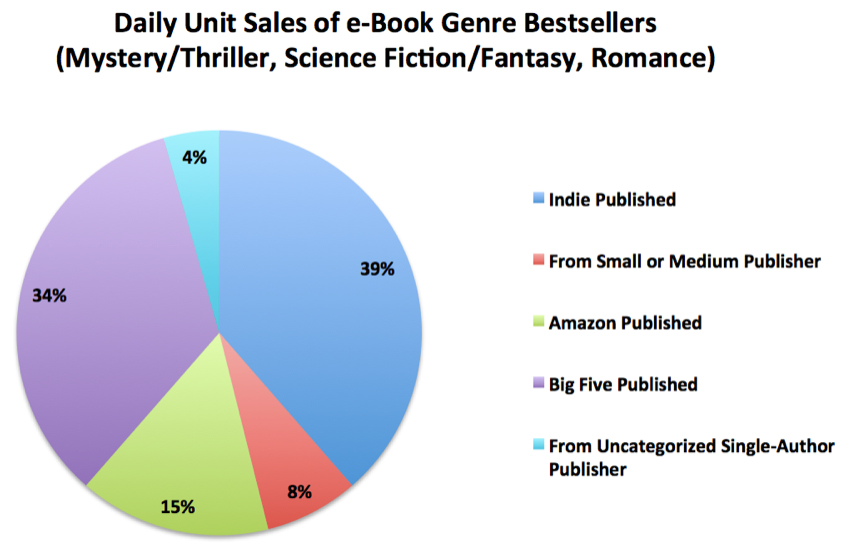
Yesterday we posted a chart from Hugh Howey’s new report on author earnings, showing indie and self-published authors pulling ahead of people published by the “big five” in terms of total unit sales. Now here’s another chart from an e-book publishing expert who’s calling some of Howey’s conclusions into question.

Chart:

E-book sales. Source: Hugh Howey

E-book sales. Source: Hugh Howey

Writing in Digital Book World, Dana Beth Weinberg points out that there are a number of questions about Howey’s data, even beyond the potential flaws that you’d already noticed. For one thing, Howey isn’t representing all self-published and indie authors — just the top 1.5 percent, or the cream of the crop. There are also some questionable assumptions in Howey’s methodology, writes Weinberg, and some statistical problems.

But leaving that stuff aside, even if you accept Howey’s data and his conclusions, it’s not clear that most of his indie/self-published authors are doing better than people published by the big mainstream publishers, argues Weinberg. What is clear, though, is that the people who are doing best, on Amazon e-book sales, are those published by Amazon’s own publishing imprints.

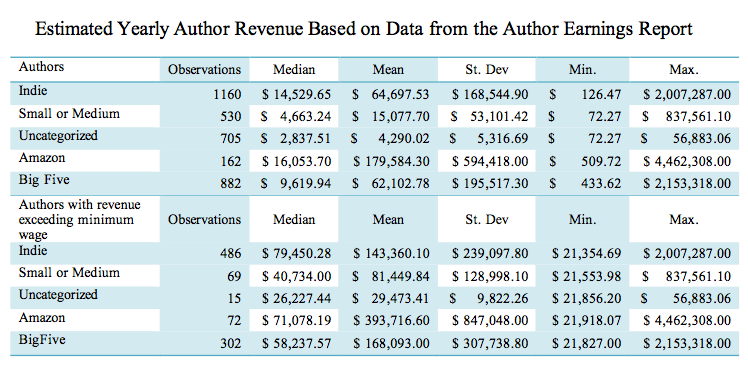
The really depressing thing? Weinberg estimates that most of the authors in the survey, whether self-published or published by a New York publishing house, are not making minimum wage:

Sales figures:

A different look at e-book sales.

A different look at e-book sales.

Full article at: http://io9.com/most-amazon-bestselling-authors-arent-making-minimum-w-1522482723

Source material at:
The Report, by Hugh Howey, Feb. 12, 2014
Full article at: http://authorearnings.com/the-report/

The Principal of Digital Abundance — thoughts on author earnings, by Damien G. Walter, Feb. 12, 2014
Full article at: http://damiengwalter.com/2014/02/12/the-principle-of-digital-abundance-thoughts-on-author-earnings/

Note: This post suggested by Research Assistant Ashlie

Leave a comment

Filed under writing tip, Writing Tip Wednesday