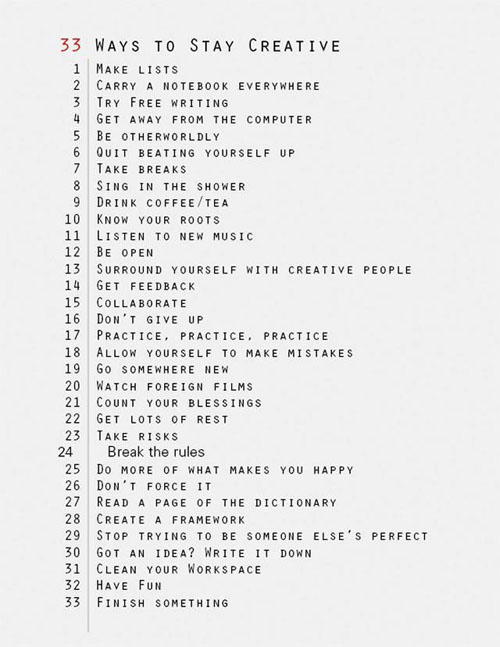
With one year about to close and another about to open, writers often make lists of what they want to accomplish the coming year: finish that novel, publish 10 short stories, win the Nobel Prize in Literature. Things like that. Below is a list that might help you in another way. That way is a list of tips for staying creative. Not sure where I picked this up, but I thought I would pass it along. Happy New Year and good luck with your writing.
Tag Archives: writing tips
Writing tip Wednesday: “Introductions”
Write Better: 3 Ways To Introduce Your Main Character
by Les Edgerton
1. Keep physical description minimal.
A character’s physical description—unless markedly different than the norm—does relatively little to draw the reader in. The character’s actions, or details such as his occupations and interests, are much more useful. The readers will furnish a perfectly good description on their own if you simply let them know that the Uncle Charley of your story is a butterfly collector, or the elderly toll-gate keeper on the Suwannee River. Doing so will accomplish more than 10 pages of describing hair and eye color, height, weight and all of that kind of mundane detail.
My own writing contains very little description of any of my characters—it’s virtually nonexistent—yet for years I’ve asked readers if they can describe a character I pick at random from my stories, and invariably they come up with a detailed description, no matter which character I choose. When I tell them I haven’t ever described the character mentioned, they’re surprised, and some swear that I did, even going so far as to drag out the story and skim for where I’ve included the description. They never find it.
2. Characterize through action.
Bestselling British writer Nick Hornby starts his novel How to Be Good by taking us through his protagonist’s inciting incident, revealed in an action that is contrary to her normal behavior and personality.
I am in a car park in Leeds when I tell my husband I don’t want to be married to him anymore. David isn’t even in the car park with me. He’s at home, looking after the kids, and I have only called him to remind him that he should write a note for Molly’s class teacher. The other bit just sort of … slips out. This is a mistake, obviously. Even though I am, apparently, and to my immense surprise, the kind of person who tells her husband that she doesn’t want to be married to him anymore, I really didn’t think I was the kind of person to say so in a car park, on a mobile phone. That particular self-assessment will now have to be revised, clearly. I can describe myself as the kind of person who doesn’t forget names, for example, because I have remembered names thousands of times and forgotten them only once or twice. But for the majority of people, marriage-ending conversations happen only once, if at all. If you choose to conduct yours on a mobile phone, in a Leeds car park, then you cannot really claim that it is unrepresentative, in the same way that Lee Harvey Oswald couldn’t really claim that shooting presidents wasn’t like him at all. Sometimes we have to be judged by our one-offs.
Wow! Don’t you wish you’d written that? I sure do!
3. Instill Individuality and Depth.
A very different example of establishing the protagonist’s character from the start is found in crime novelist Michael Connelly’s Lost Light:
There is no end of things in the heart.
Someone once told me that. She said it came from a poem she believed in. She understood it to mean that if you took something to heart, really brought it inside those red velvet folds, then it would always be there for you. No matter what happened, it would be there waiting. She said this could mean a person, a place, a dream. A mission. Anything sacred. She told me that it is all connected in those secret folds. Always. It is all part of the same and will always be there, carrying the same beat as your heart.
I am fifty-two years old and I believe it. At night when I try to sleep but can’t, that is when I know it. It is when all the pathways seem to connect and I see the people I have loved and hated and helped and hurt. I see the hands that reach for me. I hear the beat and see and understand what I must do. I know my mission and I know there is no turning away or turning back. And it is in those moments that I know there is no end of things in the heart.
What makes this opening different? Well, it’s by a brand-name author with a sizable audience already in place. Michael Connelly’s books have made the bestseller lists at least 19 more times than I’ve hit a grand-slam walk-off home run at Yankee Stadium as a member of the Bronx Bombers. This means he can write just about any opening he wants and it’s going to get published. It also means that in the hands of a writer without a ready-made audience such as Connelly enjoys, opening with the protagonist’s bit of philosophy might not work, if not done well. It could easily come across as sentimental or self-indulgent.
More details at: http://www.writersdigest.com/online-editor/write-better-3-ways-to-introduce-your-main-character?et_mid=711152&rid=239626420
Filed under Writing Tip Wednesday
Writing tip Wednesday: “Conquering writer’s block”
4 Tips On Conquering The Evil That Is Writer’s Block
by Ashley Jones
Read more at http://www.business2community.com/blogging/4-tips-conquering-evil-writers-block-01074259#1IGzOmJ9sSQZJ1DM.99
It’s funny that I’m writing this blog about writer’s block considering I was drawing a complete blank when trying to think of a topic. Writer’s block happens to the best of us, and if someone tells you they haven’t experienced a bought of writer’s block they’re likely lying.
So what do I do when I’m struggling with my writing? Sounds weird, but I like to pace around my apartment. My tiny apartment is shotgun style and it takes me approximately 15 seconds to get from one end to the other. I pace like this about 10 times. This works well for me. It makes me feel less sedentary and helps me generate ideas. I think one of the best things you can do if you’re suffering from writer’s block is distance yourself from your project for a while.
This leads me to my first major tip you should try next time you start to feel like words are the enemy:
- Step away from your computer.
- Read something you enjoy.
- Write like you speak.
- Start with a working title, and then jump in.
- Take your content one step at a time.
Aaron Sorkin (The Newsroom, The West Wing) was recently on Late Night with Seth Meyers. The two did the typical let-me-plug-my-latest-project interview. But they also talked about Sorkin’s writing process. Sorkin said whenever he experiences writer’s block he will shower and change into clean clothes to start again with a clean slate. I think this is a great idea. There’s no reason to sit and stare at a blank page. Get up and start moving around; do whatever works for you. This will help clear your head and make room for all those awesome ideas to come through.
No, Facebook doesn’t count. Pick up a magazine or check out the latest entry from your favorite blogger. You can even read a few industry blogs to see what’s new. This will get your mind off your work and help inspire you. These quick distractions can help you connect ideas in a way you didn’t see before.
Don’t try to get hung up on trying to use jargon or industry-speak. Start off by writing conversationally and the ideas will start flowing. It’s way easier to get a good pace going if you feel comfortable with the language you’re using.
Write up a quick title that focuses on the general idea of your blog. Then try to get your initial thoughts out. It doesn’t have to be grammatically correct or even make complete sense. Once you’ve got your thoughts out you can clean it up later and you’ll feel better once your ideas aren’t swimming around in your head.
If you’ve got a lot of content to work with it can feel daunting. Break your content up into sections and tackle them one by one. I usually separate my main ideas out into bullet points. Then I take those points one by one and start fleshing them out. This makes my content much more manageable and I’m less freaked out by the amount I need to complete.
Read more at http://www.business2community.com/blogging/4-tips-conquering-evil-writers-block-01074259#1IGzOmJ9sSQZJ1DM.99
Filed under writing tip, Writing Tip Wednesday
Writing tip Wednesday: “An agent interested in new writers”
Kimberly is seeking: Kimberly is interested in both commercial and literary fiction, with an emphasis in women’s fiction, contemporary romance, mysteries/thrillers, new adult and young adult, as well as certain areas of non-fiction, including business, diet and fitness.
How to submit: Email a query to Kimberly at Email Kimberly Brower. Submit a brief query letter and your first chapter (pasted into the email, not to exceed fifteen double-spaced pages) and for security purposes, do not include any attachments unless specifically requested.
Filed under writing tip, Writing Tip Wednesday
Writing tip Wednesday: “New Millennium Writings”
New Millennium Writings contest

Details at: http://newmillenniumwritings.com/awards.php
To apply online, follow these guidelines:
- No restrictions as to style, content, number of submissions, or nationality. Enter as often as you like.
- Send between now and November 17, 2014, Midnight, all U.S. time zones.
- Simultaneous & multiple submissions welcome. Previously published material welcome if under 5,000-circulation or if previously published online only.
- Each fiction or nonfiction piece is counted as a separate entry, and should total no more than 6,000 words except Short-Short Fiction (no more than 1,000 words).
- Each poetry entry may include up to three poems, not to exceed five pages total per entry. All poetry Honorable Mentions will be published.
- Save cover sheet or letter with the submission you’ll be uploading and send as one file. Should you forget to include such covers, however, it’s OK, as contact information is automatically forwarded to us when you pay online.
- Payment is $20 per submission in order to cover our many expenses and reserve your book. Payment will be by credit card or echeck through PayPal (See Rule 10).
- Each entry must be in a separate file (up to 3 poems in one file (See #6)). Many file formats are accepted.
- Enter file to upload:
- After clicking Upload, allow five seconds, then follow payment instructions to conclude your submission.
$4,000 offered in Literary Grants and Awards, Plus Publication
$1,000 for best Poem
$1,000 for best Fiction
$1,000 for best Nonfiction †
$1,000 for best Short-short Fiction
† Nonfiction includes humor, memoir, creative nonfiction, travel, opinion, essay, interview, features, investigative reporting, etc.
Details at: http://newmillenniumwritings.com/awards.php
Filed under writing tip, Writing Tip Wednesday, writing tips
Writing tip Wednesday: “Don’t try this at home”
Writer reacts to bad review and writes about tracking down the reviewer; others react to writer writing about her stalking experience
First the article about tracking down the reviewer:
“Am I being catfished?” An author confronts her number one online critic
When a bad review of her first novel appeared online, Kathleen Hale was warned not to respond. But she soon found herself wading in
by Kathleen Hale
In the months before my first novel came out, I was a charmless lunatic – the type that other lunatics cross the street to avoid. I fidgeted and talked to myself, rewriting passages of a book that had already gone to print. I remember when my editor handed me the final copy: I held the book in my hands for a millisecond before grabbing a pen and scribbling edits in the margins.“No,” she said firmly, taking the pen away. “Kathleen, you understand we can’t make any more changes, right?”
“I was just kidding,” I lied. Eventually she had to physically prise the book from my hands.
A lot of authors call this “the post-partum stage”, as if the book is a baby they struggle to feel happy about. But for me, it felt more like one of my body parts was about to be showcased.
“Are you excited about your novel?” my mom asked, repeatedly, often in singsong.
“I’m scared,” I said. Anxious and inexperienced, I began checking goodreads.com, a social reviewing site owned by Amazon. My publisher HarperTeen had sent advance copies of my book to bloggers and I wanted to see what they thought. Other authors warned me not to do this, but I didn’t listen. Soon, my daily visits tallied somewhere between “slightly-more-than-is-attractive-to-admit-here” and “infinity”.
For the most part, I found Goodreaders were awarding my novel one star or five stars, with nothing in between. “Well, it’s a weird book,” I reminded myself. “It’s about a girl with PTSD teaming up with a veteran to fight crime.” Mostly I was relieved they weren’t all one-star reviews.
One day, while deleting and rewriting the same tweet over and over (my editors had urged me to build a “web presence”), a tiny avatar popped up on my screen. She was young, tanned and attractive, with dark hair and a bright smile. Her Twitter profile said she was a book blogger who tweeted nonstop between 6pm and midnight, usually about the TV show Gossip Girl. According to her blogger profile, she was a 10th-grade teacher, wife and mother of two. Her name was Blythe Harris. She had tweeted me saying she had some ideas for my next book.
“Cool, Blythe, thanks!” I replied. In an attempt to connect with readers, I’d been asking Twitter for ideas – “The weirdest thing you can think of!” – promising to try to incorporate them in the sequel.
Curious to see if Blythe had read my book, I clicked from her Twitter through her blog and her Goodreads page. She had given it one star. “Meh,” I thought. I scrolled down her review.
“Fuck this,” it said. “I think this book is awfully written and offensive; its execution in regards to all aspects is horrible and honestly, nonexistent.”
Blythe went on to warn other readers that my characters were rape apologists and slut-shamers. She accused my book of mocking everything from domestic abuse to PTSD. “I can say with utmost certainty that this is one of the worst books I’ve read this year,” she said, “maybe my life.”
Other commenters joined in to say they’d been thinking of reading my book, but now wouldn’t. Or they’d liked it, but could see where Blythe was coming from, and would reduce their ratings.
“Rape is brushed off as if it is nothing,” Blythe explained to one commenter. “PTSD is referred to insensitively; domestic abuse is the punch line of a joke, as is mental illness.”
“But there isn’t rape in my book,” I thought. I racked my brain, trying to see where I had gone wrong. I wished I could magically transform all the copies being printed with a quick swish of my little red pen. (“Not to make fun of PTSD, or anything,” I might add to one character’s comment. “Because that would be wrong.”)
Rest of the article at: http://www.theguardian.com/books/2014/oct/18/am-i-being-catfished-an-author-confronts-her-number-one-online-critic

****
Reaction to the article:
This Is What Happens When An Author Tracks Down A Critic In Real Life
Kathleen Hale faced backlash on social media after admitting to tracking down a book blogger at her home address.
by Jenna Guillaume
On Saturday (October 18, 2014), YA author Kathleen Hale published an essay on The Guardian about confronting “her number one online critic,” and a social media storm of epic proportions erupted.
In the article, called “Am I Being Catfished?”, Hale describes how she obsessed over a book blogger named Blythe Harris who had given her book, No One Else Can Have You, a one-star review.
After Hale’s essay was published, the book-blogging community rushed to defend Harris, arguing she had done nothing wrong but that Hale had actually stalked her.
To see the array of reactions, some by well-known authors such as Neil Gaiman, go to:
http://www.buzzfeed.com/jennaguillaume/this-is-what-happens-when-an-author-tracks-down-a-critic-irl#2kyqd1o
***
Best thing to do: don’t follow this example. There will always be somebody who makes his or her “mark” by trying to leave a mark on you through your work. The best revenge is to ignore and write more and work to improve. After all, nobody’s perfect, not even critics.
Or in the words of author Robert A. Heinlein: “Critics can’t create, therefore, they feel justified in critiquing those who do. There is some logic in this: they hate all creative people equally.”
Filed under writing tip, Writing Tip Wednesday, writing tips
Writing tip Wednesday: “Glimmer Train, very short fiction contest”
VERY SHORT FICTION guidelines
Details at: http://www.glimmertrain.com/veryshort.html
Open to all writers, this category welcomes stories that have not appeared in any print publication.Maximum length: 3,000 words.
Held quarterly. Open to submissions in JANUARY, APRIL, JULY, and OCTOBER.
Next deadline: October 31.
Winners are announced in the April 1, July 1, October 1, and January bulletins, respectively, and contacted directly one week earlier.
Reading fee: $15 per story. Please, no more than three submissions per contest.
Prizes:
- 1st place wins $1,500, publication in Glimmer Train Stories, and 20 copies of that issue.
- 2nd place wins $500 (or, if accepted for publication, $700 and 10 copies).
- 3rd place wins $300 (or, if accepted for publication, $700 and 10 copies).
Only stories sent in online are considered.
To apply, go to https://www.glimmertrainpress.com/writer/html/index2.asp
Filed under writing tip, Writing Tip Wednesday, writing tips
Writing tip Wednesday: “MG vs YA”
The Key Differences Between Middle Grade vs Young Adult
by Marie Lamba (marielamba.com) author of the YA novels What I Meant…, Over My Head and Drawn. She’s also associate literary agent at The Jennifer De Chiara Literary Agency (jdlit.com)
OK, class. What sets a middle-grade novel apart from a young adult novel? If you said MG is for readers ages 8–12, and YA is for readers ages 13–18, then give yourself a check plus. But if you’re writing for the juvenile market and that’s all you know about these two categories, then I’m afraid you still need to stick around for the rest of this class. A book that doesn’t fit within the parameters of either age category is a book you won’t be able to sell.
In my work with The Jennifer De Chiara Literary Agency, I see my inbox flooded every day with queries for manuscripts that suffer from an MG/YA identity crisis. Like when a query says, “I’ve written a 100,000-word MG novel about a seventh-grader who falls in love and has sex for the first time.” Or when one states, “In my 20,000-word YA novel, a 14-year-old holds her first sleepover and learns the meaning of true friendship.” Both queries would earn a swift rejection, based on both inappropriate manuscript lengths and on content that’s either too mature or too young for the audience they’re targeting. Sadly, by not understanding what makes a book a true MG or a solid YA, these writers have hamstrung their chances for success, regardless of how well written their stories may be. It’s like they showed up to a final exam without ever cracking a book.

One difference between middle grade and young adult is the age of your protagonist. But it is not the only one.
Mg At A Glance
Age of readers: 8–12.
Length: Generally 30,000–50,000 words (although fantasy can run longer to allow for more complex world-building).
Content restrictions: No profanity, graphic violence or sexuality (romance, if any, is limited to a crush or a first kiss).
Age of protagonist: Typically age 10 for a younger MG novel, and up to age 13 for older, more complex books.
Mind-set: Focus on friends, family and the character’s immediate world and relationship to it; characters react to what happens to them, with minimal self-reflection.
Voice: Often third person.
Ya At A Glance
Age of readers: 13–18.
Length: Generally 50,000–75,000 words (although there’s also a length allowance for fantasy).
Content restrictions: Profanity, graphic violence, romance and sexuality (except for eroticism) are all allowable (though not required).
Age of protagonist: Ages 14–15 for a younger YA with cleaner content aimed at the middle-school crowd; for older and more edgy YA, characters can be up to 18 (but not in college).
Mind-set: YA heroes discover how they fit in the world beyond their friends and family; they spend more time reflecting on what happens and analyzing the meaning of things.
Voice: Often first person.
MG vs. YA Characters
When picking your hero’s age, remember that kids “read up,” which means they want to read about characters who are older than they are. So an 8-year-old protagonist won’t fly for the MG category, though it’d be OK for a younger chapter book or easy reader. For the widest audience, you’ll generally want your protagonist to be on the oldest side of your readership that your plot will allow. That means a 12- or even 13-year-old hero for MG, and a 17- or 18-year-old for YA (just remember your hero can’t be in college yet—that would push it into the “new adult” category).
MG vs. YA Readers
Middle-grade is not synonymous with middle school. Books for the middle-school audience tend to be divided between the MG and YA shelves. So which shelf do those readers go to? While there is no such thing as a ’tween category in bookstores, there are degrees of maturity in both MG and YA novels that’ll appeal to the younger and older sides of the middle-school crowd. A longer, more complex MG novel with characters who are 13 could take place in middle school and be considered an “upper-MG novel.” But the material can’t be too mature. It’s still an MG novel, after all, and most readers will be younger. Writing a sweeter, more innocent YA? Then it’s pretty likely that your readers will be ’tweens, that your characters should be around 15 years old, and that your book will be marketed as a “young YA.”
While it’s useful for you to understand these nuances as you craft your story and relate to your true audience, when it comes time to submit, don’t go so far as to define your novel as upper MG or younger YA in your query. That’s already pointing to a more limited readership. Instead, just stick to calling it either MG or YA when you submit, and let an interested agent draw conclusions about nuances from there.
MG vs. YA Content and Voice
What’s cool to a fourth-grader differs from what a 10th-grader will idolize. Same goes for the way they speak and the way they view the world. Which is why if romance appears in an MG novel, it’s limited to a crush and maybe an innocent kiss, as it is in Shugby Jenny Han. A YA could involve deep, true love as well as sexuality, as in The Fault in Our Stars by John Green. Another key difference? Overall, MG novels end on a hopeful note, while YA novels could have less optimistic endings, as in Green’s tearful story. You could say that that’s youth vs. experience coming into play.
The rest of the article at: http://www.writersdigest.com/online-editor/the-key-differences-between-middle-grade-vs-young-adult?et_mid=685611&rid=239626420
Writing tip Wednesday: “Those Moral Delimma Hooks”
5 Moral Dilemmas That Make Characters (& Stories) Better
Readers can’t resist turning pages when characters are facing tough choices. Use these 5 keys to weave moral dilemmas into your stories—and watch your fiction climb to new heights.
By Steven James
Key #1: Give Your Character Dueling Desires
Before our characters can face difficult moral decisions, we need to give them beliefs that matter: The assassin has his own moral code not to harm women or children, the missionary would rather die than renounce his faith, the father would sacrifice everything to pay the ransom to save his daughter.
A character without an attitude, without a spine, without convictions, is one who will be hard for readers to cheer for and easy for them to forget.
So, to create an intriguing character facing meaningful and difficult choices, give her two equally strong convictions that can be placed in opposition to each other.
For example: A woman wants (1) peace in her home and (2) openness between her and her husband. So, when she begins to suspect that he’s cheating on her, she’ll struggle with trying to decide whether or not to confront him about it. If she only wanted peace she could ignore the problem; if she only wanted openness she would bring it up regardless of the results. But her dueling desires won’t allow her such a simple solution.
That creates tension.
And tension drives a story forward.
So, find two things that your character is dedicated to and then make him choose between them. Look for ways to use his two desires to force him into doing something he doesn’t want to do.
Key #2: Put Your Character’s Convictions to the Test
We don’t usually think of it this way, but in a very real sense, to bribe someone is to pay him to go against his beliefs; to extort someone is to threaten him unless he goes against them.
For example:
- How much would you have to pay the vegan animal rights activist to eat a steak (bribery)? Or, how would you need to threaten her in order to coerce her into doing it (extortion)?
- What would it cost to get the loving, dedicated couple to agree never to see each other again (bribery)? Or, how would you need to threaten them to get them to do so (extortion)?
- What would you need to pay the pregnant teenage Catholic girl to convince her to have an abortion (bribery)? What threat could you use to get her to do it (extortion)?
Look for ways to bribe and extort your characters. Don’t be easy on them. As writers we sometimes care about our characters so much that we don’t want them to suffer. As a result we might shy away from putting them into difficult situations.
Guess what?
That’s the exact opposite of what needs to happen in order for our fiction to be compelling.
What’s the worst thing you can think of happening to your character, contextually, within this story? Now, challenge yourself—try to think of something else just as bad, and force your character to decide between the two.
Plumb the depths of your character’s convictions by asking, “How far will s/he go to … ?” and “What would it take for … ?”
Key #3: Force Your Character Into a Corner
Don’t give him an easy out. Don’t give him any wiggle room. Force him to make a choice, to act. He cannot abstain. Take him through the process of dilemma, choice, action and consequence:
- Something that matters must be at stake.
- There’s no easy solution, no easy way out.
- Your character must make a choice. He must act.
- That choice deepens the tension and propels the story forward.
- The character must live with the consequences of his decisions and actions.
If there’s an easy solution there’s no true moral dilemma. Don’t make one of the choices “the lesser of two evils”; after all, if one is lesser, it makes the decision easier.
For example, say you’ve taken the suggestion in the first key above and forced your character to choose between honoring equal obligations. He could be caught between loyalty to two parties, or perhaps be torn between his family obligations and his job responsibilities. Now, raise the stakes—his marriage is at risk and so is his job, but he can’t save them both. What does he do?
The more imminent you make the choice and the higher the stakes that decision carries, the sharper the dramatic tension and the greater your readers’ emotional engagement. To achieve this, ask “What if?” and the questions that naturally follow:
- What if she knows that being with the man she loves will cause him to lose his career? How much of her lover’s happiness would she be willing to sacrifice to be with him?
- What if an attorney finds herself defending someone she knows is guilty? What does she do? What if that person is her best friend?
- What if your character has to choose between killing himself or being forced to watch a friend die?
Again, make your character reevaluate his beliefs, question his assumptions and justify his choices. Ask yourself: How is he going to get out of this? What will he have to give up (something precious) or take upon himself (something painful) in the process?
Explore those slippery slopes. Delve into those gray areas. Avoid questions that elicit a yes or no answer, such as: “Is killing the innocent ever justified?” Instead, frame the question in a way that forces you to take things deeper: “When is killing the innocent justified?” Rather than, “Does the end justify the means?” ask, “When does the end justify the means?”
The other two items are:
- Key #4: Let the Dilemmas Grow From the Genre
- Key #5: Look for the Third Way.
For information on these steps and the a little more about the other three, go to http://www.writersdigest.com/online-editor/5-moral-dilemmas-that-make-characters-stories-better?et_mid=694352&rid=239626420
Filed under writing tip, Writing Tip Wednesday, writing tips
Writing tip Wednesday: “Agent hunting”
11 Steps to Finding the Agent Who’ll Love Your Book
By Lori Rader-Day, author of The Black Hour
I was ready. I had an edited manuscript. I had a tiered list of agents. I had a spreadsheet. I’d read every scrap of information about getting an agent, and I was prepared, at last, to submit my novel. The process could take months, maybe years, I’d heard. I was in for the long haul, baby. The good news is it didn’t take years to get an offer of representation. The even better news: That offer came in the form of four magic words, words I’d been told to wait for by all the experts: I love your book.
Not just a Facebook-worthy thumbs up, not a “I think I can sell this.” Love. The reason you wait for true love in publishing is because publishing requires it, and not just from the author. Remember the feverish crush that helped fuel your first draft? Your agent needs that same big-eyed reverence for your book to take it out to editors, hoping for another love connection.
So how do you snag one of these lovey-doveys for yourself?
Revise
You’re not ready until you can bounce a quarter off your manuscript. You’ve already revised, I know. Leave it alone for a month, then go back. Make sure your pages say precisely what you meant. Make your sentences sing.
Read
Meanwhile, the best way to see how it’s done is to read. Read widely. When you don’t like something, figure out why. Apply everything you learn to your draft until further ideas ping off it.
Research
Gather your intelligence. Which books are like yours, not just in subject but in tone and style? Who agented them? Read the Writer’s Digest archives. Use online resources to sort through the known universe of agent submissions. Learn as much as you can, and start a list. Rank agents in order of likelihood of love match.
Package
Learn to write a query letter. Write a synopsis. What’s a log line? Get one. If at any one of these steps you find something lacking in your story, don’t ignore the problem. Every step of this process is a chance to get it right before someone else can tell you you’re getting it wrong. Go back over your draft until your product is perfectly packaged for sale. Did your eye just twitch? Get used to thinking of your baby, your life’s creative work, as a prototype that might yet be tinkered with by other people.
Network
Time for some allies. If you have a writers’ group, they should have already had a swipe at your pages, but having a writing network isn’t just about first readers. What you want is a group of people who can tell you how the road ahead looks. Research writers’ associations in your genre and beyond. Ask at your local library, bookstores, or universities for writing groups or workshops.
Read again
The guidelines, in this case. This is your last chance before you click send to take a look at your list of agents and take note of what they want from your initial query. Getting through the front door is often about playing by the rules. Don’t send anything less—or more—than each agent has asked for.
The other tips include:
- Submit
- Write
- Track
- Submit again
- Commit.
Details on these at: http://www.writersdigest.com/editor-blogs/guide-to-literary-agents/11-steps-to-finding-the-agent-wholl-love-your-book?et_mid=683644&rid=239626420
Filed under writing tip, Writing Tip Wednesday, writing tips