Tag Archives: writing tip

Writing Tip Wednesday: Analyze Your Book Idea

HOW TO ANALYZE YOUR BOOK IDEA

By BRUCE HALE

Source: http://www.brucehalewritingtips.com/

Say you’ve got a great idea for a book (and judging from my barber, the guy at the YMCA, and my cousin’s neighbor, nearly everyone does). How do you judge whether it’s worth spending the time and effort to take your notion from idea to finished story?

Well, yes, I suppose you could pass it by your agent. But if you happen to be one of the many writers who don’t have an agent on speed-dial (and even if you do), you might also try running your idea through this quick test before you launch into writing…

CONFLICT-O-METER
First, does your cool idea contain plenty of potential for conflict, the engine that drives all story? Does your character face loads of opposition, whether internal, external, or both? Some ideas have conflict naturally built into them — a tale about fighting to the death on live TV in the Hunger Games, for example, is bound to have a wee bit of struggle involved. Does yours?

CHARACTER COUNTS
Next, how much of a grip do you have on your hero? If your idea is all concept and no character, spend some time mulling over your main character before you take things further. Do you know what makes her tick, what drives him? Is this hero someone that you’d want to spend a lot of time with? Guaranteed, if YOU aren’t keen on spending months with your character, readers won’t want to spend hours with her.

UNIQUE OR NOT?
If your idea involves another brooding vampire lover, or another kickass dystopian heroine, you might want to think it through again. Not that you can’t execute those themes in a fresh way, just that the market is so glutted with supernatural and dystopian tales, it’s harder to put your own stamp on the topic.

I’m not saying don’t be true to your story instincts or don’t fall in love with your idea. But before you invest time writing, it’s worth surveying the market. If there’s already been a Teenage Mutant Ninja Turtles book, pursuing your Teenage Mutant Ninja Squirrels idea might not be the best use of your time. Remember that you have to SELL the story after writing it. And if you’re going to accomplish this task, it helps to have at least a general idea of whether your type of story has been done before, and how well.

JUICINESS FACTOR
When you get right down to it, does your idea feel like fun? Is there plenty of juice in it, enough to sustain your enthusiasm through the inevitable challenging bits? Are you excited to tell the story or is it just one of those “this might make a cute book” ideas that you’re not emotionally drawn to? If it’s the latter, shelve it and spend your energy on an idea that’s really got some juice to it.

The more excited you are to write your story, the more readers will enjoy it. Or, to adapt a phrase from computer science: juiciness in, juiciness out.

Want to know more? This subject was covered in much greater depth in the teleseminar “Turning Your Idea Into a Story That Sells,” and you’ll find the recording here:

http://clicks.aweber.com/y/ct/?l=O8uEK&m=JvxVObrEjFLsQz&b=WF_CK_xaXIG.p4elEtaXjg

Leave a comment

Filed under Analyze Your Book Idea, Writing Tip Wednesday

CarToonsday: listen up

“Listen here, young lady!”

Leave a comment

Filed under 2012, cartoon by author, CarToonsday

Workshop Weekend: Roadmap for this blog

In case you’re wondering, and even if you aren’t, I would like to take a few moments and explain the new layout I am adopting for this blog. I have decided to make at least every work day specific to something. For example, Monday morning writing joke will be a joke focused on writing or about writing. It might also be a limerick (though nothing too naughty) or pun, which is something I have a weakness for.

Next: CarToonsday will be a cartoon, usually based in some way around writing, but not always.

Writing Tip Wednesday will have writing tips. It could also have recommendations of writing books to try, or information about writing conferences, or agents looking for new clients.

Haiku to you Thursday will be a haiku. At least for as long as I can write what I consider to be good quality ones. Sometimes I’m sure I’ll spit out a clunker, but sometimes you have to fail in order to succeed.

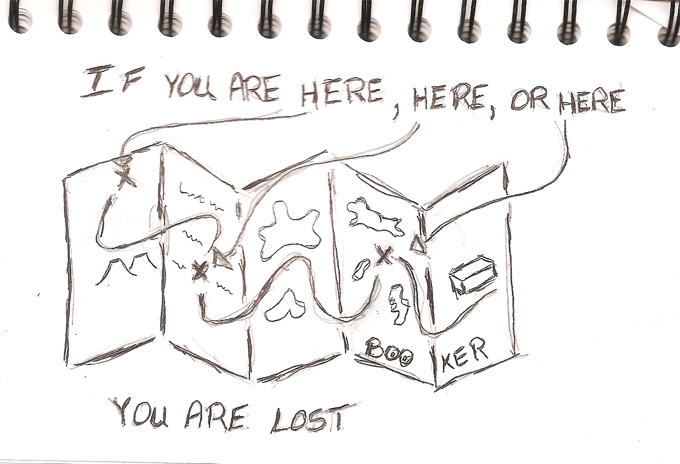
Map

At times, the roadmap might be under construction.

Freeform Friday will be another poem, maybe not a haiku but something else, or writing such as a Blathering idiot installment, The Devil’s Dictionary, an essay. Maybe even something I haven’t tried before. Could even be another cartoon. (As if one a week is not enough.)

Story Saturday will be a part of a story. Something I am working on. Could also be a Found Story (photo with piece of writing about the photo). Could even be a whole story, if short enough. Or I may write something about my struggles to write stories, though I am sure that would get old and boring quickly.

Sunday? I may just take off. Or take off Saturday and make it Story Sunday. Or the whole weekend could be titled Workshop Weekend.

I have noticed on weekends there are usually fewer visitors to my blog. People are off doing other things, I assume. Plus a day off won’t hurt. I have a regular job, family obligations, and am working on a novel and short stories as well. On my days off, I aim for between 300 and 400 words of new writing on my stories or novel. So doing that and a blog entry can be tough. I might also skip a day here and there if I don’t have something that fits that day’s theme.

Certainly, comments and suggestions are welcome. And visits, too. The more the better. I aim to keep humor and wit of one stripe or another going on this blog. You may not be rolling in the floor laughing and sometimes you might even be rolling your eyes and groaning at the puns, but at least you’re not having to pay for the self-inflicted humor wound.

Last, but not least, thank you to all who have visited my blog and especially so to those who have linked up to receive notification when I post something new. I do appreciate it. Very much. Part of the reason for trying to more regularize the format is so that you know what’s coming.

3 Comments

Filed under blog, Workshop weekend, writing

Writing tip Wednesday: Setting the Scene

By David E. Booker

The earlier entry about scene writing covered one aspect of it. Here, for your consideration, are three other items related to scene description in a story or novel.

    1) Scene description is not a list of things in a room, valley, planet, or universe. The writer is not a cataloger for a moving company, listing everything or even most thing in a scene. Scene description is a description of the important items in that scene.

    2) Scene description is about movement. When describing clouds, describe them in motion. In The Great Gatsby, when F. Scott Fitzgerald describes what Nick sees, there is almost always something moving in the scene description.

    When describing grass, describe it as a breeze rustles through it, or if it’s brown with drought, describe how crunchy it feels and sounds to a character.

    Or give a sense of movement by describing something metaphorically or with simile. For example, describe an old, rundown house by writing: “The house slumped on its foundation like a tired old man struggling with a cane to keep upright. It creaked and smelled and sighed from its efforts, and the scaffolding along one side was not much of a cane.”

    3) Describe scenery from a character’s point of view. If you are writing a first person story, that is the only way to describe scenery. But consider it even when writing from a third person point of view. And when doing so, consider two questions:

      A) What is important enough for that character to notice? Focus, at least to start, on the two or three most important things.

      B) How does the character react of feel about the items in the scene? This does not necessarily have to be a straightforward mater, such as: It was night and he was afraid of the dark. It can be subtilized by writing: “The fading daylight always brought with it a feeling of apprehension. Mike didn’t know if it was childhood and bad dreams still lurking around, or if it was because he heard sounds he could not easily identify or dismiss with a nod and a shrug. No, the sounds of the night had an insidiousness about them that he was unable to pin down or run away from.”

    ,

And that brings us to a final thought on setting the scene in stories and novels: don’t forget the other senses: touching, hearing, tasting, smelling – all the tools that can help you tell the reader how a character feels about a scene and in doing so, set the scene dynamically for the reader.

Leave a comment

Filed under scene setting, setting the scene, Writing Tip Wednesday

Writing a novel…

Writing a novel is …

Simple.

Deceptive.

Seductive.

And an Act of Defiance.

That’s why so many feel they can do it, and why so few do it successfully.

2 Comments

Filed under writing, writing tip

Writing tip: Setting

Using Setting as a Character: a Tip for Novelists

Source: http://www.rachellegardner.com/2012/06/using-setting-as-a-character-a-tip-for-novelists/

Guest Blogger: MaryLu Tyndall @MaryLuTyndall

Choosing the right setting is just as important as choosing the right characters, plot, and dialogue. Setting grounds your readers, helping them to experience the action and drama more effectively. But it does so much more than that! A setting can be so vibrant and alive that it becomes one of the characters in your story, assisting or hindering your protagonist in achieving his/her goals.

Setting as Friend

A beach at sunset or a hike to a tranquil waterfall can provide nearly as much comfort and encouragement as any good friend. If your hero has just defeated a dragon, don’t send him to a lively night club or a bull fight. Turn his setting into a place where he can recuperate and reflect, where he can hear the voice of God in the breeze.

Setting can also aid the hero in his quest. A jungle or a crowded bus station can hide the hero from his enemies just as easily as quicksand can devour them.

Setting as Antagonist

Just like a villain, the proper setting can introduce conflict, cause trouble, or thwart the hero’s plans. Consider a vicious storm, a flood, a moonless night that blinds the hero, a jungle where he gets lost, bumper-to-bumper traffic that keeps him gridlocked, an earthquake, rock slide, etc. These settings take on a life of their own, and do everything in their power to keep your hero from succeeding. You’ve heard it said that if your scene is falling flat, have someone pull out a gun. I say transport your scene to a setting filled with conflict.

Setting as Mentor

Like a wise old sage, setting can also be a mentor. Perhaps your hero must learn something before he can move on. Have him wander into a library, an old book store, a cave with ancient, mysterious writings on the walls, an archeological dig, a museum. Or perhaps your hero must survive some ordeal in order to move forward such as climb a mountain or cross a river to overcome his fears and gain the confidence he needs to achieve his goals.

Setting as a Shadow for Your Protagonist

A shadow is anything or anyone that reflects your hero’s deepest flaws. If your hero has an alcohol problem, put him in a bar where he can watch what alcohol does to others. If he’s a control freak, put him in prison. If he’s selfish, put him in a homeless shelter or soup kitchen. If he’s greedy, place him at the New York Stock Exchange. Use the appropriate setting to open his eyes to his own flaws.

Setting as a Model of What the Protagonist Wants to Be

A church, a mission trip, a charitable foundation, free medical clinic, the palace of a wise king, the courtroom of a just judge, and a loving home are all settings that can provide an atmosphere that fosters qualities to which the hero aspires.

How about using setting as a shapeshifter, a joker, a symbol of the hero’s past, a guardian? Choosing setting as a character is only limited by your imagination!

As an example: Let’s say you’re writing a breakup scene between two of your characters. Now, imagine the difference if that scene were set: at home in the living room, in a crowded restaurant, on a ship out at sea, on a ski slope, a shooting range, a fencing match. Each setting becomes a third character that determines how the scene will play out.

Setting can be a dynamic, breathing character that can either assist or hinder your hero. So, choose wisely, and you’ll add an entirely new dimension to your story.

Can you think of any favorite scenes in books you’ve read where setting is an important character? What about your own writing—how have you incorporated setting this way?

MaryLu Tyndall’s latest novel, Veil of Pearls, releases July 1 and is available for pre-order at Amazon, Barnes & Noble, and ChristianBook.com.

Leave a comment

Filed under MaryLu Tyndall, setting, writing tip

13 Things You May Not Know About Agents

By Rachelle Gardner

Source: http://www.rachellegardner.com/2012/06/13-things-you-may-not-know-about-agents/

1. We really hate getting bad news and we hate sharing it with you, but we trust you’re adult enough to handle it.

2. If we say we don’t want to submit a particular project to editors, we’re probably trying to protect both of our reputations (the writer’s and the agent’s).

3. While many of us do a great deal of editing and polishing of your manuscripts and/or proposals, the bottom line is that it’s the writer’s job to provide a marketable book. Agents shouldn’t be counted on to make it sales-ready.

4. We are very invested in your book and often feel like it’s “our baby” too (even though we KNOW it’s yours!)

5. If it seems like we’re too busy, it’s because the economics of this industry demand we carry a certain amount of volume to make a living wage.

6. We prioritize taking care of current clients above the search for new clients. So typically, queries and writer’s conferences take a back seat.

7. We really are interested in your long-term career, not just the size of the next advance.

8. We hate the slowness of publishing just as much as you do!

9. We want to set you up with the publisher and editor who will be best for you, not just the one who’s offering the most money.

10. When we’ve tried to sell your book but we’re not successful, we’re probably almost as disappointed as you. Not only are we often emotionally invested, we’ve put in a lot of time for no paycheck.

11. When you send us a manuscript to read, we don’t do it during the work day. We read in the evenings (our “free time”) and on the weekends. With Kindles and iPads, we may even be reading your manuscript on the treadmill at the gym.

12. We’re aware of all the new options for writers these days, and we’re doing our best to help steer each client in the right direction.

13. If your writing career keeps you awake at night, there’s a good chance it has kept us awake on occasion, too.

Leave a comment

Filed under agents, Rachelle Gardner, writing tip

Writing Tip Wednesday: 15 minutes

By David E. Booker

So, how much time to do you have a day to write? How much time a day do you spend?

I read about a noted short story writer who started out writing 15 minutes a day, between 11:45 PM and midnight. As a single mom of several kids, working very hard just to hold her family together, that was the only time she had after all her kids were in bed and before she went to bed.

I wish I could remember her name, but the point is not so much her name or even that she won awards for her short stories. It is that she wrote regularly, even if all she had was 15 minutes.

Fifteen (15) minutes.

If there is one piece of advice that I have heard over and over and over again, it is to develop a routine and stick to it. Show up for your writing just like you would for your job that you work to hold body and soul together so you can write. If all you have is 15 minutes a day, use it wisely and use it well. If you can spare more, or if you operate better by setting yourself a word quota, then do it that way.

The writer James Scott Bell doesn’t have a daily quota, but a weekly one, which he then breaks down into daily installments. He says having a weekly quota works better for him because it misses a day or doesn’t write the full amount one day, he can work to make it up on the other days and still hit his weekly quota.

Certainly, if having a daily quota, then set one. I believe the writer Graham Greene had a daily quota of 500 words a day. He would write 500 words and then stop.

The writer Harry Crews often rose at 4 AM to write before going to work as a professor. One of his students, the New York Times bestselling crime novelist Michael Connelly said recently of Crews, “The singular lesson I took from him was his simple adage that if you are going to be a writer then you must write every day, even if only for 15 minutes. The last part about the 15 minutes has served me well. I’m going on 30-plus years of writing every day, even sometimes for only 15 minutes.”

So, where are your 15 minutes?

[Editor’s note: Connelly quote taken from LA Times obituary article on Harry Crews, who died earlier this year. He was known to write from 4 AM to 9 AM and to begin each session with the same plea: “God, I’m not greedy. Just give me the next 500 words.”]

Leave a comment

Filed under fifteen minutes, writing tip, Writing Tip Wednesday

Writing tip Wednesday: three keys to dialogue

by David E. Booker

1) It’s not conversation. In his book, On Writing: Advice to Those Who Write to Publish (Or Would Like to), George V. Higgins, known for his dialogue, advises developing an ear for dialogue, but that dialogue in stories is not simply conversation lifted from daily life and dropped into a story.

Normal speech is full of too many “uhs, ahs, and other sounds that are verbal place holders and don’t really have any place in fictional dialogue. Also, normal speech is full of “small talk.” Things like, “Hi, how are you? How’s the husband and kids? It sure looks like the team will have a good season this year.” All things meant to keep the lines of communication open, psychologists might say, but are of little use in furthering your story. In short, good dialogue moves the story forward. Asking about the family or saying the team will have a good year only keeps the story in place.

A corollary to this is the “As you know, Fred” dialogue, which is dialogue between two people who know the information being conveyed, but they are conveying it, anyway, for the sake of the reader, who doesn’t know. Science fiction can many times be guilty of this when two scientists of the same discipline, say particle physics, “converse” with each other about what a particle is.

2) It’s often what you don’t say. Subtext is the hidden force of any scene of a story or movie. As the noted script writer and teacher, Robert McKee says, “If a scene is about what a scene is about, then the scene is dead.”

Good dialogue

Often, good dialogue is about what isn’t being said.

For example, if two people are engaged in changing a tire and all they talk about is tire changing, then the scene is dead. However, if during that scene, one member is gruff to the other one and eventually says the flat was his fault for not checking the tires to begin with, then you have an emotional charge running through the scene and dialogue is then used to convey that emotional charge, the subtext is the tug of war of one person trying to blame another and how the person being blamed reacts or handles the accusation.

3) It’s okay to only use “said” and “asked.” Many writers learning their craft try to spice up a scene by having their characters express their dialogue with: he espoused, she guffawed, he trumpeted, she queried, etc. This will only slow down a scene. It should be: he said, or he asked, if it is a question. One exception might be: she yelled. But other than these, if the scene does not convey the right intensity with which your characters should be speaking, then there is something amiss in the scene, and it won’t be fixed by exchanging “she said” for “she espoused.”

In fact there are some writers, such as the late Robert B. Parker, who use only “he said” or “she said,” even where there was a question. He figured the use of the question mark at the end of the spoken sentence was clue enough.

And please note, by saying “he” or “she,” I am not saying never use the speaker’s name. particularly when somebody is speaking for the first time in a scene, it is often recommended that the text read, “Bob said” or “Alice asked.”

There are certainly other suggestions for creating good dialogue, but mastering these three will put you on your way to having dialogue that moves the story forward and adds a good boast to your writing.

2 Comments

Filed under article by author, dialogue, writing tip, Writing Tip Wednesday

Writing Tip Wednesday: Tone those saggy middles

[Editor’s note: the essay below is taken from an e-mail newsletter sent out by the writer Bruce Hale. you can find his web site at: http://www.brucehalewritingtips.com/. You can also sign up for his e-newsletter at that site. Each electronic newsletter comes with other information, including a writing joke.]

5 TIPS FOR TONING SAGGY (STORY) MIDDLES

By Bruce Hale

I’ll be honest. I never thought that Pilates class at the Y would be good for anything other than kicking (and toning) my butt. Yet, Pilates, with its emphasis on tightening and strengthening the body’s core, has something to teach us writers.

Ever encountered a “saggy middle” in your story writing? Take a tip from Pilates and strengthen your story’s core.

In my experience, when the middle sags, I’ve either lost track of my main character’s goal, or I haven’t made it hard enough for him/her to achieve. If it feels like nothing’s at stake or the issue isn’t in doubt, then it’s hard to sustain that growing sense of suspense that all stories need.

How to tone up that saggy middle? Here are five suggestions:

1. Increase the tension

What keeps us reading is a sense of concern about the hero and doubt about whether he will achieve his goal. If your story’s middle section lacks excitement, look for ways to up the “uh-oh factor.”

Throw more obstacles into your hero’s path – whether internal or external. Internally, you could set two cherished goals at odds with each other (she has to choose between being in the school musical with that hot dude and playing soccer). Externally, you could hand the opposition a major victory that sets your hero back. Or you could stage a betrayal: Someone the hero (and reader) trusts suddenly turns out to be a bad guy.

2. Tighten up the action

Maybe the bones of your story are strong, but you’ve got a bit of flab on them — unnecessary scenes that bog down the action. Look closely at every scene. If you can trim or eliminate it without affecting the story’s forward momentum, maybe you didn’t need that scene in the first place.

3. Raise the stakes

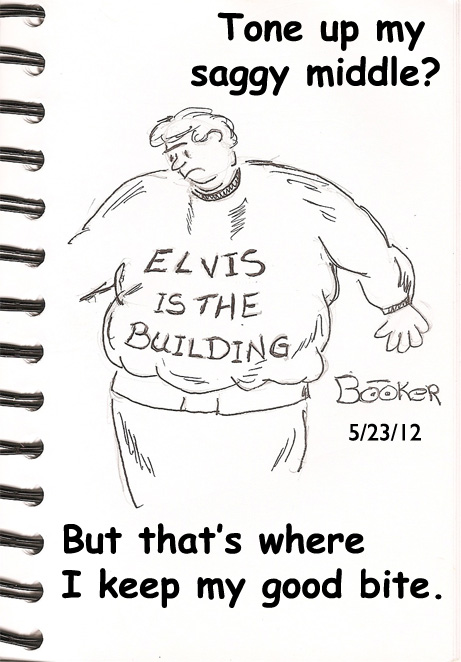
Saggy Middle

Take a good bite out of the saggy middle of your story, if you have to.

This means making the consequences of failure even weightier. If your character has been working on solving a crime, for example, you could have
the authorities accuse her, or someone close to her, of committing the crime. That way, if she doesn’t succeed, she loses more than just her good track record in solving cases. You see this a lot in detective novels – because it works.

4. Spring a revelation

This is the unexpected discovery that casts new light on everything that’s gone before it. Often a revelation occurs just before the story enters its third act, as in HOLES, where we suddenly understand the connection between the past-day and present-day tales, and we get why Stanley
Yelnats is digging in the desert.

Tricky to pull off? Absolutely. But it sure packs a punch when you can do it right.

5. Pull a reverse play

Reversals tug the rug out from under your character just when it looks like he’s making serious progress. Reversals also up the tension and hook your reader. Need an example? In THE MALTESE FALCON, just when Sam Spade thinks he’s got everything figured out, the bad guy slips him a mickey, taking Sam out of the action while his enemies run off to claim the treasured falcon.

Above all, if your story middle is sagging, go back to focus on your main character and her goal. Be sure that throughout the middle, the hero is still actively pursuing (and passionate about) his goal, and that you are continuing to throw obstacles (ever-increasing, if possible) into his path. If those two elements are in place, and you stay focused on the core of your story, chances are that your saggy middle won’t need to take a trip to Pilates class.

5 Comments

Filed under cartoon by author, Saggy middle, writing tip, Writing Tip Wednesday