
“[The writer] has to be the kind of man who turns the world upside down and says, lookit, it looks different, doesn’t it?”
—Morris West
Tag Archives: writing tip
Writers on Writing
Filed under Writers on writing
Writers on Writings
Thoughts about ideas….
“I have never felt like I was creating anything. For me, writing is like walking through a desert and all at once, poking up through the hardpan, I see the top of a chimney. I know there’s a house under there, and I’m pretty sure that I can dig it up if I want. That’s how I feel. It’s like the stories are already there. What they pay me for is the leap of faith that says: ‘If I sit down and do this, everything will come out OK.’”
—Stephen King
Filed under ideas, Stephen King, Writers on writing
Writing tip Wednesday: Seed in the sponge
You have probably heard the story of the princess and the pea, of how she could feel the small pea under the mattress, despite the comfort of the rest of the bed, and how this little thing disturbed her and distinguished her from every other young lady who slept on the bed.
Ideas for stories, novels, essays, and poems often start the same way: some little something catches your attention and for one reason or another you can’t let go of it. It disturbs and distinguishes your imagination from the imaginations of everyone else, even other writers.
But unlike the pea in bed, often that little something will crop up at the oddest of times or in the oddest of places. That is why it is a good idea to keep pen and a notebook handy. It can be a small notebook, or even a piece of paper. Not everything you write down will turn into some crowing achievement, but it is certainly easier to discard a scribble later, once you’ve had a chance to consider it, than it is to try to remember that little, nagging seed of an idea later.
So, keep something handy to write with and write on. You never know when inspiration, like a little seed, will sprout something your way.
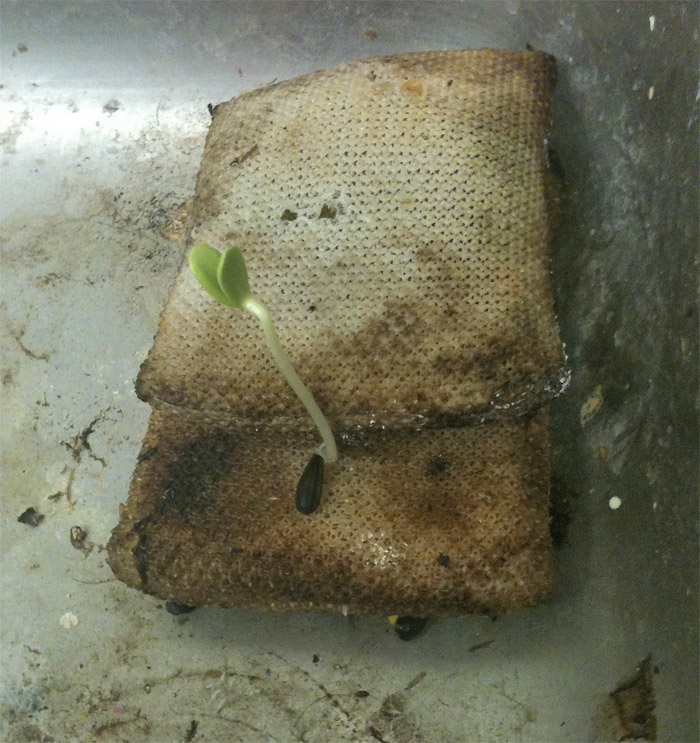
The idea sprout for a novel, essay, poem, or short story might show itself at the oddest time in the oddest of places. Keep a pen and paper handy.
Filed under Photo by author, Writing Tip Wednesday
Writers on Writing
The radical of one century is the conservative of the next. The radical invents the views. When he has worn them out the conservative adopts them.
–Mark Twain, Notebook, 1898
So, go and create a new view with your writing. Show the world something it has not sen before.
–Editor
Filed under Mark Twain, Writers on writing
Writers on writing
“Good writing is remembering detail. Most people want to forget. Don’t forget things that were painful or embarrassing or silly. Turn them into a story that tells the truth.”
—Paula Danziger
[Editor’s note: This echoes this past Wednesday’s blog entry: “Writing as Transformational Tool.” You may want to check it out.]
Filed under Pauola Danziger, Writers on writing
Writers on writing
“I do not rewrite unless I am absolutely sure that I can express the material better if I do rewrite it.”
—William Faulkner
Filed under William Faulkner, Writers on writing
Writing Tip Wednesday: Writing as a Transformational Tool
WRITING AS A TRANSFORMATIONAL TOOL
by BRUCE HALE
source: http://www.brucehalewritingtips.com/
When we tell stories, we hope we are touching the lives of our readers, making them laugh, cry, wonder, or ponder. But what if, by your writing, you could also touch your own life, help your own emotional or psychological growth?
To some extent, this happens organically. We’re drawn to subjects that have a certain resonance for us, after all. And if you write about topics that touch on your own traumas and past challenges, you’ll sometimes find that you feel better. But if you want to take it further, here are a couple of ways to go about this process more deliberately.
PROBING PAST PAIN
Ever had a sore tooth that you just couldn’t leave alone, even though it hurt when you touched it? Same principle here. Look back at your life, at those incidents that make you cringe even now — the time you embarrassed yourself in front of the classroom, the death of a friend, your first painful breakup. That’s your raw material for story.
Now spend some time writing about the memory that has the biggest charge on it. See if you can recall specific sensory details that make the experience come alive. After setting it aside for awhile, rewrite the incident from a fictional perspective, changing or inventing details to suit your story.
Voila — you’ve just created the seed for a powerful scene (or at least some potent backstory for your character). Now, this incident may not even directly appear in your story — you may use just the emotional tone — but you’ve managed to come to grips with something from your past while adding emotional depth to your tale.
Want an example? Growing up, I had a frequently challenging relationship with my stepdad; we rarely saw eye to eye. In my new book, SCHOOL FOR S.P.I.E.S.: Playing With Fire, I gave the hero, Max, a difficult relationship with his dad. Did I borrow actual incidents from my own life? No. But I used the feeling tone, that love-hate vibe, to deepen my story, and in some ways it has helped me feel more peaceful about my past relationship with my dad.
THE PENNEBAKER METHOD
If you want to get more directly therapeutic, you can also write in a directed way about what’s bugging you today.
For nearly 20 years, Dr. James Pennebaker has been asking people to write down their deepest feelings about an emotional upheaval in their lives for 15-20 minutes a day, four days running. In his book, WRITING TO HEAL, he states that many who have followed his instructions have had their immune systems strengthened, grades improved, or even lives changed.
The 4-day writing process, he says, helps us translate an experience into language, and in doing so, we essentially make that experience graspable. “Emotional upheavals touch every part of our lives,” Pennebaker explains. “These things affect all aspects of who we are, and writing helps us focus and organize the experience. When people are given the opportunity to write about emotional upheavals, they often experience improved health.”
Sound intriguing? Give it a try. You may find it improves your life as well. Or at least your stories.
Filed under Bruce Hale, writing tip, Writing Tip Wednesday
Writing tip Wednesday: To name or not to name
“What’s in a name? that which we call a rose
By any other name would smell as sweet;
So Romeo would, were he not Romeo call’d,
Retain that dear perfection which he owes
Without that title. Romeo, doff thy name,
And for that name which is no part of thee
Take all myself.”
–Juliet from the play Romeo and Juliet by William Shakespeare
If Shakespeare received a nickel for every time he was quoted, he’d be able to rebuild The Globe Theatre many times over. He might even make Donald Trump envious. But that is a story for another time.
A few thoughts on naming your characters. I have known writers who called their protagonist “X” or “Mrs. Y” throughout the draft of a story or novel, because they weren’t sure what to call him or her.

A character’s name can help ground her in your story’s world, no matter where that world is.
Who knows, if really stuck for a name or if your story is Kafkaesque, you might be able to use only a letter for the character’s name. But most of the time that won’t work.
Still, there are no etched-in-stone rules for naming characters, but here are a few suggestions. By no means are these all inclusive suggestions.
1) The first name you come up with is not unalterable. Until a story or novel is accepted for publication, you can change the name. So, if you have trouble picking out names, maybe the first thing to do is relax. The mystery writer, Robert B. Parker had originally named his private detective David Spenser, but at the last minute decided to pull the first name, because he had two sons, one named David, and he didn’t want to possibly offend his other son by not have a character named after him. So, David Spenser became Spenser, with two “S’s,” like the poet.
2) If you write in a particular genre, consider if the protagonist’s names have a certain “form” or “rhythm” to them. Turning to the detective fiction genre again, for many years the protagonists always had last names that implied the type of work they did. For example, in The Maltese Falcon, the private eye protagonist’s name was Sam Spade. Spade is a tool for digging. Private eye’s dig up information. Other examples include Mickey Spillane’s Mike Hammer and Ross MacDonald’s Lew Archer. By the way, Lew Archer was also Sam Spade’s partner in The Maltese Falcon. Archer was killed early on, so I guess Ross MacDonald decided to use the name since Dashiell Hammett wasn’t going to use it any more.
3) Names can reflect part of a characters personality or indicate social strata. For example, a woman named Bunny could be somebody who comes from a well to do family. Or a family that doesn’t but wants to think it does. The other end of the scale would be naming a character Huckleberry as in Huckleberry Finn, the protagonist is the novel about the adventures of this character whose mother is dead and whose father is a drunken illiterate.
Another example might be Mrs. Kitty Warren in George Bernard Shaw’s play Mrs. Warren’s Profession. Warren as a word means a place where rabbits bread or live. It can also mean a building housing many renters in crowded rooms. Mrs. Kitty Warren is a woman who has made her way in the world by being a brothel owner. In this case, both the first name, “Kitty” and the last name “Warren” hint at least part of the nature of the character.
Remember, unlike most of us, who are “stuck” with the names our parents gave us, the names in novels, stories, plays, and other forms of writing can be changed and can be used to help round out your protagonists (and other characters) or hint at aspects of their natures.
Some sources to consider are dictionaries of first names and what those names mean. For example, Eugene means “well born.”There are even some books that talk about the meaning’s of last names. Or, as in the case of Warren above, even a good standard dictionary can help you.
So, while Juliet is correct when she says:
“Thou art thyself, though not a Montague.
What’s Montague? it is nor hand, nor foot,
Nor arm, nor face, nor any other part
Belonging to a man.”
A name – the name you select for your protagonist – can be just as important as a hand or foot, arm or face. It is, after all, a part of that character.
Filed under character naming, writing tip, Writing Tip Wednesday
Writing tip Wednesday: Getting lost in a good story
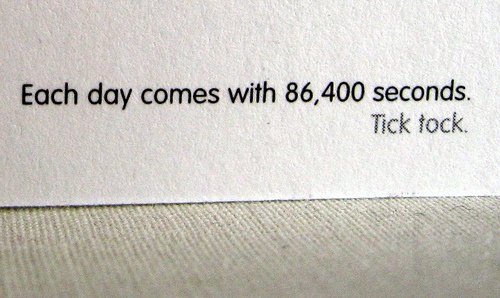
What are you writing with your seconds of each day of your life?
Each second a moment you can get lost in a good story or poem, writing or reading it.
Filed under Writing Tip Wednesday
Writing tip Wednesday: writerly thinking
How a writer thinks—elementary my dear
by DON WILLIAMS
During a holiday sometime back, the Williams clan, including in-laws, outlaws and assorted friends, gathered to play Trivial Pursuit.
A competitive lot, we turn such games into raucous entertainment. Lots of praise, derision and laughter pertain, not necessarily in that order.
The games were close and the questions difficult, prompting snorts and catcalls, and three of the teams had flamed out by the time my friend the writer’s turn came to answer a question.
My sister Rebecca drew a card and read:
Sherlock Holmes turned into the gate at 221 Baker St, stepped inside the door and climbed ___ steps to his second story flat. How many steps did he climb?
There was a collective groan.
“Bury that one,” a brother-in-law said, even as Rebecca was discarding the question. “He’ll never get that.”
“Hold on!” My friend held up his right hand. “I’ve only read one Arthur Conan Doyle book, and it wasn’t Sherlock Holmes, but I’ll take a shot at that.”
“No way. How are you going to guess that one?”
“Elementary my dear Watson,” my friend replied. “In the time-honored Holmes-ian way. Deductive Reasoning.”
“That’ll be the day,” my brother Tim said.
“Listen up,” said my friend. “It has to be at least 10 steps to Sherlock’s apartment, even if the risers are relatively high, say, 10 inches, because they have to clear that first-floor apartment’s ceiling. And the answer likely won’t be more than, say, 20 steps, even if the risers are short, because that would put the esteemed detective’s pad more than ten or twelve feet above street level. See? Already I’ve reduced the universe of possible answers to 10.”
“Yeah, yeah,” my brother Rodney said.
“So,” my friend continued, “the answer lies somewhere between 10 and 20. Let’s take them one by one.”
“Better hurry,” said my sister Kathleen, eyeing the sandglass.
“OK. Ten is a lazy number that would make the author appear lazy too, so a writer like Doyle would never use it. Not here. Nor can it be 11, because that’s a lucky number, mildly distracting and therefore intrusive. More importantly, Sherlock’s a deductive thinker, so the author wouldn’t suggest, even subliminally, that his detective’s success owes anything to a lucky number. Number 12? Again, distracting. Sir Doyle wouldn’t want his readers to be thinking, even subconsciously, about Twelve Apostles or even 12 months. Unlucky thirteen? Similary distracting.”
“Time’s almost up,” said Kathleen.

Step by step deduction led to the right conclusion.
I could see my friend faintly flush, but he continued in a calm if faster voice. “Fourteen? Now there’s a Plain Jane. No writer worth his salt would dull down a book with such tasteless seasoning, even if it is red.”
“Red?”
“See? That could be a subjective thing. And 15? Again, like 10, it’s too pat and pregnant. Makes the author appear lazy.”
“Sixteen?” a brother-in-law asked, eyeing the fleeting sands.
“Like 14, another Plain Jane, even if it is black,” my friend added.
“Seventeen?”
My friend smiled. You could almost hear bells going off. “Seventeen seems random,” he said, savoring the moment, “but it’s actually quite sexy. That unobtrusive 7, peeking from behind the place-holding 1, is subtly mystical, alluring even, hardly rising even to the level of the subliminal, yet there it is.”
Rebecca rolled her eyes. “So, is that your final answer?” she asked in a bored voice, as she glanced at the card, but we knew her attitude was all bluff.
“Yesssss,” my friend whispered aloud, calmly assured. “Seventeen it is. By far the most interesting number between 10 and 20.”
Her eyes widened. “You’re right. How did you do that?” she asked as she flashed the card, answer-side up, on the table.
“Elementary, my dear. I’m a writer.”
8888
Don Williams is a prize-winning columnist, short story writer, sometime TV commentator and the founding editor and publisher of New Millennium Writings, an annual anthology of stories, essays and poems. His awards include a National Endowment for the Humanities Journalism Fellowship at the University of Michigan, a Golden Presscard Award, the Malcolm Law Journalism Prize and many others. He was recently inducted into the East Tennessee Writers Hall of Fame. He is at work on a novel and a book of journalism..
Need a speaker, panelist, tv commentator or teacher for your group or to lead a writing workshop in your town? E-mail donwilliams7@charter.net, or visit www.NewMillenniumWritings.com. New Millennium Writings is holding a writing contest for fiction, non-fiction, and poetry that you can still enter. Deadline is July 31, 2012.


 Booker's Blog