Tag Archives: writing tip

Writing Tip Wednesday: Should Character or Plot power your Synposis

SHOULD CHARACTER OR PLOT POWER YOUR SYNOPSIS?

By Teri Brown

www.teribrownbooks.com.

What is the difference between a character-based synopsis and a plot-based synopsis? That’s the question I asked myself early last spring, when opportunity came knocking unexpectedly on my door.

Six months prior, I’d landed a great contract with Balzer+Bray for a young adult series set in the twenties. I thought I was done pursuing new contracts for a while, but after watching, (and loving!), Downton Abbey, I mentioned in an email to my agent that we should pitch an Edwardian anthology. Two weeks later, I had an editor who didn’t want an anthology with different authors; she wanted a three book series and wanted me to write it.

Even though this is for a “new adult” series– which I had never written before– I told her I could do it. To make the series happen in the short time frame she wanted, she needed a synopsis and two chapters of the first book as soon as possible.

A BETTER WAY
I wondered how I could possibly write a synopsis for a book and characters that hadn’t even existed two weeks before. I usually write the synopsis after most of the book had been written. Like many authors, I dread the synopsis, and so I immediately went into research mode, because there HAD to be a better way than pulling my hair out and winging it like I usually did.

Turns out, there is, and unless instructed otherwise, this is how I’ll approach synopses from here on out.

As I discovered through the process, you have to have great characters no matter how good your concept is, so it makes perfect sense to start with the characters and not the concept/plot. For me, that is the fundamental difference between a plot-based synopsis and a character synopsis.

Instead of starting with a plot, I started out with characters, added in the events and social issues of the time period and hoped that somehow, miraculously, a book would emerge. To my surprise it did, and the experiment ended up in a very nice three book deal.

FOCUS ON CHARACTER
Here are some tips on how you can craft your own character synopsis:

— Who are your main characters? If you have three main characters, as I did, that is how many parts of the synopsis you will have. It’s all about telling the story from their point of view.

— Get to know them. I’m not talking about their favorite colors; I’m talking about the desires of their hearts. If he/she could have anything, what would it be? It’s important to know your characters because you (and the editor) need to know why they react to the plot the way they do.

— Pick a lead. Even though my book would have three main characters and three POV’s, one of the character’s journeys would be stressed more in this particular book. I began with her and told her story as simply as I could. Then I told the next character’s story and then the next. Their stories intersected, but each main event was told from differing points of view.

Each character reacts differently to the same event because they have different emotions, problems and issues. For instance, when an evil uncle forces Prudence into service, Prudence is devastated, Victoria is righteously angry, and Rowena feels guilty because she had made a bargain with their uncle to keep Prudence with them. One event, three different reactions followed by three different actions.

— Like a plot synopsis, make sure you have the main plot points, but stress how each character reacts.

For me, writing a character synopsis is simpler because I begin with people and write their story as opposed to starting with story and then creating characters–you’ll still end up with a novel outline, either way, but this way, the characters have breathed life into it.

About: Teri Brown is proud of her two children but coming in a close second is the fact that she parachuted out of a plane and beat the original Legend of Zelda video game. She is a word scribbler, head banger, math hater, book reader, rule breaker, food fixer, novel writer, kitty keeper, and city slicker. You can find her online at www.teribrownbooks.com.

The above is taken from the e-newsletter Bruce Hale’s THE INSIDE STORY, December 2012. To learn more about Bruce Hale or his newsletter, go to www.brucehalewritingtips.com/

Leave a comment

Filed under Writing Tip Wednesday

Writing Tip Wednesday: Deadbeat news

From a TV station web site:

KNOXVILLE, Tenn. (WVLT) — More people have already died on Tennessee roads this year than all of last year. We studied the numbers with state troopers and tells us the solution is simple.

The sign shows 941 people have died this year on Tennessee roadways that’s up from 937 last year. Kathy Smith says, “That’s an awful lot. An awful lot.”

The lighted billboards let drivers know how dangerous driving can be in Tennessee. Wayne Parker says, “To see a real number and compare it to the previous year it puts things in perspective.”

Just knowing the risk isn’t helping drivers stay alive mainly because they’re not buckling up. 60% of the people killed weren’t wearing a seat belt.(Emphasis mine.) Tennessee State Trooper Sgt. Randall Martin says, “That’s a large number of people dying on the roads who could just buckle up.”

Troopers say the warmer weather had more people out on the roads leading to the increase in deadly crashes. Sgt. Randall Martin says, “Distracted driving people just not paying attention not attentive in driving not looking in defensive mode not looking at driver.”

Remember we have three weeks left so buckle up and go the speed limit so the number doesn’t go up. We also found that 71 of those deaths this year were either walking or riding a bicycle. (Emphasis mine.)

Editorial comment:
Hmmm.

“60% of the people killed weren’t wearing a seat belt.”

My smart aleck response to this is: with ONE (a) seat belt for over 560 people, it was bound to happen that there would be at least one (and probably more) driving (and dying) without the one (a) seat belt. “A seat belt” can only stretch so far.

And then there is this:
“We also found that 71 of those deaths this year were either walking or riding a bicycle.”

So the dead can walk and ride bicycles now?

Zombies live! (Pardon the contradiction in terms.)

I grasp the meaning, but the grammar and syntax in this article is an “unbelted” wreck. It wouldn’t take much to fix either issue. It could have been written: “Sixty percent of the people killed weren’t wearing their seat belts.” And “We also found that 71 of those killed this year were either walking or riding a bicycle.”

Leave a comment

Filed under Writing Tip Wednesday

Monday (morning) evening writing joke

Sometimes, good things take time; and awful things can take even longer.

Sometimes, good things take time; and awful things can take even longer.

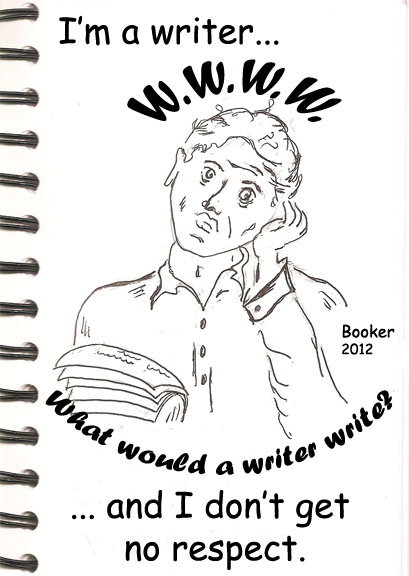
I’m a writer and I don’t get no respect. A few months back at a writing conference, I happen to talk to an agent and I asked her what was the most important thing she looked for in a manuscript. She said, “Good writing.”

When I got home I immediately sent her my manuscript.

Then I heard nothing.

And after a few more months, I still heard nothing.

Eventually I caught up with the agent at another writing conference and I was about to ask her why I hadn’t heard from her, when she raised a hand and said two words: “Still looking.”

Leave a comment

Filed under Monday morning writing joke

Writing Tip Wednesday: NO SUCH THING AS WRITER’S BLOCK?

by BRUCE HALE

http://clicks.aweber.com/y/ct/?l=O8uEK&m=JmGfH2oV7FLsQz&b=LL0Iif2G_NnGJtQ4.3UMsw

One of the most common questions I get is, “What do you do about writer’s block?” It’s hard to answer. Not because I don’t know,
but because I don’t really believe in writer’s block.

I mean, think about it. We’re the only profession that romanticizes avoiding our work. You don’t hear accountants talking about ‘accountant’s block,’ or dentists moaning, “I couldn’t remove that molar today, Bob; I had dentist’s block.”

But here we sit with our holy bugaboo, writer’s block. Now, don’t get me wrong — I do believe that we have days when it’s hard to write, but I label that as plain old, garden-variety fear and resistance. The same fear that keeps you from asking out someone you ave a crush on (fear of failure). The same resistance that keeps you from starting that new exercise regimen (resistance to change).

Fear and resistance are debilitating enough on their own without giving them a catchy name. So let’s just deal with them the way we do whenever and wherever they show up in our lives. (And no, I don’t mean by surrendering.)

PERFECTION IS THE ENEMY
I’ve noticed that when I feel fear around my writing, it’s usually the fear that it won’t be good enough. Perfection syndrome is insidious, and the only way to beat it is to address it head-on.

First, realize that nothing you write will EVER be perfect — even stories that get published. You can look back at a story you published nine years ago and see things you’d do differently today. Perfection is unattainable.

I think honestly, the best we can shoot for is “as good as I can make it right now.”

So once I’ve given myself permission to write an imperfect first draft, I just jump right into it and start. I write as quickly and sloppily as I can, never minding about proper form, just getting my ideas down on paper (or computer). I know I can always improve the story in the revision stage.

WRITING WARM-UPS
But say you have trouble even getting to the stage of writing a first, sloppy draft. What then? Just as you would with physical exercise, try doing some brief warm-ups before your writing session. You could do a personal journal, or write a journal from your character’s point of view. You could assign yourself a random topic or write about a memory.

One of my favorite ideas is to compile a Bradbury List. Just like Ray Bradbury did when he was a young writer, come up with a list of titles off the top of your head, drawing from childhood fears and fantasies. Then, as a warm-up, pick one title, set your egg timer for 10 minutes, and write a stream-of-consciousness entry about it. Don’t try to craft a story; just let the writing flow.

You may find that you pick up some good material for a future story. You may just get past that initial fear of the blank page and ease into your writing flow. And you may just discover there’s no such thing as writers block.

Here’s the signup link:
http://clicks.aweber.com/y/ct/?l=O8uEK&m=JmGfH2oV7FLsQz&b=LL0Iif2G_NnGJtQ4.3UMsw

2 Comments

Filed under Writer's Block, Writing Tip Wednesday

Can I Make More Money via Traditional or Self-Pub?

An interesting blog entry that poses questions for things to consider.

For example:

If their agent shops the book and gets a publishing offer from a reputable house, but the advance is lower than the author wants, can the author reject the offer, take back the book, and self-publish it?

Technically, the answer is usually “yes” unless the author/agent agreement stipulates otherwise. If I shop a project, you are within your rights to reject any offers and take the project back. But it’s important to realize that it puts agents in the position of spending hours and weeks and months on something for which they’ll never be compensated.

Find out more at the link below.

Can I Make More Money via Traditional or Self-Pub?.

Leave a comment

Filed under advice column, agents, writing tip

Writing tip Wednesday: breathe

“I write for the same reason I breathe — because if I didn’t, I would die.”
–Isaac Asimov

So, take a deep breath and plunge on into it. Even if you don’t know exactly what you’re doing, splash a few words around and see what happens. Think of the blank sheet of paper or the blank screen as a scene waiting to be discovered.

You might just have a masterpiece within you. Remember that Michelangelo took a block of marble rejected by his contemporaries and saw the statue ‘David’ within it. All he had to do, he said, was chip away the pieces not needed in order to create his masterpiece.

Many times a writer has to do the same thing. The block of marble is the first draft. The subsequent drafts are chipping away at that marble, removing the pieces you don’t need. Easy? No. But from a rejected pile of words can come your masterpiece. You have to be honest with yourself and hold true to your vision of the story and commit to it with confidence … and write as if you were breathing.

Tree down

Even out of ruined or rejected scenes can come your masterpiece.

Leave a comment

Filed under Photo by author, Writing Tip Wednesday

Monday (morning) writing joke: hair of the dog

Writer, no respect

Writing tip: keeping tabs on your favorite writer can be surprising.

I’m a writer and I don’t get no respect. I went into a bar that caters to well-known writers.

I told the bar tender, “Give me what your best writer has most often in here.”

She promptly handed me the tab.

2 Comments

Filed under cartoon by author, I'm a writer and I don't get no respect, Monday morning writing joke

Writing tip Wednesday: 5 Essential Tips for Writing Picture Books

By Dianne de Las Casas

When I am at book signings or doing school visits, I often hear the question, “What advice do you have for someone writing their first
picture book?” People are eager to learn the “secret” to writing a runaway best-selling picture book.

There IS a definite art to writing a picture book. For me, a perfect picture book is a seamless integration of pictures and
words. They fit together like peanut butter and jelly. The words and the pictures might be good alone but they are GREAT together.

1. A Universal Theme
Contrary to popular belief, picture books do not have to have a message although they often do. If there is a message in a picture book, it should be subtle and left for the reader to decipher. What is important is a universal theme, a theme that readers can relate to: love, bedtime, friendship, teamwork, etc. Even humor can work as a theme. THE DOT by Peter Reynolds landed in USA Today‘s Top 100 Children’s Books because of the book’s universal theme of creativity.

2. The Page Turn
Never underestimate the power of the page turn. Every good story needs to take a breath or have a moment of suspense. The page turn can be that quiet pause or that dramatic reveal. New York Times Bestselling book PETE THE CAT by Eric Litwin has an extremely successful use of the page turn, building the readers’ anticipation for the next moment in the story.

3. Think Visually
If you are not the illustrator, think (don’t write) visually. The story can be rich and full but there must still be room for the illustrator to work, stretching the confines of the story. Often, the subtext of the story can be found in the illustrations. Tell your story adroitly with an economy of words. Leslie Helakoski and Henry Cole demonstrate this perfectly with their book, BIG CHICKENS GO TO TOWN.

4. The Read-Aloud
Picture books are meant to be read aloud… in classrooms, in library story times, and at bedtime. Read your story aloud. Have others read your story aloud. Does the rhythm work? Is the story too long? Too short? How do others react to the read-aloud? Remember that you are writing for children and their keepers (parents, teachers, and librarians).

Your book must sound good to everyone hearing it. Maurice Sendak’s WHERE THE WILD THINGS ARE is one of the greatest children’s books of all time. Read it out loud and you’ll know why.

5. Jacket Flap Copy
Finally, write your jacket flap copy, that brief synopsis inside the dust jacket of the book. Even picture books, as short as they are, need to be summarized. Can you sum up your book in 1-2 sentences? Every author needs to be able to tell people what their book is about.

Okay, here’s a bonus tip. Have fun! Play with your words and have a ball. Remember that once in print, your picture book is forever. You are leaving a legacy. If even one reader is touched by your message, you are making a difference.

Dianne de Las Casas is an award-winning author, storyteller, and the Founder of Picture Book Month, an international literacy initiative that celebrates the print picture book during the month of November.

Visit Dianne’s website at http://clicks.aweber.com/y/ct/?l=O8uEK&m=IjnT4bn0sFLsQz&b=blYlm3YP2bSes8q3ckH7gg and
Picture Book Month’s website at http://clicks.aweber.com/y/ct/?l=O8uEK&m=IjnT4bn0sFLsQz&b=RXU9K3zNzvjYbP.bFLhkmQ.
Follow Dianne on Twitter: @storyconnection and Facebook: fanofdianne

Leave a comment

Filed under 2012, Writing Tip Wednesday

Writing tip Wednesday: Some tools you may need

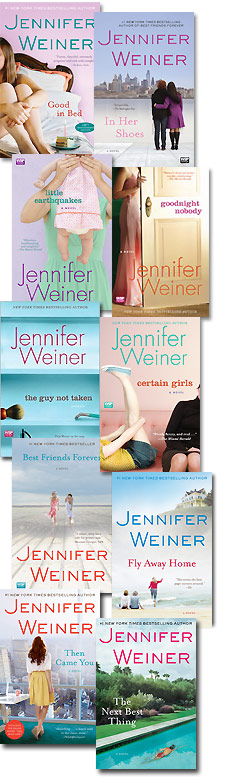
On her website (http://www.jenniferweiner.com), the author Jennifer Weiner has a list of advice if you want to be a novelist.

Weiner is the author of the novels The Next Best Thing, Then Came You, Fly Away Home, and others.

For books about writing to read, she writes “run, do not walk, to your local bookshop and buy Stephen King’s On Writing and Anne Lamott’s utterly indispensable Bird by Bird, and Eudora Welty’s One Writer’s Beginnings and Ursula LeGuin’s Steering the Craft.”

I would add a few more, but that can be for another time.

A synopsis of some of the other “tools” you need are:

Books by Jennifer Weiner

Books by Jennifer Weiner

1) The Unhappy Childhood: “Why do unhappy kids grow up to be writers? I think because being an outsider – a geek, a dweek, a weirdo … who just doesn’t fit in means that you’re naturally equipped for observing life carefully.”

2) The Miserable Love Life: “Again, a crucial ingredient for the formation of a novelist – romantic humiliation and heartbreak.”

3) Major in Liberal Arts (but not necessarily creative writing): “…a liberal arts education gives you a framework in which to place your own experiences, a context you can use to look at everything else ….”

4) Get a Job (not an MFA): She admits this one might be a bit controversial. But she says she thinks journalism “is just about the perfect career for aspiring young writers.” And if you can’t get a jog in journalism, camp counselor, cook, nanny or anything else that takes you out of your comfort zone is good.

5) Write to Please Yourself: “Tell the story that’s been growing in your heart.”

6) Get a Dog: Getting a dog can help teach you discipline and discipline is what you will need to be a writer.

7) Get Published: Submit, submit, submit. Expect to face rejection, but submit.

8) Find an Agent: This may take as much work, at least for a while, as being a writer.

9) Be a Smart Consumer: Advice on how to screen an agent that is interested in you. You don’t have to take the first one that says yes to your query letter, synopsis, finished novel.

10) Read: “Read everything. Read fiction and non-fiction, red hot best sellers and the classics you never got around to in college.”

For more details on these tools, go to http://www.jenniferweiner.com/forwriters.htm.

Leave a comment

Filed under Writing Tip Wednesday

Writers on Writing

“The scariest moment is always just before you start.”
–Stephen King

Leave a comment

Filed under Stephen King, Writers on writing