Tag Archives: writing tip

Writing tip Wednesday: “Who are you?”

On Saturday, February 1, 2014, I took a workshop sponsored by the Knoxville Writers’ Guild (www.knoxvillewritersguild.org) and led by nationally published author Pamela Schoenewaldt (www.PamelaSchoenewaldt.com and on Facebook at https://www.facebook.com/pages/Pamela-Schoenewaldt/158580547517755?ref=tn_tnmn).

The workshop was on character development. What you have below is one of the three handout exercises from the workshop. I will be posting the others over time. Each handout can be done in ten minutes or less, and oftentimes not pondering too long is best. The first exercise is called “Who are you?” The you refers to the character. This worksheet can be used for the both the protagonist and antagonist of the story or novel you are working on, or just about any character you want to use it on. It might even be helpful if writing a memoir or biography.

WHO ARE YOU?

Your name is . . .

Your age is . . .

I can see that you are . . . (location)

And you’re looking at . . .

And you’re feeling . . . .

Your great strength is . . . .

Your fear or weakness is . . . .

It’s too bad that . . . .

You’d really laugh if . . . .

Most people don’t know that you . . .

Very soon you must . . . .

The challenge will be . . . .

You will get strength from . . . .

Looking in your eyes, I know that . . .

Leave a comment

Filed under writing tip, Writing Tip Wednesday

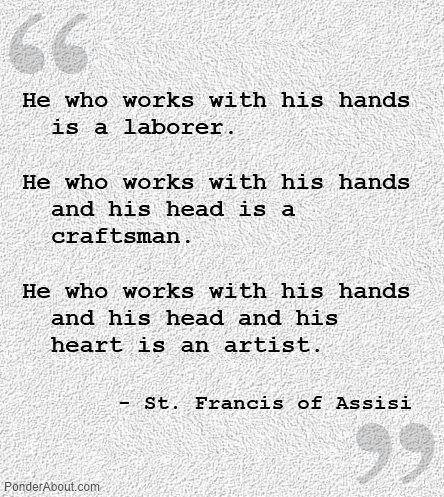
Writing tip Wednesday: “Artist”

What it takes to be the best.

What it takes to be the best.

Leave a comment

Filed under writing quotes, writing tip, Writing Tip Wednesday

Lauren Oliver’s Writing Secrets – 5 Secrets To Writing The Next Great American Novel – Cosmopolitan

Lauren Oliver's Writing Secrets – 5 Secrets To Writing The Next Great American Novel – Cosmopolitan.

Sample:

Lauren Oliver, who wrote the addictive-as-crack Delirium novels, has a new, bursting-with-intense-teen-romance novel out, Panic, about desperate kids competing for coveted prize, living not in an alternative future dystopia, but in a small town in upstate New York. Oliver herself lives in New York City and is a 31 year old badass who has written 7 novels and already had four New York Times bestsellers. Hello, impressive. She shares some secrets behind all that mad productivity. (Hey, put her tips to good work and enter the Cosmo Fiction contest, here.)

1. Make it part of your routine.
When I started writing, I had to force myself to do it everyday. Now, it’s a habit like brushing my teeth. Can you imagine how gross you would feel if you didn’t brush your teeth for a whole day? That’s how I feel now when I don’t write.

2. Figure out what works for you and your life and stick to it.
I kind of write all over the place, since I’m often traveling or bouncing around between commitments and meetings. The funniest place I do writing is on my phone. I’ve stayed loyal to BlackBerry for years because of the keyboards — I can type as quickly on a BlackBerry as I can on a computer. I wrote most of my first novel, Before I Fall on my BlackBerry. I think they should give me a sponsorship, seriously.

[Editor’s note: for the other three, click on the link above. First, can you guess what they are? Hint: one is about applying the seat of the pants to the seat of the chair.]

Leave a comment

Filed under Writing Tip Wednesday

I agree with Hanif Kureishi – creative writing courses are a waste of time | Books | theguardian.com

I agree with Hanif Kureishi – creative writing courses are a waste of time | Books | theguardian.com.

Sample:

I agree with Hanif Kureishi – creative writing courses are a waste of time

The novelist and professor Hanif Kureishi has voiced criticism of creative writing courses – and having been on one, I find it hard to disagree. Share your experiences below…

Leave a comment

Filed under Writing Tip Wednesday

Writing tip Wednesday: “Editing”

WHEN TO SAY WHEN: HOW MUCH EDITING IS ENOUGH?

by BRUCE HALE

http://www.brucehalewritingtips.com/

One of the most common questions I hear from writing students is “How do I know when to stop editing and revising my story?” Or in other words, “when do I say when?”

I ran into this same problem when making ahi stir-fry yesterday. I seared the fish awhile, then made a guess and tossed in the vegetables. (Wolfgang Puck I’m not.)

I wondered how long to let the whole mess fry. Would I overcook the fish or undercook the veggies? Finally, a gut feeling said, “Whoops, the fish might be too well-done.” Turned out that feeling was right.

With a meal, it’s too late (unless you’ve got a hungry dog handy). Overcooked isn’t curable. But with a story, provided you’ve saved your earlier drafts, over-edited isn’t irreversible.

So when do you stop cooking your story?

I believe this decision comes from a gut feeling – a blend of experience and intuition.

ONE AND DONE?
Kids do one draft and believe they’re done. But experience has taught us adult writers the importance of rewriting. Of course, the danger is that we can tend to over-think, over-edit, and try to make our story perfect.

Big news: Your story doesn’t need to be perfect. In fact it will never be perfect, because story writing isn’t like math. There isn’t one absolute, right answer.

In fact, I’d even go so far as to say that attachment to perfection is the enemy of art. In trying to get it “perfect”, we inhibit ourselves from freely expressing, and we can kill what’s alive in our
work.

So when you edit, don’t aim for “perfect.” Shoot for “as good as I can make it right now.” Your gut will guide you.

If you’re feeling too close to the story, have a trusted writing partner read it and comment. Then, if you’re still not sure, ask yourself some questions:

— Have I solicited feedback from readers I trust?

— Have I incorporated suggested changes that felt right to me?

— Am I afraid of the response this story will receive, and am I just delaying sending it out?

— Is this story as good as I can make it right now?

If you answered “yes” to all those questions, you’ve got your answer.

Enough is enough. Trust your gut. Send that manuscript out before you overcook it. (After all, Rover won’t eat an overdone story.)

___________

Bruce Hale

Bruce Hale

About Bruce…
Bruce Hale began his career as a writer while living in Tokyo, and continued it when he moved to Hawaii in 1983. Before entering the world of children’s books, he worked as a magazine editor, surveyor, corporate lackey, gardener, actor, and deejay.

Bruce has written and illustrated over 25 books for kids. His Underwhere series includes Prince of Underwhere and Pirates of Underwhere. His Chet Gecko Mysteries series includes: The Chameleon Wore Chartreuse, The Big Nap, The Malted Falcon, Hiss Me Deadly, and others. More at http://www.brucehale.com/

Leave a comment

Filed under writing tip, Writing Tip Wednesday

Writing tip Wednesday: “To Indie or not to Indie publish”

Most Amazon bestselling authors aren’t making minimum wage

By Charlie Jane Anders

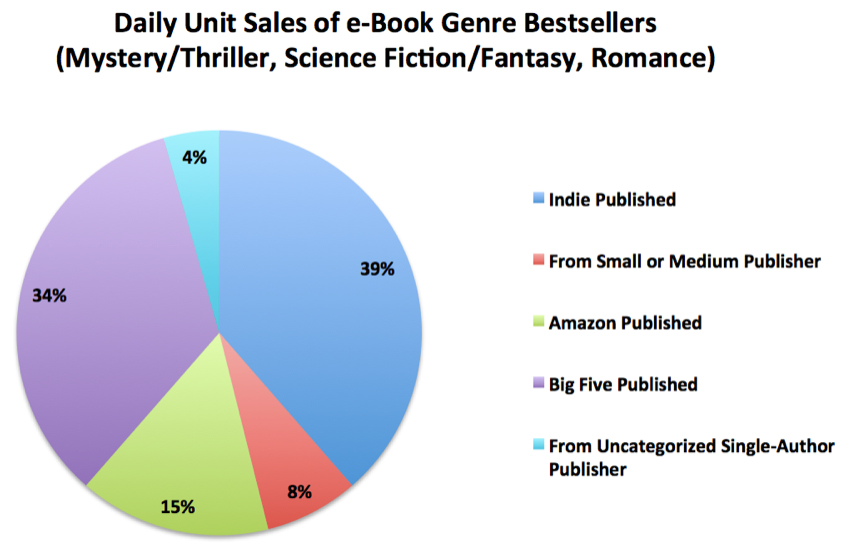
Yesterday we posted a chart from Hugh Howey’s new report on author earnings, showing indie and self-published authors pulling ahead of people published by the “big five” in terms of total unit sales. Now here’s another chart from an e-book publishing expert who’s calling some of Howey’s conclusions into question.

Chart:

E-book sales. Source: Hugh Howey

E-book sales. Source: Hugh Howey

Writing in Digital Book World, Dana Beth Weinberg points out that there are a number of questions about Howey’s data, even beyond the potential flaws that you’d already noticed. For one thing, Howey isn’t representing all self-published and indie authors — just the top 1.5 percent, or the cream of the crop. There are also some questionable assumptions in Howey’s methodology, writes Weinberg, and some statistical problems.

But leaving that stuff aside, even if you accept Howey’s data and his conclusions, it’s not clear that most of his indie/self-published authors are doing better than people published by the big mainstream publishers, argues Weinberg. What is clear, though, is that the people who are doing best, on Amazon e-book sales, are those published by Amazon’s own publishing imprints.

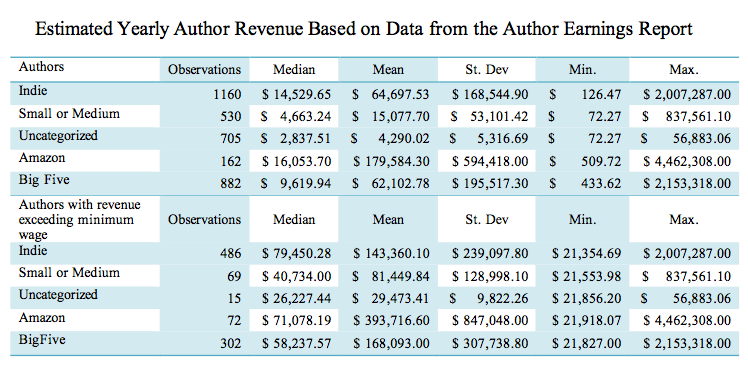
The really depressing thing? Weinberg estimates that most of the authors in the survey, whether self-published or published by a New York publishing house, are not making minimum wage:

Sales figures:

A different look at e-book sales.

A different look at e-book sales.

Full article at: http://io9.com/most-amazon-bestselling-authors-arent-making-minimum-w-1522482723

Source material at:
The Report, by Hugh Howey, Feb. 12, 2014
Full article at: http://authorearnings.com/the-report/

The Principal of Digital Abundance — thoughts on author earnings, by Damien G. Walter, Feb. 12, 2014
Full article at: http://damiengwalter.com/2014/02/12/the-principle-of-digital-abundance-thoughts-on-author-earnings/

Note: This post suggested by Research Assistant Ashlie

Leave a comment

Filed under writing tip, Writing Tip Wednesday

Writing tip Wednesday: “The End”

Dos and Don’ts for the Last 10,000 Words of Your Story

By James V. Smith Jr.

DON’T INTRODUCE ANY NEW CHARACTERS OR SUBPLOTS.
Don’t introduce anything new. Any appearances within the last fifty pages should have been foreshadowed earlier, even if mysteriously. What this means: If you bring in a new character this late, your audience will feel cheated, as if you’ve been holding back important information for a cheap surprise. They want clues throughout the novel so that way, even if they couldn’t solve it early, they can look back and say “Oh yeah, now that makes sense.”

DON’T DESCRIBE, MUSE, EXPLAIN, OR PHILOSOPHIZE.
In other words, keep the author out of the story, and don’t let it drag. By this point in the story, setup is done, complication is wrapping up, and resolution should be entirely uncluttered so you and the reader can make an unimpeded dash to the finish line. Keep description to a minimum, action and conflict to the max.

What this means: No long details about the setting or sudden dishing about backstory. This is what your story is all about. Your protagonist has sacrificed and made wrong turns to get to this moment. Make these pages as face-paced as possible.

DO CREATE THAT SENSE OF OH, WOW!
Once or twice on every page, if possible, more frequently.

What this means: Stories that play out “Then this happened. Then this happened. Then this happened.” in the final moments aren’t memorable. It’s better to put in an “But unexpectedly …” as the final chapters close up your story, especially if it ties up moments you’ve foreshadowed earlier in your novel.

DO ENMESH YOUR READER DEEPLY IN THE OUTCOME OF YOUR STORY.
Make her unable to put down your novel to go to bed, to work, or even to the bathroom until she sees how it turns out.

What this means: Like in sports, the most captivating part is the final minutes or innings of a close game. You can’t take your eyes off of it because you not only want to know the outcome, you feel like you need to know the outcome—and you need to know it immediately. Think of your ending in those terms.

To learn more, go to: http://www.writersdigest.com/how-to-improve-your-writing-skills-the-last-10000-words?et_mid=656501&rid=239626420

Leave a comment

Filed under writing tip, Writing Tip Wednesday

Writing tip Wednesday: “Raise the stakes, honey!”

By Kathi Appelt

I have been a writer my whole life long, beginning with writing on walls as a toddler to writing professionally as an adult. In that life-long career, I have written articles, picture books, non-fiction, poetry, essays, short stories, a memoir, and even a song or two.

But for years and years the novel was a form that absolutely eluded me.

NOVEL PROBLEMS
For a long time, I told myself that I didn’t need to write a novel. After all, I had plenty of published work to stand on, and I had plenty of ideas for new works.

But I was kidding myself, because in my heart of hearts, it was a novel that I wanted to write. So, I took courses, I bought how-to books, I went to workshops. I did all of the required groundwork. Why couldn’t I crack this genre?

In the meantime, I had drawer after drawer, boxes stacked upon boxes, of half-finished novels that were just that: half-finished.

It seemed like I could create wonderful characters, interesting landscapes, and great, colorful details. My characters, despite their goals, just didn’t seem to make much progress. I’d get about half way through and then my story would lose steam and whimper into oblivion.

It wasn’t until I took an on-line course with master teacher Dennis Foley that I realized that the essential element missing from my work was tension.

GETTING TENSE
Now, plots are plots. I knew how to create plots. They involve a character who is moving toward a goal. And as Dennis so aptly puts it: “a goal is nothing more than whatever your character is trying to achieve, overcome or acquire.” Easy peasy.

Yeah, right!

How could it be that I could have a character, in search of a goal, with all of the other elements in place, but still come up short?

As it turns out, in order for a reader to care about your story, the stakes have to be raised. You can have a character overcome incredible odds and obstacles, but if there’s nothing at stake, then there’s no reason to pull for that same character.

Let’s consider an example. Say we have a great guy named Phillip who is a cross-country racer and whose goal is to win the regional track meet. We’ll put Phillip at the starting line and pull the trigger on the starting pistol. Kapow! Off he goes.

If we use a basic plot, with three obstacles of increasing difficulty, we can first have Phillip develop an annoying blister on his heel. But because Phillip is tough, he runs through the pain. Next, it starts to snow. Now Phillip is having trouble seeing the track because of the snow, and his blister is getting worse, so the odds against his winning are increasing. Finally, he stumbles and turns his ankle. The entire pack is well ahead of him and Phillip is trailing badly.

WHY DOES IT MATTER?
We’ll leave it there. Whether Phillip wins or not doesn’t really matter. But what is missing from this story is the why of it. Why is it so important that Phillip win this race?

You see, there’s nothing wrong with this plot, nothing wrong with the obstacles, nothing wrong with the character. But we have no idea what the stakes are and why it matters so much to Phillip to win that race. Is a college scholarship at stake? Is he racing to prove something to his family, something
about honor, about perseverance, about stamina? Is he racing to win enough money to buy medicine for his little daughter?

What will be irrevocably lost if he doesn’t win? Why is it so important to Phillip?

And that’s the key word – important. The stakes have to be so important to the main character that if they don’t achieve, acquire or overcome their goal, we the reader will care. If not, then it’s just a race.

Winning or losing doesn’t matter unless the stakes are high.

Raise ’em, honey. Otherwise, nobody will care.

___

Kathi Appelt

Kathi Appelt

Kathi Appelt is a National Book Award finalist (for THE UNDERNEATH), and the author of over 20 books for kids and teens. Her tales havewon numerous national and state awards, and she serves on the faculty of the Vermont College of Fine Arts’ MFA in Children’s Writing program. Catch up with her online at: www.kathiappelt.com

Leave a comment

Filed under Writing Tip Wednesday

The 16 Habits of Exuberant Human Beings, by Kate Bratskeir

The 16 Habits of Exuberant Human Beings, by Kate Bratskeir.

Sample of article:

Martin Seligman, the father of positive psychology, theorizes that while 60 percent of happiness is determined by our genetics and environment, the remaining 40 percent is up to us.

In his 2004 Ted Talk, Seligman describes three different kinds of happy lives: The pleasant life, in which you fill your life with as many pleasures as you can, the life of engagement, where you find a life in your work, parenting, love and leisure and the meaningful life, which “consists of knowing what your highest strengths are, and using them to belong to and in the service of something larger than you are.”

After exploring what accounts for ultimate satisfaction, Seligman says he was surprised. The pursuit of pleasure, research determined, has hardly any contribution to a lasting fulfillment. Instead, pleasure is “the whipped cream and the cherry” that adds a certain sweetness to satisfactory lives founded by the simultaneous pursuit of meaning and engagement.

****

While not directly a writing tip, a more positive frame of mind might just help with writing, especially when few others seem interested in what you are doing.

Leave a comment

Filed under Writing Tip Wednesday

Writing tip Wednesday: The Daily Routines of Famous Writers | Brain Pickings

The Daily Routines of Famous Writers | Brain Pickings.

Happy 2014!

Leave a comment

Filed under Writers on writing, Writing Tip Wednesday