Tag Archives: writing tip

Writing tip Wednesday: “New Year, new start”

6 Tips for (Really) Finishing Your First Book in 2015

Source: http://www.huffingtonpost.com/carrie-visintainer/6-tips-for-really-finishi_b_6392358.html

by Carrie Visintainer

It’s that time of year for New Year’s Resolutions. Love ’em or hate ’em, they come up in all kinds of conversations. Maybe one of your big goals is to publish a book. (Possibly, this has been a resolution of yours for several years, and you just keep transferring it forward.) So in 2015, why not commit? Make it a priority and knock out that first novel, memoir, or story collection. Here are six tips for making your book happen this year.

1. Choose a writing space: This doesn’t have to be an entire room of your own, but it does help to have a designated area just for you, just for writing.

2. Carve out time: This is a challenge for pretty much everyone, no matter your life circumstances. … But you can control this, and you can start by setting realistic goals. Maybe you shoot for an hour every day, or ten pages, or 1,000 words. Do this for a month, and you’ll be amazed: The pages will begin to add up.

3. Turn off your inner censor: We all want to write things that sound beautiful and intelligent; rivaling literary greats and authors we admire. … Be easy on yourself (which is very hard). Commit to the task of putting words on a page without judgment. There’s plenty of time to go back and revise later.

4. Stop at an energetic place: During each writing session, it might take you a while to get warmed up, but then words will begin to flow. Keep going with this, and then do something key: Stop writing for the day when you’re still feeling energized.

5. Join a writers’ group: Critique groups are useful for several reasons. Accountability and camaraderie are but two reasons. … If you don’t know of any critique groups in your area, try posting an ad in a coffee shop or café and see who replies.

6. Reward yourself: Because the act of writing isn’t particularly glamorous — it might even be the hardest thing you’ve ever done — it’s important to celebrate.

Rest of the article at: http://www.huffingtonpost.com/carrie-visintainer/6-tips-for-really-finishi_b_6392358.html

Leave a comment

Filed under writing tip, Writing Tip Wednesday

Writing tip Wednesday: “We have our ways”

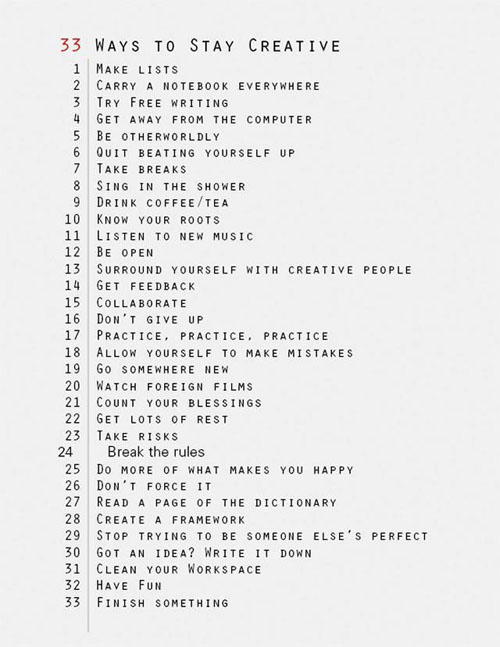
With one year about to close and another about to open, writers often make lists of what they want to accomplish the coming year: finish that novel, publish 10 short stories, win the Nobel Prize in Literature. Things like that. Below is a list that might help you in another way. That way is a list of tips for staying creative. Not sure where I picked this up, but I thought I would pass it along. Happy New Year and good luck with your writing.

List not all-inclusive, but it might help in the coming year. It's a new year, make your own

List not all-inclusive, but it might help in the coming year. It’s a new year, make your own.

1 Comment

Filed under Writing Tip Wednesday

Writing tip Wednesday: “Introductions”

Write Better: 3 Ways To Introduce Your Main Character

by Les Edgerton

Source: http://www.writersdigest.com/online-editor/write-better-3-ways-to-introduce-your-main-character?et_mid=711152&rid=239626420

1. Keep physical description minimal.

A character’s physical description—unless markedly different than the norm—does relatively little to draw the reader in. The character’s actions, or details such as his occupations and interests, are much more useful. The readers will furnish a perfectly good description on their own if you simply let them know that the Uncle Charley of your story is a butterfly collector, or the elderly toll-gate keeper on the Suwannee River. Doing so will accomplish more than 10 pages of describing hair and eye color, height, weight and all of that kind of mundane detail.

My own writing contains very little description of any of my characters—it’s virtually nonexistent—yet for years I’ve asked readers if they can describe a character I pick at random from my stories, and invariably they come up with a detailed description, no matter which character I choose. When I tell them I haven’t ever described the character mentioned, they’re surprised, and some swear that I did, even going so far as to drag out the story and skim for where I’ve included the description. They never find it.

2. Characterize through action.

Bestselling British writer Nick Hornby starts his novel How to Be Good by taking us through his protagonist’s inciting incident, revealed in an action that is contrary to her normal behavior and personality.

I am in a car park in Leeds when I tell my husband I don’t want to be married to him anymore. David isn’t even in the car park with me. He’s at home, looking after the kids, and I have only called him to remind him that he should write a note for Molly’s class teacher. The other bit just sort of … slips out. This is a mistake, obviously. Even though I am, apparently, and to my immense surprise, the kind of person who tells her husband that she doesn’t want to be married to him anymore, I really didn’t think I was the kind of person to say so in a car park, on a mobile phone. That particular self-assessment will now have to be revised, clearly. I can describe myself as the kind of person who doesn’t forget names, for example, because I have remembered names thousands of times and forgotten them only once or twice. But for the majority of people, marriage-ending conversations happen only once, if at all. If you choose to conduct yours on a mobile phone, in a Leeds car park, then you cannot really claim that it is unrepresentative, in the same way that Lee Harvey Oswald couldn’t really claim that shooting presidents wasn’t like him at all. Sometimes we have to be judged by our one-offs.

Wow! Don’t you wish you’d written that? I sure do!

3. Instill Individuality and Depth.

A very different example of establishing the protagonist’s character from the start is found in crime novelist Michael Connelly’s Lost Light:

There is no end of things in the heart.

Someone once told me that. She said it came from a poem she believed in. She understood it to mean that if you took something to heart, really brought it inside those red velvet folds, then it would always be there for you. No matter what happened, it would be there waiting. She said this could mean a person, a place, a dream. A mission. Anything sacred. She told me that it is all connected in those secret folds. Always. It is all part of the same and will always be there, carrying the same beat as your heart.

I am fifty-two years old and I believe it. At night when I try to sleep but can’t, that is when I know it. It is when all the pathways seem to connect and I see the people I have loved and hated and helped and hurt. I see the hands that reach for me. I hear the beat and see and understand what I must do. I know my mission and I know there is no turning away or turning back. And it is in those moments that I know there is no end of things in the heart.

What makes this opening different? Well, it’s by a brand-name author with a sizable audience already in place. Michael Connelly’s books have made the bestseller lists at least 19 more times than I’ve hit a grand-slam walk-off home run at Yankee Stadium as a member of the Bronx Bombers. This means he can write just about any opening he wants and it’s going to get published. It also means that in the hands of a writer without a ready-made audience such as Connelly enjoys, opening with the protagonist’s bit of philosophy might not work, if not done well. It could easily come across as sentimental or self-indulgent.

More details at: http://www.writersdigest.com/online-editor/write-better-3-ways-to-introduce-your-main-character?et_mid=711152&rid=239626420

Leave a comment

Filed under Writing Tip Wednesday

Writing tip Wednesday: “Conquering writer’s block”

4 Tips On Conquering The Evil That Is Writer’s Block

by Ashley Jones

Read more at http://www.business2community.com/blogging/4-tips-conquering-evil-writers-block-01074259#1IGzOmJ9sSQZJ1DM.99

It’s funny that I’m writing this blog about writer’s block considering I was drawing a complete blank when trying to think of a topic. Writer’s block happens to the best of us, and if someone tells you they haven’t experienced a bought of writer’s block they’re likely lying.

So what do I do when I’m struggling with my writing? Sounds weird, but I like to pace around my apartment. My tiny apartment is shotgun style and it takes me approximately 15 seconds to get from one end to the other. I pace like this about 10 times. This works well for me. It makes me feel less sedentary and helps me generate ideas. I think one of the best things you can do if you’re suffering from writer’s block is distance yourself from your project for a while.

This leads me to my first major tip you should try next time you start to feel like words are the enemy:

  • Step away from your computer.
  • Aaron Sorkin (The Newsroom, The West Wing) was recently on Late Night with Seth Meyers. The two did the typical let-me-plug-my-latest-project interview. But they also talked about Sorkin’s writing process. Sorkin said whenever he experiences writer’s block he will shower and change into clean clothes to start again with a clean slate. I think this is a great idea. There’s no reason to sit and stare at a blank page. Get up and start moving around; do whatever works for you. This will help clear your head and make room for all those awesome ideas to come through.

  • Read something you enjoy.
  • No, Facebook doesn’t count. Pick up a magazine or check out the latest entry from your favorite blogger. You can even read a few industry blogs to see what’s new. This will get your mind off your work and help inspire you. These quick distractions can help you connect ideas in a way you didn’t see before.

  • Write like you speak.
  • Don’t try to get hung up on trying to use jargon or industry-speak. Start off by writing conversationally and the ideas will start flowing. It’s way easier to get a good pace going if you feel comfortable with the language you’re using.

  • Start with a working title, and then jump in.
  • Write up a quick title that focuses on the general idea of your blog. Then try to get your initial thoughts out. It doesn’t have to be grammatically correct or even make complete sense. Once you’ve got your thoughts out you can clean it up later and you’ll feel better once your ideas aren’t swimming around in your head.

  • Take your content one step at a time.
  • If you’ve got a lot of content to work with it can feel daunting. Break your content up into sections and tackle them one by one. I usually separate my main ideas out into bullet points. Then I take those points one by one and start fleshing them out. This makes my content much more manageable and I’m less freaked out by the amount I need to complete.

Read more at http://www.business2community.com/blogging/4-tips-conquering-evil-writers-block-01074259#1IGzOmJ9sSQZJ1DM.99

Leave a comment

Filed under writing tip, Writing Tip Wednesday

Writing tip Wednesday: “Agent for new writers”

Rebecca Scherer

Rebecca Scherer

About Rebecca: Unable to narrow her focus to just one subject, Rebecca Scherer earned her BA from the Macaulay Honors College at Hunter College in Political Science, English Lit, and German language. After several years at the agency, Rebecca now has daily opportunities to put her wide range of interests to use as she actively builds her client list. Find her on Twitter: @RebeccaLScherer.

She is seeking: women’s fiction, mystery, suspense/thriller, romance, upmarket fiction at the cross between commercial and literary

How to contact: Contact her via e-mail: Email Rebecca Scherer. Put “Query: [Title]” in the subject line. Send a query letter, brief synopsis (1-2) pages, and the first three chapters. Please paste the letter and synopsis in the body of the email, though the chapters can either be pasted or attached.

Additional information at: http://www.writersdigest.com/editor-blogs/guide-to-literary-agents/new-literary-agent-alert-rebecca-scherer-of-jane-rotrosen-agency?et_mid=704752&rid=239626420

Leave a comment

Filed under writing tip, Writing Tip Wednesday

Writing tip Wednesday: “An agent interested in new writers”

Kimberly Bower

Kimberly Bower

About Kimberly: Kimberly fell in love with reading when she picked up her first Babysitter’s Club book at the age of seven and hasn’t been able to get her nose out of a book since. Reading has always been her passion, even while pursuing her business degree at California State University, Northridge and law degree at Loyola Law School, Los Angeles. By joining the Rebecca Friedman Literary Agency in 2014, she has been able to merge her legal background with her love of books. Although she loves all things romance, she is also searching for books that are different and will surprise her, with empathetic characters and compelling stories. Follow her on Twitter at @kimberlybrower

Kimberly is seeking: Kimberly is interested in both commercial and literary fiction, with an emphasis in women’s fiction, contemporary romance, mysteries/thrillers, new adult and young adult, as well as certain areas of non-fiction, including business, diet and fitness.

How to submit: Email a query to Kimberly at Email Kimberly Brower. Submit a brief query letter and your first chapter (pasted into the email, not to exceed fifteen double-spaced pages) and for security purposes, do not include any attachments unless specifically requested.

Details at: http://www.writersdigest.com/editor-blogs/guide-to-literary-agents/new-literary-agent-alert-kimberly-brower-of-rebecca-friedman-literary-agency?et_mid=704752&rid=239626420

Leave a comment

Filed under writing tip, Writing Tip Wednesday

cARtOONSDAY: “tIPPING pOINT”

Why writers don't work for tips.

Why writers don’t work for tips.

Leave a comment

Filed under cartoon by author, CarToonsday

Writing tip Wednesday: “Glimmer Train contest for New Writers”

SHORT STORY AWARD for NEW WRITERS guidelines

Glimmer Train

Glimmer Train

Open only to writers whose fiction has not appeared, nor is scheduled to appear, in any print publication with a circulation over 5,000. (Entries must not have appeared in any print publication.)

Most entries run from 1,500 – 6,000 words, but any lengths up to 12,000 words are welcome.

Held quarterly. Open to submissions in FEBRUARY, MAY, AUGUST, and NOVEMBER. Next deadline: November 30. *

Winners are announced in the May 1, August 1, November 1, and February 1 bulletins, respectively, and contacted directly one week earlier.

  • This category is open only to emerging writers whose fiction has not appeared in any print publication with a circulation over 5000. (Seven of the last eight 1st place New Writer winners have been those authors’ first print publications.)
  • Second- and 3rd-place winners receive $500/$300, respectively, or, if accepted for publication, $700. Winners and finalists will be announced in the February 1 bulletin, and contacted directly the previous week.
  • Most submissions run 1,500 – 6,000 words, but can be as long as 12,000. Reading fee is $15 per story. Please, no more than three submissions per category.

To submit: http://www.glimmertrainpress.com/writer/html/index2.asp

Leave a comment

Filed under writing tip, Writing Tip Wednesday

Writing tip Wednesday: “New Millennium Writings”

New Millennium Writings contest

nmw-logo2
Details at: http://newmillenniumwritings.com/awards.php

To apply online, follow these guidelines:

  1. No restrictions as to style, content, number of submissions, or nationality. Enter as often as you like.
  2. Send between now and November 17, 2014, Midnight, all U.S. time zones.
  3. Simultaneous & multiple submissions welcome. Previously published material welcome if under 5,000-circulation or if previously published online only.
  4. Each fiction or nonfiction piece is counted as a separate entry, and should total no more than 6,000 words except Short-Short Fiction (no more than 1,000 words).
  5. Each poetry entry may include up to three poems, not to exceed five pages total per entry. All poetry Honorable Mentions will be published.
  6. Save cover sheet or letter with the submission you’ll be uploading and send as one file. Should you forget to include such covers, however, it’s OK, as contact information is automatically forwarded to us when you pay online.
  7. Payment is $20 per submission in order to cover our many expenses and reserve your book. Payment will be by credit card or echeck through PayPal (See Rule 10).
  8. Each entry must be in a separate file (up to 3 poems in one file (See #6)). Many file formats are accepted.
  9. Enter file to upload:
  10. After clicking Upload, allow five seconds, then follow payment instructions to conclude your submission.

$4,000 offered in Literary Grants and Awards, Plus Publication
$1,000 for best Poem
$1,000 for best Fiction
$1,000 for best Nonfiction †
$1,000 for best Short-short Fiction
† Nonfiction includes humor, memoir, creative nonfiction, travel, opinion, essay, interview, features, investigative reporting, etc.

Details at: http://newmillenniumwritings.com/awards.php

1 Comment

Filed under writing tip, Writing Tip Wednesday, writing tips

Writing tip Wednesday: “Don’t try this at home”

Writer reacts to bad review and writes about tracking down the reviewer; others react to writer writing about her stalking experience

First the article about tracking down the reviewer:

“Am I being catfished?” An author confronts her number one online critic

When a bad review of her first novel appeared online, Kathleen Hale was warned not to respond. But she soon found herself wading in

by Kathleen Hale

Source: http://www.theguardian.com/books/2014/oct/18/am-i-being-catfished-an-author-confronts-her-number-one-online-critic
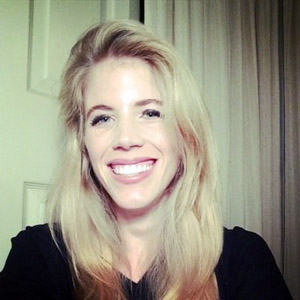
Kathleen Hale

Kathleen Hale

In the months before my first novel came out, I was a charmless lunatic – the type that other lunatics cross the street to avoid. I fidgeted and talked to myself, rewriting passages of a book that had already gone to print. I remember when my editor handed me the final copy: I held the book in my hands for a millisecond before grabbing a pen and scribbling edits in the margins.

“No,” she said firmly, taking the pen away. “Kathleen, you understand we can’t make any more changes, right?”

“I was just kidding,” I lied. Eventually she had to physically prise the book from my hands.

A lot of authors call this “the post-partum stage”, as if the book is a baby they struggle to feel happy about. But for me, it felt more like one of my body parts was about to be showcased.

“Are you excited about your novel?” my mom asked, repeatedly, often in singsong.

“I’m scared,” I said. Anxious and inexperienced, I began checking goodreads.com, a social reviewing site owned by Amazon. My publisher HarperTeen had sent advance copies of my book to bloggers and I wanted to see what they thought. Other authors warned me not to do this, but I didn’t listen. Soon, my daily visits tallied somewhere between “slightly-more-than-is-attractive-to-admit-here” and “infinity”.

For the most part, I found Goodreaders were awarding my novel one star or five stars, with nothing in between. “Well, it’s a weird book,” I reminded myself. “It’s about a girl with PTSD teaming up with a veteran to fight crime.” Mostly I was relieved they weren’t all one-star reviews.

One day, while deleting and rewriting the same tweet over and over (my editors had urged me to build a “web presence”), a tiny avatar popped up on my screen. She was young, tanned and attractive, with dark hair and a bright smile. Her Twitter profile said she was a book blogger who tweeted nonstop between 6pm and midnight, usually about the TV show Gossip Girl. According to her blogger profile, she was a 10th-grade teacher, wife and mother of two. Her name was Blythe Harris. She had tweeted me saying she had some ideas for my next book.

“Cool, Blythe, thanks!” I replied. In an attempt to connect with readers, I’d been asking Twitter for ideas – “The weirdest thing you can think of!” – promising to try to incorporate them in the sequel.

Curious to see if Blythe had read my book, I clicked from her Twitter through her blog and her Goodreads page. She had given it one star. “Meh,” I thought. I scrolled down her review.

“Fuck this,” it said. “I think this book is awfully written and offensive; its execution in regards to all aspects is horrible and honestly, nonexistent.”

Blythe went on to warn other readers that my characters were rape apologists and slut-shamers. She accused my book of mocking everything from domestic abuse to PTSD. “I can say with utmost certainty that this is one of the worst books I’ve read this year,” she said, “maybe my life.”

Other commenters joined in to say they’d been thinking of reading my book, but now wouldn’t. Or they’d liked it, but could see where Blythe was coming from, and would reduce their ratings.

“Rape is brushed off as if it is nothing,” Blythe explained to one commenter. “PTSD is referred to insensitively; domestic abuse is the punch line of a joke, as is mental illness.”

“But there isn’t rape in my book,” I thought. I racked my brain, trying to see where I had gone wrong. I wished I could magically transform all the copies being printed with a quick swish of my little red pen. (“Not to make fun of PTSD, or anything,” I might add to one character’s comment. “Because that would be wrong.”)

Rest of the article at: http://www.theguardian.com/books/2014/oct/18/am-i-being-catfished-an-author-confronts-her-number-one-online-critic

****

Reaction to the article:

This Is What Happens When An Author Tracks Down A Critic In Real Life

Kathleen Hale faced backlash on social media after admitting to tracking down a book blogger at her home address.

by Jenna Guillaume

Source: http://www.buzzfeed.com/jennaguillaume/this-is-what-happens-when-an-author-tracks-down-a-critic-irl#2kyqd1o

On Saturday (October 18, 2014), YA author Kathleen Hale published an essay on The Guardian about confronting “her number one online critic,” and a social media storm of epic proportions erupted.

In the article, called “Am I Being Catfished?”, Hale describes how she obsessed over a book blogger named Blythe Harris who had given her book, No One Else Can Have You, a one-star review.

After Hale’s essay was published, the book-blogging community rushed to defend Harris, arguing she had done nothing wrong but that Hale had actually stalked her.

To see the array of reactions, some by well-known authors such as Neil Gaiman, go to:
http://www.buzzfeed.com/jennaguillaume/this-is-what-happens-when-an-author-tracks-down-a-critic-irl#2kyqd1o

***

Best thing to do: don’t follow this example. There will always be somebody who makes his or her “mark” by trying to leave a mark on you through your work. The best revenge is to ignore and write more and work to improve. After all, nobody’s perfect, not even critics.

Or in the words of author Robert A. Heinlein: “Critics can’t create, therefore, they feel justified in critiquing those who do. There is some logic in this: they hate all creative people equally.”

Leave a comment

Filed under writing tip, Writing Tip Wednesday, writing tips