Tag Archives: writing tip

Writing tip Wednesday: “Rules from Rule”

Breaking Into True Crime: Ann Rule’s 9 Tips for Studying Courtroom Trials

by Zachary Petit

Source: http://www.writersdigest.com/online-editor/ann-rule-on-breaking-into-true-crime?et_mid=772391&rid=239626420

Ann Rule

Ann Rule

Bestseller Ann Rule had a heck of a journey to becoming a writer—something she never really wanted to be in the first place. “All I ever wanted to be was a police officer,” she told the crowd in her ThrillerFest session “How to Stalk a Serial Killer and Tell the Gruesome Tale: All You Need to Know to Write Great True Crime.” “The one thing I knew I didn’t want to be was a writer.” Rule thought it was all too hard—heck, you’d have to rewrite what you already wrote.

As a kid, she would visit her grandpa, who was a sheriff, but to see him she’d have to go to the jail. There, she was given the job of bringing prisoners their meals. From an early age, she was fascinated by crime—not the how, but the why.

“I think that we come to our genre naturally,” she said.

Following her passions over the years, she took any ridealong with law enforcement she could get. Attended classes. Got an associate’s degree in criminal science.

***

“You can’t let the naysayers make think you can’t make it, because you can,” she said.

If you want to be a true crime writer, Rule said the best thing you can be is immensely curious. And, you should go to trials—something anyone can do. From a life spent in courtrooms, here are Rule’s tips and etiquette for doing just that.

  1. You can usually get a press pass, but there’s often a deluge of writers trying to obtain one. Rule calls the prosecutor’s assistant.
  2. Study the witnesses, watch the jury, and soak up the entire experience.
  3. Try to obtain the court documents from the court reporter or the prosecutor, or purchase them.
  4. Observe the other reporters in the room, and analyze what they’re doing.
  5. If you’re sitting out in the hall with potential witnesses, don’t ask them about anything. You can comment on the weather or the courtroom benches being hard, but “Keep your eyes and ears open and your mouth pretty shut.”
  6. Don’t take newspapers into the courtroom.
  7. Know what you’re getting yourself into. “You don’t want to start a nonfiction unless you’re really in love with it, and usually you want a go-ahead from an editor.”
  8. Absorb detail. “When I’m writing a true-crime book I want the reader to walk along with me.” Rule describes the temperature, how the air feels—“I think it’s very important to set the scene.” As far as the writing, you can novelize, but keep all of your facts straight.
  9. Don’t use the real name of a rape or sexual crime victim in your writing. (Though Rule has written about a few who have asked to have their names included.) As Rule said of her subjects at large, “I always care about my people. And if I didn’t, I wouldn’t be doing what I’m doing.”

Complete article: http://www.writersdigest.com/online-editor/ann-rule-on-breaking-into-true-crime?et_mid=772391&rid=239626420
Leave a comment

Filed under 2015, writing tip, Writing Tip Wednesday

Writing tip Wednesday: “Enemy Mine”

HOW TO COMBAT A WRITER’S WORST ENEMY

by Bruce Hale

source: http://www.brucehalewritingtips.com/

Bruce Hale

Bruce Hale

Nearly every writer has felt it — that deep inner conviction that even though you should be writing your latest story, the most important thing for you to do right now, this very instant, is trim those blasted toenails.

Or feed the cat. Or sort that box of old photos. Or clean the oven. Or check to see if anything has magically materialized in the fridge since you last checked it half an hour ago.

Ah, the siren song of procrastination! We know we want to write. We love writing (or at least we love the feeling of having written). And yet, when it’s time to apply the “bum glue,” we find reasons to wander. So many wise writers in so many different ways have said, “writing = derriere + chair.”

Still, we avoid, we dilly-dally, we find any and all reasons not to sit down and work. Are writers just a masochistic lot? Do we get some payoff from punishing ourselves?

Don’t ask me. I’m just as blind as the next writer. The last week or so, as I’ve been starting my latest book, I’ve noticed some strange occurrences. Time and time again, I sit down in my lovely, comfy, ergonomic chair to write. And then, an hour later, I find myself in the living room with no idea how I got there.

Alien abduction, perhaps?

Or I wake to find I’ve spent an hour futzing about with e-mail or surfing the Net. It’s frustrating, especially when I’ve set myself a minimum page goal for the day.

Am I just your basic psycho?

I don’t think so. (At least, not for those reasons.) Lately I’ve begun to look at this whole approach-avoidance thing as part of my process. Maybe this is just how my muse operates.

True, it’s not the tidy, organized method I’d prefer. But the creative process is a strange and amazing thing.

As anyone who’s ever tried to push a stalled car can tell you, it takes a lot of effort to overcome inertia. So maybe that’s what this behavior is — part of the push to overcome inertia and get the story going.

I’m finding that if I cut myself a little slack, it helps. Not let myself off the hook, exactly — I still have to show up everyday and make the effort. But I’m working on not beating myself up when at day’s end I’ve only produced one page instead of three.

After all, progress is progress. And I look at it this way: Hey, at least I’ve gotten my nails trimmed.

1 Comment

Filed under 2015, writing tip, Writing Tip Wednesday

Writing tip Wednesday: “As bad as cliches”

Tip once, tip often.

Tip once, tip often.

Leave a comment

Filed under 2015, writing tip, Writing Tip Wednesday

6 Scientifically-Proven Ways To Boost Creativity

by Carina Wolff

Ever notice how some days you’re brimming with ideas, while others you’re staring at a blank canvas or computer screen and wondering how you ever found inspiration in the first place? Unfortunately, a creative block can happen to the best of us, and it can strike at any time. Feeling unmotivated and uninspired can be a frustrating feeling, but just because you’re feeling stuck in the moment doesn’t mean you’re doomed to unoriginality forever.

When these debilitating moments strike, you can sit and stare aimlessly at the computer until your eyes hurt, or you can figure out a way to kickstart your mind and get those creative juices flowing. If you find yourself at a loss for good ideas, or just need an extra boost of creativity in your life, try the following six strategies that have been proven to help stimulate your thinking.

Source: http://www.simplemost.com/6-scientifically-proven-ways-boost-creativity/

Take a walk
Studies have found that walking, whether indoors or outdoors, increases creative thinking in the moment as well as the moments after. Even mild exercise can have a positive effect on cognition, so next time you feel yourself in a rut, consider taking even a brief stroll.

Daydream
Though it may seem counterintuitive, allowing your mind to wander actually boosts your creativity, and it can even help your working memory. Next time you’re feeling stuck, you may be better off letting yourself space out than trying to force yourself to focus, as studies have found that daydreaming does enhance your creative problem solving skills rather than hinder you.

Drink a little
Whip out that glass of wine! Turns out, having a drink or two can help loosen your mind and spark creativity. Researchers have found that having a blood alcohol level of just under the legal limit of .08 helps you perform creative tasks better, likely because it allows your mind to wander to solutions you may have never considered before.

Play some music
Many studies have found that listening to any type of music that you like helps your creative thinking and improves cognitive functioning. It doesn’t have to be just Mozart; as long as you enjoy what’s playing, the song will put you in a positive mood and increase arousal, both factors in how you perform creatively.

Doodle
Now you won’t have to feel so guilty about covering that work memo in smiley faces and flowers during a meeting. Doodling helps stimulate visual thinking, which helps bring you out of one brain mode and into another. It also frees up working memory space, allowing your mind to wander and access new ideas.

Take a power nap
Not only can a quick 20 minute nap refresh and restore you, but it can also help increase activity in the right side of the brain, which is generally associated with creative thinking and problem-solving tasks. As long as you slip into REM (rapid eye movement) sleep, your nap can help boost your cognitive thinking, improve memory, and enhance your problem solving skills.

More ideas at: http://www.simplemost.com/6-scientifically-proven-ways-boost-creativity/

Leave a comment

Filed under 2015, writing tip, Writing Tip Wednesday

Writing tip Wednesday: “Missing comma kills parking ticket”

Ohio appeals court ruling is a victory for punctuation, sanity

by SARAH LARIMER

Source: https://www.washingtonpost.com/news/post-nation/wp/2015/07/01/ohio-appeals-court-ruling-is-a-victory-for-punctuation-sanity/?tid=sm_fb

Look, I know you’re all busy, but let’s just take a minute today and celebrate Judge Robert A. Hendrickson and the 12th District Court of Appeals in Ohio.

These defenders of punctuation.

These champions of copy editors everywhere.

That one court that totally called out a village ordinance for its comma-related failings.

(I know!!!)

(Pretty great, right?)

Here’s what happened, according to court documents. Back in February 2014, Andrea Cammelleri was cited for a violation when she left her pickup truck parked on a street in West Jefferson, Ohio.

That was because an ordinance in the village stated it was illegal to park “any motor vehicle camper, trailer, farm implement and/or non-motorized vehicle” on a street for more than 24 hours.

At a bench trial, Cammelleri argued that “the ordinance did not apply because the language prohibits a motor vehicle camper from being parked on the street for an extended period of time.”

That’s: Motor vehicle camper.

Not: Motor vehicle, camper.

“The trial court held that when reading the ordinance in context, it unambiguously applied to motor vehicles and ‘anybody reading [the ordinance] would understand that it is just missing a comma,’” court documents state.

Cammelleri was initially convicted, according to the Columbus Dispatch, but filed an appeal.

The Dispatch reports:

She pointed out that the ordinance prohibited “any motor vehicle camper, trailer, farm implement and/or non-motorized vehicle” from daylong parking and argued that her truck is not a “motor vehicle camper.”

The village argued that the lack of a comma separating motor vehicle from camper was a typo and did not invalidate her violation. But the court sided with Cammelleri. Grammar counts, the judges said.

“By utilizing rules of grammar and employing the common meaning of terms, ‘motor vehicle camper’ has a clear definition that does not produce an absurd result,” Hendrickson wrote in his ruling. “If the village desires a different reading, it should amend the ordinance and insert a comma between the phrase ‘motor vehicle’ and the word ‘camper.’”

Additional details: https://www.washingtonpost.com/news/post-nation/wp/2015/07/01/ohio-appeals-court-ruling-is-a-victory-for-punctuation-sanity/?tid=sm_fb

Leave a comment

Filed under 2015, writing tip, Writing Tip Wednesday

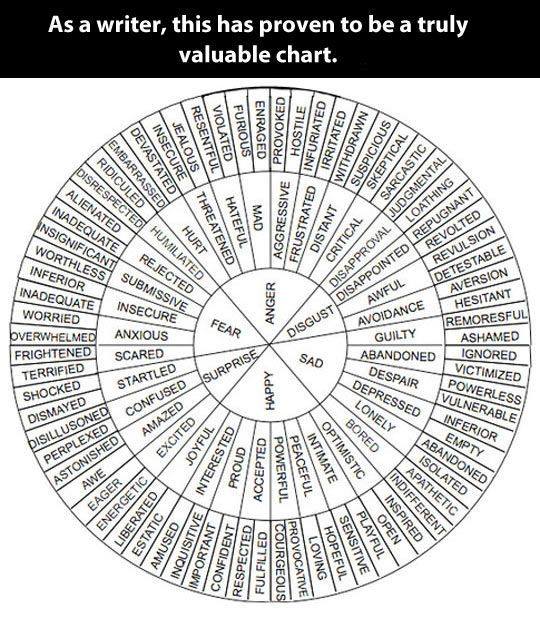
Writing tip Wednesday: “Wheel of Words”

A quick chart that might help if you get stuck.

A quick chart that might help if you get stuck.

Leave a comment

Filed under 2015, writing tip, Writing Tip Wednesday

Writing tip Wednesday: “Write for Yourself”

Want to Succeed in Self-Publishing? Write for Yourself: Tips from an Indie Author

by DRUCILLA SHULTZ

Source: http://www.publishersweekly.com/pw/by-topic/authors/pw-select/article/66636-want-to-succeed-in-self-publishing-write-for-yourself-tips-from-an-indie-author.html

KP Ambroziak 100dpi_3x4K.P. Ambroziak knows the sense of fulfillment and independence that going indie can bring. After self-publishing her vampire novel, The Journal of Vincent Du Maurier, Ambroziak received a positive review from Publishers Weekly, with our reviewer calling her book “fast-paced [and] suspenseful” and saying “science fiction and horror fans alike will anxiously race toward this journal’s end and eagerly request the next installment.”

Ambroziak has studied the indie market, but spends more time writing than promoting. The way she sees it, “without a good story, one that is polished and well-written, you’ve got nothing to sell.” Her response is also rooted in the fact that indie authors must fight against the stigma of “bad” writing. Still, Ambroziak says she was surprised by how good it felt to know someone had read her story. “The first review I received was unsolicited, and the thrill I felt at knowing I’d shared something intimate (my words) with someone (a stranger) was most surprising.”

We asked author K. P. Ambroziak if she had any tips for other self-published authors:

Mistakes are Part of the Process
“The lonely road of self-publishing has both advantages and disadvantages…For instance, you get to choose the cover page, decide if you agree with an edit, you get to name your book, pick your release date and whether there’ll be a second, third, or 11th book in your series. These can seem like daunting choices, but in fact they’re part and parcel of the road, and if you can embrace them, the control they offer bolsters up the whole of your self-publishing venture. You learn with each mistake you make, and self-publishing affords you the opportunity to correct those mistakes and apply them to future projects. Not knowing everything is a good thing.”

Write for Yourself

Reviews Aren’t Everything

Rest of the article: http://www.publishersweekly.com/pw/by-topic/authors/pw-select/article/66636-want-to-succeed-in-self-publishing-write-for-yourself-tips-from-an-indie-author.html

1 Comment

Filed under 2015, Writing Tip Wednesday, writing tips

Writing tip Wednesday: “10 Poignant Practices for Every Writer”

Here are 10 smart, yet simple ways for every writer—from novelists to journalists to poets—to enrich his or her mind and become better at cultivating ideas and putting them to the page.

Source: http://www.writersdigest.com/online-editor/10-poignant-practices-for-every-writer?et_mid=752210&rid=239626420

by MELISSA CLARK

1. Travel the world
Old, young, rich, poor, there are many ways to see the world, soak up other cultures, see examples of creativity in art, food, music, architecture. Lately, I’ve been applying to and attending artist residencies to work on my writing in other countries including Spain, Portugal and Mexico. Even if you’re only able to take a day trip, take it! Soak up any experience you can get that lives outside your day-to-day life.

2. Journal
Not just the “My boyfriend broke up with me” kind. (Though that’s fine, too.) Write down your thoughts, ideas, memories, draw pictures, and record dreams. There are many ways to journal including blogs, Pinterest, and various apps. Who knows what ideas the younger you has in store for the older you. You’ll never know if you don’t record them.

3. Be a student throughout your life
So many colleges and universities offer extension courses. I like taking classes outside of my writing interest and have taken Nude Figure Drawing, Ceramics, Anger Management and Stand-Up Comedy, among others. Ultimately, anything you learn can be useful to your writing.

4. Also be a teacher
I grew up in a family that supported my creativity, but many people don’t and they need a mentor to help them navigate the waters. I not only teach in colleges, but at unexpected places, too, like spas and retreats. I love meeting and being inspired by different types of students all over the country. Why not volunteer your time teaching writing to kids or the elderly? Everyone has a story. How wonderful if you’re able to help someone express theirs.

5. Realize that no idea is too big/small/silly/crazy
One afternoon at lunch with a friend I ate too much (as usual). When I lifted my shirt to show him my bloated belly, he said, “Are you sure you’re not pregnant?” and I said, “Yeah, right, from a lazy sperm!” This off-the-cuff comment inspired my first novel, “Swimming Upstream, Slowly,” about a woman who becomes pregnant from a lazy sperm. Silly? Absolutely! Published novel? That’s right! What ideas are you preventing from being realized because you think they are too big/small/silly/crazy?

Other tips include:

6. When you hear “no” do it anyway

7. Accept your shadow side

8. Invest in a good therapist

9. Forgive yourself

10. Practice gratitude

About Melissa Clark: Clark is an author, television writer and college instructor. She is the author of the novels, Bear Witness, Swimming Upstream, Slowly, and Imperfect. Her essay, “Rachael Ray Saved My Life” is included in the anthology The Cassoulet Saved Our Marriage.

She is also the creator of the animated television series, “Braceface,” starring the voice of Alicia Silverstone which aired on the ABC Family Channel. She has written scripts for “Rolie Polie Olie,” “Totally Spies,” “Sweet Valley High,” among others. Melissa teaches creative writing and literature courses both privately.

Complete entry at: http://www.writersdigest.com/online-editor/10-poignant-practices-for-every-writer?et_mid=752210&rid=239626420

1 Comment

Filed under 2015, Writing Tip Wednesday, writing tips

Wednesday writing tip: New Agent to consider

New Literary Agent Alert: Linda Camacho of Prospect Agency

Source: http://www.writersdigest.com/editor-blogs/guide-to-literary-agents/new-literary-agent-alert-linda-camacho-of-prospect-agency?et_mid=748601&rid=239626420#sthash.Zwys5wOi.dpuf

Linda Camacho

Linda Camacho

Linda joined Prospect Agency in 2015 after nearly a decade in publishing. After graduating from Cornell University, Linda interned at Simon & Schuster and Writers House literary agency, and worked at Penguin before happily settling into children’s marketing at Random House. She has an MFA in creative writing from the Vermont College of Fine Arts. Follow her on Twitter: @LindaRandom

In terms of submissions, Linda is pretty omnivorous. She enjoys a variety of categories and genres, ranging from clean and lighthearted to edgy and dark. She is currently seeking: Adult, middle grade, and young adult fiction across all genres (romance, horror, fantasy, realistic, light sci-fi, and graphic novels). Select literary fiction (preferably with commercial bent). Diversity of all types (ethnicity, disability, sexuality, etc.). Linda is NOT seeking: Early readers/chapter books, screenplays, poetry, and short stories.

Linda is currently accepting queries through Prospect Agency’s Submissions page: https://www.prospectagency.com/submissions.php. Please include three chapters and a brief synopsis. Do not query by email or letter mail and do not submit unsolicited manuscripts or inquire about the status of submissions via email.

Details at: http://www.writersdigest.com/editor-blogs/guide-to-literary-agents/new-literary-agent-alert-linda-camacho-of-prospect-agency?et_mid=748601&rid=239626420#sthash.Zwys5wOi.dpuf

1 Comment

Filed under 2015, writing tip, Writing Tip Wednesday

Writing tip Wednesday: “Ten tips for SEO”

Ten tips on good SEO writing

Source: http://www.geeksnack.com/2015/04/22/ten-tips-good-seo-writing/

Good SEO writing is much about writing skills and writing techniques. As a blogger, you need to know how to structure your text in subheadings and paragraphs. If your text is appealing and clear, you will attract the interest of your readers. They will gladly like, tweet, share and comment your content if they like it.

1. Think before writing – Good SEO writing tips

n order for your article to be highly ranked in Google search, you need to have writing skills. This means you need to think before you write. To think about what your readers will say after they read your article, what actions and reactions your article can cause. You should write down these answers before starting writing.

2. Arrange your ideas – Good SEO writing tips

You need to arrange your ideas in a logical manner, in every post you write. Some sorts of short introduction, a body where you will write the main ideas and a conclusion text, this structure is a very good and stable one, that normally attracts most readers. After that, you could start the real writing process.

3. Structure your paragraphs – Good SEO writing tips

You should be able to start new paragraphs according to some rules, not just because you consider it looks nicer for your text. Every paragraph should contain one main idea or subject. Paragraphs are important, so do not abuse their usage but also do not forget about them. Paragraphs are the most basic design for the text and readers can enjoy them or not.

4. Use subheadings – Good SEO writing tips

Your article should be organized in subheadings. They will lead your reader in a very quick and efficient way. Readers will be able to scan your text and to find more easily the necessary information for them.

5. Use signal words – Good SEO writing tips

Using signal words is also indicated, because they make readers to focus over the most important things. Words like also, first of all, nevertheless, indeed etc. are good choices in this respect.

Other tips include:

6. Proofread and test your article – Good SEO writing tips

7. Write longer posts – Good SEO writing tips

8. Update content – Good SEO writing tips

9. Inlink – Good SEO writing tips

10. Content is key – Good SEO writing tips

Read the rest: http://www.geeksnack.com/2015/04/22/ten-tips-good-seo-writing/

If you don’t know, SEO stands for Search Engine Optimization.

1 Comment

Filed under 2015, Writing Tip Wednesday, writing tips