Tag Archives: William Shakespeare

Archaeology Is Revealing New Clues About Shakespeare’s Life (And Death)

New technology is helping archaeologists uncover details of the playwright’s home, workplaces and his final resting place.

The Conversation

  • William Mitchell

https://getpocket.com/explore/item/william-shakespeare-archaeology-is-revealing-new-clues-about-the-bard-s-life-and-death?utm_source=pocket-newtab

Waxwork of Shakespeare by Madame Tussauds in Berlin. Photo from Anton Ivanov via Shutterstock.

William Shakespeare is widely regarded as one of the greatest authors of all time and one of the most important and influential people who has ever lived. His written works (plays, sonnets and poems) have been translated into more than 100 languages and these are performed around the world.

There is also an enduring desire to learn more about the man himself. Countless books and articles have been written about Shakespeare’s life. These have been based primarily on the scholarly analysis of his works and the official record associated with him and his family. Shakespeare’s popularity and legacy endures, despite uncertainties in his life story and debate surrounding his authorship and identity.

The life and times of William Shakespeare and his family have also recently been informed by cutting-edge archaeological methods and interdisciplinary technologies at both New Place (his long-since demolished family home) and his burial place at Holy Trinity Church, Stratford-upon-Avon. The evidence gathered from these investigations by the Centre of Archaeology at Staffordshire University provides new insights into his interests, attitudes and motivations – and those of his family – and shows how archaeology can provide further tangible evidence. These complement traditional Shakespearean research methods that have been limited to sparse documentary evidence and the study of his works.

Archaeology has the ability to provide a direct connection to an individual through the places and objects associated with them. Past excavations of the Shakespearean-era theatres in London have provided evidence of the places he worked and spent much of his time.

Attributing objects to Shakespeare is difficult, we have his written work of course, his portrait(s) and memorial bust – but all of his known possessions, like those mentioned in his will, no longer exist. A single gold signet ring, inscribed with the initials W S, is thought by some to be the most significant object owned and used by the poet, despite its questionable provenance.

Shakespeare’s House

Shakespeare’s greatest and most expensive possession was his house, New Place. Evidence, obtained through recent archaeological investigations of its foundations, give us quantifiable insights into Shakespeare’s thought processes, personal life and business success.

The building itself was lost in the 18th century, but the site and its remains were preserved beneath a garden. Erected in the centre of Stratford-upon-Avon more than a century prior to Shakespeare’s purchase in 1597, from its inception, it was architecturally striking. One of the largest domestic residences in Stratford, it was the only courtyard-style, open-hall house within the town.

This type of house typified the merchant and elite classes and in purchasing and renovating it to his own vision, Shakespeare inherited the traditions of his ancestors while embracing the latest fashions. The building materials used, its primary structure and later redevelopment can all be used as evidence of the deliberate and carefully considered choices made by him and his family.

Shakespeare focused on the outward appearance of the house, installing a long gallery and other fashionable architectural embellishments as was expected of a well-to-do, aspiring gentleman of the time. Many other medieval features were retained and the hall was likely retained as the showpiece of his home, a place to announce his prosperity, and his rise in status.

It provided a place for him and his immediate and extended family to live, work and entertain. But it was also a place which held local significance and symbolic associations. Intriguingly, its appearance also resembled the courtyard inn theatres of London and elsewhere with which Shakespeare was so familiar, presenting the opportunity to host private performances.

In Search of the Bard

Extensive evidence of the personal possessions, diet and the leisure activities of Shakespeare, his family and the inhabitants of New Place were recovered during the archaeological investigations, revolutionising what we understand about his day-to-day life.

An online exhibition, due to be made available in early May 2020, presents 3D-scanned artefacts recovered at the site of New Place. These objects, some of which may have belonged to Shakespeare, have been chosen to characterise the chronological development and activities undertaken at the site.

Open access to these virtual objects will enable the dissemination of these important results and the potential for others to continue the research.

Here Lies …

Archaeological evidence recovered from non-invasive investigations at Shakespeare’s burial place has also been used to provide further evidence of his personal and family belief. Multi-frequency Ground Penetrating Radar (GPR) was used to investigate the Shakespeare family graves below the chancel of Holy Trinity Church.

A number of legends surrounded Shakespeare’s burial place. Among these were doubts over the presence of a grave, its contents, tales of grave robbing and suggestions of a large family crypt. The work confirmed that individual shallow graves exist beneath the tombstones and that the various members of Shakespeare’s family were not buried in coffins, but in simple shrouds. Analysis concluded that Shakespeare’s grave had been disturbed in the past and that it was likely that his skull had been removed, confirming recorded stories.

These family graves occupy a significant (and expensive) location in Holy Trinity Church. Despite this, the simple nature of Shakespeare’s grave, with no elite trappings or finery and no large family crypt, coupled with his belief that he should not be disturbed, confirm a simple regional practice based on pious religious observance and an affinity with his hometown.

There is still so much we don’t know about Shakespeare’s life, so it’s a safe bet that researchers will continue to investigate what evidence there is. Archaeological techniques can provide quantifiable information that isn’t available through traditional Shakespearean research. But just like other disciplines, interpretation – based on the evidence – will be key to unlocking the mysteries surrounding the life (and death) of the English language’s greatest writer.

William Mitchell is a Lecturer in Archaeology at Staffordshire University.
Leave a comment

Filed under 2020, author, author profile

To Be or Not to Be Insulting

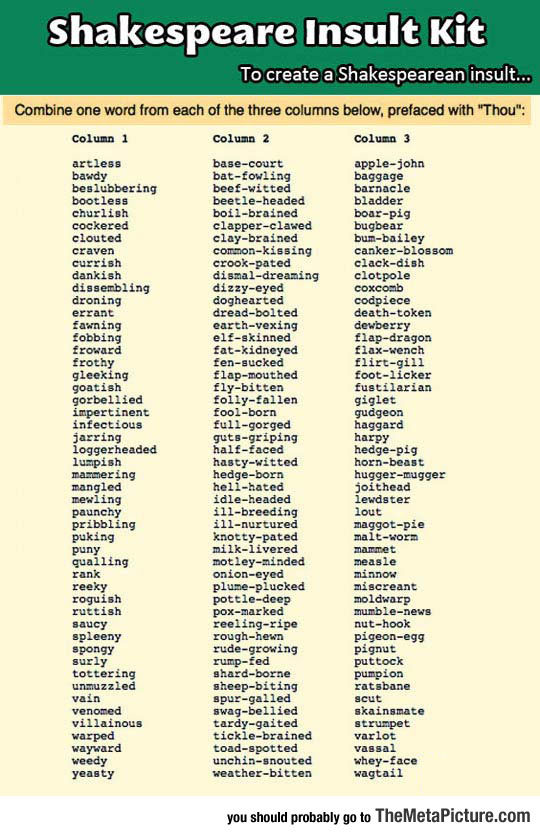
Shakespeare Insult Kit

Leave a comment

December 15, 2018 · 11:58 pm

Words and phrases from the Bard

Words and phrases we owe to Shakespeare. Born around this time in April in 1564.

Words and phrases we owe to Shakespeare. Born around this time in April in 1564.

Leave a comment

Filed under 2016, word play, words, Words to live by

Writing tip Wednesday: “Giving books”

Giving the gift of writing takes on many forms.

Giving the gift of writing takes on many forms.

Wait, you may say. How is giving books a writing tip? you may ask.

Answer: You can’t take the reading side of the relationship between writer and reader for granted. You have to help “grow the market,” as it is called in marketing-speak today. With all the options available to occupy people’s dwindling free time, you can’t assume books are the first thing somebody thinks of. In short, if you want people to read your work, you have to help make sure they are reading.

Below is the opening of an article by Alanna Okun. The title of the article is “Books to Give as Gifts for Every Occasion.” You may not agree with all the selections made in the article, and that’s okay. I didn’t. But if you aren’t giving books as gifts, how can you expect others to give yours as a gift?

GRADUATION

The Elements of Style, by Strunk & White

Bonus points if it’s the version of this classic that’s illustrated by the luminous Maira Kalman; that’ll make it feel more like a keepsake and less like a standard-issue textbook (albeit a wonderful one) on the first day of sophomore English Lit.

This Is Water, by David Foster Wallace

This legendary speech was given by the late David Foster Wallace at Kenyon College and contains the kind of simple yet staggeringly important advice that any high school/college/grad school student/actually human, in general, would benefit from thinking about for at least a few minutes.

“It is,” the speech ends, “about simple awareness — awareness of what is so real and essential, so hidden in plain sight all around us, that we have to keep reminding ourselves, over and over: ‘This is water, this is water.’”

For illustrations and more suggestions, go to http://www.buzzfeed.com/alannaokun/books-to-give-as-gifts-for-every-occasion

2 Comments

Filed under Writing Tip Wednesday

Writing tip Wednesday: To name or not to name

“What’s in a name? that which we call a rose
By any other name would smell as sweet;
So Romeo would, were he not Romeo call’d,
Retain that dear perfection which he owes
Without that title. Romeo, doff thy name,
And for that name which is no part of thee
Take all myself.”
–Juliet from the play Romeo and Juliet by William Shakespeare

If Shakespeare received a nickel for every time he was quoted, he’d be able to rebuild The Globe Theatre many times over. He might even make Donald Trump envious. But that is a story for another time.

A few thoughts on naming your characters. I have known writers who called their protagonist “X” or “Mrs. Y” throughout the draft of a story or novel, because they weren’t sure what to call him or her.

Man in space suit

A character’s name can help ground her in your story’s world, no matter where that world is.

Who knows, if really stuck for a name or if your story is Kafkaesque, you might be able to use only a letter for the character’s name. But most of the time that won’t work.

Still, there are no etched-in-stone rules for naming characters, but here are a few suggestions. By no means are these all inclusive suggestions.

    1) The first name you come up with is not unalterable. Until a story or novel is accepted for publication, you can change the name. So, if you have trouble picking out names, maybe the first thing to do is relax. The mystery writer, Robert B. Parker had originally named his private detective David Spenser, but at the last minute decided to pull the first name, because he had two sons, one named David, and he didn’t want to possibly offend his other son by not have a character named after him. So, David Spenser became Spenser, with two “S’s,” like the poet.

    2) If you write in a particular genre, consider if the protagonist’s names have a certain “form” or “rhythm” to them. Turning to the detective fiction genre again, for many years the protagonists always had last names that implied the type of work they did. For example, in The Maltese Falcon, the private eye protagonist’s name was Sam Spade. Spade is a tool for digging. Private eye’s dig up information. Other examples include Mickey Spillane’s Mike Hammer and Ross MacDonald’s Lew Archer. By the way, Lew Archer was also Sam Spade’s partner in The Maltese Falcon. Archer was killed early on, so I guess Ross MacDonald decided to use the name since Dashiell Hammett wasn’t going to use it any more.

    3) Names can reflect part of a characters personality or indicate social strata. For example, a woman named Bunny could be somebody who comes from a well to do family. Or a family that doesn’t but wants to think it does. The other end of the scale would be naming a character Huckleberry as in Huckleberry Finn, the protagonist is the novel about the adventures of this character whose mother is dead and whose father is a drunken illiterate.

Another example might be Mrs. Kitty Warren in George Bernard Shaw’s play Mrs. Warren’s Profession. Warren as a word means a place where rabbits bread or live. It can also mean a building housing many renters in crowded rooms. Mrs. Kitty Warren is a woman who has made her way in the world by being a brothel owner. In this case, both the first name, “Kitty” and the last name “Warren” hint at least part of the nature of the character.

Remember, unlike most of us, who are “stuck” with the names our parents gave us, the names in novels, stories, plays, and other forms of writing can be changed and can be used to help round out your protagonists (and other characters) or hint at aspects of their natures.

Some sources to consider are dictionaries of first names and what those names mean. For example, Eugene means “well born.”There are even some books that talk about the meaning’s of last names. Or, as in the case of Warren above, even a good standard dictionary can help you.

So, while Juliet is correct when she says:
“Thou art thyself, though not a Montague.
What’s Montague? it is nor hand, nor foot,
Nor arm, nor face, nor any other part
Belonging to a man.”

A name – the name you select for your protagonist – can be just as important as a hand or foot, arm or face. It is, after all, a part of that character.

Leave a comment

Filed under character naming, writing tip, Writing Tip Wednesday