Tag Archives: Wednesday

Writing tip Wednesday: “Elmore Leonard says…”

From Elmore Leonard’s Ten Rules of Writing.

http://www.elmoreleonard.com/index.php

  1. Never open a book with weather. If it’s only to create atmosphere, and not a charac­ter’s reaction to the weather, you don’t want to go on too long. The reader is apt to leaf ahead look­ing for people. There are exceptions. If you happen to be Barry Lopez, who has more ways than an Eskimo to describe ice and snow in his book Arctic Dreams, you can do all the weather reporting you want.
  2. Avoid prologues: they can be ­annoying, especially a prologue ­following an introduction that comes after a forward. But these are ordinarily found in
    Elmore Leonard

    Elmore Leonard

    non-fiction. A prologue in a novel is backstory, and you can drop it in anywhere you want. There is a prologue in John Steinbeck’s Sweet Thursday, but it’s OK because a character in the book makes the point of what my rules are all about. He says: “I like a lot of talk in a book and I don’t like to have nobody tell me what the guy that’s talking looks like. I want to figure out what he looks like from the way he talks.”
  3. Never use a verb other than “said” to carry dialogue. The line of dialogue belongs to the character; the verb is the writer sticking his nose in. But “said” is far less intrusive than “grumbled,” “gasped,” “cautioned,” “lied.” I once noticed Mary McCarthy ending a line of dialogue with “she asseverated” and had to stop reading and go to the dictionary.
  4. Never use an adverb to modify the verb “said” … he admonished gravely. To use an adverb this way (or almost any way) is a mortal sin. The writer is now exposing himself in earnest, using a word that distracts and can interrupt the rhythm of the exchange. I have a character in one of my books tell how she used to write historical romances “full of rape and adverbs.”
  5. Keep your exclamation points ­under control. You are allowed no more than two or three per 100,000 words of prose. If you have the knack of playing with exclaimers the way Tom Wolfe does, you can throw them in by the handful.
  6. Never use the words “suddenly” or “all hell broke loose.” This rule doesn’t require an explanation. I have noticed that writers who use “suddenly” tend to exercise less control in the application of exclamation points.
  7. Use regional dialect, patois, sparingly. Once you start spelling words in dialogue phonetically and loading the page with apos­trophes, you won’t be able to stop. Notice the way Annie Proulx captures the flavor of Wyoming voices in her book of short stories Close Range.
  8. Avoid detailed descriptions of characters, which Steinbeck covered. In Ernest Hemingway’s “Hills Like White Elephants,” what do the “Ameri­can and the girl with him” look like? “She had taken off her hat and put it on the table.” That’s the only reference to a physical description in the story.
  9. Don’t go into great detail describing places and things, unless you’re ­Margaret Atwood and can paint scenes with language. You don’t want descriptions that bring the action, the flow of the story, to a standstill.
  10. Try to leave out the part that readers tend to skip. Think of what you skip reading a novel: thick paragraphs of prose you can see have too many words in them.

My most important rule is one that sums up the 10: if it sounds like writing, rewrite it.
Leave a comment

Filed under 2016, writing tip, Writing Tip Wednesday

Writing tip Wednesday: “Guidance from an author”

Neil Gaiman

http://www.neilgaiman.com/

  1. Write.
  2. Put one word after another. Find the right word, put it down.
  3. Finish what you’re writing. Whatever you have to do to finish it, finish it.
  4. Put it aside. Read it pretending you’ve never read it before. Show it to friends whose opinion you respect and who like the kind of thing that this is.
  5. Remember: when people tell you something’s wrong or doesn’t work for them, they are almost always right. When they tell you exactly what they think is wrong and how to fix it, they are almost always wrong.
  6. Fix it. Remember that, sooner or later, before it ever reaches perfection, you will have to let it go and move on and start to write the next thing. Perfection is like chasing the horizon. Keep moving.
  7. Laugh at your own jokes.
  8. The main rule of writing is that if you do it with enough assurance and confidence, you’re allowed to do whatever you like. (That may be a rule for life as well as for writing. But it’s definitely true for writing.) So write your story as it needs to be written. Write it ­honestly, and tell it as best you can. I’m not sure that there are any other rules. Not ones that matter.

Leave a comment

Filed under 2016, writing tip, Writing Tip Wednesday

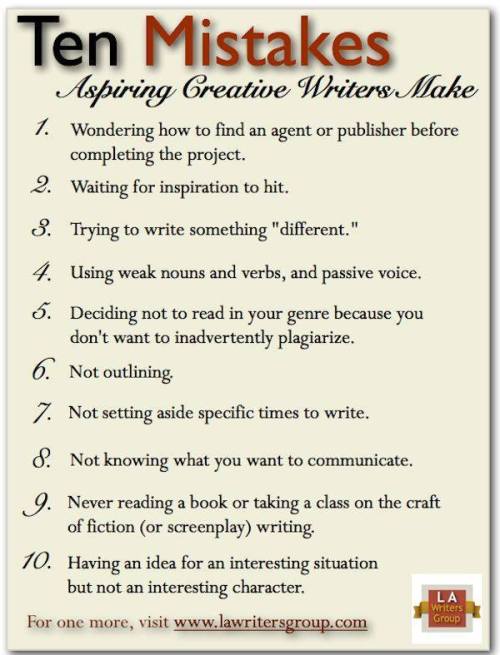
Writing tip Wednesday: “Ten to avoid”

Some may be easier to avoid than others. For more tips, go to www.lawritersgroup.com.

Some may be easier to avoid than others. For more tips, go to www.lawritersgroup.com.

Leave a comment

Filed under 2016, writing tip, Writing Tip Wednesday

Writing tip Wednesday: “Scholarship to Killer Nashville”

Write your ticket to the conference

KillerNashville

Killer Nashville has been expanding each year and become one of the premiere events on the calendar for crime fiction fans. This year, organizers are offering two scholarship opportunities for writers who want to attend but may not have the financial means. Winners will receive funds towards registration, breakout sessions, writing critique sessions, and lodging. If you’re interested in either the Lisa Jackson Scholarship or Jimmy Loftin Memorial Scholarship, write a 500-word essay that describes your financial need and why you’d like to attend the conference. Anyone is eligible to enter (traditionally or independently published or unpublished). Deadlines: apply by July 1 for the Jackson award and July 31 for the Loftin award.

Killer Nashville takes place August 18-21, 2016, and is being held at the Embassy Suites Nashville South Cool Springs. This year’s Guest of Honors are Janet Evanovich and Kevin O’Brien, with other featured guests to include 2016 John Seigenthaler Recipient Robert Randisi as well as Anne Perry and William Kent Krueger. Registration is open for anyone wanting to attend.

There is a discounted conference fee for members of Sisters in Crime and Mystery Writers of America.

Leave a comment

Filed under 2016, writing tip, Writing Tip Wednesday

Writing tip Wednesday: “Try this at home”

Unable to get started writing. Try this suggestion from well-known writer William F. Nolan:

You sit frozen at the keys. Just can’t begin writing, How to break free again, start the words flowing? You need something to ignite the creative spark. Well, people, I have one sure solution to your problem. Get up. Go to a bookshelf, take out a collection of stories’ pick one — and read the first half of a chosen story. Stop. Then write your own end half, using elements from the printed first half. Then go back to the first half of the printed story, and write your own version of the first half. Presto! You have a brand new tale! Sure, you can’t sell it since it has the plot and characters from the original printed story, but it got you going again, right? Got the creative juices flowing. Now you’ll be able to take off on a story of your own. Works every time.

William F. Nolan

Leave a comment

Filed under 2016, writing tip, Writing Tip Wednesday

Writing tip Wednesday: “Agent to consider”

New Literary Agent Alert: Amanda Jain of Inklings Literary

http://www.writersdigest.com/editor-blogs/guide-to-literary-agents/new-literary-agent-alert-amanda-jain-of-inklings-literary?utm_source=newsletter&utm_campaign=wds-csa-nl-160421&utm_content=838292_GLA160421&utm_medium=email

Amanda Jain

Amanda Jain

About Amanda: After earning a BA in English, Amanda worked in the trade department at W.W. Norton for seven years before leaving to pursue graduate studies. She graduated in 2011 with a MA in the history of decorative arts. Amanda then joined Inklings Literary in 2014, first as Michelle’s assistant. She is now building her client list. Find her on Twitter.

She is seeking: historical fiction (in all genres), women’s / book club / upmarket fiction, romance (particularly historical, suspenseful, or with a comedic bent), mysteries (particularly historical or cozy, or historical cozies), and narrative nonfiction in the areas of social history, archaeology, art history, material culture, etc. She is also interested in select young adult and middle grade projects with unique hooks and a strong voice.

In all cases, what Amanda is most looking for is a story that completely immerses the reader in the world of the book. She wants to feel the sun on her shoulders, smell the smoke of the battlefield, and hear the horses galloping in the distance. Amanda is NOT the agent to query with picture books, memoirs, self-help, poetry, erotica, science fiction and fantasy, horror, or inspirational fiction.

How to submit: To e-query, type “Query (Agent Name): (Book Title)” in the subject line to query(at)inklingsliterary(dot)com. No attachments. In the body of the email, send a query letter that includes :the title, genre, and word count of your project, a brief blurb about the story, a brief bio including any publishing credits, the first 10 pages of your manuscript, and a brief synopsis (1-2 pages). “Our response time varies for queries, but the general response time is within 3 months for queries, and 4 months for manuscripts. If you have not received an answer for your query after 3 months,” the agency is not interested in the project.

Leave a comment

Filed under 2016, writing tip, Writing Tip Wednesday

Writing tip Wednesday: “Agent to consider”

New Literary Agent Alert: Kelly Peterson of Corvisiero Literary

Source: http://www.writersdigest.com/editor-blogs/guide-to-literary-agents/new-literary-agent-alert-kelly-peterson-of-corvisiero-literary?utm_source=newsletter&utm_campaign=wds-csa-nl-160421&utm_content=838292_GLA160421&utm_medium=email

Kelly Peterson

Kelly Peterson

About Kelly: Kelly is a junior agent at Corvisiero Literary. Kelly has spent her whole life with a book in her hands. Whether it’s from reading, writing, or day dreaming, her mind has always been up in the clouds wishing her fantasy stories would come true. Down on earth, somewhere between reading during science class, writing while she should be sleeping, and spending her social hours pretending she wasn’t actually a closet nerd, she finally realized that her life would be a lot happier if she just accepted her love of books. A graduate of West Chester University, she earned her B.S.Ed. in English and went to pursue a career in teaching. Little did she know that despite all of her hard work, the environment she ended up in would be one she disliked. After taking a step back and reassessing her life, she realized that maybe she should have focused on the world of literary agents and publishing a long time ago.

She is seeking:

  • Middle Grade: Fantasy, Paranormal, Sci-fi.
  • Young Adult: Fantasy (all sub genres of fantasy accepted), Steampunk, Sci-Fi, Paranormal, Historical (19th century and earlier with strong heroines), Dystopian (hold the cyborgs, the scorch, and diseases, please), Sword and Sorcery, a very selective few for Contemporary Romance, and any combination of the above with strong, female main characters.
  • New Adult: Fantasy, Paranormal, Romance (Cowboys, anyone? Sexy and somewhat geeky entrepreneur? Celebrity? Yes?), Historical Romance, or any combination of the above.
  • Adult Fiction: Fantasy, Romance.

Her truest passion is for YA Fantasy. More recently, Steampunk has quickly crept up the charts in her heart as well.

With books, there’s just something about strong female main characters holding their own against the world, in an environment that Kelly could never, in her wildest dreams, find herself living within. It tears at her heart and pulls at her soul, especially when the main character finds that she never needed another to complete her in the first place.

She is not seeking Nonfiction, Emotional Turmoil, Mystery/Crime, Children’s Picture Books.

How to submit: query [at] corvisieroagency.com. Then address your Query to a specific agent, using the phrase “Query for [Agent Name]: [Name of Submission]” in the Subject Line. “For fiction, we require a query letter pasted into the body of your email along with a 1-2 page synopsis (that includes spoilers and the ending) and the first 5 pages of your manuscript either attached as 2 separate Word .doc files or pasted into the Query email.” There are more guidelines here.

Leave a comment

Filed under 2016, writing tip, Writing Tip Wednesday

Writing tip Wednesday: “Conflict”

Conflict is the difference between expectation and result.

Conflict is the difference between expectation and result.

Leave a comment

Filed under 2016, writing tip, Writing Tip Wednesday

Writing tip Wednesday: “Don’t say this at home”

"Said" or "asked" is usually enough. As in Mike said or Beth asked.

“Said” or “asked” is usually enough. As in Mike said or Beth asked.

Leave a comment

Filed under writing tip, Writing Tip Wednesday

Stephen King on writing

Stephen King Used These 8 Writing Strategies to Sell 350 Million Books
The best-selling novelist shares his secrets to selling so many books.

by Glenn Leibowitz

Source: http://www.inc.com/glenn-leibowitz/8-simple-writing-strategies-that-helped-stephen-king-sell-350-million-books.html

Stephen King is one of the most prolific and commercially successful authors of the past half century, with more than 70 books of horror, science fiction, and fantasy to his name. Estimates put the total sales of his books at between 300 and 350 million copies.

Stephen King

Author offers advice.

16 years ago, King shared everything he knows about writing in a book that instantly became a bestseller: On Writing: A Memoir of the Craft. Part memoir, part codification of his best writing strategies, the book has become a classic among writers.

I discovered – and devoured – it a dozen years ago, when I was trying to take my writing to the next level. I recommend it to all of my writer friends.

You don’t have to be a fan of King’s writing to appreciate the wisdom within the pages of this book. Nor do you have to be a novelist: The book has highly practical strategies that writers of nonfiction can immediately apply to their writing.

Here are eight writing strategies King shares that have helped him sell 350 million books:

1. Tell the truth.

“Now comes the big question: What are you going to write about? And the equally big answer: Anything you damn well want. Anything at all… as long as you tell the truth… Write what you like, then imbue it with life and make it unique by blending in your own personal knowledge of life, friendship, relationships, sex, and work… What you know makes you unique in some other way. Be brave.”

2. Don’t use big words when small ones work.

“One of the really bad things you can do to your writing is to dress up the vocabulary, looking for long words because you’re maybe a little bit ashamed of your short ones. This is like dressing up your household pet in evening clothes.”

3. Use single-sentence paragraphs.

“The object of fiction isn’t grammatical correctness but to make the reader welcome and then tell a story… to make him/her forget, whenever possible, that he/she is reading a story at all.

The single-sentence paragraph more closely resembles talk than writing, and that’s good. Writing is seduction. Good talk is part of seduction. If not so, why do so many couples who start the evening at dinner wind up in bed?”

4. Write for your Ideal Reader.

“Someone – I can’t remember who, for the life of me – once wrote that all novels are really letters aimed at one person. As it happens, I believe this.

I think that every novelist has a single ideal reader; that at various points during the composition of a story, the writer is thinking, ‘I wonder what he/she will think when he/she reads this part?’ For me that first reader is my wife, Tabitha… Call that one person you write for Ideal Reader.”

5. Read a lot.

“Reading is the creative center of a writer’s life. I take a book with me everywhere I go, and find there are all sorts of opportunities to dip in. The trick is to teach yourself to read in small sips as well as in long swallows. Waiting rooms were made for books – of course! But so are theater lobbies before the show, long and boring checkout lines, and everyone’s favorite, the john.”

6. Write one word at a time.

“In an early interview (this was to promote Carrie, I think), a radio talk-show host asked me how I wrote. My reply – ’One word at a time’– seemingly left him without a reply. I think he was trying to decide whether or not I was joking. I wasn’t. In the end, it’s always that simple.”

7. Write every day.

“The truth is that when I’m writing, I write every day, workaholic dweeb or not. That includes Christmas, the Fourth, and my birthday (at my age you try to ignore your goddam birthday anyway)… When I’m writing, it’s all the playground, and the worst three hours I ever spent there were still pretty damned good.”

8. Write for the joy of it.

“Yes, I’ve made a great deal of dough from my fiction, but I never set a single word down on paper with the thought of being paid for it… Maybe it paid off the mortgage on the house and got the kids through college, but those things were on the side – I did it for the buzz. I did it for the pure joy of the thing. And if you can do it for joy, you can do it forever.”


Leave a comment

Filed under 2016, Uncategorized, writing tip, Writing Tip Wednesday