
Tag Archives: Wednesday
Writing tip Wednesday: “Write better Villains”
How to Write Better Villains: 5 Ways to Get Into the Mind of a Psychopath
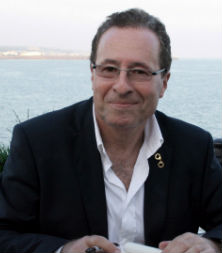
By Peter James
1. Where to find a psychopath who will talk to you – the importance of meeting your monster.
Over my years of research for my Roy Grace mystery novels I’ve given many talks in prisons for the charity, The Reading Agency, which encourages literacy in UK prisons, as it gives me the opportunity to meet many different kinds of criminal face to face.
I had been wanting to write about a female “black widow” character for some time, and had been studying past cases, and thinking hard about creating a convincing character. Three years ago I was talking in a women’s prison and there was a well-spoken middle-aged woman in the audience who was asking particularly smart questions about literature. She fascinated me, being clearly well educated and I wondered what crime she had committed. Perhaps she killed someone drunk driving, or something like that, I wondered?
 One big perk of my talks is that I get to mingle with the prisoners after and chat to them one-on-one. I made a beeline for her. I never ask a prisoner outright what they have done – it’s not proper etiquette! So as an icebreaker I said, ‘How much longer do you have to serve?’
She replied, in a booming voice, ‘Nine and a half more bloody years – and it’s just not fair! A woman did exactly what I did, in London, and she’s only got six more years to go.’
‘So, what brought you in here?’ I asked, somewhat startled.
‘I poisoned my mother-in-law, the old bag!’
‘OK,’ I replied, somewhat astonished. Then she went on.
‘The thing was, she went into hospital to die, so I embezzled her bank account. Then the bloody woman didn’t die – she came home. I realized she would find out so I had to poison her. Then I realized my husband would find out so I had to poison him, too. And it’s just not fair – this woman in London did exactly what I did and she’s only got six more years!’
As I was being taken back out by a prison officer I said to him, ‘Is this woman for real?’
‘Oh yes sir, he replied. ‘Her husband was three months on life support and he has permanent brain damage – and she’s just angry about the length of her sentence…’
I knew at once I had found my character for Love You Dead!
2. Make your monsters lovable.
If you think about the most endearing – and enduring – characters in the history of literature they are the ones that are not simply portrayed as black and white evil, but with shades of coloring. Think about Dracula – he is a monster but he has huge charisma and charm. Frankenstein’s monster turns to his creator, Dr Frankenstein and tells him he never wanted to be born. Hannibal Lecter, perhaps the most success monster in all of modern literature, is enormously charming, charismatic, he has style and people find themselves rooting for him, despite knowing just how utterly evil he really is.
3. Avoid stereotypes. A psychopath isn’t always a man in black in a dark alley with a sharp knife.
It may be a surprise to some people, but yes, there really are good psychopaths as well as bad ones. Or perhaps, paraphrasing from George Orwell’s Animal Farm, puts it into better perspective: Some psychopaths are less evil than others. He could be a past or a President of the United States? The CEO of a Fortune 100 company? Being a psychopath is the best qualification to get you to the top of a chosen path in life, but the worst to have once you are there: The reason most serial killers get away with it so long is that they are bright and cunning – and often total chameleons, able to blend into society. Ted Bundy, America’s worst to date is a classic example. A good-looking, charismatic former law student, estimated to have killed and raped over 100 young women. But it’s not just a good qualification if you want to be a serial killer, it’s a great one if you want to become a captain of industry or a top politician. The combination of charm, intelligence and utter ruthlessness is potent. The psychopath is capable of saying anything just to get to the top – how many politicians do we all know who’ve said totally opposing things many times during their climb up the greasy pole. But ultimately it is hubris that can be their downfall because their lack of empathy means they fail to read the warning signs. President Richard Nixon is a classic; Idi Amin; Saddam Hussein; Gadhafi. And how many CEOs of major companies, like Bernie Madoff and the late Robert Maxwell?
4. How to come up with a well-developed backstory for your psychopathic character.
Some years ago I spent a day at Broadmoor, the UK’s premier high-security psychiatric hospital. It took me a year before my request was accepted, but it was worthwhile because what I saw and learned there has helped me with so many subsequent characters. The qualification for admission to Broadmoor is, essentially, to be violently criminally insane. I asked the resident chaplain if he felt that there were some people who were born evil, or did something happen in their lives to turn them that way?
He replied that the inmates were divided roughly 50/50 into schizophrenics and psychopaths. Schizophrenia was a chemically treatable mental illness, and provided they took their medication, around 70% of the inmates in this category could eventually go back into the world and live ordinary lives. But for the psychopaths, it was very different.
He explained a psychopath is likely to first present symptoms at around the age of four. The majority is male but there are female ones also – as we will see. The earliest signs are likely to be a lack of empathy and no real sense of a moral code of right or wrong. A boy steals his best friend’s favourite toy – with absolutely zero guilt. He will also from an early age be an accomplished liar – and rarely found out.
The psychopath brought up in a loving, stable family may well go on to become a hugely successful businessman or politician. But the one brought up in a broken home, or a violent, abusive situation, is likely to become dangerously warped. Many serial killers come from such latter backgrounds, as did Adolf Hitler who had a bullying father who would not let him pursue the career as a painter he wanted in life.
5. Talk through any major villain you are creating with a forensic psychiatrist or psychologist.
I was chatting at lunch with former armed serial bank robber, and self-confessed psychopath, Steve Tulley. As a teenager in prison, for his first robbery, he met criminal legend Reggie Kray, and persuaded him to let him be his pupil and teach him everything he knew. At 58, broke, Tulley is living in a bedsit in Brighton and has spent more of his life in jail than free. I asked him what was the largest sum he had ever got away with. He told me it was £50k in a bank job. So what did he do with the money? He replied, excitedly that he’d rented a suite in Brighton’s Metropole Hotel and, in his words, ‘Larged it for six months until it was all gone.”
I asked Steve if he had the chance to live his life over again would he have done it differently? ‘No,’ he replied with a gleam in his eyes. ‘I’d do it all again. It’s the adrenaline, you see!’
From subsequently talking to forensic psychiatrists and psychologists, I’ve learned that this “adrenaline” buzz that Steve talks of goes hand-in-hand, with some criminals, with the ruthless, chaotic, hand-to-mouth existence they lead. One of the most chilling things I ever saw was the police video of Dennis Rader – the BTK Strangler– confessing. When asked why he had bound, tortured and killed – horrifically – his victims he replied, simply and matter-of-factly, ‘It was erotic, I got a buzz from it.”
Filed under 2017, writing tip, Writing Tip Wednesday, writing tips
Writing tip Wednesday: “New agent to consider”
Quressa Robinson of D4EO Literary
 About Quressa: Quressa Robinson joined the D4EO Literary Agency in 2016 and is actively building her client list. Quressa was an acquiring editor at St. Martin’s Press, where she edited both fiction and nonfiction. Her acquisitions include Certain Dark Things (a Publishers Weekly Fall Announcement Top 10 Pick and October B&N Staff Pick) and The Beautiful Ones—both by Locus, World Fantasy, Sunburst, and Aurora Award-nominated author Silvia Moreno-Garcia; Spells of Blood and Kin (which received a starred PW review) by Claire Humphrey; and The Atlas of Forgotten Places by Jenny D. Williams, among others.
She is seeking: Science fiction/fantasy (including speculative/magical realism), nonfiction (celebrity, pop culture, pop science), upmarket and commercial women’s fiction, historical fiction, family sagas, contemporary young adult, and science fiction/fantasy young adult crossover. “I am particularly interested in OwnVoices and inclusive narratives. Genre bending is also great, i.e. epic fantasy romance or upmarket fantasy.”
How to submit: Send all queries to quressa@d4eo.com. Include the first fifty pages of your novel or full proposal and sample chapters as a Word attachment. If the submission is a simultaneous submission, please indicate that in your query. E-mail queries only.
Filed under 2017, writing tip, Writing Tip Wednesday
Writing tip Wednesday: “New Agent to consider”
Paula Munier of Talcott Notch Literary
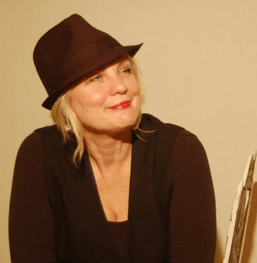 Paula Munier (Talcott Notch Literary)
Notes: “High concept only.”
How to submit: E-query editorial [at] talcottnotch.net with “Query for Paula: [title]” in the subject line.
From their query page http://www.talcottnotch.net/index.php/queries:
What should an ideal query include?
Fiction
Your fiction query should include your genre, such as mystery, science fiction or mainstream, whether the project is for adults or for children, and the length of the complete project in number of words (for example, 86,000 words), not pages. The query should give us a brief overview of the book’s plot and main characters, but does not have to include a complete synopsis. For first-time authors, we do prefer that the project be complete before you query us.
Nonfiction
Your nonfiction query should include your subject area, such as history, biography or business, the main concept of the book, the word count you project the book will be when completed, and your credentials to write the work. Unlike many first novels, many first nonfiction projects do not require that the book be finished before it can be marketed successfully, and we’ll be looking to see that the book proposal and a sample chapter is available here instead. Let us know how long you feel you will take to complete the book. Be realistic with your estimations. It doesn’t matter if you give us an estimate that sounds good if you cannot deliver the book on that date.
Things that Make a Query Stand Out
Hook us in your first paragraph. What’s the most outstanding aspect of your book? Is it your characters’ conflict? Is it your protagonist’s background? Is it the completely surprising revelation you uncovered in your research for your new health book? Don’t assume that you have your entire query to get to your point. If you don’t hook your reader with your opening, your query could get pushed aside.
Show you know your market. Nothing says you haven’t given this a thought better than saying your book is for readers 8-80. But if you say your book is YA and would appeal to readers of two specific writers (particularly if they simply aren’t the two best-known at the moment!) and can even list reasons why, then you’re getting warm.
Don’t forget your ten pages. We ask specifically for the first ten pages of the manuscript and without those, we have to make a decision based solely on the query. Perhaps your query letter isn’t your strongest point, and your voice in your manuscript is amazing? Don’t lose out on the chance to convince us! Just be sure to paste those into the body of the email rather than add them as an attachment.
Things to Avoid In a Query
Don’t stress the fact you are a new writer if you are. Stress your qualifications to write the project and your ability to promote it successfully.
Don’t suggest a book length that is simply not marketable. Research the publishers’ websites, author guidelines and new releases to know what they’re publishing right now.
Don’t quote nice things other people told you when they were turning down your query or book. It might seem like a good idea to tell us that Fabulous Editor X or Amazing Agent Y told you your writing was compelling or your characters were complex, but the next person reading this is going to wonder why that editor or agent didn’t sign the book. In fact, by giving us the quotes from rejections, you’re making the book less appealing, not more.
Avoid insisting the book is going to be a bestseller, even if you feel certain it will be! Let your story and your writing speak for itself.
Filed under 2017, writing tip, Writing Tip Wednesday
Writing tip Wednesday: Agent to consider
New Literary Agent Alert: Maximilian Ximenez of L. Perkins Agency

About Maximilian: Maximilian Ximenez grew up within the New York publishing industry. Prior to joining the L. Perkins Agency, he worked at Blizzard Entertainment, creators of the popular Warcraft, StarCraft, and Diablo video game franchises. He is a strong believer in publishing and narrative as a central pillar of franchise and transmedia development.
He is seeking: Maximilian is actively pursuing clients for both fiction and nonfiction works. In fiction, he is acquiring science fiction, fantasy, horror, and thrillers, particularly cyberpunk and neo-noir as well as books with a uniquely deconstructive bent. For nonfiction, Maximilian is seeking popular science, true crime, and books pertaining to arts and trends in developing fields and cultures.
How to submit: For submissions, please send an email to maximilian [at] lperkinsagency.com with your bio, a brief synopsis, and the first five pages of your book or novel in the body.
Filed under 2017, writing tip, Writing Tip Wednesday
Writing tip Wednesday: “New agent to consider”
New Literary Agent Alert: Shana Kelly of Einstein Literary

Shana Kelly
About Shana: Shana started her publishing career in the literary department of the William Morris Agency, where she worked for ten years. She began in foreign rights in the New York office and later worked out of the London office for two years. Shana was the signing agent for many successful authors, including New York Times bestseller Curtis Sittenfeld, author of PREP and ELIGIBLE. For the past eight years, Shana has worked as a freelance editor and publishing consultant.
She is seeking: Shana is looking for novels with great writing and surprising plots; her favorite books fall between commercial and literary. She has a soft spot for well written thrillers and psychological suspense.
How to submit: Please submit a query letter and the first ten double-spaced pages of your manuscript in the body of the e-mail (no attachments) to submissions@einsteinliterary.com Please put Shana’s name in the subject line of your e-mail.
Filed under 2017, writing tip, Writing Tip Wednesday
Isaac Asimov: How to Never Run Out of Ideas Again – Personal Growth – Medium
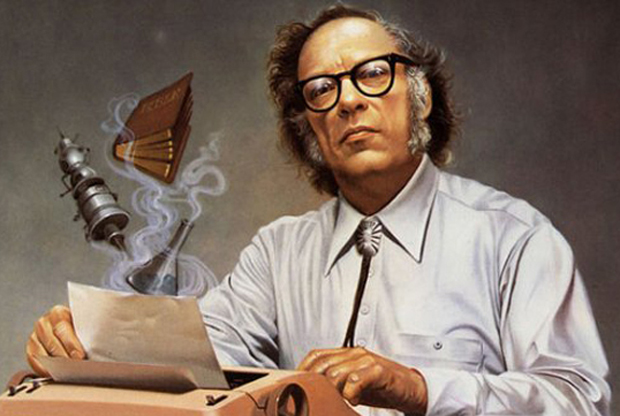 If there’s one word to describe Isaac Asimov, it’s “prolific”.
Source: Isaac Asimov: How to Never Run Out of Ideas Again – Personal Growth – Medium
by Charles Chu
If there’s one word to describe Isaac Asimov, it’s “prolific.”
To match the number of novels, letters, essays and other scribblings Asimov produced in his lifetime, you would have to write a full-length novel every two weeks for 25 years.
Why was Asimov able to have so many good ideas when the rest of us seem to only have 1 or 2 in a lifetime? To find out, I looked into Asimov’s autobiography, It’s Been a Good Life.
Asimov wasn’t born writing 8 hours a day 7 days a week. He tore up pages, he got frustrated and he failed over and over and over again. In his autobiography, Asimov shares the tactics and strategies he developed to never run out of ideas again.
Let’s steal everything we can.
________________________________________
1. Never Stop Learning
Asimov wasn’t just a science fiction writer. He had a PhD in chemistry from Columbia. He wrote on physics. He wrote on ancient history. Hell, he even wrote a book on the Bible.
Why was he able to write so widely in an age of myopic specialization?
Unlike modern day “professionals”, Asimov’s learning didn’t end with a degree—
“I couldn’t possibly write the variety of books I manage to do out of the knowledge I had gained in school alone. I had to keep a program of self-education in process. My library of reference books grew and I found I had to sweat over them in my constant fear that I might misunderstand a point that to someone knowledgeable in the subject would be a ludicrously simple one.”
To have good ideas, we need to consume good ideas too. The diploma isn’t the end. If anything, it’s the beginning.
Growing up, Asimov read everything —
“All this incredibly miscellaneous reading, the result of lack of guidance, left its indelible mark. My interest was aroused in twenty different directions and all those interests remained. I have written books on mythology, on the Bible, on Shakespeare, on history, on science, and so on.”
Read widely. Follow your curiosity. Never stop investing in yourself.
________________________________________
2. Don’t Fight the Stuck
It’s refreshing to know that, like myself, Asimov often got stuck —
Frequently, when I am at work on a science-fiction novel, I find myself heartily sick of it and unable to write another word.
Getting stuck is normal. It’s what happens next, our reaction, that separates the professional from the amateur.
Asimov didn’t let getting stuck stop him. Over the years, he developed a strategy…
I don’t stare at blank sheets of paper. I don’t spend days and nights cudgeling a head that is empty of ideas. Instead, I simply leave the novel and go on to any of the dozen other projects that are on tap. I write an editorial, or an essay, or a short story, or work on one of my nonfiction books. By the time I’ve grown tired of these things, my mind has been able to do its proper work and fill up again. I return to my novel and find myself able to write easily once more.
When writing this article, I got so frustrated that I dropped it and worked on other projects for 2 weeks. Now that I’ve created space, everything feels much, much easier.
The brain works in mysterious ways. By stepping aside, finding other projects and actively ignoring something, our subconscious creates space for ideas to grow.
________________________________________
3. Beware the Resistance
All creatives — be they entrepreneurs, writers or artists — know the fear of giving shape to ideas. Once we bring something into the world, it’s forever naked to rejection and criticism by millions of angry eyes.
Sometimes, after publishing an article, I am so afraid that I will actively avoid all comments and email correspondence…
This fear is the creative’s greatest enemy. In the The War of Art, Steven Pressfield gives the fear a name.
He calls it Resistance.
Asimov knows the Resistance too —
The ordinary writer is bound to be assailed by insecurities as he writes. Is the sentence he has just created a sensible one? Is it expressed as well as it might be? Would it sound better if it were written differently? The ordinary writer is therefore always revising, always chopping and changing, always trying on different ways of expressing himself, and, for all I know, never being entirely satisfied.
Self-doubt is the mind-killer.
I am a relentless editor. I’ve probably tweaked and re-tweaked this article a dozen times. It still looks like shit. But I must stop now, or I’ll never publish at all.
The fear of rejection makes us into “perfectionists”. But that perfectionism is just a shell. We draw into it when times are hard. It gives us safety… The safety of a lie.
The truth is, all of us have ideas. Little seeds of creativity waft in through the windowsills of the mind. The difference between Asimov and the rest of us is that we reject our ideas before giving them a chance.
After all, never having ideas means never having to fail.
________________________________________
4. Lower Your Standards
Asimov was fully against the pursuit of perfectionism. Trying to get everything right the first time, he says, is a big mistake.
Instead, get the basics down first —
Think of yourself as an artist making a sketch to get the composition clear in his mind, the blocks of color, the balance, and the rest. With that done, you can worry about the fine points.
Don’t try to paint the Mona Lisa on round one. Lower your standards. Make a test product, a temporary sketch or a rough draft.
At the same time, Asimov stresses self-assurance —
[A writer] can’t sit around doubting the quality of his writing. Rather, he has to love his own writing. I do.
Believe in your creations. This doesn’t mean you have to make the best in the world on every try. True confidence is about pushing boundaries, failing miserably, and having the strength to stand back up again.
We fail. We struggle. And that is why we succeed.
________________________________________
5. Make MORE Stuff
Interestingly, Asimov also recommends making MORE things as a cure for perfectionism —
By the time a particular book is published, the [writer] hasn’t much time to worry about how it will be received or how it will sell. By then he has already sold several others and is working on still others and it is these that concern him. This intensifies the peace and calm of his life.
If you have a new product coming out every few weeks, you simply don’t have time to dwell on failure.
This is why I try to write multiple articles a week instead of focusing on one “perfect” piece. It hurts less when something flops. Diversity is insurance of the mind.
________________________________________
6. The Secret Sauce
A struggling writer friend of Asimov’s once asked him, “Where do you get your ideas?”
Asimov replied, “By thinking and thinking and thinking till I’m ready to kill myself. […] Did you ever think it was easy to get a good idea?”
Many of his nights were spent alone with his mind —
I couldn’t sleep last night so I lay awake thinking of an article to write and I’d think and think and cry at the sad parts. I had a wonderful night.
Nobody ever said having ideas was going to be easy.
If it were, it wouldn’t be worth doing.
________________________________________
Filed under 2016, Writing Tip Wednesday, writing tips
Writing tip Wednesday: “Crap”

So, what’s stopping you?
Filed under 2016, writing tip, Writing Tip Wednesday
National Novel Writing Month 2016: 10 Tips For NaNoWriMo Writers
So you’re thinking about writing a novel for National Novel Writing Month. Here are some tips to help you get started and to stay the course.
Source: National Novel Writing Month 2016: 10 Tips For NaNoWriMo Writers

As the Ernest Hemmingway quote goes, “There is nothing to writing. All you do is sit down at a typewriter and bleed.” The quote illuminates a truth for writers everywhere: Writing a novel is much easier said than done.
That fact is one of the reasons why the founder of National Novel Writing Month, which begins Tuesday, launched the NaNoWriMo community in 1999. That led to the month of November being known as NaNoWriMo, which encourages writers to bear down and get serious about writing their next novel.
From Tuesday through 11:59 p.m. Nov. 30, participating writers are tasked with penning a 50,000-word novel. If they finish early they are encouraged to keep writing. One of the main points of NaNoWriMo is to set writing goals and reach them, as opposed to shooting for a Pulitzer-winning novel (although aiming to write the book of a generation is an admirable endeavor).
Below are 10 tips for getting started writing a novel and staying on-task. Grab your typewriter (fine, computer) and a box of Band-Aids for your fingers, sit down and write with these tips.
- First, sign up for NaNoWriMo and create your profile. You will be able to receive help from esteemed authors and connect with fellow writers. Committing to the program will hold you accountable for your writing.
- Decide how you want to plan your novel. Yes, there’s even a step before the big steps. The NaNoWriMo website’s places writers into two categories: a “planner” and a “pantser.” The first believes in solid preparation and will likely have their stories fleshed out before Nov. 1. That means if you’re your reading up on these tips, you’re probably in the latter group of those who let their spontaneity take the reins. The latter also prefers to dive right in and see what unfolds along the way.
- Prep your novel! If you don’t have somewhat of a story idea already, it’s time to get going. The NaNo website has published videos and tips on how to properly plan for your story for the month ahead.
- Check out the literature the site also publishes on tips for character building, fiction writing, story building and more. Plan ahead, but don’t let the planning process keep you from this next step…
- WRITE. There’s no avoiding it. The best thing to do is just write.
- Once you’ve started, plan your pace for the month and commit to completing a certain amount of words every day. The goal is to write 50,000 words, so the word count is a tangible goal that needs to be met.
- Try to write at the same time every day. This doesn’t necessarily work for everyone, but by committing to the same time, you’ll be less likely to push aside the time for socializing or doing chores. Some people prefer writing first thing in the morning, while others prefer the late-night grind. Find your “time” and stick to it.
- Reach out to others. The community through NaNoWriMo is meant to help you get the resources and support you need to complete your story. Contrary to popular belief, writing does not just have to be a solitary experience that you share with you and yourself in a cold, damp garret – your writing is meant to be shared. So seek out friends, family members, fellow writers or mentors who might offer you feedback on your writing or even just moral support.
- Don’t give up! This might not be the most original tip, but it’s impossible to keep going if you don’t believe in yourself or your story. Keep at it, and keep at it some more. Some days the words will fly, while other days will feel tedious and awful (remember the part about the proverbial “bleeding” – grab those Band-Aids and get back to work).
- Have fun. You’re writing a novel, not fighting a war. Have fun and enjoy the process. Nothing beats the beauty of when the human mind and imagination coming together to create something completely original and unique.
Filed under 2016, writing tip, Writing Tip Wednesday
Writing tip Wednesday: “Get it write”
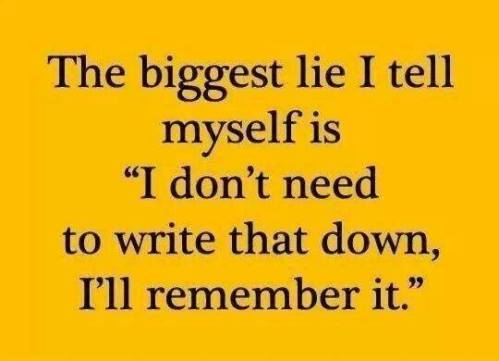
One of the easiest things to do is also one of the hardest, and that is to write down that piece of dialogue, turn of phrase, descriptive passage, ear catching name for a character, or any other part of writing.
Granted, it can be hard to write something down when you are driving or in the middle of shopping for food for that big holiday meal, or even in the dark watching a movie. I’m sure you can fill in the line, I had a great idea, but I couldn’t write it down because….
The only thing I can say is I have kicked myself too many times over things I have forgotten when I told myself I would remember them until I could write them.
Sometimes, it helps me to remember the first letter of each word in a phrase I am trying to remember until I can write it down. But I always, or at least almost always, have a pen and paper with me, even a scrap piece of paper. And though I still fail, I try to write it down as soon as I can after the idea has come to me.
It’s not always easy, but nobody said writing should be. Sometimes it is. Often it isn’t, so don’t make it harder on yourself by not having pen and paper or some other way of recording that bit of inspiration when it comes your way. Even if I don’t end up using it, I have acknowledged it, and I have found that acknowledging inspiration helps bring forth more inspiration, while ignoring it or being lazy about it only causes it to go elsewhere, to someone else who will appreciate it.
–David E. Booker
Filed under 2016, writing tip, Writing Tip Wednesday


 Booker's Blog