
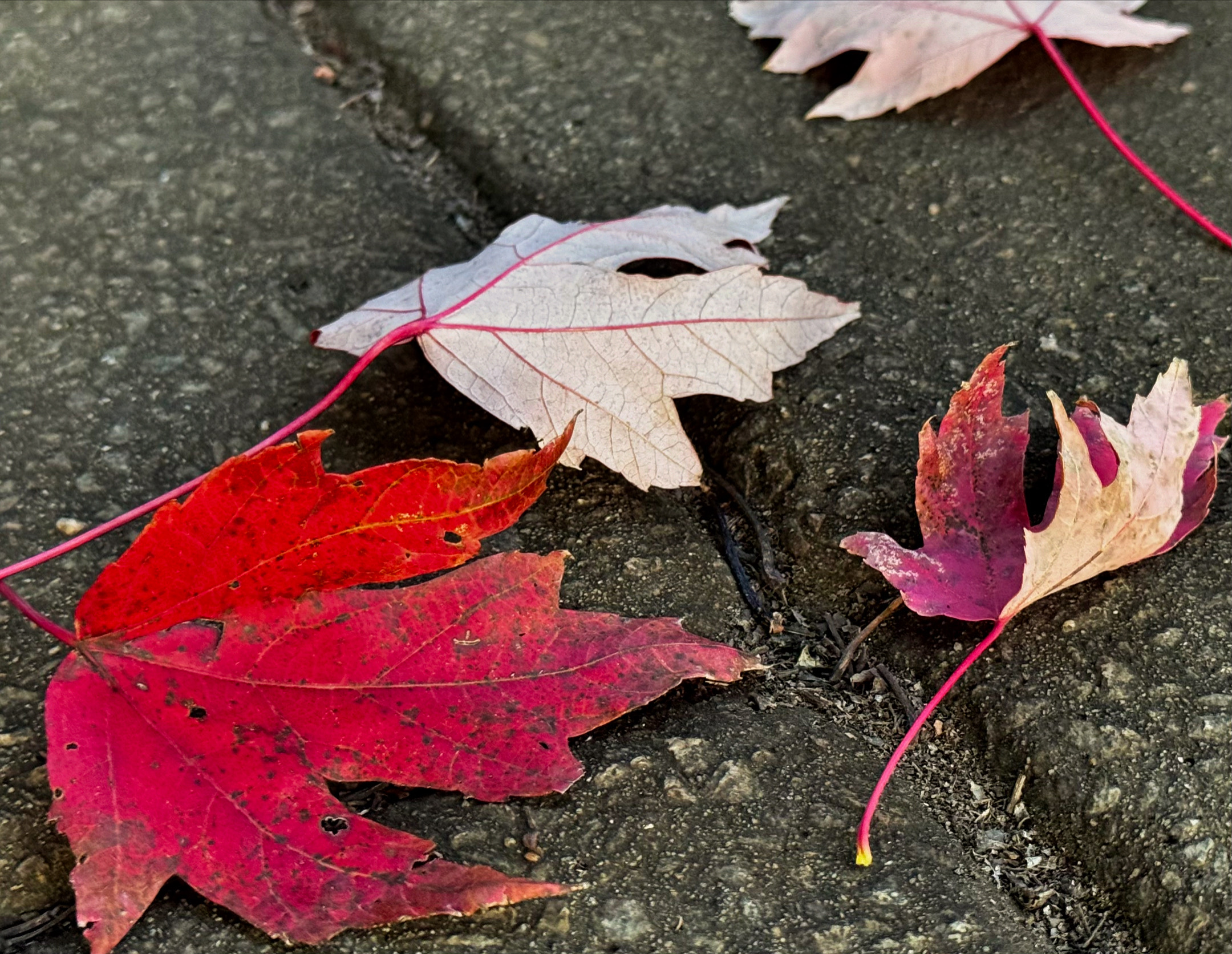
Hear
The sound of no sound. /
The quiet voice of no voice. /
Hear one fall leaf fall.
.
.
#hear #leaf #sound #voice #fall #haiku #poem #poetry #haiga #photo #oldnorthknoxville #davidebooker #november #saturday #112324 #2024
Hear
The sound of no sound. /
The quiet voice of no voice. /
Hear one fall leaf fall.
.
.
#hear #leaf #sound #voice #fall #haiku #poem #poetry #haiga #photo #oldnorthknoxville #davidebooker #november #saturday #112324 #2024

Soup
On a rainy night, /
I create broccoli cheese soup /
from your recipe /
and for a moment I am /
listening to you, again.
.
.
#soup #broccoli #cheese #night #recipe #you #listening #tanka #waga #photo #haiga #poem #poetry #oldnorthknoxville #davidebooker #february #saturday #021024 #020424
Don’t Muzzle (or Muffle) Your Writing Voice
By TOM BENTLEY
I think about the issue of voice in writing quite often. You know, your writing voice, that whiff of brimstone or reverberant cello note or cracked teeth and swollen tongue that stamps your writing as having been issued from you alone. Many writers, particularly younger ones, struggle to find their voice: the word choice, the cadence, the tone, the very punctuation—the stuff that slyly suggests or that screams that you wrote it.
You’d never mistake Donald Barthelme for Ernest Hemingway; the word blossoms gathered in Virginia Woolf’s garden would have flowers not found in the window-box plantings of Joan Didion. So your writing and your writing voice shouldn’t be confused with Schlomo Bierbaum’s—it should be yours alone.
One of the things that made me think of a person’s voice was a literal voice: a few years ago I saw Ricki Lee Jones in concert, and was so struck by her uniqueness as a performer (and possibly as a person). She was cuckoo and mesmerizing in the best of ways on stage: banging on the roof of the piano, exhorting the other players, talking to them in asides during some songs. She played a lunatic version of Don’t Fear the Reaper(!), beating out a slapclap on the top of her piano. The performance was so Rikki Lee Jones: singular, eccentric, passionate, moody. You wanted to be around her just to see what she might do or say (or sing) next. Her voice was hers and hers alone.
Your Writing Voice Is There for the Singing
When you’re developing your writing voice, you might be so painstakingly wrapped up in expressing yourself JUST SO that you drain the blood out of your writing, or pull the plug on the electricity of your ideas. You might have read an essay by Pico Iyer or a story by Alice Munro or a novel by Cormac McCarthy and you might be trying so hard to source and employ the rhythms, humors and tics of those gifted writers that you spill onto the page a fridge full of half-opened condiments that cancel each other’s flavors.
Be yourself behind the pen, be the channel between what cooks in your brain and what courses through the keyboard. Even if that self is one day the grinning jester and another the sentimental fool, be fully that person, unmasked, on the page. Maybe you grew up in a slum in Mumbai or have a pied-à-terre in every European capital, maybe your adolescence was a thing of constant pain, maybe you never made a wrong move, maybe you never moved at all—it should be in your writing, whether in its proclamations or its subtext. Your voice is all the Crayons in your box.
For instance, if you’re inclined to the confessional (like all us old Catholics), turn to your sins: I was a very enterprising shoplifter in high school, running a cottage resale business on the side. While I don’t recommend they teach my techniques in business school, I later forged my history of happy hands into an award-winning short story, and then turned the account of having won that short story contest into a published article in a Writer’s Market volume. Ahh, the just desserts of an empire of crime.
A Voice, and Its Chorus
Of course it’s no monotone: Sometimes I might write about Sisyphus and sometimes I might write about drool (and sometimes I might speculate whether Sisyphus drooled while pushing the rock up that endless hill). By that I mean your short stories might have a female narrators, male narrators, be set in a tiny town one time and in a howling metropolis the next. But you still must find the voice—your voice—for that story.
I like to write essays that often take a humorous slant, but at the same time, that isn’t the limit or restriction I put on my own expression. I published a piece on not actually knowing my father despite my years with him, and another that discusses never finding out what happened to my high school girlfriend after she vanished in Colombia. Both had a tone of pathos. That pensive tone is also one of my voices, and its sobriety doesn’t cancel the chiming of my comic voice. So your voice might be part of a choir.
Rest of the article: http://www.writersdigest.com/online-editor/dont-muzzle-or-muffle-your-writing-voice?et_mid=758567&rid=239626420
Filed under 2015, writing tip, Writing Tip Wednesday
I crave the sound of your voice,
the touch of your syllables to my ear,
a kindness of words only you can speak.
Sentences that mean nothing
when spoken by others –
a clattering of consonants to these empty ears –
are wonder of time on your lips.
Your voice carries the lightness of words,
the weight of our history,
and the magic of the moment yet to be.
Filed under free verse, poem, poetry


 Booker's Blog