Tag Archives: Tom Dupree

Celebrity Killed The Radio Star | You and Me, Dupree

Source: Celebrity Killed The Radio Star | You and Me, Dupree

Unknown.jpeg

One of the most moving, most significant, most powerful books I’ve read over the last few years is mainly made up of illustrations. It’s the remarkable ALL THE ANSWERS, a “graphic memoir” by Michael Kupperman, and I strongly urge you to give it a spin.

The author is not new to me: I published Michael Kupperman’s first book, SNAKE ’N’ BACON’S CARTOON CABARET, nearly twenty years ago. We had noticed his work in such publications as the Oxford American, and every time we saw another cheerily demented comic strip we wound up wiping tears of laughter from our faces. Mike has a straight-laced, almost retro drawing style that you can tell a mile away (by now, others are obviously trying to imitate it). But the cultural melange roiling around in his brain is unique, charming and dangerous. He loves old Hollywood, old media (heavy-breathing magazine ads from the Thirties and Forties are a huge inspiration), mass marketing to innocents, deliberately absurd juxtapositions — you can’t possibly get ahead of him before you turn the page.

Either you love this stuff to death or you want to throw it across the room. Some people at the publisher where I worked were far from smitten, but to their credit they said, we don’t get it, but we get that you get it. I got the green light and set out to find the guy who signed his work “P. Revess” by calling those magazines and asking, where do you send the checks? Turned out they headed right here, to New York City, to a guy named “Michael Kupperman.” When I called him to ask about his interest in possibly doing a book, I detected a hint of suspicion, the do-you-have-Prince-Albert-in-a-can type. But I proved my bona fides and we made a deal. No agent, no nuthin.
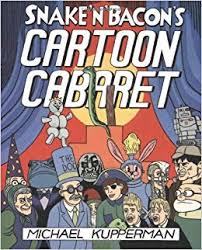
The book sold modestly but steadily (it’s still in print after all this time, which is an achievement on its own), but more important, it introduced Mike to a growing and influential audience. Art directors loved his funky visual style: I started to see his spot illustrations in unexpected places like the New Yorker. One week he did the cover and interior color illos for the lead story in an issue of Fortune. He was all over the place outside the comics field for a while.

He was also getting noticed in the world of comedy. Andy Richter, Conan O’Brien’s original sidekick, was such an early fan that he gave us a quote for our book cover. Conan himself called Mike “probably one of the greatest comedy brains on the planet.” Robert Smigel, who is also probably one of the greatest comedy brains on the planet, heartily agreed and adapted some wild stuff for his TV FUNHOUSE, and Michael Kupperman was officially hip. There’s since been more tv, more illustration, more comics, and in 2013 Mike won the Eisner Award, comics’ highest honor, for a fevered, off-the-scale-hilarious story about the 1969 moon landing in his book TALES DESIGNED TO THRIZZLE.

I’ve been following Mike’s career as best I could in the years since we worked together. I’m proud of him. But nothing prepared me for this latest dazzler. It comes from someplace deep inside the artist, an excruciatingly personal corner where he hasn’t allowed us before. As the flap copy calmly states, “This is his first serious book.”

Nearly every creative person I’ve ever encountered, myself certainly included, loves it when s/he is credited by name. A couple times I casually asked Mike why he signed a pseudonym instead and never got a straight answer. Maybe this book provides a clue. I didn’t know it, but there was a time when “Kupperman” was one of the most famous surnames in America. It belonged to an unwitting pioneer of celebrity culture, a child star whose popularity was launched and exploited by the mass medium of radio. This was Michael’s father, Joel Kupperman. He was a Quiz Kid — probably the best known Quiz Kid of them all.

Joel was a “child prodigy” when that term was new. He scored better than 200 on the Stanford-Binet test when he was only six years old. His specialty was doing complex mathematical calculations in his head; he was also a maven at trivia and remembered nearly everything he read. He was a perfect fit for QUIZ KIDS, a radio program created by broadcasting executive Louis G. Cowan (the author calls him “almost certainly the smartest person in this book”) in which children answered questions sent in by listeners. Joel’s first appearance was in 1942; he was five.

Today Joel is a grandfather. He spent fifty years teaching and writing books about philosophy. He has been a good man, neither an abuser nor philanderer, but to his son lamentably distant. Now, before Joel succumbs to the dementia that has just been diagnosed, the young Kupperman wants to open a subject which his father has compartmentalized and never discussed: the traumatic years on QUIZ KIDS which basically stole his childhood, tormented him as he grew out of single-digit cuteness and the show migrated to television, and caused him to recoil from the whole experience.

The complexities which intertwine to form this saga include the state of mass media in the mid-twentieth century, Joel’s stern and smothering stage mother, the role of anti-Semitism on QUIZ KIDS, the high price of fame, and most searingly, the poignant real-life relationship between a wounded father and his son, who is by now raising his own young boy. These strands dart and weave and intersect in magical ways: ALL THE ANSWERS turns on a dime from humor to heartbreak.

It looks simple, but looks are deceiving. The pages are trimmed to 6-by-9, just like a book full of words. It’s drawn in black-and-white (like the book we did together). The illustrative style is Kupperman-clean, with slightly more ornate chapter-heading ”splash pages,” and show off how the artist can conjure familiar people from real life with just a few economical lines (a secret cache of scrapbooks assiduously kept by Joel’s mother provides all the contemporary source material needed). The first-person narration is active, impassioned, haunting and honest, a world away from the hyperventilating wisenheimer of gonzo Kupperman comics. The text in ALL THE ANSWERS is so clear that it serves to emphasize the rich subtext. Ideas, emotions, relationships, issues, injustices, yearnings — they all pop off the pages in deeply human ways. It appears to be hand-lettered, though I bet there’s a computer involved by now, but this isn’t a comic book. It’s exactly what it claims to be: a graphic memoir. The closest cousin I can think of is Alison Bechdel’s FUN HOME, but this feels even more basic and vital, and you can’t stop comparing the World War II years — QUIZ KIDS’s golden age — with our culture today. As you read, Michael Kupperman’s very personal world expands to encompass your own.

Artists are supposed to startle and surprise us. Boy, did this book deliver. I didn’t know Michael Kupperman had it in him. I’ll be thinking about this for a long time, especially while reading this talented man’s next outrageous bit of goofiness, which I hope comes along very soon. (He’s got an agent now.) It’ll be even more fun now that I know the guy a little better.

Leave a comment

Filed under 2019, author

Adventures In Editing, Part V

Step up, sit down, and read about one editor’s adventures in editing. If you are a writer, it is worth your time, and if you are a reader, it is also worth you time. And if you don’t do either, well, then, shame on you.

Tom Dupree's avatarYou and Me, Dupree

editing

One day, Bantam publisher Irwyn Applebaum summoned me into his office and asked, “How do you respond when I say, ‘Tom Robbins’?” Without even thinking, I said, “one of the great prose stylists of his generation.” He said, “That’s what I thought. I want you to go out to Seattle and meet him. You might become his editor.” (Spoiler Alert: I did, and I did. But I’m getting ahead of myself.)

In past pieces in this series, I’ve tried to give you some idea of what life is really like from the editor’s point of view. I began writing “Adventures In Editing” because I rarely read about that aspect of the publishing business, and the little I did read described only a cookie-cutter, stereotypical, author-v.-editor relationship that tended to come from the author’s side of the negotiating desk: much of it seemed to emanate from Writer’s Digest

View original post 1,755 more words

Leave a comment

Filed under editor

E-book pricing: possible lawsuit

[Editor’s note: This is a follow up to an article posted on this blog on 12/18/2011. Click on Category listing “e-book” below to bring up that article by Tom Dupree.]

Source: http://www.huffingtonpost.com/2012/04/10/apple-lawsuit-ebooks-doj_n_1416473.html?ncid=edlinkusaolp00000003

Apple Lawsuit: DOJ May Sue Tech Company Over eBooks As Early As Wednesday

By Diane Bartz and Poornima Gupta

4/10/2012 8:17 PM (Eastern Time)

WASHINGTON/SAN FRANCISCO, April 10 (Reuters) – The Justice Department could sue Apple Inc as early as Wednesday over alleged electronic book price-fixing, while settling with several publishers as early as this week, two people familiar with the matter said.

The Justice Department is investigating alleged price-fixing by Apple and five major publishers: CBS Corp’s Simon & Schuster Inc; HarperCollins Publishers Inc; Lagardere SCA’s Hachette Book Group; Pearson and Macmillan, a unit of Verlagsgruppe Georg von Holtzbrinck GmbH.

A lawsuit against Apple, one of the parties not in negotiations over a potential settlement, could come as early as Wednesday but no final decision had been made, the people said.

Apple declined to comment. The Justice Department and the five publishers could not be reached for comment.

The Justice Department is investigating whether deals Apple cut two years ago with the quintet of major publishers – when the consumer electronics maker launched its iPad tablet computer – were done with the intent of propping up prices for digital books, sources have said.

As part of those agreements, publishers shifted to a model that allowed them to set the price of e-books and give Apple a 30 percent cut of sales, the sources have said.

Talks between the Justice Department and some publishers had been proceeding, with settlements expected as soon as this week, one of the two sources familiar with the matter said on condition of anonymity, because the discussions were not public.

A negotiated settlement is expected to eliminate Apple’s so-called “most favored nation” status, which had prevented the publishers from selling lower-priced e-books through rival retailers such as Amazon.com Inc or Barnes & Noble Inc , sources had told Reuters last month.

But the situation was fluid, those sources said at the time.

Leave a comment

Filed under e-book, publishers, publishing

The price creep of e-books

This is an interesting companion piece to the one on self-publishing that I posted earlier. If interested in writing, this is also a good blog to follow. Tom Dupree has many years experience as an editor, and it would be worth your time to tap into that knowledge.

http://tomdup.wordpress.com/2011/12/15/e-customers-creeped-out-by-price-creep/

E-Customers Creeped Out By Price Creep

By Tom Dupree

There’s a piece on page 1 of today’s Wall Street Journal about e-book sticker shock, another good job by the Journal’s book-beat reporter Jeff Trachtenberg. I’ve been railing about this issue ever since Apple persuaded the six major publishers to disallow any discounting by retailers on e-books. As Mr. Trachtenberg points out, this restriction doesn’t apply to print books, so you have the increasingly common phenomenon of e-editions equaling, and even surpassing, the discounted print edition at retailers like Amazon.com. In at least one instance (emphasis on “at least”), Ken Follett’s doorstop FALL OF GIANTS, the publisher’s e-book price is $18.99 – but the paperback edition can be bought new for $16.50.

Let’s re-emphasize what’s actually going on here. The major players in an industry which faces massive headwinds, book publishing, is deliberately overpricing its most promising and fastest-growing revenue stream, specifically to dampen e-demand and reduce “cannibalization” of “higher-margin” hardcover and trade paperback editions. Mr. Trachtenberg points out that under the “retail model,” by which Amazon was charging $9.99 for new bestsellers, it was the retailer who took the loss; the author and publisher still received roughly half of the full retail price. But under the current “agency model,” the publisher retains 70%, and the retailer gets the rest. No more “loss leaders,” and essentially no more $9.99 bestsellers.

But look closer at the Follett. Dutton’s suggested retail price for this 985-page tome in hardcover is $36. Under the “retail model,” it collected $18 per e-copy, just as it did for a hardcover, and Amazon could give it away if they liked. Of course, that’s no way to run a business: “How do we do it? Volume!” What Amazon was trying to do was to jump-start a nonexistent e-book market and worry about coaxing it into profitability later; they’ve always been forward-thinking in that way. But under the “agency model,” Dutton gets 70% of $18.99, the highest price I’ve encountered for a commercial trade e-book, which is $13.30 per e-copy, and all retailers receive the same $5.70 (I rounded both numbers to the next penny). $13.30 — and remember, this is the absolute Beluga of e-pricing — is $4.70 less than $18. But who’s counting?

My point exactly.

Now let’s consider Apple’s motives. It’s a wonderful company, but it’s no less ruthless just because its antagonizer-in-chief has passed away. When Apple was the “first mover” in digital music, it used the leverage of its huge installed iPod base to oppose the big record labels by dampening the retail price from $15-$16 for a whole CD to 99 cents for an individual song (boy, that price rings a bell. And it’s increased since then, too). But in e-books, Apple found itself, uncharacteristically, in Amazon’s wake (Steve Jobs had infamously sniffed at the Kindle’s launch: “People don’t read any more”). So now what it had to do was eliminate Amazon’s price advantage – and, amazingly, in a reversal of its effect on the music business, it succeeded in propping up the retail price of e-books! Justice is now looking into whether preventing discounting constitutes illegal collusion among the major publishers (as are European authorities), and I don’t know much about the law so can’t speculate, but it does sound fishy, and it protects retailers (guaranteed profit) at the expense of consumers (higher prices).

I have some friends in the book biz who’ve read my previous musings and have some pretty good arguments that nobody seems to be considering. For example, it’s an age-old fact that for big bestselling authors like Mr. Follett, or Stephen King or John Grisham or Danielle Steel or Nora Roberts, publishers pay way too much up front as an “advance,” otherwise known as a “guarantee against royalties.” First, it’s necessary because everybody else is waving huge paychecks around, and you have to be there to compete. Second, a major author can be a tentpole for the rest of your list: if you, Ms. Retailer, want the new Grisham, you’ll have to hear about all the other great stuff we have. Third, there’s the intangible prestige factor, as authors and agents want to be with the house that publishes XXX. But these millions represent a nonrefundable guarantee which has to “earn out” before a book realizes its true potential for perennial profit down the road. (I’ve heard that Mr. King has a deal which plays down the guarantee in favor of a larger participation on the back end, like major movie stars sometimes do.) A surprise hit like THE HELP is very profitable immediately, but big bestsellers from well-known authors always start out deep in the red, and I’d love to know what Kathryn Stockett’s agent has in mind for her next contract.

That means you have to scramble for every penny you can find during the hot new-release period with the ads and the DAILY SHOW spots, very much like movie studios do. My question is: why aren’t the big publishers doing so?

Mr. Trachtenberg quotes a publisher as saying people are realizing the advantages of e-books and are willing to pay a premium for them. I’ve heard that too from some consumers. But $18.99? (P.S.: Book prices never go anywhere but up.) He shares more ominous quotes from others. A reader says it’s hard to justify a $10-$15 e-book when you can pick up a used print copy for $2 or $3 on Amazon. If that was the Ken Follett, the author and publisher made no money on the used-copy resale, when they could have received $18 for a “retail-priced” e-book. Also, the ability to self-publish and shop online is hitting the major publishers from the low end. As an industry consultant says, some e-buyers may opt for “five-star-reviewed” self-published mysteries or romances which are going for $2.99 or $3.99. Plus, if it’s digital it’s stealable, and remember that millions of otherwise law-abiding kids believed downloading from Napster was justifiable because CD prices were too high.

I think it’s fair to say that most e-reading devices have been purchased since “agency pricing” went into effect about two years ago, so possibly it’s only the early adopters like me who recoil against $12.99 and $14.99 books, or e-editions which cost more than paperbacks. Most new e-reader owners may think that’s the going rate you pay for not having to lug the physical book around, being able to read it on damn near every mobile device there is, etc. Yet as a “veteran,” I’d still be willing to wait, even a whole year, so the publishers have time to sell every hardcover they possibly can, if they’d only then give me a fairly-priced e-edition so I could fairly pay the author and publisher instead of ignoring them.

As it is, I have a list of saved backlist books that I’ll never buy in print editions; I just want to read them once. Every month or so I check on them, and every so often a publisher will experiment with a temporary lower price (this is why the publishers will probably survive any accusation of price-fixing; each one is free to charge anything it likes). I will either get the price I want, or the publisher will lose a sale which I would guess is sorely needed. It’s as simple as that.

Leave a comment

Filed under e-book, publishers, publishing, Tom Dupree, writing, writing tip