

Tag Archives: The New Yorker
cARtOONSdAY: “tHE wRITING sTRUGGLE”
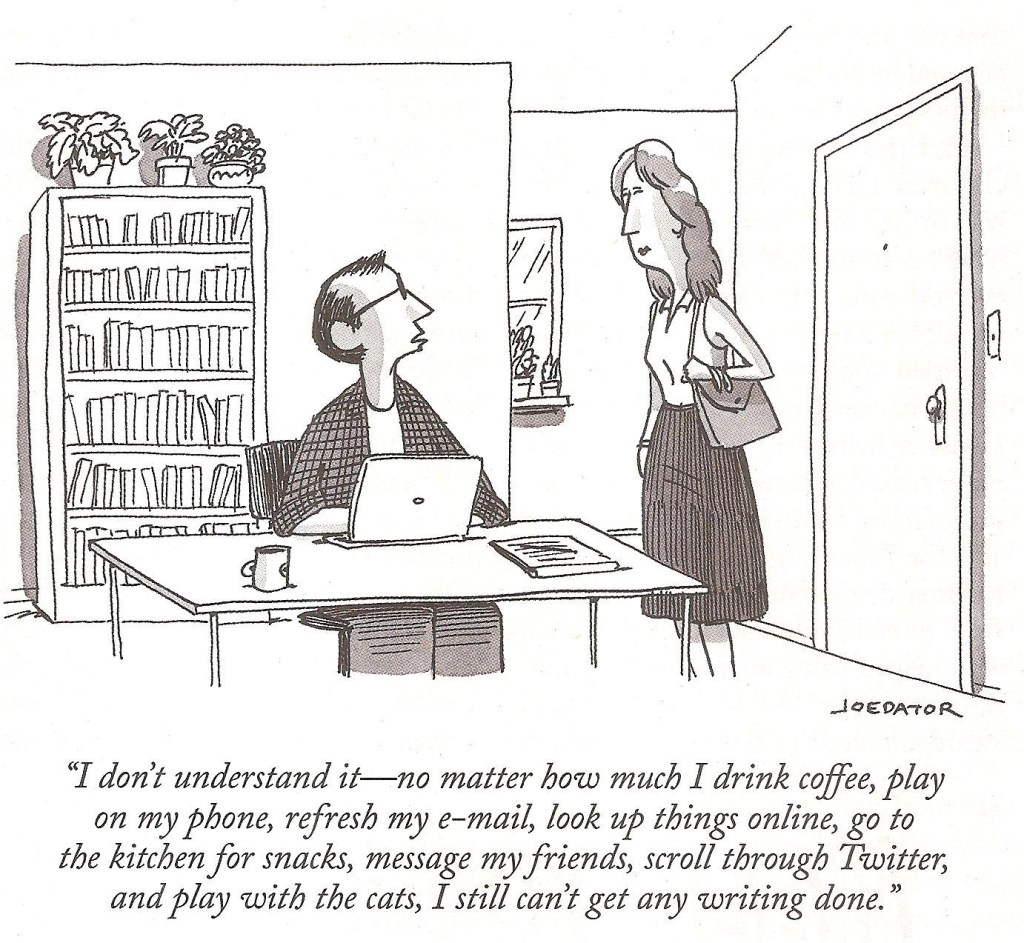
The pro in procrastination does not make you a professional writer.
June 9, 2020 · 9:39 pm
Between Solitude and Loneliness | The New Yorker
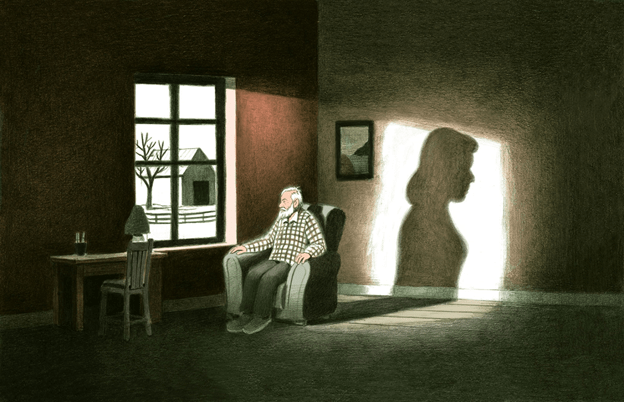
At eighty-seven, I am solitary. I live by myself on one floor of the 1803 farmhouse where my family has lived since the Civil War. After my grandfather died, my grandmother Kate lived here alone. Her three daughters visited her. In 1975, Kate died at ninety-seven, and I took over. Forty-odd years later, I spend my days alone in one of two chairs. From an overstuffed blue chair in my living room I look out the window at the unpainted old barn, golden and empty of its cows and of Riley the horse. I look at a tulip; I look at snow. In the parlor’s mechanical chair, I write these paragraphs and dictate letters. I also watch television news, often without listening, and lie back in the enormous comfort of solitude. People want to come visit, but mostly I refuse them, preserving my continuous silence. Linda comes two nights a week. My two best male friends from New Hampshire, who live in Maine and Manhattan, seldom drop by. A few hours a week, Carole does my laundry and counts my pills and picks up after me. I look forward to her presence and feel relief when she leaves. Now and then, especially at night, solitude loses its soft power and loneliness takes over. I am grateful when solitude returns.
Born in 1928, I was an only child. During the Great Depression, there were many of us, and Spring Glen Elementary School was eight grades of children without siblings. From time to time I made a friend during childhood, but friendships never lasted long. Charlie Axel liked making model airplanes out of balsa wood and tissue. So did I, but I was clumsy and dripped cement onto wing paper. His models flew. Later, I collected stamps, and so did Frank Benedict. I got bored with stamps. In seventh and eighth grade, there were girls. I remember lying with Barbara Pope on her bed, fully clothed and apart while her mother looked in at us with anxiety. Most of the time, I liked staying alone after school, sitting in the shadowy living room. My mother was shopping or playing bridge with friends; my father added figures in his office; I daydreamed.
In summer, I left my Connecticut suburb to hay with my grandfather, on this New Hampshire farm. I watched him milk seven Holsteins morning and night. For lunch I made myself an onion sandwich—a thick slice between pieces of Wonder Bread. I’ve told of this sandwich before.
At fifteen, I went to Exeter for the last two years of high school. Exeter was academically difficult and made Harvard easy, but I hated it—five hundred identical boys living two to a room. Solitude was scarce, and I labored to find it. I took long walks alone, smoking cigars. I found myself a rare single room and remained there as much as I could, reading and writing. Saturday night, the rest of the school sat in the basketball arena, deliriously watching a movie. I remained in my room in solitary pleasure.
At college, dormitory suites had single and double bedrooms. For three years, I lived in one bedroom crowded with everything I owned. During my senior year, I managed to secure a single suite: bedroom and sitting room and bath. At Oxford, I had two rooms to myself. Everybody did. Then I had fellowships. Then I wrote books. Finally, to my distaste, I had to look for a job. With my first wife–people married young back then; we were twenty and twenty-three–I settled in Ann Arbor, teaching English literature at the University of Michigan. I loved walking up and down in the lecture hall, talking about Yeats and Joyce or reading aloud the poems of Thomas Hardy and Andrew Marvell. These pleasures were hardly solitary, but at home I spent the day in a tiny attic room, working on poems. My extremely intelligent wife was more mathematical than literary. We lived together and we grew apart. For the only time in my life, I cherished social gatherings: Ann Arbor’s culture of cocktail parties. I found myself looking forward to weekends, to crowded parties that permitted me distance from my marriage. There were two or three such occasions on Friday and more on Saturday, permitting couples to migrate from living room to living room. We flirted, we drank, we chatted–without remembering on Sunday what we said Saturday night.
After sixteen years of marriage, my wife and I divorced.
For five years I was alone again, but without the comfort of solitude. I exchanged the miseries of a bad marriage for the miseries of bourbon. I dated a girlfriend who drank two bottles of vodka a day. I dated three or four women a week, occasionally three in a day. My poems slackened and stopped. I tried to think that I lived in happy license. I didn’t.
Jane Kenyon was my student. She was smart, she wrote poems, she was funny and frank in class. I knew she lived in a dormitory near my house, so one night I asked her to housesit while I attended an hour-long meeting. (In Ann Arbor, it was the year of breaking and entering.) When I came home, we went to bed. We enjoyed each other, libertine liberty as much as pleasures of the flesh. Later I asked her to dinner, which in 1970 always included breakfast. We saw each other once a week, still dating others, then twice a week, then three or four times a week, and saw no one else. One night, we spoke of marriage. Quickly we changed the subject, because I was nineteen years older and, if we married, she would be a widow so long. We married in April, 1972. We lived in Ann Arbor three years, and in 1975 left Michigan for New Hampshire. She adored this old family house.
For almost twenty years, I woke before Jane and brought her coffee in bed. When she rose, she walked Gus the dog. Then each of us retreated to a workroom to write, at opposite ends of our two-story house. Mine was the ground floor in front, next to Route 4. Hers was the second floor in the rear, beside Ragged Mountain’s old pasture. In the separation of our double solitude, we each wrote poetry in the morning. We had lunch, eating sandwiches and walking around without speaking to each other. Afterward, we took a twenty-minute nap, gathering energy for the rest of the day, and woke to our daily fuck. Afterward I felt like cuddling, but Jane’s climax released her into energy. She hurried from bed to workroom.
For several hours afterward, I went back to work at my desk. Late in the afternoon, I read aloud to Jane for an hour. I read Wordsworth’s “Prelude,” Henry James’s “The Ambassadors” twice, the Old Testament, William Faulkner, more Henry James, seventeenth-century poets. Before supper I drank a beer and glanced at The New Yorker while Jane cooked, sipping a glass of wine. Slowly she made a delicious dinner—maybe veal cutlets with mushroom-and-garlic gravy, maybe summer’s asparagus from the bed across the street—then asked me to carry our plates to the table while she lit the candle. Through dinner we talked about our separate days.
Summer afternoons we spent beside Eagle Pond, on a bite-sized beach among frogs, mink, and beaver. Jane lay in the sun, tanning, while I read books in a canvas sling chair. Every now and then, we would dive into the pond. Sometimes, for an early supper, we broiled sausage on a hibachi. After twenty years of our remarkable marriage, living and writing together in double solitude, Jane died of leukemia at forty-seven, on April 22, 1995.
Now it is April 22, 2016, and Jane has been dead for more than two decades. Earlier this year, at eighty-seven, I grieved for her in a way I had never grieved before. I was sick and thought I was dying. Every day of her dying, I stayed by her side—a year and a half. It was miserable that Jane should die so young, and it was redemptive that I could be with her every hour of every day. Last January I grieved again, this time that she would not sit beside me as I died.
By Donald Hall, October 15, 2016

How to Choose a Writing Instrument and What It Says About You
Illustration by Jason Adam Katzenstein

If you use a red pen, you are either grading undergraduate papers or you are a sociopath.
Source: How to Choose a Writing Instrument and What It Says About You | The New Yorker
Cormac McCarthy purchased a powder blue Olivetti Lettera 32 mechanical typewriter in a Tennessee pawnshop, in 1963, for fifty dollars, and used it for the next five decades, producing an estimated five million words tickling its ivories. An author’s instrument is more than a tool; it is an extension of his very soul. With that in mind, choose your weapon carefully. (I use the Olivetti Lettera 22—an earlier model—myself.)
Ballpoint pen: Let me guess—you probably have a great idea for a book that you’ve been meaning to write but haven’t actually got around to starting?
Fountain pen: You don’t use contractions because you think that they degrade the language, and your epigraphs are all in Latin. You include epigraphs in everything you write.
Electric typewriter: All of your protagonists are thinly veiled versions of yourself. You order rye at bars and secretly think that you should have been alive in the sixties.
Manual typewriter: You spent six hundred dollars on a typewriter that you’ve used twice.
No. 2 pencil: You keep one behind your ear because you think it looks writerly, but exclusively use it to jot down to-do lists.
Pencil you can only sharpen with a pocket knife: You have gone camping two or three times in your life and bring it up at least once per conversation.
Mechanical pencil: You’re taking notes in an Algebra 2 class.
MacBook: You like the idea of hiking more than you actually like hiking and are impressed with yourself for liking the Beatles.
Desktop computer: You are either a Serious Writer who needs to be cut off from distraction in order to focus completely on your art, or you are sixty-five years old.
Red pen: You are either grading undergraduate papers or you are a sociopath.
Micron: Your notebook is the type with the grid dots because you think that lines constrain your creativity but you still need to write straight.
Quill: You have gone to a Renaissance Faire unironically. Please, for all of our sakes, stop calling women “m’lady.”
Tablet: You type with a single finger.
From “The White Man’s Guide to White Male Writers of the Western Canon,” by Dana Schwartz, illustrated by Jason Adam Katzenstein, to be published by Harper Collins.
Filed under 2019, Monday morning writing joke
How to Celebrate Walt Whitman’s Two-Hundredth Birthday – New Yorker
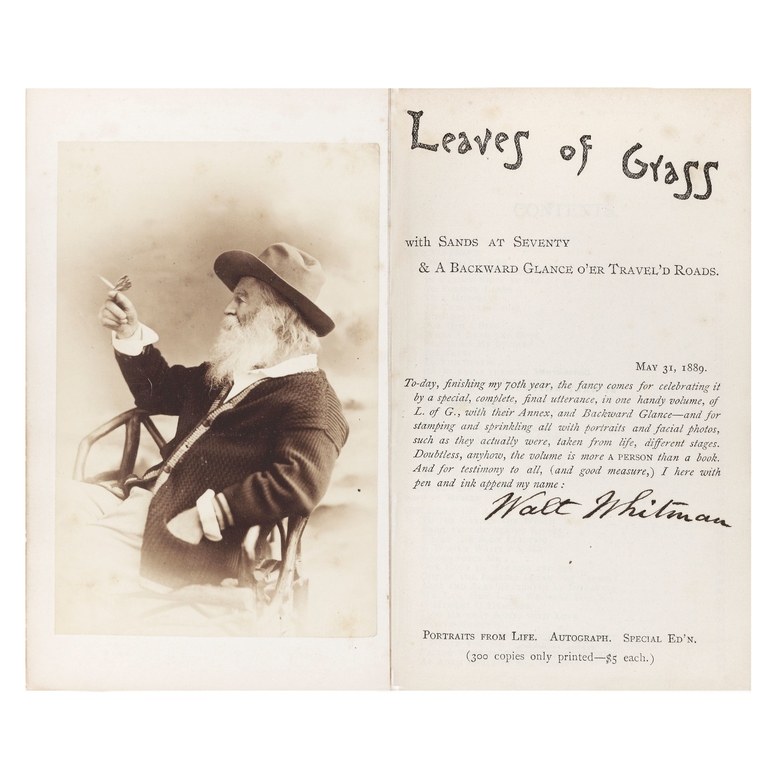
Loaf at your ease, luxuriating in the poet’s unhurried, insinuated cadences.
Source: How to Celebrate Walt Whitman’s Two-Hundredth Birthday | The New Yorker
This year we celebrate the two-hundredth birthday of Walt Whitman; and by “we” I mean all of us who take conscious pleasure in speaking American English. Whitman invented a poetry specific to this language and open to the kinds of experience, peculiar to democracy in a polyethnic society on a vast continent, that might otherwise be mute. Public events commemorating the bicentennial include three summer shows in New York—at the Morgan Library, the New York Public Library, and the Grolier Club—that touch on the story of his life. There are books, manuscripts, prints, photographs, audio and video elements, and relics—at the Public Library, a lock of his hair, and, at the Grolier, snips that may be from his beard. The shows are excellent of their kind: informational and evocative, about remembering. But I don’t much care for them. They have unavoidably cultish auras, akin to celebrity worship; not that Whitman would have minded, he having been a shame-free self-promoter who ghosted rave reviews of “Leaves of Grass” and played to his sappy popular image as “the Good Gray Poet” (less good if brunet, less gray if bad?). Such exhibits are to poetry as museum wall texts are to art works—supposedly enhancing but often displacing aesthetic adventure.
I recommend observing the occasion at home, or on vacation. Sit down with a loved one and read aloud two poems: the miraculous “The Sleepers” (1855), in which Whitman eavesdrops on the slumber of multitudes, alive and dead, and interweaves dreams of his own—at one point joining a merry company of spirits, of whom he says, “I reckon I am their boss, and they make me a pet besides”—and “When Lilacs Last in the Dooryard Bloom’d” (1865), his epic elegy for Abraham Lincoln, in which the President isn’t named, even as his loss interpenetrates nature, symbolized by the unearthly song of “the gray-brown bird,” a hermit thrush. (I’ve gone online to hear its call: a melancholy arpeggio, repeated at different pitches.) In either case, see how far you get before you’re in tears, then pull yourself together and continue to the end. Reading Whitman silently enriches, but hearing your own or a partner’s voice luxuriate in the verse’s unhurried, insinuating cadences, drawn along on waves of alternately rough and delicate feeling, can quite overwhelm. That’s because your voice, if you are fluent in American, is anticipated, pre-wired into the declarative but intimate, easy-flowing lines. It’s as if you were a phonograph needle dropped into a vinyl groove.
Whitman was born the second of nine children on a farm in West Hills, on Long Island, where his father struggled in various lines of work. When Whitman was three, the family moved to Brooklyn, and, in 1830, he left school, at age eleven, to help support the household. He took jobs as a printer, meanwhile roaming the city and, an insatiable reader, haunting libraries. After the printing district burned down, in 1835, he returned to Long Island, working unhappily as a schoolteacher and pursuing a knockabout career in journalism. By 1846, he was the editor of the prestigious Brooklyn Daily Eagle, from which he was fired, two years later, for his radical free-soil and anti-slavery politics. Among subsequent ventures, he founded a weekly newspaper; another fire destroyed the office after its initial issue.
In 1855, Whitman self-published the first of an eventual nine editions of “Leaves of Grass.” He advertised it by printing, without permission, a private letter of praise that he had received from Ralph Waldo Emerson, whose essay “The Poet,” from 1844, reads in parts like a directive—“America is a poem in our eyes; its ample geography dazzles the imagination, and it will not wait long for metres”—that young Walt more than carried out. The book gradually gained wide notice, while often coming under attack for alleged obscenity. Whitman’s homosexuality became unmistakable in his impassioned “Calamus” poems of “adhesiveness,” named for a plant with phallus-shaped “pink-tinged roots,” but, even before then, his sensuality, regarding women as well as men, was earthy enough to rattle the genteel. He expressed fervent Union patriotism at the start of the Civil War and, in 1862, travelled south of Washington, D.C., to find his brother George, who had been wounded in the Battle of Fredericksburg. For the next three years, he served indefatigably as a volunteer nurse and comforter of wounded, sick, and, too often, dying soldiers in Washington hospitals. “The real war will never get in the books,” he wrote, but certain of its awful aspects are etched in his own writing.
Those harrowing years amplified Whitman’s already Romantic conceptions of death. If Keats was “half in love with easeful death,” Whitman was head over heels for it, as a subject fit for his titanic drive to coax positive value from absolutely anything. (“What indeed is beautiful, except Death and Love,” he wrote. Note that death has pride of place.) Meanwhile, he piloted his soul in genial company with all other souls, afoot like him on ideal democracy’s Open Road, exulting in human variety. If he failed any definitive American experience, it was aloneness. That lack was made good by his younger contemporary Emily Dickinson: the soul in whispered communication with itself. Both poets dealt with the historical novelty of a nation of splintered individuals who must speak—not only for themselves but to be reassured of having selves at all. There have been no fundamental advances in the spiritual character—such as it is, touch and go—of our common tongue since Whitman and Dickinson. It’s a matter of the oneness of what they say with how they sound saying it. Admittedly, Whitman can be gassy and Dickinson obscure, but they mined truth, and mining entails quantities of slag. They derived messages from and for the mess of us.
Whitman’s flaws were at once eccentric and typical of his day. He was a sucker for modish philosophies and supposed sciences, from positivism to phrenology. In “Salut au Monde!” (called “Poem of Salutation” on its first publication, in 1856), he exalted the “divine-souled African, large, fine-headed, nobly-formed, superbly destined, on equal terms with me!” But he was less universalist in his journalism and made pointedly racist remarks in later years, calling blacks “baboons” and “wild brutes”—a serious matter in any era but especially today, at a moment of newly concerted will to face down the pestilential afterlife of slavery. Whitman had imbibed a version of social Darwinism that predicted the decline of nonwhite peoples, Asians sometimes excepted. It’s not for me to say that this, much less his slurs, should be forgiven. Even so, in liberalism he was miles ahead of his most penetrating modern critic, D. H. Lawrence, whose apposite essay in his alternately profound and infuriating “Studies in Classic American Literature” leaps to my mind whenever I think of Whitman.
Lawrence is sardonic about Whitman’s hyperbolism. Quoting the line “I am he that aches with amorous love,” Lawrence comments, “Better a bellyache.” He taxes Whitman with a disintegration of personhood, “leaking out in a sort of dribble, oozing into the universe.” But then he writes, “Whitman, the great poet, has meant so much to me”—as “a strange, modern, American Moses” and “a great changer of the blood in the veins of men.” Lawrence quails at democracy, from which he wants to rescue Whitman. “The only riches, the great souls,” he concludes, with bullying confidence in having one himself. But for Whitman the soul is fungible, shared by all. It’s a terrific contrast: Lawrence bitterly struggling to be free of Old World constrictions, Whitman born free to “loaf at my ease, observing a spear of summer grass.” Lawrence craved the American’s freedom without surrendering his own alpha-male prerogative, recoiling from a charity of spirit that was a common sense of citizenship to Whitman. Having no use for prerogatives, Whitman took in all the world that was and returned himself to it, giving himself continuously away. ♦
Filed under 2019, author tribute
Ted Chiang’s Soulful Science Fiction – The New Yorker
With just fourteen short stories and a novella, the author behind the recent film “Arrival” has gained a rapturous following within the genre and beyond.
Source: Ted Chiang’s Soulful Science Fiction – The New Yorker

by Joshua Rothman
In the early nineteen-nineties, a few occurrences sparked something in Ted Chiang’s mind. He attended a one-man show in Seattle, where he lives, about a woman’s death from cancer. A little later, a friend had a baby and told Chiang about recognizing her son from his movements in the womb. Chiang thought back to certain physical principles he had learned about in high school, in Port Jefferson, New York, having to do with the nature of time. The idea for a story emerged, about accepting the arrival of the inevitable. A linguist, Chiang thought, might learn such acceptance by deciphering the language of an alien race with a different conception of time. For five years, when he wasn’t working as a technical writer in the software industry, Chiang read books about linguistics. In 1998, he published “Story of Your Life,” in a science-fiction anthology series called Starlight. It was around sixty pages long and won three major science-fiction prizes: the Nebula, the Theodore Sturgeon, and the Seiun, which is bestowed by the Federation of Science Fiction Fan Groups of Japan. Last year, “Arrival” was released, an adaptation of “Story of Your Life,” in which Amy Adams plays a linguist who learns, decades in advance, that her daughter will die, as a young woman, of a terminal illness, but goes ahead with the pregnancy anyway.
Chiang is now forty-nine, with streaks of gray in his ponytail. He started writing science fiction in high school. Since then, he has published fourteen short stories and a novella. By this means, he has become one of the most influential science-fiction writers of his generation. He has won twenty-seven major sci-fi awards; he might have won a twenty-eighth if, a few years ago, he hadn’t declined a nomination because he felt that the nominated story, “Liking What You See: A Documentary,” was unfinished. (It imagines using neuroscience to eliminate “lookism,” or the preference for beautiful faces.) Many of Chiang’s stories take place in the past, not the future. His first published story, “Tower of Babylon,” which appeared in 1990 and won a Nebula Award, follows Hillalum, a Babylonian stonecutter tasked with climbing to the top of the world and carving a doorway into its granite ceiling. It has the structure of a parable and an uncanny and uncompromising material concreteness. At the top of the tower, Hillalum finds that the roof of the world is cold and smooth to the touch. The stonecutters are eager to find out what lies on the other side of the sky, but they are also afraid, and, in a prayer service, Chiang writes, “they gave thanks that they were permitted to see so much, and begged forgiveness for their desire to see more.” Chiang goes to great lengths to show how ancient stonecutting techniques might actually be used to breach the floor of Heaven. He writes the science fiction that would have existed in an earlier era, had science existed then.
Chiang’s stories conjure a celestial feeling of atemporality. “Hell Is the Absence of God” is set in a version of the present in which Old Testament religion is tangible, rather than imaginary: Hell is visible through cracks in the ground, angels appear amid lightning storms, and the souls of the good are plainly visible as they ascend to Heaven. Neil, the protagonist, had a wife who was killed during an angelic visitation—a curtain of flame surrounding the angel Nathanael shattered a café window, showering her with glass. (Other, luckier bystanders were cured of cancer or inspired by God’s love.) Attending a support group for people who have lost loved ones in similar circumstances, he finds that, although they are all angry at God, some still yearn to love him so that they can join their dead spouses and children in Heaven. To write this retelling of the Book of Job, in which one might predict an angel’s movements using a kind of meteorology, Chiang immersed himself in the literature of angels and the problem of innocent suffering; he read C. S. Lewis and the evangelical author Joni Eareckson Tada. Since the story was published, in 2001, readers have argued about the meaning of Chiang’s vision of a world without faith, in which the certain and proven existence of God is troubling, rather than reassuring.
Earlier this winter, I began talking with Chiang about his work, first through Skype, then over the phone and via e-mail. He still works as a technical writer—he creates reference materials for programmers—and lives in Bellevue, near Seattle. “I’m curious about what you might call discredited world views,” he told me, during a phone conversation. “It can be tempting to dismiss people from the past—to say, ‘Weren’t they foolish for thinking things worked that way?’ But they weren’t dummies. They came up with theories as to how the universe worked based on the observations available to them at the time. They thought about the implications of things in the ways that we do now. Sometimes I think, What if further observation had confirmed their initial theories instead of disproving them? What if the universe had really worked that way?”
Chiang has been described as a writer of “humanist” sci-fi; many readers feel that his stories are unusually moving and wonder, given their matter-of-fact tone, where their emotional power comes from. His story “The Great Silence” was included in last year’s edition of “The Best American Short Stories,” and Junot Díaz, who edited that volume, has said that Chiang’s “Stories of Your Life and Others” is “as perfect a collection of stories as I’ve ever read.” Chiang himself seems to find this kind of praise bewildering. When, after about a month of long-distance conversation—he is a slow, careful speaker, and so I had asked to interview him again and again—we met for lunch at a ramen restaurant in Bellevue, I asked Chiang why he thought his stories were beloved. He threw up his hands and laughed with genuine incredulity. He had “no idea” how to account for his own success, he said. He seems almost to regard his stories as research projects pursued for their own sake. When I asked him to speculate—surely all writers have some sense of why they are valued?—he blushed and declined.
Chiang was born on Long Island in 1967. He went to Brown and majored in computer science. In 1989, he attended the Clarion Workshop, a kind of Bread Loaf for sci-fi and fantasy writers. Around that time, he moved to Seattle, where he met Marcia Glover, his long-term partner, during a stint at Microsoft (“I was documenting class libraries or A.P.I.s,” he said); she’s an interface designer turned photographer. He admires the writing of Annie Dillard and enjoyed “The Last Samurai,” by Helen DeWitt.
Beyond this narrow Wikipedian territory, Chiang is reluctant to venture. Although he is amiable and warm, he is also reticent and does not riff. Over several conversations, I learned, in addition, that he owns four cats, goes to the gym three times a week, and regards a small cylindrical seal made of hematite sometime around 1200 B.C. as one of his most treasured possessions—it was a gift from his sister, a reference to “Tower of Babylon.” He told me that, when he was a child, his family celebrated Christmas but wasn’t religious. When I asked Chiang if he had hobbies, he said no, and then, after a long pause, admitted that he plays video games. He refused to say what he eats for breakfast. Eventually, I sent him an e-mail with twenty-four questions that, I hoped, might elicit more personal details:
Do you have a favorite novel?
There isn’t one that I would want to single out as a favorite. I’m wary of the idea of a favorite anything.
You’ve spent many years living near the water. Do you like the sea?
Not particularly. I don’t actually spend much time on the coast; it’s just chance that I happened to move here.
What was the last work of art that made you cry?
Don’t know.
Do you consider yourself a sensitive person?
Yes.
What Chiang really wanted to talk about was science fiction. We spoke about free will (“I believe that the universe is deterministic, but that the most meaningful definition of free will is compatible with determinism”), the literary tradition of naturalism (“a fundamentally science-fictional approach of trying to work out the logical consequences of an idea”), time travel (he thinks of “A Christmas Carol” as the first time-travel story), and the metaphorical and political incoherence of Neill Blomkamp’s aliens-under-apartheid movie “District 9” (he believes that “Alien Nation,” in which the aliens are framed as immigrants, is more rigorously thought through). Chiang reframes questions before answering them, making fine philosophical distinctions. He talks more about concepts than he does about people. “I do want there to be a depth of human feeling in my work, but that’s not my primary goal as a writer,” he said, over lunch. “My primary goal has to do with engaging in philosophical questions and thought experiments, trying to work out the consequences of certain ideas.”
Chiang’s novella, “The Lifecycle of Software Objects,” grew, he said, out of his intellectual skepticism about how artificial intelligence is imagined in science fiction. Often, such computers are super-competent servants born in a lab and preprogrammed by engineers. “But what makes any human being a good, reliable worker?” he asked me. “A hundred thousand hours of good parenting, of unpaid emotional labor. That’s the kind of investment on which the business world places no value; it’s an investment made by people who do it out of love.” “Lifecycle” tells of Ana and Derek, two friends who, almost by accident, become the loving and protective parents of artificially intelligent computer programs. Ana and Derek spend decades raising their virtual children, and, by means of a “slow, difficult, and very fraught process”—playing, teaching, chiding, comforting—succeed in creating artificial beings with fully realized selves. Having done so, they are loath to sell their children, or copies of them, to the Silicon Valley startups that are eager to monetize them. They face, instead, the unexpected challenges of virtual parenthood: What do you do when the operating system on which your child runs becomes obsolete? How can you understand the needs and wants of a child so different from yourself?
In an e-mail, I asked Chiang to tell me about his own parents. (He has no children.) Did they inspire the ones in his novella? “I’m not going to try to describe their personalities,” he wrote, “but here are some basic facts”:
Both of my parents were born in mainland China. Their families fled to Taiwan during the Communist Revolution. They went to college in Taiwan and came to the U.S. for their graduate studies; they met here. They’re divorced. My father still works as a professor in the engineering department at SUNY Stony Brook. My mother is retired, but used to be a librarian. I didn’t have them in mind when writing “Lifecycle.”
Perhaps there’s something contrarian in Chiang’s refusal to acknowledge, or even describe, the role that his life plays in the construction of his fiction. Alternatively, he may be being accurate. Contemplating his e-mail, I found myself thinking, in a Chiangian way, about the nature of ethics. According to one theory, a system of ethics flows from the bottom up, emerging from the network of agreements we make in everyday life. According to another, it flows from the top down, and consists of absolute moral truths that are discoverable through rigorous analysis. The feelings in Chiang’s stories are discovered from the top down. “The Lifecycle of Software Objects” isn’t a story about Chiang’s parents disguised as a thought experiment. It’s a thought experiment so thorough that it tells us something about the feeling of parenthood. That kind of thoroughness is unusual. It is, in itself, a labor of love.
“I don’t get that many ideas for stories,” Chiang said, around a decade ago, in an interview with the sci-fi magazine Interzone. “If I had more ideas, I would write them, but unfortunately they only come at long intervals. I’m probably best described as an occasional writer.” That is still more or less true. Chiang continues to make ends meet through technical writing; it’s unclear whether the success of “Arrival” could change that, or even whether he would desire such a change. A script based on another of his stories, “Understand,” is also in development. “I don’t want to try to force myself to write novels in order to make a living,” Chiang wrote, in an e-mail. “I’m perfectly happy writing short stories at my own pace.”
In the course of our conversations, he and I discussed various theories about his writing—about what, in general, his project might be. At lunch, he proffered one theory—that his stories were an attempt to resist “the identification of materialism with nihilism.” Over the phone, I suggested another, perhaps related theory—that Chiang’s stories are about the costs and uses of knowledge. I pointed out that some of his stories are about the pain of knowing too much, while others are about the long path to knowing, which permits of no shortcuts. In “Story of Your Life,” Chiang’s linguist, Louise, finds that knowing your life story in advance doesn’t make you want to change it; if anything, it makes you more determined to live it out in full. Knowledge alone is flat and lifeless; it becomes meaningful through the accumulation of experience over time.
Chiang, in his precise and affable way, questioned my idea that his stories were “about” knowledge. “Is that really a useful way to characterize my stories, as opposed to other people’s stories?” he asked. He laughed—and then suggested a different subject that, he’d noticed, was a “recurring concern” in his work. “There’s a book by Umberto Eco called ‘The Search for the Perfect Language,’ ” he said. “It’s a history of the idea that there could be a language which is perfectly unambiguous and can perfectly describe everything. At one point, it was believed that this was the language spoken by angels in Heaven, or the language spoken by Adam in Eden. Later on, there were attempts by philosophers to create a perfect language.” There’s no such thing, Chiang said, but the idea appealed to him in an abstract way. In “Understand,” he pointed out, the protagonist learns to reprogram his own mind. He knits together the vocabularies of science and art, memory and prediction, literature and math, physics and emotion. “He’s searching for the perfect language, a cognitive language in which he can think,” Chiang said. “A language that will let him think the kinds of thoughts he wants.”
Filed under 2017, author profile
Can reading make you happier?
By Ceridwen Dovey

No outlet, except maybe to happiness.
But the session was a gift, and I found myself unexpectedly enjoying the initial questionnaire about my reading habits that the bibliotherapist, Ella Berthoud, sent me. Nobody had ever asked me these questions before, even though reading fiction is and always has been essential to my life. I love to gorge on books over long breaks—I’ll pack more books than clothes, I told Berthoud. I confided my dirty little secret, which is that I don’t like buying or owning books, and always prefer to get them from the library (which, as I am a writer, does not bring me very good book-sales karma). In response to the question “What is preoccupying you at the moment?,” I was surprised by what I wanted to confess: I am worried about having no spiritual resources to shore myself up against the inevitable future grief of losing somebody I love, I wrote. I’m not religious, and I don’t particularly want to be, but I’d like to read more about other people’s reflections on coming to some sort of early, weird form of faith in a “higher being” as an emotional survival tactic. Simply answering the questions made me feel better, lighter.
We had some satisfying back-and-forths over e-mail, with Berthoud digging deeper, asking about my family’s history and my fear of grief, and when she sent the final reading prescription it was filled with gems, none of which I’d previously read. Among the recommendations was “The Guide,” by R. K. Narayan. Berthoud wrote that it was “a lovely story about a man who starts his working life as a tourist guide at a train station in Malgudi, India, but then goes through many other occupations before finding his unexpected destiny as a spiritual guide.” She had picked it because she hoped it might leave me feeling “strangely enlightened.” Another was “The Gospel According to Jesus Christ,” by José Saramago: “Saramago doesn’t reveal his own spiritual stance here but portrays a vivid and compelling version of the story we know so well.” “Henderson the Rain King,” by Saul Bellow, and “Siddhartha,” by Hermann Hesse, were among other prescribed works of fiction, and she included some nonfiction, too, such as “The Case for God,” by Karen Armstrong, and “Sum,” by the neuroscientist David Eagleman, a “short and wonderful book about possible afterlives.”
I worked my way through the books on the list over the next couple of years, at my own pace—interspersed with my own “discoveries”—and while I am fortunate enough to have my ability to withstand terrible grief untested, thus far, some of the insights I gleaned from these books helped me through something entirely different, when, over several months, I endured acute physical pain. The insights themselves are still nebulous, as learning gained through reading fiction often is—but therein lies its power. In a secular age, I suspect that reading fiction is one of the few remaining paths to transcendence, that elusive state in which the distance between the self and the universe shrinks. Reading fiction makes me lose all sense of self, but at the same time makes me feel most uniquely myself. As Woolf, the most fervent of readers, wrote, a book “splits us into two parts as we read,” for “the state of reading consists in the complete elimination of the ego,” while promising “perpetual union” with another mind.
Bibliotherapy is a very broad term for the ancient practice of encouraging reading for therapeutic effect. The first use of the term is usually dated to a jaunty 1916 article in The Atlantic Monthly, “A Literary Clinic.” In it, the author describes stumbling upon a “bibliopathic institute” run by an acquaintance, Bagster, in the basement of his church, from where he dispenses reading recommendations with healing value. “Bibliotherapy is…a new science,” Bagster explains. “A book may be a stimulant or a sedative or an irritant or a soporific. The point is that it must do something to you, and you ought to know what it is. A book may be of the nature of a soothing syrup or it may be of the nature of a mustard plaster.” To a middle-aged client with “opinions partially ossified,” Bagster gives the following prescription: “You must read more novels. Not pleasant stories that make you forget yourself. They must be searching, drastic, stinging, relentless novels.” (George Bernard Shaw is at the top of the list.) Bagster is finally called away to deal with a patient who has “taken an overdose of war literature,” leaving the author to think about the books that “put new life into us and then set the life pulse strong but slow.”
Today, bibliotherapy takes many different forms, from literature courses run for prison inmates to reading circles for elderly people suffering from dementia. Sometimes it can simply mean one-on-one or group sessions for “lapsed” readers who want to find their way back to an enjoyment of books. Berthoud and her longtime friend and fellow bibliotherapist Susan Elderkin mostly practice “affective” bibliotherapy, advocating the restorative power of reading fiction. The two met at Cambridge University as undergraduates, more than twenty years ago, and bonded immediately over the shared contents of their bookshelves, in particular Italo Calvino’s novel “If on a Winter’s Night a Traveller,” which is itself about the nature of reading. As their friendship developed, they began prescribing novels to cure each other’s ailments, such as a broken heart or career uncertainty. “When Suse was having a crisis about her profession—she wanted to be a writer, but was wondering if she could cope with the inevitable rejection—I gave her Don Marquis’s ‘Archy and Mehitabel’ poems,” Berthoud told me. “If Archy the cockroach could be so dedicated to his art as to jump on the typewriter keys in order to write his free-verse poems every night in the New York offices of the Evening Sun, then surely she should be prepared to suffer for her art, too.” Years later, Elderkin gave Berthoud,who wanted to figure out how to balance being a painter and a mother, Patrick Gale’s novel “Notes from an Exhibition,” about a successful but troubled female artist.
They kept recommending novels to each other, and to friends and family, for many years, and, in 2007, when the philosopher Alain de Botton, a fellow Cambridge classmate, was thinking about starting the School of Life, they pitched to him the idea of running a bibliotherapy clinic. “As far as we knew, nobody was doing it in that form at the time,” Berthoud said. “Bibliotherapy, if it existed at all, tended to be based within a more medical context, with an emphasis on self-help books. But we were dedicated to fiction as the ultimate cure because it gives readers a transformational experience.”
Berthoud and Elderkin trace the method of bibliotherapy all the way back to the Ancient Greeks, “who inscribed above the entrance to a library in Thebes that this was a ‘healing place for the soul.’ “ The practice came into its own at the end of the nineteenth century, when Sigmund Freud began using literature during psychoanalysis sessions. After the First World War, traumatized soldiers returning home from the front were often prescribed a course of reading. “Librarians in the States were given training on how to give books to WWI vets, and there’s a nice story about Jane Austen’s novels being used for bibliotherapeutic purposes at the same time in the U.K.,” Elderkin says. Later in the century, bibliotherapy was used in varying ways in hospitals and libraries, and has more recently been taken up by psychologists, social and aged-care workers, and doctors as a viable mode of therapy.
There is now a network of bibliotherapists selected and trained by Berthoud and Elderkin, and affiliated with the School of Life, working around the world, from New York to Melbourne. The most common ailments people tend to bring to them are the life-juncture transitions, Berthoud says: being stuck in a rut in your career, feeling depressed in your relationship, or suffering bereavement. The bibliotherapists see a lot of retirees, too, who know that they have twenty years of reading ahead of them but perhaps have only previously read crime thrillers, and want to find something new to sustain them. Many seek help adjusting to becoming a parent. “I had a client in New York, a man who was having his first child, and was worried about being responsible for another tiny being,” Berthoud says. “I recommended ‘Room Temperature,’ by Nicholson Baker, which is about a man feeding his baby a bottle and having these meditative thoughts about being a father. And of course ‘To Kill a Mockingbird,’ because Atticus Finch is the ideal father in literature.”
Berthoud and Elderkin are also the authors of “The Novel Cure: An A-Z of Literary Remedies,” which is written in the style of a medical dictionary and matches ailments (“failure, feeling like a”) with suggested reading cures (“The History of Mr. Polly,” by H. G. Wells). First released in the U.K. in 2013, it is now being published in eighteen countries, and, in an interesting twist, the contract allows for a local editor and reading specialist to adapt up to twenty-five per cent of the ailments and reading recommendations to fit each particular country’s readership and include more native writers. The new, adapted ailments are culturally revealing. In the Dutch edition, one of the adapted ailments is “having too high an opinion of your own child”; in the Indian edition, “public urination” and “cricket, obsession with” are included; the Italians introduced “impotence,” “fear of motorways,” and “desire to embalm”; and the Germans added “hating the world” and “hating parties.” Berthoud and Elderkin are now working on a children’s-literature version, “A Spoonful of Stories,” due out in 2016.
For all avid readers who have been self-medicating with great books their entire lives, it comes as no surprise that reading books can be good for your mental health and your relationships with others, but exactly why and how is now becoming clearer, thanks to new research on reading’s effects on the brain. Since the discovery, in the mid-nineties, of “mirror neurons”—neurons that fire in our brains both when we perform an action ourselves and when we see an action performed by someone else—the neuroscience of empathy has become clearer. A 2011 study published in the Annual Review of Psychology, based on analysis of fMRI brain scans of participants, showed that, when people read about an experience, they display stimulation within the same neurological regions as when they go through that experience themselves. We draw on the same brain networks when we’re reading stories and when we’re trying to guess at another person’s feelings.
Other studies published in 2006 and 2009 showed something similar—that people who read a lot of fiction tend to be better at empathizing with others (even after the researchers had accounted for the potential bias that people with greater empathetic tendencies may prefer to read novels). And, in 2013, an influential study published in Science found that reading literary fiction (rather than popular fiction or literary nonfiction) improved participants’ results on tests that measured social perception and empathy, which are crucial to “theory of mind”: the ability to guess with accuracy what another human being might be thinking or feeling, a skill humans only start to develop around the age of four.
Keith Oatley, a novelist and emeritus professor of cognitive psychology at the University of Toronto, has for many years run a research group interested in the psychology of fiction. “We have started to show how identification with fictional characters occurs, how literary art can improve social abilities, how it can move us emotionally, and can prompt changes of selfhood,” he wrote in his 2011 book, “Such Stuff as Dreams: The Psychology of Fiction.” “Fiction is a kind of simulation, one that runs not on computers but on minds: a simulation of selves in their interactions with others in the social world…based in experience, and involving being able to think of possible futures.” This idea echoes a long-held belief among both writers and readers that books are the best kinds of friends; they give us a chance to rehearse for interactions with others in the world, without doing any lasting damage. In his 1905 essay “On Reading,” Marcel Proust puts it nicely: “With books there is no forced sociability. If we pass the evening with those friends—books—it’s because we really want to. When we leave them, we do so with regret and, when we have left them, there are none of those thoughts that spoil friendship: ‘What did they think of us?’—‘Did we make a mistake and say something tactless?’—‘Did they like us?’—nor is there the anxiety of being forgotten because of displacement by someone else.”
George Eliot, who is rumored to have overcome her grief at losing her life partner through a program of guided reading with a young man who went on to become her husband, believed that “art is the nearest thing to life; it is a mode of amplifying experience and extending our contact with our fellow-men beyond the bounds of our personal lot.” But not everybody agrees with this characterization of fiction reading as having the ability to make us behave better in real life. In her 2007 book, “Empathy and the Novel,” Suzanne Keen takes issue with this “empathy-altruism hypothesis,” and is skeptical about whether empathetic connections made while reading fiction really translate into altruistic, prosocial behavior in the world. She also points out how hard it is to really prove such a hypothesis. “Books can’t make change by themselves—and not everyone feels certain that they ought to,” Keen writes. “As any bookworm knows, readers can also seem antisocial and indolent. Novel reading is not a team sport.” Instead, she urges, we should enjoy what fiction does give us, which is a release from the moral obligation to feel something for invented characters—as you would for a real, live human being in pain or suffering—which paradoxically means readers sometimes “respond with greater empathy to an unreal situation and characters because of the protective fictionality.” And she wholeheartedly supports the personal health benefits of an immersive experience like reading, which “allows a refreshing escape from ordinary, everyday pressures.”
So even if you don’t agree that reading fiction makes us treat others better, it is a way of treating ourselves better. Reading has been shown to put our brains into a pleasurable trance-like state, similar to meditation, and it brings the same health benefits of deep relaxation and inner calm. Regular readers sleep better, have lower stress levels, higher self-esteem, and lower rates of depression than non-readers. “Fiction and poetry are doses, medicines,” the author Jeanette Winterson has written. “What they heal is the rupture reality makes on the imagination.”
One of Berthoud’s clients described to me how the group and individual sessions she has had with Berthoud have helped her cope with the fallout from a series of calamities, including losing her husband, the end of a five-year engagement, and a heart attack. “I felt my life was without purpose,” she says. “I felt a failure as a woman.” Among the books Berthoud initially prescribed was John Irving’s novel “The Hotel New Hampshire.” “He was a favorite writer of my husband, [whom] I had felt unable to attempt for sentimental reasons.” She was “astounded and very moved” to see it on the list, and though she had avoided reading her husband’s books up until then, she found reading it to be “a very rewarding emotional experience, both in the literature itself and ridding myself of demons.” She also greatly appreciated Berthoud guiding her to Tom Robbins’s novel “Jitterbug Perfume,” which was “a real learning curve for me about prejudice and experimentation.”
One of the ailments listed in “The Novel Cure” is “overwhelmed by the number of books in the world,” and it’s one I suffer from frequently. Elderkin says this is one of the most common woes of modern readers, and that it remains a major motivation for her and Berthoud’s work as bibliotherapists. “We feel that though more books are being published than ever before, people are in fact selecting from a smaller and smaller pool. Look at the reading lists of most book clubs, and you’ll see all the same books, the ones that have been shouted about in the press. If you actually calculate how many books you read in a year—and how many that means you’re likely to read before you die—you’ll start to realize that you need to be highly selective in order to make the most of your reading time.” And the best way to do that? See a bibliotherapist, as soon as you can, and take them up on their invitation, to borrow some lines from Shakespeare’s “Titus Andronicus”: “Come, and take choice of all my library/And so beguile thy sorrow…”
Ceridwen Dovey is the author of the novel “Blood Kin” and the short-story collection “Only the Animals.”
Please read
James Patterson Would Like You to Read
By Troy Patterson
Source: http://www.newyorker.com/books/page-turner/james-patterson-would-like-you-to-read?mbid=rss

Author James Patterson would like you to read.
Patterson became the best-selling novelist of the twenty-first century on the strength of his superlative skills as an adman—his knack for the art of the sale, his gift for managing creative talent. Relying on a retinue of co-authors, he is the chief executive of an unsleeping pulp mill perpetually boosting capacity. He has placed nineteen books on the Times’ best-seller lists since January. He has three hundred and twenty-five million books in print and an annual income of something like ninety million dollars. He has a new pitch.
One recent afternoon, Patterson summoned this interviewer (no relation) to an expense-account joint in midtown. He inhabited his corner banquette with no airs, drank his Diet Coke with mild thirst, and spoke with a lot of Hudson Valley in his voice. Patterson was born sixty-nine years ago in Newburgh, New York—the town across from Beacon on the wrong side of the river—and his accent did something untranscribable when he mentioned his filing drawers. The drawers are in the home office at his winter palace, in Palm Beach. Very deep, they hold a hundred and seventeen fresh manuscripts, slender but all good to go.
Patterson has enticed Hachette Book Group to grant him reign over a new imprint called BookShots. Each volume runs twenty-five to thirty thousand words, or a hundred and twenty-five to a hundred and fifty pages, or somewhere between one full “Double Indemnity” and two-thirds a “Gatsby.” Tolstoy is a full meal; Turgenev is a fabulous dessert; a BookShot is a bag of Funyuns. “We have this convention of the novel that you have to know everything about the frigging characters,” Patterson said. “Like: What? You know, a lot of people don’t know their spouses that well.”
Patterson “grew up being a little literary snob” who matured into knowing his limits. “At a certain point, it occurred to me I couldn’t write ‘One Hundred Years of Solitude,’ but at that point I read ‘The Day of the Jackal.’ “ This he could maybe manage. He settled on a practical poetics: “Action reveals character even more than ‘bullshit, bullshit, bullshit’ in our heads.” BookShots is the natural extension of this philosophy. Why muck around with interiority? Why must a mass-market paperback aspire to the thickness of a foam travel pillow? Why not test the demand for low-commitment narratives priced at five dollars a hit? “I’m certainly not trying to break any new ground in terms of the structure of the novel,” Patterson said. “I just find that less seems to be more.”
One of the first BookShots—published this week, precisely a year after Patterson presented the concept—is “Cross Kill.” An installment of Patterson’s Alex Cross series, it is one of the few productions to flow from his solitary pen. Controlled prose, confirmed audience, a first printing of five hundred thousand copies, great. And Patterson plainly relishes collaborating with reporters on a true-crime horror show, titled “Filthy Rich,” about the highly affluent sex criminal Jeffrey Epstein. But most often he farms out the word processing to co-authors, who receive detailed outlines and send back work that ranges in quality from vibrant schlock to hectic dreck. He’s also curating a BookShots Flames series for readers who crave to imagine the love shared by, say, an Appletini-tippling city gal and a rodeo cowboy named Tanner. “I came up with title for that one,” Patterson said. The title for that one is “Learning to Ride.”
When I asked what inspired BookShots, Patterson said, “I was kinda blocked,” using the word in an awesome caricature of the opposite of its usual sense. He published seventeen books in 2015. Only seventeen! With all his ideas and his infrastructure? With so many pots potentially boiling in his institutional kitchen?! Hachette is scheduled to published twenty-three BookShots in 2016, plus fifteen other Patterson titles. These numbers are open to upward revision.
“My hope is that it increases the habit of reading,” Patterson said. He is sincere in this goal, which aligns both with his philanthropic support of literacy and his personal gripes about the electorate’s analytic skills. “We have this country of nincompoops now.” It is discouraging, for instance, to see the populace swayed by political promises of mass deportations: “Like thirty million cops come to their homes and walk them across the Rio Grande? I mean, stop it already.” (I wondered if the author still golfs at the Trump course in West Palm. “Yeah, I do sometimes,” he said. “I go there to golf, not to vote.”) “You go to Sweden”—a country of ten million people—“and they have books that sell a million copies there. Gas stations sell books. It’s good for people.”
When I wondered about Patterson’s commercial hopes for the new project, he evaded the question quite suavely. “You know, I remember a long time ago—uh, who’s the ‘Star Wars’ guy?” George Lucas? “Yeah, I met him a really long time ago, and we were talking about his idea of success, and he said, ‘My thing is, I just keep pushing the rock up the steep hill, and as long as I feel like I keep going up the hill it’s good.’ You know, same thing.”
“You do what you can do,” Patterson said. “I’m not an empire builder.”
Filed under 2016, book publishing, books


 Booker's Blog