Tag Archives: The New York Times

Gene Wolfe, Acclaimed Science Fiction Writer, Dies at 87 – The New York Times

Gene Wolfe, a prolific science fiction and fantasy writer whose best works, full of inventive language, mysteries and subtly conveyed themes, are considered to be among the genre’s finest, died on Sunday in Peoria, Ill. He was 87.

His daughter Therese Goulding said the cause was heart disease.

Mr. Wolfe broke through in 1972 with “The Fifth Head of Cerberus,” a novella (which he soon expanded to three novellas) whose narrator, an inhabitant of the twin planetary system of St. Croix and St. Anne, tells the story of how he came to kill his father.

His most acclaimed work was the four-novel series “The Book of the New Sun,” published from 1980 to 1983.

“The publication of his brilliant ‘Fifth Head of Cerberus’ in 1972 earned him a place among the small band of accomplished stylists in science fiction, along with Samuel R. Delany, Thomas M. Disch, Joanna Russ and one or two others,” Gerald Jonas wrote in The New York Times when the final book of the series, “The Citadel of the Autarch,” appeared. “The completed ‘Book of the New Sun’ establishes his pre-eminence, pure and simple.”

Mr. Wolfe also wrote numerous short stories and published several collections. The most recent of his 30 or so novels were “The Land Across” (2013), an earthbound story about a travel writer who explores an obscure East European country, and “A Borrowed Man” (2015), a futuristic noir.

Mr. Wolfe was much admired by his fellow writers.

“He’s the finest living male American writer of SF and fantasy — possibly the finest living American writer,” Neil Gaiman wrote in 2011 in The Guardian. “Most people haven’t heard of him. And that doesn’t bother Gene in the slightest. He just gets on with writing the next book.”

Gene Rodman Wolfe was born on May 5, 1931, in Brooklyn. His father, Emerson Leroy Wolfe, was a salesman; after the family moved to Houston in about 1937, he and Mr. Wolfe’s mother, Mary Olivia (Ayers) Wolfe, also ran a diner. In the days before readily available air-conditioning, the Texas heat made an impression on young Gene.

The publication of Mr. Wolfe’s “The Fifth Head of Cerberus” in 1972, one critic wrote, “earned him a place among the small band of accomplished stylists in science fiction.”

The publication of Mr. Wolfe’s “The Fifth Head of Cerberus” in 1972, one critic wrote, “earned him a place among the small band of accomplished stylists in science fiction.”

“I stood and read in front of an electric fan,” Mr. Wolfe told the MIT Technology Review in 2014. “That’s what we kids did in that hot weather.”

After graduating from Lamar High School in Houston, he enrolled at Texas A&M, where he wrote his first short stories while studying engineering. But his grades were poor and he dropped out; he then was drafted into the Army, serving during the Korean War as a combat engineer. He returned from Korea “a mess,” as he put it.

“I’d hit the floor at the slightest noise,” he later recalled. His marriage to Rosemary Dietsch in 1956 helped him find stability, he said.

After graduating from the University of Houston on the G.I. Bill he became an engineer at Procter & Gamble, where his accomplishments included developing the machine used to cook the dough for Pringles potato chips. (“I developed it,” he clarified in an interview in the 2007 book “Shadows of the New Sun: Wolfe on Writing, Writers on Wolfe,” in response to the perception that he had come up with the concept. “I did not invent it. That was done by a German gentleman.”) He started looking for a side income, and resumed what he had done at Texas A&M.

“If you have a wife and four children, as I do,” he told The Washington Post in 1983, “you tend to be scraping around for ways to make a bit of additional income.”

In 1965 he finally sold a story, “The Dead Man,” to “one of those skin magazines, a poor man’s Playboy,” as he put it. His fortunes began to improve when the science fiction writer and magazine editor Damon Knight began buying his work.

His first novel, “Operation Ares,” appeared in 1970. “The Fifth Head of Cerberus” appeared two years later and was nominated for both a Nebula and a Hugo, the top awards in the genre. (He lost out on the Nebula to Arthur C. Clarke and on the Hugo to Ursula K. Le Guin.)

Despite the acclaim and more novels — “Peace” in 1975, “The Devil in a Forest” in 1976 and “The Shadow of the Torturer” (the first of the “New Sun” series) in 1980 — writing remained a sideline. From 1972 to 1984 Mr. Wolfe was an editor for Plant Engineering, a trade journal.

“We had a staff of 24, and all of us had several jobs,” he said. “It seemed to me that I had more than most. I was the robot editor; I was the screws editor, the glue editor, the welding editor. I was in charge of power transmission belts, and gears, and bearings, and shafts, and all sorts of stuff like that.”

“The Citadel of the Autarch” was the fourth and final book of the series “The Book of the New Sun,” Mr. Wolfe’s most acclaimed work, published from 1980 to 1983.

“The Citadel of the Autarch” was the fourth and final book of the series “The Book of the New Sun,” Mr. Wolfe’s most acclaimed work, published from 1980 to 1983.

With the success of the “New Sun” series, he became a full-time writer. The series, set in the distant future, involves the journeys of Severian, an apprentice torturer who as the saga begins violates code by showing mercy to a prisoner. He then proceeds to wander the land, encountering giants, cults and more.

“A wise reader will keep a dictionary nearby, but it won’t always prove useful,” The New Yorker said of the series in a 2015 article about Mr. Wolfe. “Though Wolfe relies merely on the strangeness of English — rather than creating a new language, like Elven or Klingon — he nonetheless dredges up some truly obscure words: cataphract, fuligin, metamynodon, cacogens.”

Mr. Wolfe liked to employ the unreliable-narrator technique, keeping readers guessing about what was true and what wasn’t. His stories could be bleak, but they also had dashes of comedy.

“I have been told often enough that I have a sense of humor that makes strong men faint and women reach for weapons,” he said in the introduction to “Castle of Days,” a 1995 story collection.

He returned to the “New Sun” universe with two later series, but he also kept exploring. “The Wizard Knight,” a two-book series published in 2004, had a medieval-inspired setting. “The Land Across,” his recent book about a travel writer, explored a fictional land that, as Alan Cheuse put it in a review for NPR, “appears to have more affinity with Kafka country than any other.”

Mr. Wolfe won numerous awards, including two Nebulas, and in 2013 he was named a Science Fiction and Fantasy Writers of America grand master, one of the field’s most prestigious titles.

His wife died in 2013, and a son, Roy, died in 2017. In addition to Ms. Goulding, he is survived by another daughter, Madeleine Fellers; a son, Matthew; and three granddaughters.

In a 1988 interview with the literary critic Larry McCaffery, Mr. Wolfe talked about the genesis of his often intricate stories, how ideas would knock around inside his head and eventually gel into something.

“There’s a wonderful ‘Peanuts’ cartoon that pretty much describes what I’m talking about,” he said. “Snoopy is on the top of his doghouse and he writes something like: ‘A frigate appeared on the edge of the horizon. The king’s extravagances were bankrupting the people. A shot rang out. The dulcet voice of a guitar sounded at the window.’ Then he turns and looks at the reader and says, ‘In the last chapter I’m going to pull all this together!’ ”

Leave a comment

Filed under 2019, author tribute

Harlan Ellison, Intensely Prolific Science Fiction Writer, Dies at 84 – The New York Times

By Richard Sandomir

Harlan Ellison, Intensely Prolific Science Fiction Writer, Dies at 84

9-12 minutes

By Richard Sandomir

Harlan Ellison, a furiously prolific and cantankerous writer whose science fiction and fantasy stories reflected a personality so intense that they often read as if he were punching his manual typewriter keys with his fists, died on Wednesday at his home in Los Angeles. He was 84.

His wife, Susan Ellison, confirmed his death but said she did not know the cause. He had had a stroke and heart surgery in recent years.

Mr. Ellison looked at storytelling as a “holy chore,” which he pursued zealously for more than 60 years. His output includes more than 1,700 short stories and articles, at least 100 books and dozens of screenplays and television scripts. And although he was ranked with eminent science fiction writers like Ray Bradbury and Isaac Asimov, he insisted that he wrote speculative fiction, or simply fiction.

“Call me a science fiction writer,” Mr. Ellison said on the Sci-Fi Channel (now SyFy) in the 1990s. “I’ll come to your house and I’ll nail your pet’s head to a coffee table. I’ll hit you so hard your ancestors will die.”

Mr. Ellison’s best-known work includes “A Boy and His Dog” (1969), a novella set in a postapocalyptic wasteland of the United States, which was made into a 1975 movie; “I Have No Mouth and I Must Scream” (1967), a short story about a computer that tortures the last five humans on earth; “The City on the Edge of Forever,” a beloved back-in-time episode of the “Star Trek” television series in 1967; and “ ‘Repent, Harlequin!’ Said the Ticktockman” (1965), about a futuristic society in which time is regimented by a fearsome figure called the Ticktockman.

“But no one called him that to his mask,” Mr. Ellison wrote. “You don’t call a man a hated name, not when that man, behind his mask, is capable of revoking the minutes, the hours, the days and nights, the years of his life. He was called the Master Timekeeper to his mask.”

Mr. Ellison was a fast-talking, pipe-smoking polymath who once delighted talk-show hosts like Merv Griffin and Tom Snyder with his views on atheism, elitism, violence and Scientology.

He could be wild, angry and litigious. He said that he lost his job with the Walt Disney Company — on the first day — when he stood up in its commissary (with company executives watching) and described how he wanted to make an animated pornographic film starring Mickey and Minnie Mouse.

He is said to have sent a dead gopher to a publisher and attacked an ABC executive, breaking his pelvis.

He frequently criticized studios and television producers when he believed they had copied his stories. His many lawsuits included one against the makers of the movie “The Terminator,” which accused them of plagiarizing “Soldier,” a script he wrote in 1964 for the TV series “The Outer Limits.”

And he remained upset for years that Gene Roddenberry, the creator of “Star Trek,” and others had made rewrites to his script for “The City on the Edge of Forever.” Decades later, he sued CBS Paramount TV for merchandising royalties that he felt he was owed from the episode.

Ms. Ellison said that her husband eventually put his “Star Trek” imbroglio behind him. But he would never watch the classic episode.

“Let’s not go that far,” she said in a telephone interview.

Harlan Jay Ellison was born on May 27, 1934, in Cleveland. His father, Louis, was a dentist and jeweler, and his mother, Serita (Rosenthal) Ellison, worked in a thrift store. Growing up, partly in Painesville, Ohio, about 30 miles northeast of Cleveland, he was bullied in school, largely for being Jewish. The experience made him feel like an outsider and fueled his anger.

“I survived their tender mercies with nothing more debilitating to show for it than a lifelong, blood-drenched obsession for revenge,” he wrote in “Harlan Ellison’s Watching,” a collection of film reviews first published in 1989.

That anger imbued his writing, said James Gunn, the founding director of the Gunn Center for the Study of Science Fiction at the University of Kansas in Lawrence.

“Some writers were able to detach themselves and write objectively,” Mr. Gunn said in a telephone interview, “but you could always sense that Harlan was in there yelling. You could hear Bradbury in his stories, but he was not violent at all; he had a melancholy attitude.”

After his father died, Harlan moved back to Cleveland with his mother and his sister, Beverly, in 1949 and started the Cleveland Science Fiction Club, became a frequent moviegoer and worked as a runner for local mobsters, he told The Plain Dealer of Cleveland.

He left home several times, traveling around the country and variously working on a tuna boat, as a truckdriver and as a short-order cook, among other jobs.

Mr. Ellison attended Ohio State University but left after two years. At one point he punched an English professor who had told him that he did not see any writing talent in him. Thereafter, Mr. Ellison sent copies of his published stories to the professor.

In the mid-1950s he began publishing a torrent of work — in publications like Galaxy and Fantastic Science Fiction — that would continue for years. He wrote stories, novels and novellas. He edited anthologies like “Dangerous Visions” (1967) and a sequel. And he wrote episodes of television series like “Route 66,” “The Man From U.N.C.L.E.,” “The Alfred Hitchcock Hour,” the 1980s revival of “The Twilight Zone” and, improbably, “The Flying Nun” (an episode in which Sally Field’s character, Sister Bertrille, and two other nuns land on a remote island).

In 1965, he found he had become a character in Gay Talese’s celebrated New Journalism article “Frank Sinatra Has a Cold, published in Esquire magazine. By Mr. Talese’s account, Sinatra, annoyed at the boots that Mr. Ellison was wearing in the pool room of a private club in Beverly Hills, asked him what he did for a living.

“I’m a plumber,” Mr. Ellison answered.

When someone interjected that Mr. Ellison had written the screenplay of “The Oscar,” a forthcoming film, Sinatra replied: “Oh, yeah? Well, I’ve seen it, and it’s a piece of crap.”

Mr. Ellison then said, “That’s strange, because they haven’t even released it.” (It was released in 1966.)

He left after few more testy exchanges with Sinatra. (Sinatra, coincidentally, had a cameo role in “The Oscar.”)

By the time he encountered Sinatra, Mr. Ellison was already reviewing movies and writing essays about buddy films and other genres.

Most of the movies he reviewed were mainstream productions like “Rosemary’s Baby” (which he loved) and “Star Trek: The Motion Picture” (which he called “stultifyingly predictable”).

In a review of “Harlan Ellison’s Watching” in The New York Times in 1989, Robert Moss wrote that “one is never tempted to stop reading” despite Mr. Ellison’s occasional windiness. His criticism, Mr. Moss added, “has some of the spellbinding quality of a great nonstop talker with a cultural warehouse for a mind.”

In recent years, Mr. Ellison wrote a graphic novel, “7 Against Chaos” (2013),” with the artist Paul Chadwick for DC Comics. About 30 of his stories were reissued digitally. He published “None of the Above,” an unproduced screenplay based on “Bug Jack Barron,” a story by Norman Spinrad, a science fiction writer who had been his friend since the 1950s.

Mr. Ellison was also the star of “Dreams With Sharp Teeth” (2008), a documentary feature about his life directed by Erik Nelson. In the film, which showcases Mr. Ellison’s fierce, volcanic and argumentative personality, he is described as a “hurricane,” “an alternately impish and furious 11-year-old boy” and, by his friend Robin Williams, “a skin graft on a leper.”

In describing her husband’s friendship with Mr. Williams, Ms. Ellison said, “Talent will find talent.”

His marriage to Susan Toth, his only immediate survivor, was his fifth; his four previous marriages ended in divorce.

Isaac Asimov once called Mr. Ellison “one of the best writers in the world.” But he lamented that Mr. Ellison had too often been sidetracked by his furies.

“It is simply terrible that that he should be constantly embroiled in matters which really have nothing to do with his writing and which slow him down tragically,” Mr. Asimov wrote in 1994 in his autobiography, “I, Asimov.”

He added: “He claims he is five feet four inches tall, but it doesn’t really matter. In talent, energy and courage, he is eight feet tall.”

Leave a comment

Filed under 2018, author obituary, author tribute

Bookstores Stoke Trump Resistance With Action, Not Just Words – The New York Times

By JULIE BOSMAN

A hundred people packed a bookstore in Brooklyn to write postcards to elected officials and, as the invitation urged, “plot next steps.” In St. Louis, bookstore owners began planning a writer-studded event to benefit area refugees. At a bookshop in Massachusetts, a manager privately asked his senior staff members how the store should respond to the Trump presidency.
“Go hard,” they told him.

In the diffuse and suddenly fierce protest movement that has sprung up on the left since President Trump took office, bookstores have entered the fray, taking on roles ranging from meeting place to political war room.

Many stores have distributed information for customers who are mobilizing against Mr. Trump’s actions: his cabinet choices, his threat to cut off funding for sanctuary cities and his immigration bans on refugees and many Muslims. At City Stacks, a bookstore in Denver, employees printed out forms with elected officials’ contact information in a gentle nudge to customers. On Inauguration Day, Broadway Books in Portland, Ore., handed out free copies of “We Should All Be Feminists,” a book-length call to arms by Chimamanda Ngozi Adichie, the novelist.

All over the country, independent bookstores have filled their windows and displays with “1984,” by George Orwell; “It Can’t Happen Here,” by Sinclair Lewis; and other books on politics, fascism, totalitarianism and social justice. Booksellers have begun calling the front table devoted to those titles the #Resist table.

“A lot of people are saying, ‘We’ve turned our store over to the revolution,’” said Hannah Oliver Depp, the operations manager for Word, which has bookstores in New Jersey and New York. “I do think that it is going to fundamentally change bookstores and book selling.”

Some stores, including large chains like Barnes & Noble, with customers from across the spectrum, have steered away from the political realm. Some stores say they have worked to keep the latest book displays balanced — with titles from the left and the right.

“My taste comes into play,” said Cathy Langer, the director of buying for the Tattered Cover in Denver, “but my politics do not, ever.”

But many places have become buzzing hubs of protest, like Women & Children First in Chicago, which last month hosted a forum on “Art and Resistance,” a craft circle to knit pink “pussyhats,” and a gathering with customers for coffee and doughnuts on the morning after the inauguration, before they all rode the “L” to join in the downtown Women’s March.

“Let’s raise our voices together and let the incoming administration know that they do not speak for us,” the store wrote to customers in an email before the rally.

Political organizing is perhaps a natural extension of what bookstores have done for centuries: foster discussion, provide access to history and literature, host writers and intellectuals.

“All bookstores are mission-driven to some degree — their mission is to inspire and inform, and educate if possible,” said Elaine Katzenberger, publisher and executive director of City Lights in San Francisco, a store with a long history of left-wing activism.

“When Trump was elected, everyone was just walking around saying: ‘What do I do. What do we do?’” she added. “One of the places you might find some answers is in books, in histories, in current events, even poetry.”

For many booksellers, the urge to join a protest movement is new. Several who were interviewed said they had never before tried to mobilize their customers politically; many are, for the first time, making their own political views crystal clear.

“In the past, we hadn’t really been like, ‘O.K., here’s where we stand,’” said Lacy Simons, the owner of Hello Hello Books in the seaside town of Rockland, Me. Ms. Simons said she was jolted into action the day after the election, when customers began drifting into the store, not to buy books, exactly, but in search of solace.

“This is just one of the places where people went,” she said. “If they were gutted from the election, people just came in to pet the books.”

Her plans to push back against Mr. Trump’s policies are just beginning: Later this month, the store’s new social justice reading and action group will meet for the first time (suggested reading: “What We Do Now: Standing Up for Your Values in Trump’s America”). She also intends to distribute political leaflets and other materials to customers, on the model of bookstores that handed out mimeographed resistance newspapers during the Vietnam War.

Stephanie Valdez, an owner of Community Bookstore in Brooklyn, has already hosted a postcard-writing event, and lately she has paged through books on political organizing, looking for guidance for getting her store more involved.

“I think bookstores are a place where people go to understand the world,” she said. “And I think we’re just one of many places that will become a center of activism.”

Gayle Shanks, a co-owner of Changing Hands in Phoenix, said her store’s Facebook page had gone political, as staff members filled it with articles about national politics and First Amendment issues. At the suggestion of one of her young employees, staff members began piecing together a display of books written by authors from the seven majority-Muslim countries from which Mr. Trump suspended immigration.

Ms. Shanks took her regular email newsletter in December, usually a chatty vehicle for suggesting new books or sharing publishing-industry news, to write about her sorrow over Mr. Trump’s election and the “cronies” he had selected to serve in his cabinet.

More than 50 recipients wrote back with praise, thanking her for airing her views. One man did not. “Shut up and sell books,” he wrote.

And some stores have been more muted, conscious of alienating more conservative customers.

“A lot of bookstores kind of want to be everything to all people,” said Josh Christie, an owner of Print, a bookstore in Portland, Me. “They want to be apolitical and carry everything from every viewpoint. People are worried about losing that sale.” (Print announced that in light of Mr. Trump’s immigration ban, it was donating all profits from sales on the first Saturday this month to the American Civil Liberties Union of Maine.)

Ann Patchett, a novelist and an owner of Parnassus Books in Nashville, said she had simply embraced the notion of her bookstore as a place where anyone could come, get information and exchange ideas.

“I have written on the bookstore website about the election and the importance of reading and community and how more than ever we need to,” Ms. Patchett said. “That is outwardly as political as we’ve gotten.”

She echoed one of the biggest blows of Mr. Trump’s election for people in the literary world: the realization that the new president is not much of a reader. That is a stark contrast to former President Barack Obama, a devoted reader, writer and frequent visitor of independent bookstores while he was in office.

“Now more than ever, books are so important,” Ms. Patchett said. “The only way we’re going to get out of this in the larger sense is through education.”

Leave a comment

Filed under 2017, bookstore, politics

Ann Patchett’s Guide for Bookstore Lovers – The New York Times

The pilgrims have been coming to Nashville for as long as the Grand Ole Opry has been on the radio. They come for Fan Fair and Taylor Swift concerts or just to walk down Lower Broad in cowboy boots. Parents visit their children in college. Conventioneers deplane by the thousands. Nashville is a hip city now, with a food scene, an art scene and two poorly performing professional sports teams.

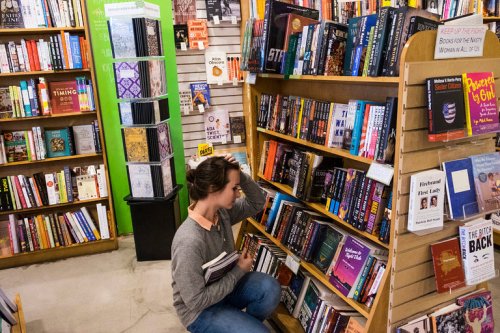
With all the reasons to travel to Nashville, one might be surprised to learn that some people come just to see a small independent bookstore. It’s true. The Book Faithful journey to Music City because they still like their novels printed on paper. They come because they’ve heard about the shop dogs, or because someone told them years ago that bookstores were moving onto the endangered species list and they wanted to see one that was thriving in its natural habitat: in a strip mall, behind Fox’s Donut Den, beside Sherwin-Williams Paint Store. Some come in hopes of seeing a favorite author read, or catching a glimpse of the author who co-owns the store.

That would be me.

Karen Hayes and I opened Parnassus Books in November 2011. This summer, when Pickles and Ice Cream Maternity went out of business, we took down the adjoining wall and doubled our space. Business is good, which, by bookstore standards, means we spring for employee health insurance and pay the rent.

Karen and I are vocal supporters of the Shop Local movement, while at the same time benefiting from the Destination Bookstore travelers. It seems as if every time I’m in the back room signing special orders or meeting with staffers to pick a book for our First Editions Club, Bill, the tall Englishman who works the front, comes to tell me a book club has just arrived from Omaha or Bangor or Sweden. I go out and pose for group pictures, recommend books, give an impromptu tour. I always ask the same question, “What made you think I’d be here?” because seriously, I’m gone a lot. They always give me the same answer: I’m not why they came. They came to see the store.

With its high wooden shelves and rolling ladders and dangling stars, Parnassus is — if I may say so myself — worth a visit, a reminder that a strip mall need not be judged by its parking lot. But there are many bookstores that could stand as the centerpiece of a vacation. Here are some categories to consider when searching for one.

Children’s Books

Before we opened Parnassus, I made a fact-finding tour of American bookstores. The best advice I got was this: If you want customers, you have to raise them yourself. That means a strong children’s section. If e-books have taken a bite out of the adult market, they’ve done very little damage to children’s books, maybe because even the most tech-savvy parents understand that reading “Goodnight Moon” off your phone doesn’t create the same occasion for bonding.

There are some knockout stores that sell nothing but children’s books, including the Curious George Store in Cambridge, Mass., Wild Rumpus in Minneapolis, Books of Wonder in New York, and Tree House Books in Ashland, Ore., as well as loads of general interest stores that do a particularly great job with their children’s section, like Women & Children First in Chicago and Greenlight Bookstore in Brooklyn.

For many of us, children’s books are the foundation of bookselling, the cornerstone, the rock on which this church is built.

Before going, be sure to check the bookstores’ events calendars for visiting authors. If I may make a sweeping generalization, children’s book authors — from those who write board books suitable for teething to those who write young adult fiction full of vampires and angst — are the nicest people on the planet. Not only will they talk to your child or young adult, they will relate to them, they will draw pictures for them, they will create an indelible link between reading and joy.

The Destination Stores

I’m not sure why you’d be going to Greenwood, Miss., except for a mad desire to see TurnRow Book Company. It’s one of the most beautiful bookstores I know, and the sheer unlikelihood of its presence makes a traveler feel she’s stumbled into an oasis in the Mississippi Delta. Thanks to the Viking Range plant, the town also has a few top-notch restaurants and a very pretty inn, but the bookstore is the reason to go.

And since you’re in Greenwood, you’ve got to go to Oxford, a town defined by its writers. You can visit Faulkner’s home as well as the bookstore, or make that bookstores. Richard Howorth, the former mayor of Oxford, has three locations on the downtown square: the original Square Books; Square Books, Jr., the children’s store; and Off Square, which sells discount books and provides space for author events. Despite the enormity of Ole Miss, these three stores are the backbone of Oxford.

When was the last time you strolled around downtown Los Angeles near Skid Row? Never? I’m from Los Angeles and it took the Last Bookstore to get me there. The store’s tagline, “What are you waiting for? We won’t be here forever,” has a suitably apocalyptic ring to it, but the place is so monumental that it’s hard to imagine it going anywhere: 22,000 square feet on three floors with new and used books, vinyl records and gallery space. The whole thing appears to have been made out of books, books that are folded and fanned and stacked into towering sculptures. The clientele is as eclectic and fascinating as the reading selection. It did my heart good to see so many tattooed kids with black nail polish and nose rings sprawled out in chairs reading books.

As long as you’re going to places you never thought you’d go, head to Plainville, Mass., to see An Unlikely Story Bookstore & Café, which I hope will soon replace Disney World as the place all parents feel duty-bound to take their children. Jeff Kinney took part of the proceeds from his juggernaut series “Diary of a Wimpy Kid” and built his hometown a four-story bookstore — the ultimate fulfillment of literary civic duty. The building contains a dazzling bookshop, event space and cafe, and the top floor will soon be a Wimpy Kid museum, complete with movie props and the model for the Wimpy Kid Macy’s Thanksgiving Day parade balloon. (How do you know that your character is reaching the heights of Snoopy? You get your own parade balloon.)

The Tiny Stores

I’m a sucker for a little bookstore. In the right hands, the limited space can set off an explosion of personality and innovation. It’s like going to a French bistro with five tables and five things on the menu: You discover they’re exactly the right five things. New York City, land of skyrocketing rents and ubiquitous nail salons, has some of the best tiny bookstores in the world, including the Corner Bookstore, 192 Books and my favorite, Three Lives & Company. Sometimes what’s lost in square footage is made up for by a brilliant staff, or maybe it’s just that the people who work in tiny stores really do know exactly where every book is located. And they’ve read them. Little bookstores give off that same warm, snug feeling one gets from reading a novel in a comfy chair. Go look at the light in Newtonville Books outside Boston, or drive down the cape to Provincetown Bookshop, that essential last stop before hitting the beach. The novelist Louise Erdrich owns the tiny Birchbark Books in Minneapolis, a store that uses a chunk of its limited space to display an elaborately carved confessional box. You’ll wish every bookstore had one.

The Venerables

In Washington you see the Vietnam Memorial, the new National Museum of African American History & Culture and Politics & Prose Bookstore. It’s where the Obamas shop, and it’s where the movers and shakers of our nation’s capital come to see what’s really going on. It also happens to be where I eat lunch, as they have the best bookstore cafe I know.

Doesn’t everyone who visits Harvard go across the street to the Harvard Book Store, a shop as esteemed as the university? When you’re finished there (it will take all day), walk down Plympton Street to Grolier Poetry Book Shop. In Cambridge a store that sells nothing but poetry seems indispensable.

But if you’re interested in Grolier’s aesthetic opposite, go to the fabulous Books & Books. It’s everything I love about Miami without any of the things I don’t love about Miami, a store where books are elevated to new heights of gorgeousness. Just walking in the door of either the Coral Gables or South Beach location makes me feel like an automatic hipster, a book hipster. I always leave with armloads of art books and travel books, things I never knew I needed but I do need desperately.

And then, of course, there’s Powell’s: an entire block, a dizzying, self-proclaimed City of Books. The fact that Portland, Ore., celebrates being defined by its independent bookstore is really all you need to know about Portland.
The Personals

I went on my first book tour in 1992 when I was 28, and I have been going on book tours ever since. I have made it a point to go to bookstores in every town I’ve ever driven through. I go both as a writer and a reader, for business and for pleasure, and I have been in love with too many to make a comprehensive list here. Still, I have to call out some of my favorites, like Boswell Book Company in Milwaukee, lit by the internal fire of one Daniel Goldin, a stupendously great bookseller. And since you’re in Milwaukee, you won’t be that far from McLean & Eakin Booksellers in Petoskey, Mich., a personal favorite that proves Northern Michigan has a lot more to offer than cherries and apples. Malaprop’s was the heart and soul of Asheville, N.C., when Asheville was a sleepy little hippie town, and it’s still its heart and soul now that the city is cool and overcrowded, a position Malaprop’s maintained by being unabashedly true to itself.

No bookstore ever made a strip mall look better than Book Passage in Corte Madera, Calif. Every author you could hope to see comes to read at Book Passage.

And then there’s Explore Booksellers in Aspen, Colo., a town that’s gotten so expensive that the bookstore would have to sell Chanel bags alongside Michael Chabon novels in order to make the rent, so a group of people got together and bought it so that the town could have a bookstore

All these bookstores will welcome you, as will those I failed to mention. They’re delicate little ecosystems based on a passion for books and a belief in community. They’re here for you, but they need your attention and support to thrive.

Of course we’d love to see you at Parnassus. The shop dogs are lazy. They pile up in the office and sleep beneath the desks, but if you ask, we’ll wake them up and send them out on the floor. When you’ve gotten your recommendations from our brilliant staff, and listened to story time in the children’s section, and seen a couple of authors (and country music stars) shopping themselves, we’ll give you advice on where to go to dinner and hear music. Or maybe you just want to sit in a quiet chair and read your new book. Go ahead, that’s what we’re here for.

Ann Patchett’s most recent novel is “Commonwealth.”

Leave a comment

Filed under 2016, bookstore

Should Novels Aim for the Heart or the Head? – The New York Times

Is it a good thing for a novel to stimulate our emotions? Montaigne, Brecht and others thought not.

Source: Should Novels Aim for the Heart or the Head? – The New York Times

The devil is in the detail. Talking about moments when excruciating gallstone pains made him believe he was soon to die, Montaigne remarks: “When I looked upon death as the end of my life, universally, then I looked upon it with indifference. Wholesale, I could master it: Retail, it savaged me; the tears of a manservant, the distributing of my wardrobe, the known touch of a hand, a routine word of comfort discomforted me and made me weep.”

It is the details that attach us to life and arouse our emotions. “A hound, a horse, a book, a wineglass and whatnot,” Montaigne observes, all “had their role in my loss.” Reasoning and accumulated wisdom, he goes on, may give us some insight into human grief, but it is the small things, picked up by ears and eyes — “organs which can be stirred by inessentials only” — that will really have an impact. So we might be aware of, but not greatly moved by, the plight of Syrian refugees until the photograph of a dead child face down in the sand triggers our emotions and has us bursting into tears.

Having made these observations, Montaigne embarks on what might best be described as a creative writing lesson in reverse. Literature, he points out, is adept at exploiting this aspect of our psychology; it focuses on evocative inessentials to stimulate our emotional response. Generally unmoved by the human condition, we nevertheless “disturb our souls with fictional laments.” It hardly even matters that they are invented: “The plaints of Dido and Ariadne in Virgil and Catullus arouse the feelings of the very people who do not believe in them.”

And he asks a question that no one asks these days: “Is it right for the arts to serve our natural weakness and to let them profit from our inborn animal-stupidity?” Aside from its astute selection of moving detail, art is constantly in the business of manipulating our emotions, as if this were an end in itself. This, after all, was Plato’s objection to the arts and every kind of artistic effect — that it was manipulative and potentially mendacious. Or simply a waste: “How often,” Montaigne asks, “do we encumber our spirits with yellow bile or sadness by means of such shadows?”

If we apply these ideas to narrative fiction as it is today, what do we find? First, the idea that a book, or film for that matter, stimulates extreme emotions is constantly deployed as a promotional tool. Terrifying, hair-raising, profoundly upsetting, painfully tender, heartbreaking, devastating, shocking, are all standard fare in dust-jacket blurbs and newspaper reviews; it is as if the reader were an ectoplasm in need of powerful injections of adrenaline. Anything that disturbs us, arouses us, unsettles us, is unconditionally positive. “You will be on the edge of your seat.” “Your heart will be thumping.” “Your pulse will be racing.” Aristotle’s response to Plato, that arousing emotion could be positive so long as the emotion was clarified, cathartically contained and understood, is rarely invoked. At best there is the implication that arousing emotions fosters sympathy, perhaps even empathy, with fictional characters and that such sympathy then breaks down our prejudices and hence is socially useful. So readers will frequently be invited to contemplate the sufferings of threatened minorities or discriminated-against ethnic groups, or the predicament of those who are young, helpless and preferably attractive. But this is an alibi and we all know it; what matters is stimulating emotion to sell books.

Similarly, creative writing courses, as far as I am able to judge, are obsessed with technique — how to arrive at that powerful detail, how to give it prominence, how to grab the reader, not why we want to grab the reader or to what end. Traditional literature courses used to reflect on the way detail was used inside a novel’s overall vision. The present zeitgeist invites us only to contemplate how the trigger can be pulled, not where the bullet is going, because the purpose of creative writing courses — especially when the fees are high — is to teach the would-be writer how to produce a publishable narrative, not a “good,” let alone a “responsible” narrative.

Montaigne is hardly alone in criticizing an overeasy excitement of the sentiments. In recent times, Bertolt Brecht objected to the stimulation of emotional identification with fictional characters, and Muriel Spark argued strongly against arousing compassion in novels; it allowed readers, she complained, to “feel that their moral responsibilities are sufficiently fulfilled by the emotions they have been induced to feel.” She advocated satire and ridicule instead as more effective tools of social criticism.

Samuel Beckett entirely rejected the idea of narrative as a vehicle for arousing emotion. Again and again he blocks any sympathy for his characters, drawing attention to their fictional status, making their suffering grotesque and comic rather than endearing. Yet even he understands how naturally narrative moves in this direction, admitting that in the final analysis even the struggle to avoid arousing emotions will confer a kind of pathos on the author.

But does it actually matter? Why not let novels stimulate emotions all they will and readers buy into them as intensely as they wish? The hell with it. What on earth could be wrong with that?

Montaigne’s comments on the evocative power of detail are not isolated. He lived in an age of division and dogmatism; the religious wars between Catholics and Huguenots lasted almost 40 years and caused countless deaths. In 1572 the St. Bartholomew’s Day Massacre alone saw thousands of Huguenots killed by their Catholic enemies. Montaigne’s position was always that we must be extremely careful about our emotions, in particular our tendency to get emotional about ideas. He didn’t advise neutrality, but simply that “we should not nail ourselves so strongly to our humors and complexions.” To foster emotions deliberately and habitually was dangerous, because once a strong emotion had kicked in it was very difficult to find a way back. Certainly, had he been alive today, he would have seen a continuity not just between violent fiction and real violence, war films and war, but also more generally between a culture that has turned the stimulation of emotion into a major industry and a society torn apart by heated conflicts of all kinds.

No civilization has ever produced as much narrative as our own, and with so little collective control. Thousands upon thousands of stories and novels are published worldwide every month. Not to mention TV series and films. There is intense competition: competition to get published, competition to win prizes, competition to reach a national audience, competition to reach an international audience. Of course there are various cards to play in that competition: wit, creativity, ideology, comedy, savviness; but the factor most frequently stressed, the one no one can do without, is emotional impact. When was the last time you heard a novel praised because it invited the reader to a higher level of intellectual engagement with complex issues? Or because it retreated from spicy detail to offer a balanced view of life overall? Or because its characters managed to handle potentially dangerous conflicts without arriving at a destructive showdown? Often as we read it seems that all the energy and creativity of the writer has been channeled into conjuring up those piquant, lurid or simply shocking details that will unleash the reader’s emotions.

How can we suppose that this state of affairs, this constant rush for the most disturbing, the most poignant, the most emphatic, the most terrifying, has no effect on the way we respond to the dramas of our lives? As I write this morning, three months after Brexit, two months after the Republican Convention nominated Donald Trump, following a summer that has seen scores of deaths from terrorism and with Aleppo still under relentless bombing, all I hear around me is violent, overheated, highly emotional rhetoric, ferocious discrediting of all adversaries, poignant details of the lives of unlucky victims, horror for the future and, beneath it all, a complacent excitement about our own capacity for feeling life intensely.

***
Tim Parks’s most recent book is “The Novel: A Survival Skill.”

Leave a comment

Filed under 2016, novel