Tag Archives: technology

The byte may destroy the book but the novel isn’t over yet

Technology has always had an effect on the form of the novel, but the story remains.

by Camilla Nelson

Source: http://theconversation.com/the-byte-may-destroy-the-book-but-the-novel-isnt-over-yet-42556?utm_medium=email&utm_campaign=Latest+from+The+Conversation+for+3+June+2015+-+2901&utm_content=Latest+from+The+Conversation+for+3+June+2015+-+2901+CID_d9aa7eed4583444a6198564d2fce1b93&utm_source=campaign_monitor&utm_term=The

In This Will Destroy That, also known as Book V, Chapter 2 of Notre Dame de Paris, Victor Hugo presents his famous argument that it was the invention of the printing press that destroyed the edifice of the gothic cathedral. Stories, hopes and dreams had once been inscribed in stone and statutory, wrote Hugo. But with the arrival of new printing technologies, literature replaced architecture.

Today, “this” may well be destroying “that” again, as the Galaxy of the Internet replaces the Gutenberg Universe. If a book is becoming something that can be downloaded from the app store, texted to your mobile phone, read in 140-character installments on Twitter, or, indeed, watched on YouTube, what will that do to literature – and particularly Hugo’s favourite literary form, the novel?

At one time, the typewriter was the cutting edge technology for novel writing.

At one time, the typewriter was the cutting edge technology for novel writing.

Debates about the future of the book are invariably informed by conversations about the death of the novel. But as far as the digital novel is concerned, it often seems we’re in – dare I say it – the analogue phase. The publishing industry mostly focuses on digital technologies as a means for content delivery – that is, on wifi as a replacement for print, ink, and trucks. In terms of fictional works specifically created for a digital environment, publishers are mostly interested in digital shorts or eBook singles.

At 10,000 words, these are longer than a short story and shorter than a printed novel, which, in every other respect, they continue to resemble.

Digital editions of classic novels are also common. Some, such as the Random House edition of Anthony Burgess’s A Clockwork Orange (1962), available from the App store, are innovatively designed, bringing the novel into dialogue with an encyclopedic array of archival materials, including Burgess’ annotated manuscript, old book covers, videos and photographs.

Also in this category is Faber’s digital edition of John Buchan’s 39 Steps (2013), in which the text unfolds within a digital landscape that you can actually explore, albeit to a limited degree, by opening a newspaper, or reading a letter.

But there is a strong sense in which novels of this sort, transplanted into what are essentially gaming-style environments for which the novel form was not designed, can be experienced as deeply frustrating. This is because the novel, and novel reading, is supported by a particular kind of consciousness that Marshall McLuhan memorably called the “Gutenberg mind”.

Novels are linear and sequential, and post-print culture is interactive and multidimensional. Novels draw the mind into deeply imagined worlds, digital culture draws the mind outward, assembling its stories in the interstices of a globally networked culture.

For the novel to become digital, writers and publishers need to think about digital media as something more than just an alternative publishing vehicle for the same old thing. The fact of being digital must eventually change the shape of the novel, and transform the language.

Far from destroying literature, or the novel genre, digital experimentation can be understood as perfectly in keeping with the history of the novel form. There have been novels in letters, novels in pictures, novels in poetry, and novels which, like Robinson Crusoe (1719), so successfully claimed to be factual accounts of actual events that they were reported in the contemporary papers as a news story. It is in the nature of the novel to constantly outrun the attempt to pin it down.

So too, technology has always transformed the novel. Take Dickens, for example, whose books were shaped by the logic of the industrial printing press and the monthly and weekly serial – comprising a long series of episodes strung together with a cliffhanger to mark the end of each installment.

So what does digital media do differently? Most obviously, digital technology is multimodal. It combines text, pictures, movement and sound. But this does not pose much of a conceptual challenge for writers, thanks, perhaps, to the extensive groundwork already laid by graphic novel.

Rather, the biggest challenge that digital technology poses to the novel is the fact that digital media isn’t linear – digital technology is multidimensional, allowing stories to expand, often wildly and unpredictably, in nonlinear patterns.

Rest of the article at: http://theconversation.com/the-byte-may-destroy-the-book-but-the-novel-isnt-over-yet-42556?utm_medium=email&utm_campaign=Latest+from+The+Conversation+for+3+June+2015+-+2901&utm_content=Latest+from+The+Conversation+for+3+June+2015+-+2901+CID_d9aa7eed4583444a6198564d2fce1b93&utm_source=campaign_monitor&utm_term=The

Leave a comment

Filed under 2015, novel

cARtOONSdAY: tHE mILLION mONKEY tYPE

Monkey at the keyboard

Some say a million monkeys at a million keyboards would eventually write something equal to Shakespeare’s works. Depends upon the monkeys. They might decide upon the million monkey march, or something a little more at play.

Leave a comment

Filed under 2012, cartoon by author, CarToonsday

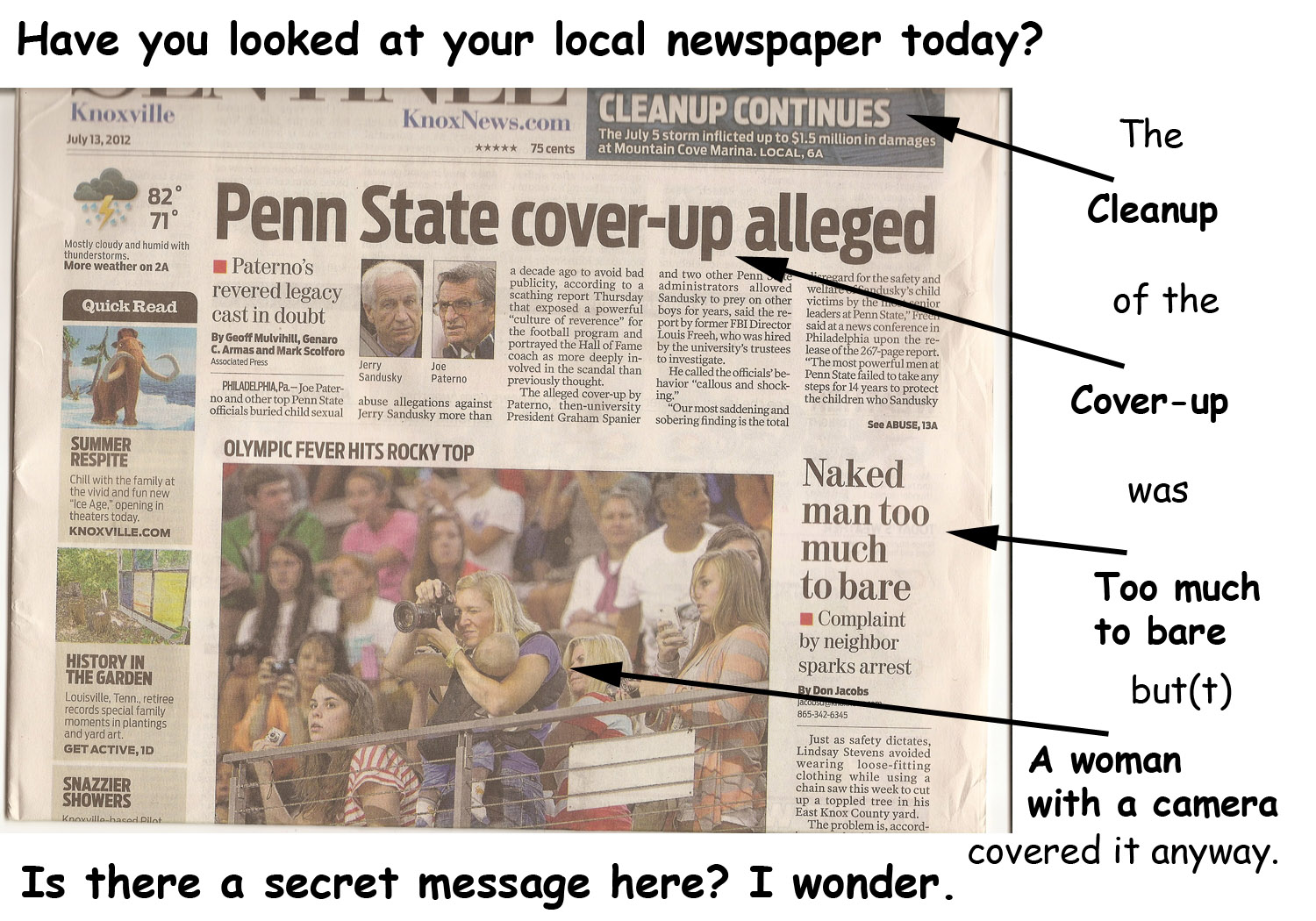
The cleanup of the cover-up was too much to bare, but a woman with a camera covered it anyway.

The cleanup of the cover-up was too much to bare

Are newspapers sending us subliminal messages? Have you checked yours, today?

2 Comments

Filed under newspaper humor

The blathering idiot and Internet dating

The blathering idiot and Zoey had decided to see other people. Well, Zoey had announced she was going to see other people. The blathering idiot saw other people every day, but that was not what Zoey meant. Reluctantly, he tried getting dates. Less than reluctantly, the women refused, some politely, some derisively, some laughing so hard they had tears streaming down their cheeks and nothing else to say. And those that did say something polite usually said that it was not about him, but about her.

Eventually, the blathering idiot turned to dating web sites such as “Oui, Hook U Up,” or OHUUP for short. Their tag line was: “We put the We back in Oui.”

For several weeks he logged in, and talked with several women, exchanging e-mails, photos, even details of things liked and things he wanted to do and try. But he was not able to get a date. At the last minute, they would have a reason why they couldn’t meet, even for coffee or a soda.

But they did keep suggesting he sign up for the Platinum Oui for a Week Club, guaranteed to get him Oui more attention.

He didn’t have the extra money for the POW Club.

He was feeling down, wondering what he was doing wrong, when he ran across Xenia at the downtown library. She was there with some of her friends and somebody other than her mother Zoey watching over them.

She asked how he was. He told her.

“Mom’s meeting some guy she met online.”

The blathering idiot nodded.

“Though I think she really misses you.”

In some ways, he missed Xenia more than Zoey.

“I think those web sites are bogus.”

He nodded.

“I have a friend whose dad tried several of them. He told my mom he was about to fly over to Russia to meet one he had chatted with online. But he began to wonder and after chatting with a few other women from the same site realized he had been talking to some sort of computer program.”

“Really?”

Xenia nodded.

“Said he was embarrassed to admit it, but didn’t want her making the same mistake. Said he thought about reporting them, but then looked at ‘that legal stuff’ he called it on the site and it said something about using staff members and bots to enhance customer satisfaction.”

The blathering idiot and internet dating

Some things are a (key) stoke of luck and some things are a (key) stroke of genius, and then some things are a (key) stroke too far.

When the blathering idiot got back to his computer, he logged into the web site, found his inbox had sixteen “oui notes” waiting for him.

Instead of reading them, he pulled up that “legal stuff” and though it was dull and at times difficult reading, he did find a section that read:

“OHUUP may, in its sole discretion, cause or allow you to be contacted by one or more Super Oui Profiles (“SOP”, “SOPs”) as a part of its “SOP” feature. A SOP may represent a person employed by OHUUP or an affiliate of OHUUP or an automated digital actor created by OHUUP. Nothing contained in an SOP is intended to describe or resemble any real person, and is included on the Website only for the personal enjoyment or entertainment of Users.

“Furthermore, SOPs are used to enhance your online experience, by (for example) stimulating communications with other Users, by introducing you to new or existing features of the Service, or by encouraging active participation on the Website. SOPs may also be used to monitor User activities and communications to ensure compliance with these Terms. In the event that the User responds to a communication from a SOP, the User may, but is not guaranteed to, receive one or more additional communications from such SOPs. Any communication between you and a SOP is for your personal enjoyment or entertainment….”

There was more, but he had read enough.

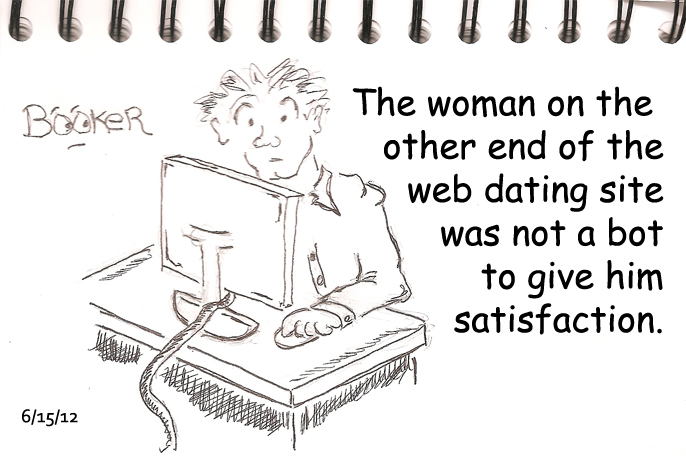
Another oui note showed up. And another. He glanced at them. Then he realized there must be some mistake. Something was amiss, or not really a miss. Somehow, he was mistakenly getting some woman’s “oui notes.” In this case, the blathering idiot decided, it was a not a bot her, but a bot him.

Leave a comment

Filed under blathering idiot, cartoon by author, Internet dating

“Hal, open the keyboard. Hal….”

Could a computer write this story?

Source: http://www.cnn.com/2012/05/11/tech/innovation/computer-assisted-writing/index.html?hpt=hp_bn11

By John Sepulvado, CNN

updated 3:21 PM EDT, Fri May 11, 2012

(CNN) — Computer applications can drive cars, fly planes, play chess and even make music.

But can an app tell a story?

Chicago-based company Narrative Science has set out to prove that computers can tell stories good enough for a fickle human audience. It has created a program that takes raw data and turns it into a story, a system that’s worked well enough for the company to earn its own byline on Forbes.com.

Kristian Hammond, Narrative Science’s chief technology officer, said his team started the program by taking baseball box scores and turning them into game summaries.

“We did college baseball,” Hammond recalled. “And we built out a system that would take box scores and historical information, and we would write a game recap after a game. And we really liked it.”

Narrative Science then began branching out into finance and other topics that are driven heavily by data. Soon, Hammond says, large companies came looking for help sorting huge amounts of data themselves.

“I think the place where this technology is absolutely essential is the area that’s loosely referred to as big data,” Hammond said. “So almost every company in the world has decided at one point that in order to do a really good job, they need to meter and monitor everything.”

Narrative Science hasn’t disclosed how much money is being made or whether a profit is being turned with the app. The firm employs about 30 people. At least one other company, based in North Carolina, is working on similar technology.

Meanwhile, Hammond says Narrative Science is looking to eventually expand into long form news stories.

That’s an idea that’s unsettling to some journalism experts.

Kevin Smith, head of the Society of Professional Journalists Ethics Committee, says he laughed when he heard about the program.

“I can remember sitting there doing high school football games on a Friday night and using three-paragraph formulas,” Smith said. “So it made me laugh, thinking they have made a computer that can do that work.”

Smith says that, ultimately, it’s going to be hard for people to share the uniquely human custom of story telling with a machine.

“I can’t imagine that a machine is going to tell a story and present it in a way that other human beings are going to accept it,” he said. “At least not at this time. I don’t see that happening. And the fact that we’re even attempting to do it — we shouldn’t be doing it.”

Other experts are not as concerned. Greg Bowers, who teaches at the Missouri School of Journalism, says computers don’t have the same capacity for pitch, emotion and story structure.

“I’m not alarmed about it as some people are,” Bowers said. “If you’re writing briefs that can be easily replicated by a computer, then you’re not trying hard enough.”

[Editor’s note: This is one half of an interesting set of articles. I will post the second one here soon. By story in this article, it doesn’t mean a fiction story or a poem. I’m not sure when, if ever, a computer application or program will be able to create a convincing fictional story. But it is something innate in humans, as the next article points out. The article deals with Alzheimer’s patience and their ability to tell stories even when they have problems with their memories.]

2 Comments

Filed under Hal, non-fiction, software application, technology, writing

E-book battles: writers pawns and prize

[Editor’s note: while not directly related to the e-book lawsuit, it is related as it pertains to Amazon, probably the biggest seller of books and e-books. As before, to find out more about the e-book lawsuit, click on e-book in the “Filed under” section at the bottom of this blog post. Thanks for stopping by.]

Source: http://www.nytimes.com/2012/04/16/business/media/amazons-e-book-pricing-a-constant-thorn-for-publishers.html?src=recg

April 15, 2012

Daring to Cut Off Amazon

New York Times

By DAVID STREITFELD

TULSA, Okla. — Plenty of people are upset at Amazon these days, but it took a small publishing company whose best-known volume is a toilet-training tome to give the mighty Internet store the boot.

The Educational Development Corporation, saying it was fed up with Amazon’s scorched-earth tactics, announced at the end of February that it would remove all its titles from the retailer’s virtual shelves. That eliminated at a stroke $1.5 million in annual sales, a move that could be a significant hit to the 46-year-old EDC’s bottom line.

“Amazon is squeezing everyone out of business,” said Randall White, EDC’s chief executive. “I don’t like that. They’re a predator. We’re better off without them.”

It is an unequal contest. EDC has 77 employees, no-frill offices on an industrial strip here and a stock-market valuation of $18 million — hardly a threat to Amazon, a Wall Street darling worth $86 billion. But Mr. White’s bold move to take his 1,800 children’s books away from the greatest retailing success of the Internet era is more evidence of the extraordinary tumult within the book world over one simple question: who gets to decide how much a book costs?

The Justice Department last week sued five major publishers and Apple on price-fixing charges, simultaneously settling with three of the houses. The publishers say they were not illegally colluding but simply taking advantage of a new device platform — Apple’s iPad — to sell their e-books in a different way, where they controlled the prices.

The publishers wanted to stop Amazon from using what one of them called “the wretched $9.99 price point,” according to court papers. Selling e-books so cheaply, they feared, would solidify Amazon’s robust grip on the business while simultaneously building a low-price mind-set among consumers that could prove ruinous to other bookstores and the publishers themselves.

EDC does not produce e-books, but saw exactly this happening with its physical inventory. Amazon was buying EDC’s books from a distributor and discounting them to the bone, just as it does with everything it sells. This might have been a boon for readers, but it was creating trouble with other retailers who carry the company’s titles, as well as with EDC’s network of independent sales agents, who market its books from their homes.

“They were becoming showrooms for Amazon,” Mr. White said. “We were shooting ourselves in the foot.”

Amazon is generally reluctant to explain its business practices and declined to comment for this article. But its executives say it is shaking up an antiquated business model by eliminating middlemen and passing the savings on to consumers. Publishers that try to cling to the past, they have said, will die.

The retailer’s growing list of critics, however, argue that Amazon has $48 billion in revenue but hardly any profit, proof that its approach is opportunistic and unsustainable. When traditional publishers, booksellers and wholesalers are destroyed, these opponents say, Amazon will be left with a monopoly that will be detrimental to the larger health of the culture.

In recent months, the dispute over Amazon’s strategy of selling books below cost has boiled over from several directions.

During the holiday season, Amazon encouraged customers to use physical stores as showrooms before ordering more cheaply online, a move that infuriated bookstores in particular. Publishers and distributors say that Amazon, never exactly shy in negotiating terms, has been more assertive in its quest for ever-better deals.

In February, Amazon demanded better margins from the Independent Publishers Group, a Chicago distributor of dozens of small imprints. IPG balked, so Amazon removed nearly 5,000 of the company’s e-books from its site.

“Amazon wants the price of books to be very, very low — lower than the publishing community can support,” said Curt Matthews, IPG’s chief executive. “Making a book is still a craft industry. Books need to be edited, to be publicized. Someone needs to say this is good and this is not. If there is not enough money to support that whole chain, the system will break down.”

Publishers have often been ambivalent about Amazon. On the one hand, it offers an extraordinarily efficient method of distributing their wares. Readers anywhere can easily order the most obscure volume and have it delivered the next day. With e-books, access is even easier, but publishers’ vulnerability is compounded; Amazon controls not just the method of distribution but the actual device the text is consumed on.

“Last year was the best in our 37 years, mainly due to the way Amazon was pushing the books,” said Bryce Milligan of Wings Press in San Antonio, an IPG client. “Then Amazon cut us off because they couldn’t get a better deal. Now our e-books sales are down 50 percent.”

If publishers and wholesalers feel threatened, writers are caught in the middle — both pawns and prize.

Ted McClelland, a writer in Chicago, had two IPG e-books dropped by Amazon. He just got a royalty statement on one of them, “Horseplayers: Life at the Track.” Half of his modest income on the book came from Kindle sales on Amazon.

“I don’t know whether Amazon is being greedy or IPG is being cheap, but I’m caught in the middle,” Mr. McClelland said. “What matters to me is getting my books back on Kindle.”

Here in Tulsa, EDC operates out of offices on the eastern outskirts in a less-than-glamorous district of warehouses and auto supply shops. Like IPG, it is primarily a distributor, selling picture books developed in England by Usborne Books to toy stores and bookshops in the United States. Its publishing line, Kane Miller, produces the popular “Everyone Poops” book and its sequels.

EDC’s so-called consultants — a direct sales force of about 7,000 women — sell to friends and acquaintances as well as their local schools. For a while the party plan was successful. Sales more than doubled from 2000 to 2004.

In recent years, though, the consultants have found it rough going. They would pass around a picture book like “The Noisy Body Book” or “Guess How Much I Miss You,” talking it up, and then the customer would order it online. Sales fell about 20 percent. Frustrated consultants began quitting.

What happened in February to Christy Reed, a sales consultant in Pleasanton, Tex., was becoming all too routine. Her school district decided to order 16 copies of a science encyclopedia and a science dictionary but then completed the deal on Amazon.

“I worked so hard to sell those books,” Mrs. Reed said. “I had to talk to so many different people. Then I lost the sale to a couple of clicks on the computer.”

She acknowledged that the district saved a few dollars but added: “I’m here, in the neighborhood. I went to school here. My kids went to school here. Yes, they got the books for less. But my earnings go back into our community. Amazon’s do not.”

After Mr. White, EDC’s chief, heard about that episode, his exasperation with Amazon peaked. Several times in the past, he had grappled with the retailer. He tried to get it to lower its discount on his books three years ago, but a tentative deal did not stick, he said. He was outraged that the company did not collect sales tax, which had the effect of making its books even cheaper.

Two months ago, he asked his biggest wholesaler, Baker & Taylor, to stop selling all EDC books to Amazon. When Baker & Taylor refused, Mr. White canceled its account. Baker & Taylor declined repeated requests to comment about EDC.

Of EDC’s $26 million in annual revenue, Baker & Taylor was responsible for about 6 percent, most of which was because of Amazon. Mr. White, a trim 70, said that when he made the decision to bail out, his blood pressure soared. But he’s also reveling in the excitement, just a little. He commissioned a drawing of EDC in the role of David taking on the giant Amazon. “I’m Type A,” he said. “I don’t mind a fight.”

Somewhat to Mr. White’s surprise, EDC is doing better without Amazon, at least for the moment. (Some of its books are still available on Amazon from third-party sellers.) Sales in March rose, in part because of new accounts like a toy store in Round Rock, Tex., that placed an initial order for 61 books. And colleagues in the business have been congratulating the publisher, or at least expressing their admiration for Mr. White’s guts.

“I tell them, ‘You never had the chance to make 7,000 women happy in one day,’ ” he said.

Leave a comment

Filed under books, e-book, publishers, publishing

E-book publishing lawsuit article / opinion

Source: http://www.nytimes.com/2012/04/16/business/media/amazon-low-prices-disguise-a-high-cost.html?_r=1

April 15, 2012

Book Publishing’s Real Nemesis

By DAVID CARR

The Justice Department finally took aim at the monopolistic monolith that threatened to dominate the book industry. So imagine the shock when the bullet aimed at threats to competition went whizzing by Amazon — which not long ago had a 90 percent stranglehold on e-books — and instead, struck five of the six biggest publishers and Apple, a minor player in the realm of books.

That’s the modern equivalent of taking on Standard Oil but breaking up Ed’s Gas ’N’ Groceries on Route 19 instead.

Last week, the Justice Department sued in United States District Court in New York, charging that Apple, Hachette, HarperCollins, Macmillan, Penguin and Simon & Schuster had colluded to fix e-book prices. (Hachette, Simon & Schuster and HarperCollins have already agreed to settle.)

The suit has its roots in 2007, when Amazon released the Kindle and began selling some of the most sought-after books for $9.99 in order to bolster sales of its device. Not surprisingly, booksellers and publishers hated this price with the force of 10,000 suns because it made physical books sold for $25 or more seen outrageously overpriced.

Under the wholesale arrangement with Amazon, the publishers received half of the list price, which yielded better money, but gave them no control over the pricing of their product. With the introduction of the iPad, publishers got a crack at remaking their deal because Apple allowed them to set the price and then took a cut of 30 percent.

That so-called agency model developed with Apple allowed publishers, not just Amazon, to set the price and in a move that caught the interest of the Justice Department, they all came up with pretty much the same price. (Why the crumbling book business is worthy of so much attention from Justice while Wall Street skates is a broader question we’ll leave for another day.)

Let’s stipulate that there may have been some manner of price-fixing here, perhaps even arranged in “private rooms for dinner in upscale Manhattan restaurants,” as the complaint darkly charged. The Justice Department is entrusted with, among other things, protecting the interests of American consumers and, given a narrow focus on price, its move on the publishers make sense.

But pull back a few thousand feet and take a broader look at the interests of consumers From the very beginning and with increasingly regularity, Amazon has used its market power to bully and dictate. It leaned on the Independent Publishers Group in recent months for better terms and when those negotiations didn’t work out, Amazon simply removed the company’s almost 5,000 e-books from its virtual shelves. The Seattle Times just published a series with examples of how Amazon uses its scale not only to keep its prices low, but its competitors at bay.

As low-margin companies trapped in a declining business with fewer outlets, book publishers face an existential threat. “If we are fixing prices for our benefit, we don’t seem to be very good at it,” said one publishing executive mordantly. (He declined to be named criticizing the lawsuit because of his involvement in the settlement.)

The deal struck with Apple also allowed other players into the e-book business, including independent bookstores. Previously, Amazon’s $9.99 subprofit price was a virtually impenetrable barrier to entry for anyone who couldn’t afford to lose millions in order to gain market share. Remember that it was only after agency pricing went into effect that Barnes & Noble was able to gain an impressive 27 percent of the e-book market.

Now Amazon has the Justice Department as an ally to rebuild its monopoly and wipe out other players. If the decision to charge the publishers was good for competition, why had the stock price of Barnes & Noble dropped more than 10 percent since Wednesday? Borders is long gone, and the possible loss of Barnes & Noble would be bad for consumer choice, online or off.

There are some ironies here. Amazon views e-books as cheap software sold to animate device sales, in this case, the Kindle. And who does that remind you of? Ah yes, Apple, which shrank music to a 99-cent single business to propel the sale of iPods.

This time, Apple is on the side of the angels, mostly because the company doesn’t have the leverage of a dominant device. Peter Kafka at AllThingsD dug out a throwaway line in the middle of the complaint from the Justice Department that said, “Apple also contemplated illegally dividing the digital content world with Amazon, allowing each to ‘own the category’ of its choice — audio/video to Apple and e-books to Amazon.”

The counterargument to the publishers’ position runs like this: why should consumers be saddled with paying an extra few dollars just to keep competition alive? In the short term, the answer seems clear. But Richard Epstein, a professor at the New York University School of Law, pointed out, “it is not clear that lower prices are necessarily in the long-term interests of the public at large.”

He said that lower prices work both ways, spelling “low costs to consumers and low royalties to authors.” Anyone who has written a book, including me, can tell you that book publishing has always been a bit of a clubby business, with uniform practices in realms beyond pricing. Among many other standards: sell your book to any publisher you wish, but you will never get more than 15 percent of net royalties on the hardcover edition.

Robert F. Levine, a lawyer with an extensive practice in publishing, said there’s a practical reason for all that uniformity. The book business is both hermetic and dwindling.

“There is not a drop of new capital coming into this business,” he said. “The margins are low and there is almost no growth, so you end up with a rather small industry, with a handful of companies and a handful of players.” Scott Turow, a big-time author who is president of the Authors Guild, worries that the club is going to get a lot smaller. “It is breathtaking to stand back and look at this and believe that this is in the public interest,” he said. “The only rationale is e-book prices will go down, for how long? What happens when there is no one left to compete with them?”

I’d be lying if I said I didn’t get a little thrill when I found out on Amazon that I could get an e-book version of “Fifty Shades of Grey,” the No. 1 book on the New York Times best-seller list, for just $9.99. But after a week of watching the Justice Department and Amazon team up, I’ve learned that low prices come with a big cost. Maybe I’ll order it at my local bookstore instead.

carr@nytimes.com; Twitter: @carr2n

[Editor’s note: you can find additional entries on this subject, by clicking on e-book listed below.]

Leave a comment

Filed under e-book, publishers, publishing

E-book pricing: possible lawsuit

[Editor’s note: This is a follow up to an article posted on this blog on 12/18/2011. Click on Category listing “e-book” below to bring up that article by Tom Dupree.]

Source: http://www.huffingtonpost.com/2012/04/10/apple-lawsuit-ebooks-doj_n_1416473.html?ncid=edlinkusaolp00000003

Apple Lawsuit: DOJ May Sue Tech Company Over eBooks As Early As Wednesday

By Diane Bartz and Poornima Gupta

4/10/2012 8:17 PM (Eastern Time)

WASHINGTON/SAN FRANCISCO, April 10 (Reuters) – The Justice Department could sue Apple Inc as early as Wednesday over alleged electronic book price-fixing, while settling with several publishers as early as this week, two people familiar with the matter said.

The Justice Department is investigating alleged price-fixing by Apple and five major publishers: CBS Corp’s Simon & Schuster Inc; HarperCollins Publishers Inc; Lagardere SCA’s Hachette Book Group; Pearson and Macmillan, a unit of Verlagsgruppe Georg von Holtzbrinck GmbH.

A lawsuit against Apple, one of the parties not in negotiations over a potential settlement, could come as early as Wednesday but no final decision had been made, the people said.

Apple declined to comment. The Justice Department and the five publishers could not be reached for comment.

The Justice Department is investigating whether deals Apple cut two years ago with the quintet of major publishers – when the consumer electronics maker launched its iPad tablet computer – were done with the intent of propping up prices for digital books, sources have said.

As part of those agreements, publishers shifted to a model that allowed them to set the price of e-books and give Apple a 30 percent cut of sales, the sources have said.

Talks between the Justice Department and some publishers had been proceeding, with settlements expected as soon as this week, one of the two sources familiar with the matter said on condition of anonymity, because the discussions were not public.

A negotiated settlement is expected to eliminate Apple’s so-called “most favored nation” status, which had prevented the publishers from selling lower-priced e-books through rival retailers such as Amazon.com Inc or Barnes & Noble Inc , sources had told Reuters last month.

But the situation was fluid, those sources said at the time.

Leave a comment

Filed under e-book, publishers, publishing

A byte of a tome: encylopedia goes online only

http://www.boston.com/news/nation/articles/2012/03/14/last_entry_for_encyclopaedia_britannica_book_form/

CHICAGO—Hours after Encyclopaedia Britannica Inc. announced it will stop publishing print editions of its flagship encyclopedia for the first time in more than 200 years, someone among the editing minions of free online rival Wikipedia made an irony-free note of that fact.

“It was announced that after 244 years, the Encyclopaedia Britannica is going out of print, instead focusing on its online encyclopedia,” the entry read.

The book-form of Encyclopaedia Britannica has been in print since it was first published in Edinburgh, Scotland, in 1768. It will stop being available when the current stock runs out, the company said. The Chicago-based company will continue to offer digital versions.

Officials said the end of the printed, 32-volume set has been foreseen for some time.

“This has nothing to do with Wikipedia or Google,” Encyclopaedia Britannica Inc. President Jorge Cauz said. “This has to do with the fact that now Britannica sells its digital products to a large number of people.”

The top year for the printed encyclopedia was 1990, when 120,000 sets were sold, Cauz said. That number fell to 40,000 just six years later in 1996, he said. The company started exploring digital publishing in the 1970s. The first CD-ROM edition was published in 1989 and a version went online in 1994.

The final hardcover encyclopedia set is available for sale at Britannica’s website for $1,395.

“The sales of printed encyclopedias have been negligible for several years,” Cauz said. “We knew this was going to come.”

The company plans to mark the end of the print version by making the contents of its website available free for one week, starting Tuesday.

Online versions of the encyclopedia now serve more than 100 million people around the world and are available on mobile devices, the company said. The encyclopedia has become increasingly social as well, Cauz said, because users can send comments to editors.

“A printed encyclopedia is obsolete the minute that you print it,” Cauz said. “Whereas our online edition is updated continuously.”

Lynne Kobayashi of the Language, Literature & History section of the Hawaii State Library notes some people will always prefer using print sources, but that readers are becoming attuned to online searching because of a proliferation of electronic publishing.

“There are many advantages to online searching, chief among them the ability to search within the text,” Kobayashi said. “The major disadvantage is the need for a computer or devices with access to the Internet.”

Kobayashi said her decision to use traditional or online resources depends on the question she wants answered.

“Sometimes subject knowledge and familiarity with standard resources may get faster results than keying in a search and sifting through results,” she said. “If the search is broader, searching across several online sources may yield more options.”

Britannica has thousands of experts’ contributors from around the world, including Nobel laureates and world leaders such as former President Bill Clinton and Archbishop Desmond Tutu. It also has a staff of more than 100 editors.

“To me, the most important message is that the printed edition was not what made Britannica,” Cauz said. “The most important thing about Britannica is that Britannica is relevant and vibrant because it brings scholarly knowledge to an editorial process to as many knowledge seekers as possible.”

Kobayashi said as information professionals, librarians see an important part of their role as directing patrons to trustworthy information sources.

“While Wikipedia has become ubiquitous, the Britannica remains a consistently more reliable source,” she said.

——

Online: http://www.britannica.com

Leave a comment

Filed under encylopedia, online, publishing