
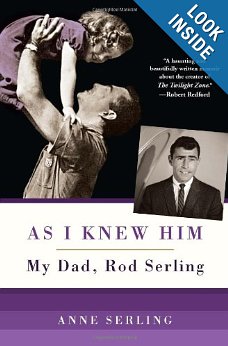
One of the books published recently about Rod Serling.
With the recent publication of
Serling: The Rise and Twilight of TV’s Last Angry Man by Gordon F. Sander, and
As I Knew Him: my Dad, Rod Serling by his youngest daughter Anne Serling, it seems the interest in Rod Serling and his seminal work on the TV show
The Twilight Zone will not go away.
For several years I have been working on a novel entitled A Small Resurrection. Below is brief pitch for the novel and below that the first Act (chapter) of the novel:
Is believing in what you see the same thing as seeing what you believe in?
Knoxville, Tennessee, is the last place T. Xavier Gabriel wants to be. But the director of the 8th highest grossing film in Hollywood has come to town to ask his ex-wife for forbearance in paying the large alimony and possibly also for a loan to help restart his fallen career. She, however, has other plans. She wants him to rescue their 22-year-old daughter from the undue influences of a 24-year-old evangelical preacher. Gabriel wants nothing to do with that, having already admitted to be a failure once as a father, he doesn’t want a second bite of the apple. But when he finds his daughter keeping company with a resurrected Rod Serling, he sees a chance to use this Serling look-alike to resurrect his own career. But getting Serling away from his daughter puts her in jeopardy, and Gabriel must decide if he is going to save her or save his career. To save her, he must enlist the aid of Serling, who is not quite sure who he is or why he has been resurrected, and in saving her he puts an end ever resurrecting his career.
A SMALL RESURRECTION
by DAVID E. BOOKER
Act I: One More Pallbearer
A prop woman readied the coffin. At the behest of the director, she walked up and down the length of the three-foot deep grave, adjusting the bier’s position by the hole and trying not to knock free any of the flat-black paint sprayed on the soil to give it depth.
“No, no. A little more to the right, babe. There you go, that’s it.” T. Xavier Gabriel glanced through the camera’s viewfinder and clapped his hands. “Okay, people, places everybody. Time is on the short.” He checked the filter on one of the cameras as four banks of Klieg lights were turned on and three separate lights repositioned.
“Hey, dim the lights,” Gabriel said. “This is supposed to be a night scene: Night scene. See the stars.” He pointed skyward, but saw instead that it was overcast with lightning dancing among the clouds.
“Damn,” he muttered.
Several of the crew laughed lowly.
He shook his head. Another snafu in the making. “Damn. Goddamn.”
Gabriel glanced at his watch: 11:47 p.m. Post mortem. Pre migraine. Petty and mundane. He stomped his foot. It was a child-like gesture, but nothing adult-like seemed to be working now or for any part of 1985 that he’d directly had a hand in.
“Places everybody. Places. We shoot in fifteen minutes. Fifteen minutes. Places.” The assistant director walked around waving a flashlight and a clipboard. “Time is on the short.”
Gabriel smiled. It was a stiff, brittle, unsure smile: a guest at the funeral home smile. “Time is on the short” was his personal euphemism for running into overtime, something he had already been crucified for more than once. He rubbed his forehead and wondered if he’d ever get back to Hollywood, or if he’d spend the rest of his life in commercials, talking to semi trained mammals and now mimics of a dead man.
He glanced at the crumpled note still wadded in his hand. His ex-wife could find him anywhere. Two hours earlier he’d made the mistake of answering the phone.
#
“Wanda—”
“My name’s Drucilla. Sister Drucilla now. Wanda was my pagan name.”
“Whatever.”
“Don’t take that tone with me!”
“And don’t pester me about coming to Tennessee. Or alimony.”
“Prick that you are – Lord forgive me my wicked mouth – you might be the only one who can save her.”
“She’s not back into drugs, is she?”
“Worse.”
“Worse?”
“She’s into religion.”
“But you’re into religion.”
“Hers is the wrong kind.”
To Gabriel they were all the wrong kind.
“Listen, Gabe, you come and get here away from this cult and I’ll forgive you all the back alimony you owe me. Deal?”
As he paused to consider her offer, he could, again, smell the scent of her lilac perfume as if she were standing near him. The memory of the sent was so immediate that he glanced around the small room in the small trailer, expecting to see her standing nearby … glaring at him. Fortunately, she wasn’t.
“I’ll think about it,” Gabriel said
“It’s a more generous offer than you deserve.”
“I’ll think about it.”
“It’s only on the table for two days.”
“I said I’ll think about it.” He racked the receiver. There was no satisfaction in it.
#
Thunder rumbled from the edge of the horizon.
A production assistant walked up to him and handed him a message. Gabriel glanced at it.
Acid poured into his stomach.
#
“Fourteen minutes, people.”
Three prop men tested the rainheads, readying them to make rain. This would be the forty seventh attempt. One fourth of an inch of water stood in several places where it had not rained naturally in two and a half months. A gust of wind shook a bank of lights.
“Somebody anchor that damn thing down,” Gabriel said. He wished he had a drink. Something long and tall and cool to take The Edge off. Or even something stout and rolled and fiery. Or maybe even something white and powdery and inhaled. He had learned to be less picky recently in several areas of his life.
The Klieg lights died: flickering, then fading like the headlights of two dozen cars. A swath of lightning, as in a 1940s film noir, flashed over Gabriel’s shoulder, highlighting him in silhouette and casting his shadow among the trampled brown grass in front of him. It was exactly the effect he had been trying for in the past forty six attempts.
Part of the lights came back on. Technicians scurried to bring the others back to life. The mimic was standing near a single light draped with spun glass to diffuse its glare. Its position to him and his to the other lights cast his face and body in predominant dimness, smudging even further his strongly derivative features. But even in total darkness, Gabriel doubted he could see the similarity between this man and the dead host of The Twilight Zone: Rod Serling.
But the owners of Walton’s Funeral Homes insisted there was similarity, especially since they had chosen him from a list of sixty four candidates. “Besides, he has that sort of all American patriotic look, too,” Walton’s representative to the set had said. “And we want to work that aspect into the commercial. After all, our caskets are made in America.”
The other besides, the one not mentioned was that this mimic was the best they could afford on the budget they had. Gabriel had insisted on and won the battle for a complete professional crew and the better mimics had all been signed by an advertising conglomerate. Ten years after his death, imitating Rod Serling was a lively business. Imitators had been appearing everywhere, selling almost everything from late-night hamburgers to children’s board games to trips through a car wash. Even people who only knew about The Twilight Zone second- or third-hand recognized the clones, though many of them were referred to as Sterlings.
A large rain drop hit Gabriel squarely in the middle of his mostly bald head. His hair had started falling out in droves since he had turned fifty.
The rest of the lights flickered on. Gabriel grabbed a bull horn. “Okay, everybody. We start in five minutes. Five minutes. Get the mimic.”
Maybe this time they could get it right. Then get the hell out of here. He wasn’t superstitious, or so he told himself. He had made a conscientious effort to rid himself of that when he rid himself of his religious convictions. Still, the idea of being in a graveyard at midnight sent little twinges up the small of his back.
The mimic moved toward Gabriel, his hands clasped in front of him, his head cocked slightly to one side, trying desperately to take staccato steps. It wasn’t working.
A seemingly endless network of wires and cables from portable generators and control equipment preceded the mimic, web like, along the ground. It curled toward the casket, then away, into the night, as if afraid of the light. A technician picked up a trunk line and moved it out of the way.
Gabriel turned around, the bull horn near his lips. “Places everyone, the mimic has arrived. All prepare to receive him and pay him homage.”
“Hosannah. Hosannah in the highest,” the assistant director said, drawing disembodied laughter from the darkness behind the lights.
A jet rumbled by, low and directly overhead. The graveyard echoed briefly with its presence. Lightning flashed as it passed, its fuselage, as if photographed, briefly glowing an eerie bright blue. Its image hung in the air well into the first peal of thunder.
John Wilson Johnson, the mimic, moved toward the coffin, taking his time, stepping over electric wire spider boxes as if he were a hero on parade to the guillotine.
Johnson passed Gabriel and flashed the broadest smile his face would allow. “It is fixed.”
Gabriel nodded and flashed back a smile, his jaw muscles tight with the pressure of wanting to get it over with. Though he couldn’t see her, he knew the Walton’s representative was somewhere in the dark, spying, keeping an eye on him, on the time, on the cost.
Johnson walked around the coffin twice, touched it, then closed his eyes and began reciting Shakespeare. A workman finished soaking up the last puddles of water next to the casket and hurried out of Johnson’s way.
A smattering of raindrops splattered against the equipment. Everything held. Workman rushed in and wiped off the coffin, quickly checking the ground around it.
The crew quieted, except for the goosh goosh goosh of a tapping foot against a thin film of water.
“Silence! I must get into my role.”
Gabriel stopped tapping. Instead, he crossed his arms first one way, then another.
Johnson looked down at the coffin and stroked it gently, as if attempting to tame it. “‘There is a history in all men’s lives, Figuring the nature of the times deceas’d.’”
He glanced at the dummy hole. “‘A little, little grave, an obscure grave.’”
Then Johnson turned to the crowd. “‘No longer mourn for me when I am dead/ Than you shall hear the surly sullen bell.’”
First one, then two bolts of lightning snapped through the air.
“Get in the coffin.” Gabriel stepped toward the mimic: then stopped. Yelling at this guy only served to make him leave the scene. He lowered his voice to barely above a whisper. “Get in the box. It’s about to rain and we would all like to get out of here. Pleeessse.” The please squeaked as if spoken by a rusty gate.
“‘Good night, good night! parting is such sweet sorrow.’”
Gabriel took another step toward Johnson, his voice still restrained. “‘Youth’s a stuff will not endure.’”
Johnson backed away, waving his hands in a flourish as if throwing off chains. “‘O! that this too too solid flesh would melt, Thaw, and resolve itself into a dew.’”
“‘Nothing in his life/ Became him like the leaving it.’” Gabriel rushed forward and grabbed Johnson by the coat sleeve. “Claustrophobia or no claustrophobia, get in the damn box: now!”
Johnson turned toward Gabriel, reached down and gently removed his hand. “I was only trying to get into the role. Rodman Edward Sterling, after all, was a great admirer of the Bard. There could be a Clio in this, if it is done right.”
“Undoubtedly.” Gabriel pointed to the coffin. “But enough is enough. Get in the box.”
“But–”
“No buts. Do as I say.” Gabriel clenched his teeth. He tasted bile in the back of his throat. Undoubtedly this commercial was not going to win a Clio, or any other advertising award.
Johnson stepped toward the casket, hesitated, then climbed down inside, mumbling something about “‘The strain of man’s bred…,’” and finally saying as he crossed his arms: “‘But now I am cabin’d, confin’d, bound in/ To saucy doubts and fears.’”
Gabriel waited, then walked over and closed the lower lid. “Uncross your arms.”
“You’ll lose the effect if I uncross my arms.” Johnson averted his glance to Gabriel’s right hand resting on the lip of the upper lid. “It … it won’t be visually grabbing.”
“Let me worry about that.” He worked the lid, partly without thinking, then realizing that he had the mimic’s undivided attention. The lid had accidentally closed three times already, and it wasn’t easy for someone inside the small space to get it back open by himself.
“I think–”
“Don’t! You’re not paid to. Do as you’re told and we can all go home for a very late supper.” Gabriel worked the lid down and up until he had it and Johnson in the positions he wanted. “Now uncross your arms and clasp your hands in front of you at belt level. Like this.” Gabriel demonstrated and Johnson followed suit. “Very good.” He stepped back and turned to the crew. “Okay, everybody, places. Places. Let’s see if we can get this right this time.” He wiped his hand across his face and looked skyward. For a moment, he crossed his fingers.
Gabriel hoped to instill the sensation of the ground curving upward (created by the distortion in a wide angle lens) and opening as if it was going to swallow the viewer. It was the reverse of what Hitchcock had done in Vertigo. Hitchcock had had the luxury of a very good model. Gabriel did not. He only hoped the sensation, which would last only a few seconds — then the commercial would hard cut to a medium close up, the job of the second camera, which would then move into a tight shot — would obscure his use of a cheap clay and plastic creation.
Finally, the commercial would end on a long shot with a voice over dissolving into the muffled patter of cold, heavy, special effects created raindrops. Even the sound would be created. But only the opening shot had been filmed, in a small corner of a rented studio, and that had taken twenty seven tries.
It began pouring rain.
The ground shook for a moment.
The coffin lid snapped shut.
Gabriel stood in the rain as the rest of the crew scurried about, trying to save as much of the delicate equipment as they could. Two Klieg lights popped and died. Water dripped down their faces, almost tears.
It had all seemed so easy when he started. After all, how hard could it be to find, in New York, a Rod Serling look alike? Somebody who looked a little like him, who sounded a little like him, a sort of human palimpsest who could say, in plain, staccato English: “Submitted for your approval … the need to face the inevitable. The need to plan for the day when you can no longer play, when the endless turmoil of life has reached its final quietude. Don’t you deserve your day of rest? Don’t your loved ones? Then why don’t you make your arrangements, today, at Walton’s Funeral Homes.” Not parlors. They were no longer called parlors. Parlors were passé. “Sixteen convenient locations in the Greater New York Metropolitan Area to serve you. Ask about our American Plan, where your tax refund automatically goes to establish yours and your family’s day of rest. Or you, too, may be left out … in The Twilight Zone.”
#
The Walton’s representative, decked in a black raincoat, sinewed toward him. Gabriel slipped his hands into his pants pockets. The woman reminded him of a childhood teacher: nice looking (thinking back on it), but definitely a knuckle rapper.
At the last moment, he darted over to the coffin, figuring he could use the excuse of helping the mimic as a reason to avoid the rep. He gripped the lid and pulled it open.
Inside lay Rod Serling … the real Rod Serling.
Gabriel let go of the lid and it slapped shut again.
He almost didn’t re-open it.
#
He had not seen the real Rod Serling, Gabriel told himself, two hours later, sitting in a dry, dilapidated bar about to close. Dead men don’t rise from the dead: not now, not ever.
He raised his glass, curling it back toward himself as if to examine it. “Alas, poor Rodman, I knew him well.” He had, in a “former” life, a younger, enthusiastic life, directed two Zone episodes.
He tasted his first drink. He was sure there was plaster dust mixed in it. The rain had let up in intensity, but not in intent. Ask for Serling and you get….
Gabriel looked around. The room was peopled with tired, sad faces that matched the decor. Both looked as if they were on the lip of the real world. It was then he noticed the awkwardly hand lettered Going Out of Business sign behind the bar.
A middle aged man in a rumbled suit plunked down across from him. “Crying, fucking shame they’re closing this place down, ain’t it?”
“Huh?” Gabriel felt the man’s weight hit the faded red booth seat before he turned and saw him.
“Place’s been open nearly fifty years.” The man leaned slightly toward Gabriel as if Gabriel had a hearing problem. “You know, friend, when my father opened this place, farmers used to drink here when it first opened. Farmers for Chrissake. They’d come and have a drink or two and talk about things. Really talk. It was a neighborhood bar then.” The more he spoke, losing words and repeating others, the louder he got, and the more drunk Gabriel realized he was. “Now, just ’cause I’m in a pinch, they’re going to turn this into some fucking yuppie thing or other. A glorified pick up joint.”
”Fast food and fast bars.” Gabriel wished the man would go away: fast.
The man snorted. “You got that right, friend. And you know what, I hear they have one of those Sterling impersonators lined up to promote the place, even before it’s open.” He then got up and walked to another table, where he sat down and began his sermon again.
Gabriel finished the drink and ordered another one. Unfortunately, his last. The waitress told him the place was closing early so the workers could have one last private cry before going home for good. Then she apologized for the owner: the man in the gray rumbled suit. “He started early.”
She reached for the glass, but Gabriel refused to relinquish it until he had another full one. It was his assurance “Cutie” would return. She had told him her name, but he liked “Cutie” better, easier to remember.
He held the empty glass, staring at the bottom. He felt surer than ever, though he no longer believed in them, that it would take a miracle to save his flagging career. “Lord, ‘…Take away this cup from me….’” He snickered and then cursed himself for backsliding. His ex-wife would say there was yet hope for him; his daughter would be ecstatic. Both wanted to see him for their own reasons. For his own reasons, he had avoided going to Tennessee to see them.
The last drink arrived. It was double the size he expected. Gabriel raised himself in his booth and turned his head to thank the bartender. Standing behind the bar was a short man with dark hair in jacket and tie. He looked like—
He snatched the glass from the waitress.
He slumped in his booth and gulped his drink before trying to look at the bar again. If the inevitable was coming, it certainly wasn’t going to catch him sober.
When he looked again, what he saw behind the bar was not Rod Serling. At least not now.






 Booker's Blog