Tag Archives: Sunday

The root of over 400 languages?

Mysterious Indo-European homeland may have been in the steppes of Ukraine and Russia

by Michael Balter

Source: http://news.sciencemag.org/archaeology/2015/02/mysterious-indo-european-homeland-may-have-been-steppes-ukraine-and-russia?utm_source=facebook&utm_medium=social&utm_campaign=facebook

What do you call a male sibling? If you speak English, he is your “brother.” Greek? Call him “phrater.” Sanskrit, Latin, Old Irish? “Bhrater,” “frater,” or “brathir,” respectively. Ever since the mid-17th century, scholars have noted such similarities among the so-called Indo-European languages, which span the world and number more than 400 if dialects are included. Researchers agree that they can probably all be traced back to one ancestral language, called Proto-Indo-European (PIE). But for nearly 20 years, scholars have debated vehemently when and where PIE arose.

Two long-awaited studies, one described online this week in a preprint and another scheduled for publication later this month, have now used different methods to support one leading hypothesis: that PIE was first spoken by pastoral herders who lived in the vast steppe lands north of the Black Sea beginning about 6000 years ago. One study points out that these steppe land herders have left their genetic mark on most Europeans living today.

The studies’ conclusions emerge from state-of-the-art ancient DNA and linguistic analyses, but the debate over PIE’s origins is likely to continue. A rival hypothesis—that early farmers living in Anatolia (modern Turkey) about 8000 years ago were the original PIE speakers—is not ruled out by the new analyses, most agree. Although the steppe hypothesis has now received a major boost, “I would not say the Anatolian hypothesis has been killed,” says Carles Lalueza-Fox, a geneticist at Pompeu Fabra University in Barcelona, Spain, who participated in neither of the new studies.

Up until the 1980s, variations of the steppe hypothesis held sway among most linguists and archaeologists tracking down Indo-European’s birthplace. Then in 1987, archaeologist Colin Renfrew of the University of Cambridge in the United Kingdom proposed that PIE spread with farming from its origins in the Fertile Crescent of the Middle East, moving west into Europe and east further into Asia; over time the languages continued to spread and diversify into the many Indo-European languages we know today.

Traditional linguists, meanwhile, painstakingly reconstructed PIE by extrapolating back from modern languages and ancient writings. (Listen to a short fable spoken in PIE here: http://news.sciencemag.org/2015/02/sound-proto-indo-european.) They disdained Renfrew’s idea of an Anatolian homeland, arguing for example that the languages were still too similar to have begun diverging 8000 years ago.
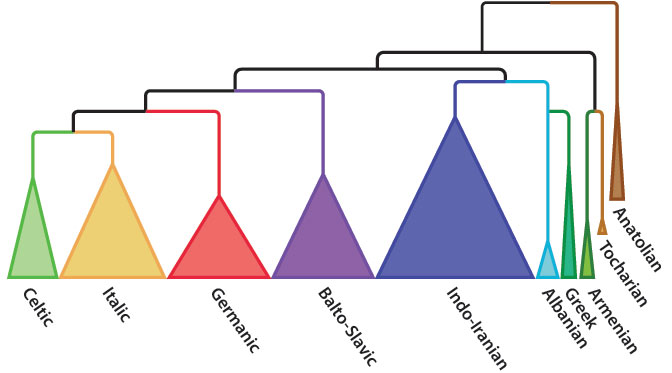
More than 400 Indo-European languages diverged from a common ancestral tongue; the earliest ones (top right), Anatolian and Tocharian, arose in today’s Turkey and China, respectively.

More than 400 Indo-European languages diverged from a common ancestral tongue; the earliest ones (top right), Anatolian and Tocharian, arose in today’s Turkey and China, respectively.

Rest of the article: http://news.sciencemag.org/archaeology/2015/02/mysterious-indo-european-homeland-may-have-been-steppes-ukraine-and-russia?utm_source=facebook&utm_medium=social&utm_campaign=facebook

1 Comment

Filed under language

New words to live by: “Cacklebrain”

It is the first or second weekend of the month and time, once again, for a new word to live by. This is a word or phrase not currently in use in the U.S. English lexicon, but might need to be considered. Other words, such as obsurd, crumpify, subsus, flib, congressed, and others, can be found by clicking on the tags below. Today’s New Word is a compounding of two words cackle and brain. Without further chattering, cacklebrain is the new word / phrase for this month:

Cackle, n. 1) chatter or idle talk. 2) a form of laughter, usually shrill and broken in nature. 3) the sound of such laughter.

(There is also a verb form meaning idle talk, prattle, or to sound like a hen, or laugh in a shrill, broken manner, but the noun form is more what we are interested in here.)

Brain, n. Anatomy. That oblong organ sitting on top of your neck, enclosed in cranium, composed of two halves of convoluted gray and white matter directing your central nervous system.

How about Cacklebrain?

Cacklebrain, n. A person whose brain and mouth are full of shrill, idle patter, laughter always at somebody else’s expense, and an overweening sense of self-importance. In short, to motor your mouth with your mind in neutral and think you have said something profound. Example, most Fox network commentators. Example, Sarah Palin.

Cacklebrain is related to loopid another New Word. Exposure to Cacklebrains is a strong sign of Loopidity, a spiraling condition from which few escape.

Leave a comment

Filed under new word, New words to live by

A bit of old news: “Poetry and politics don’t mix”

For S.C.’s Poet Laureate, An Inauguration Poem Without An Inaugural Audience

by LAURA SULLIVAN

Source: http://www.npr.org/blogs/thetwo-way/2015/01/14/377028376/for-s-c-s-poet-laureate-an-inauguration-poem-without-an-inaugural-audience

South Carolina's Poet Laureate Marjory Wentworth snubbed at recent GOP governor's inauguration.

South Carolina’s Poet Laureate Marjory Wentworth snubbed at recent GOP governor’s inauguration.

South Carolina Gov. Nikki Haley starts her second term today. But absent from the inaugural ceremony will be a long-standing tradition: a poem read by the state’s poet laureate.

State officials say they cut the two-minute poem for time, but some residents suspect it was the mention of slavery that got it tossed.

Poet Laureate Marjory Wentworth has written poems for South Carolina’s past three inaugurations. She describes those efforts as “safe.”

The poems leaned heavily on nature and animals.

But this year, she says, she was moved watching the protests across the country ignited by the deaths of unarmed black men. She wanted to incorporate some of that subject matter into her writing.

She took to Facebook and asked South Carolina’s residents their opinions and asked them to tell her what they thought she should write about.

“Some of them were quite beautiful,” she said of the posts she got.

Many suggested that the sensitive topic of slavery was the reason the poem was snubbed.

The rest of the story at: http://www.npr.org/blogs/thetwo-way/2015/01/14/377028376/for-s-c-s-poet-laureate-an-inauguration-poem-without-an-inaugural-audience

Leave a comment

Filed under poetry, politics

Twenty-four things about publishing…

24 Things No One Tells You About Book Publishing

Ten years ago, my first novel Prep came out. Three novels later, here’s what I’ve learned about the publishing industry and writing since then.

by Curtis Sittenfeld

Writing is only part of the mystery.

Writing is only part of the mystery.

Source: http://www.buzzfeed.com/curtissittenfeld/things-no-one-ever-tells-you-about-the-publishing-industry?bffbbooks

  1. When it comes to fellow writers, don’t buy into the narcissism of small differences. In all their neurotic, competitive, smart, funny glory, other writers are your friends.
  2. Unless you’re Stephen King, or you’re standing inside your own publishing house, assume that nobody you meet has ever heard of you or your books. If they have, you can be pleasantly surprised.
  3. At a reading, 25 audience members and 20 chairs is better than 200 audience members and 600 chairs.
  4. There are very different ways people can ask a published writer for the same favor. Polite, succinct, and preemptively letting you off the hook is most effective.
  5. Blurbs achieve almost nothing, everyone in publishing knows it, and everyone in publishing hates them.
  6. But a really good blurb from the right person can, occasionally, make a book take off.
  7. When your book is on best-seller lists, people find you more amusing and respond to your emails faster.
  8. When your book isn’t on best-seller lists, your life is calmer and you have more time to write.
  9. The older you are when your first book is published, the less gratuitous resentment will be directed at you.
  10. The goal is not to be a media darling; the goal is to have a career.
  11. The farther you live from New York, the less preoccupied you’ll be with literary gossip. Like cayenne pepper, literary gossip is tastiest in small doses.
  12. Contrary to stereotype, most book publicists aren’t fast-talking, vapid manipulators; they’re usually warm, organized youngish women (yes, they are almost all women) who love to read.
  13. Female writers are asked more frequently about all of the following topics than male writers: whether their work is autobiographical; whether their characters are likable; whether their unlikable characters are unlikable on purpose or the writer didn’t realize what she was doing; how they manage to write after having children.

For the other eleven, go to: http://www.buzzfeed.com/curtissittenfeld/things-no-one-ever-tells-you-about-the-publishing-industry?bffbbooks

Leave a comment

Filed under publishing, publishing news

Author regrets writing story

“Brokeback Mountain” author Annie Proulx says she regrets writing the story

by Daisy Wyatt

Source: http://www.independent.co.uk/arts-entertainment/books/news/brokeback-mountain-author-annie-proulx-says-she-regrets-writing-the-story-9949636.html

Annie Proulx has said she regrets writing “Brokeback Mountain” due to the number of men who have written to her complaining about the story’s ending.

The US author said she wishes she had not written the short story after the “hassle and problems and irritation” she received after the film came out in 2005.

“So many people have completely misunderstood the story. I think it’s important to leave spaces in a story for readers to fill in from their own experience, but unfortunately the audience that ‘Brokeback’ reached most strongly have powerful fantasy lives,” Proulx said in an interview with the Paris Review.

“And one of the reasons we keep the gates locked here is that a lot of men have decided that the story should have had a happy ending. They can’t bear the way it ends – they just can’t stand it.

“So they rewrite the story, including all kinds of boyfriends and new lovers and so forth after Jack is killed. And it just drives me wild.”

The author said the majority of letters she received complaining about the film’s ending began “I’m not gay, but…” and added that she was frustrated the men did not seem to understand that the story was not about the lead characters Jack and Ennis.

“It’s about homophobia; it’s about a social situation; it’s about a place and a particular mindset and morality. They just don’t get it,” she said.

Rest of the article at: http://www.independent.co.uk/arts-entertainment/books/news/brokeback-mountain-author-annie-proulx-says-she-regrets-writing-the-story-9949636.html

Leave a comment

Filed under author commentary, author interview

Throw up

by David E. Booker

I throw up for no good reason:
any time and any season.
A piece of lint is in the air.
It floated up from my underwear.
It is there now; it frightened me.
I’ll either throw up or go pee pee.
I can see now my sensitive ways
cause my parents problems many days.
When we travel for hours in a car
they have wonder just how far
we can go before I begin
to say, “I’m sensitive to throwing up again.”
I take a deep breath and feel the bile.
Has it only been a little while?
My older brother sits next to me.
He hopes I’ll hurl on my DVD.
We still have many miles to go
but I don’t have that much self-control.
A bug goes SPLAT against the window.
I can feel my tummy start to billow.
That bug’s guts are the color
of what I’ll throw up from my supper.
I throw up for no good reason:
any time and any season.
Even when I feel I’m okay,
my stomach throws up just like I say.

Leave a comment

Filed under poetry by author

The Millions: A Year in Reading: Tom Nissley

The Millions : A Year in Reading: Tom Nissley.

I did something in 2014 that would throw a wrench into anyone’s reading: I bought a bookstore. Selling books, as I wasn’t surprised to find, doesn’t leave much time for reading them. Also, it meant I became — not for the first time, but never so publicly, on such a daily basis — a professional reader, as many of us are lucky to end up being in one way or another, as teachers or editors or researchers or some other line of work that corrals your attention from the luxury of polymorphous curiosity into something more traditionally productive, in my case trying to keep up with some of the new releases I might be able to share with my customers.

So, early in the year, my reading shifted back from personal to pro, but there were good books on both sides of the divide. And aside from a few favorites (see below), what I find myself remembering as vivid reading experiences are not consistently excellent books like Marilynne Robinson’s Lila, Ben Lerner’s 10:04, David Markson’s Reader’s Block, Vera Brittain’s Testament of Youth, Lawrence Wright’s Thirteen Days in September, Tove Jansson’s The Summer Book, Jeff VanderMeer’s Annihilation, Edward Hirsch’s Gabriel, Brendan Koerner’s The Skies Belong to Us, and William Gibson’s The Peripheral — all very good books I’d happily put in your hands if you walked into my store — but the more jagged-edged books I might hand you with a caveat.

I remember, with delight, the first half of Anthony Trollope’s The Eustace Diamonds — “Finally reading Trollope,” I told everyone, or, rather, tweeted. “What took me so long to sample this deliciousness?” — before his stamina started to outlast mine. I was delighted too with the first half of Joseph O’Neill’s The Dog and the voice he captured, as companionable as Netherland’s but more chilling (like P.G. Wodehouse telling a J.G. Ballard story), even if for me that voice never grew into a full book. I admired and enjoyed Farther and Wilder, Blake Bailey’s biography of Charles Jackson, but I wondered if his subject was worth his talents until the final third — usually the least interesting in any biography — when Jackson’s accumulated troubles, and his belated reckoning with them, made his life profoundly moving. And though Joel Selvin’s Here Comes the Night had for me a hole at its center == the interior life of its ostensible subject, unsung record man Bert Berns, remained a cipher — I loved Selvin’s hepcat riffs on Berns and his fellow “centurions of pop.”

The rest of the article at: http://www.themillions.com/2014/12/a-year-in-reading-tom-nissley.html

1 Comment

Filed under books

Sunday silliness: “They’re back!”

Charlie Brown, Snoopy, Woodstock, and friends blow in for the holiday season.

Charlie Brown, Snoopy, Woodstock, and friends blow in for the holiday season.

And they brought a friend and some fun.

And they brought a friend and some fun.

Just when you think it is safe to go outside, to enjoy the season, to appreciate the outdoor decorations … you come across this!

Keep you distance … for if you dare and cross through the candy cane arch you will enter a world of both of silliness and air, strange lights and odd shapes, dark corners and strange surprises. You will have just crossed over … into the Holiday Zone.

Leave a comment

Filed under holiday decor, Inflatables, Sunday silliness

#giveabook

#giveabook

#giveabook

The New York City book publisher is preparing for a holiday social media campaign that aims at encouraging people to offer books to friends as holiday gifts while also helping children’s rights organization Save the Children. – See more at: http://www.wow-dude.net/article/242/Penguin-Random-House-to-donate-a-book-every-time-some-uses-the-GiveaBook-hashtag.html#sthash.rZmlm8qL.dpuf

The campaign kicks off on November 29 and every time someone uses the #giveabook hashtag on Facebook or Twitter, Penguin Random House donates a book to Save the Children. The campaign runs through December 24 and the book publisher will donate up to 25,000 books.

But that’s not all, because the #giveabook campaign also has a video challenge part, where people name a book they’re giving to a friend and reasons to why they’re doing it. Similar to the extremely successful #icebucketchallenge campaign, people are encouraged to “challenge” three of their friends and then post the video online using the #giveabook hashtag. Successful authors such as National Book Award winners Phil Klay and Jacqueline Woodson or Nick Offermanand Mike Tyson have already created videos where they offer books and nominate other people. The videos plus more information is available on the campaign’s official Twitter account and Facebook page.

Another cool fact is that the day when the #giveabook campaign starts, November 29, is also Small Business Saturday, the shopping holiday that promotes and supports American small and local businesses. On this occasion, Penguin Random House encourages people to support independent bookstores by shopping from then and not from the big retailers or online shops. – See more at: http://www.wow-dude.net/article/242/Penguin-Random-House-to-donate-a-book-every-time-some-uses-the-GiveaBook-hashtag.html#sthash.rZmlm8qL.dpuf

[Editor’s note: I have already given three books to two people, though I did it before I knew about his. If you read this, you know who you are. I won’t spoil the surprise by saying what the books are. But go ahead, Mark and John, give books to somebody else.]

1 Comment

Filed under books

The Real Lolita

By Sarah Weinman

The story of 11-year-old Sally Horner’s abduction changed the course of 20th-century literature. She just never got to tell it herself.

Sally Horner and Frank La Salle

Sally Horner and Frank La Salle

Sally Horner walked into the Woolworth’s on Broadway and Federal to steal a five-cent notebook. She had to, if the girls’ club she desperately wanted to join were to accept her into its ranks. She’d never stolen anything in her life; usually she went to that particular five-and-dime for school supplies and her favorite candy. But with days to go before the end of fifth grade, Sally was looking for a ticket to the ruling class, far removed from the babies below her at Northeast School in Camden, New Jersey.

It would be easy, the girls told her. Nobody would suspect a girl like Sally as a thief. Despite her mounting dread at breaking the law, she believed them. On the afternoon of June 13, 1948, she had no idea a simple act of shoplifting would destroy her life.

Once inside, she reached for the first notebook she could find on the gleaming white nickel counter. She stuffed it into her bag and sprinted away, careful to look straight ahead to the exit door. Then, right before the getaway, came a hard tug on her arm.

Sally looked up. A slender, hawk-faced man loomed above her, iron-gray hair peeking out from underneath a wide-brimmed fedora. His eyes, set directly upon Sally’s, blazed a mix of steel blue and gray. A scar sliced across his cheek by the right side of his nose, while his shirt collar shrouded another mark on his throat. The hand gripping Sally’s arm bore the traces of an even older, half-moon stamp forged by fire. Any adult would have sized him up as well past 50, but he looked positively ancient to Sally, who had turned 11 just two months before. Sally’s initial nerves dissipated, replaced by the terror of being caught.

“I am an FBI agent,” the man said to Sally. “And you are under arrest.”

Sally did what many young girls would have done in a similar situation: She cried. She cowered. She felt immediately ashamed.

As the tears fell, the man froze her in place with his low voice. He pointed across the way to City Hall, the tallest building in Camden, and said that girls like her would be dealt with there. If it went the way they normally handled thieving youths, he told her, Sally would be bound for the reformatory.

Sally didn’t know that much about reform school, but what she knew was not good. She kept crying.

But his manner brightened. It was a lucky break he caught her and not some other FBI agent, the man said. If she agreed to report to him from time to time, he would let her go. Spare her the worst. Show some mercy.

Sally felt her own mood lift, too. He was going to let her go. She wouldn’t have to call her mother from jail—her poor, overworked mother, Ella, still grappling with the suicide of her alcoholic husband, Sally’s father, five years earlier; still tethered to her seamstress job, still unsure how she felt about her older daughter Susan’s pregnancy, which would make Ella a grandmother for the first time. Sally looked forward to becoming an aunt, whatever being an aunt meant. But she couldn’t think about that. The man was going to let her go.

On her way home from school the next day, though, the man sought her out again. Without warning, the rules had changed: Sally had to go with him to Atlantic City—the government insisted. She’d have to convince her mother he was the father of two school friends, inviting her to a seashore vacation. He would take care of the rest with a phone call and a convincing appearance at the Camden bus depot.

His name was Frank La Salle, and he was no FBI agent—rather, he was the sort G-men wanted to drive off the streets, though Sally didn’t learn that until it was far too late. It took 21 months to break free of him, after a cross-country journey from Camden, New Jersey, to San Jose, California. That five-cent notebook didn’t just alter Sally Horner’s own life, though: it reverberated throughout the culture, and in the process, irrevocably changed the course of 20th-century literature.

*

Rest of the story can be found at: http://penguinrandomhouse.ca/hazlitt/longreads/real-lolita

[Editor’s note: thank you to Ashlie for sending this my way.]

1 Comment

Filed under inspiration, novel