Tag Archives: Sunday

New words to live by: “Internept”

It is time, once again, for New words to live by. This is a word or phrase not currently in use in the U.S. English lexicon, but might need to be considered. Other words, such as obsurd, crumpify, subsus, flib, congressed, and others, can be found by clicking on the tags below. Today’s New Word is a compounding of two nouns into a new word. Without further waiting, Internept is the new word for this month.

OLD WORDS
Internet, n. vast computer network linking smaller computer networks worldwide, including governmental, commercial, and education networks. Often preceded by the word “the” and sometimes capitalized: “The Internet.”

Inept, n. 1. Lacking skill or aptitude for an assignment or task. 2. Incompetent, clumsy, awkward, out-of-place.

NEW WORD
Internept, n. 1. Those times when the Internet is so slow as to be worthless, unable to perform the tasks directed to it. 2. A person so awkward, clumsy, or out of place when attempting to perform tasks on the Internet. Such a person is a step or two ahead of the Luddite.

Example:
Jim knew what they were going to say, that he was incompetent with computers, maybe even a Luddite. But he knew how to turn on a computer and to do some basic functions. It just seemed that every time he got on the Internet, the stupid thing bogged down, and no matter what he did, he couldn’t speed it up. When he asked for help, somebody accused him of being Internept.

[Editor’s note: Thank you to Ashlie for the suggestion.]

Leave a comment

Filed under 2016, new word, New words to live by

A tribute to writer John D. MacDonald

John D and me: David Morrell

by David Morrell

Source: http://ticket.heraldtribune.com/2016/02/12/john-d-and-me-david-morrell/

John D. MacDonald

John D. MacDonald

John D. MacDonald gave me two gifts. One was the most memorable summer of reading in my life. I’d always been a fan of his standalone novels, particularly of “The Executioners” (1958) and its film adaptation, “Cape Fear” (1962). There was a second version of Cape Fear, of course, but that was many years later, and this is a story about the summer of 1979. That was when I very belatedly discovered MacDonald’s Travis McGee series.

I can’t explain why I hadn’t been aware of what I later called the MacDonald “color” series. After all, the McGee books had been around since “The Deep Blue Good-by” in 1964. But in 1979, “The Green Ripper” was published (about McGee confronting a group of domestic terrorists, long before most people imagined such a thing), and the clever title caught my eye. I read it with an intensity that matched its plot and immediately returned to the bookstore where I’d found “The Green Ripper.” I purchased the seventeen Travis McGee novels that preceded it, carrying the armload to my car. Every afternoon that summer, after I finished writing five pages of my own fiction, I luxuriated in the reward of sitting on my back porch, a cold beer at hand, reading them all.

What a joy. What a mythology. McGee’s houseboat, The Busted Flush, and the fascinating community at Bahia Mar marina in Fort Lauderdale. His economist companion, Meyer, whose words of wisdom about investing still ring true. McGee’s tragic girlfriends. His fondness for Boodles gin. Thanks to MacDonald’s vivid storytelling, I felt I was there and knew McGee and Meyer well enough to call them friends. There would be three more McGee books after “The Green Ripper,” concluding with “The Lonely Silver Rain” in 1985. Those final three were published over a span of six years. Now, instead of rushing through them, as I had with all those volumes in my greatest summer of reading, I savored them.

MacDonald died from heart-surgery complications in 1986. I have a letter from him, dated that year, in which he responded to a “thank you” note of mine—which brings me to his second gift to me. Back in 1972, when my debut novel, “First Blood,” was published, introducing the character of Rambo, MacDonald had honored me with my very first publicity quote, giving an unknown author a boost from a legend. I never forgot his generosity, and for some reason, in 1986, I felt compelled to thank him again.

Let’s jump forward to 1991. That summer, I was invited to give a talk at a reading festival in Fort Lauderdale, my first time in Florida. For the Saturday afternoon of that conference, I didn’t have any duties, so I used the opportunity to walk to nearby Bahia Mar marina. My goal was to find slip F-18 where The Busted Flush was supposedly moored.

I soon discovered that MacDonald had invented slip F-18. But I used my memory of the McGee novels to figure out where slip F-18 would be if it had existed, and in a moment as powerful to me as that summer twelve years earlier, I found this historical marker: “Dedicated to the ‘Busted Flush,’ home of Travis McGee, fictional hero & salvage consultant, created by John D. MacDonald, author, 1916-1986. Designated a literary landmark, February 21, 1987.”

I wept.

***

David Morrell is the author of “First Blood,” the novel in which Rambo was created. His latest is a Victorian mystery/thriller, “Inspector of the Dead.”

***

Source: http://ticket.heraldtribune.com/2016/02/12/john-d-and-me-david-morrell/

2 Comments

Filed under 2016, author tribute, authors

Writing thought: “Fairy tales”

C. K. Chesterton quote on dragons

Leave a comment

February 7, 2016 · 10:55 pm

“Holly’s Corner,” part 10

[Writer’s note: What began as a writing prompt — photo and first paragraph — has become at least the start of a story. I will endeavor to add short sections to it, at lest as long as there is some interest. It might be a little rough in parts, but that’s because it is coming “hot off the press,” which could be part of the fun of it. In the meantime, you are free to jump off from any part of this story thus far and write your own version. Click Holly’s Corner below to get Parts 1 – 9.]

by David E. Booker

“Tea anyone?” Father Brown wriggled himself around me and walked into the room carrying a wicker service tray that was sagging slightly toward the center from the weight of the teapot.

I pointed toward the low coffee table and said, “Now.”

He gave me a look like I was demanding tea immediately.

“In a minute,” he said.

It was a cool, rainy day down at Holly's Corner.

It was a cool, rainy day down at Holly’s Corner.

I helped him put it on the coffee table. Maybe Father believed he could beat gravity, but I had other faith. Once the tray was on the coffee table, he shooed me away.

“Take care of your client.”

I could not want to tell him she was not my client. She would have heard and he seemed almost too please that there was one.

I walked over to my desk and took a seat behind it, letting Father Brown serve the tea and make a few pleasant bits of small talk as he did so. When he was done, I asked him to leave.

He frowned.

“Investigator / client privilege,” I said.

“But I found her first,” he said.

“Hey,” she said. “Nobody found me. I found you.”

“And so you did,” I said. “I don’t believe I caught your name.”

“Probably ’cause I ain’t thrown it at you.”

I had a feeling that she was teetering on the edge of sobriety and that whatever repercussions from her dip into alcohol would be manifesting themselves soon. I preferred they didn’t manifest themselves in my office.

“My name’s Rachel. Rachel Ray. Friends call me Ray Ray. I hate Ray Ray. They think they’re being sweet or cute or something or other, but mostly they’re being fuckin’ annoying.”

She took another breath and was about to go on, when I said, “Mrs. Ray.”

“Miss Ray or Ms Ray. I am not now nor have I ever been married.”

“You say it like you’re swearing an oath.”

She smirked at me and then reached for her rolling pin. I decided not to duck.

“I want to hire you.”

“I don’t do recipes.”

“That’s what you think this is about.”

“And you carry around a rolling pin because it is the latest in fashion accessories?”

She lowered the pin. “I don’t believe in guns.”

“The same can’t be said for threats.”

“Do you always speak your mind?”

(To be continued.)

Leave a comment

Filed under 2016, photo by David E. Booker, Story by author

The aroma of books

What Causes the Smell of New & Old Books?

Source: http://www.compoundchem.com/2014/06/01/newoldbooksmell/
The smell of books.

The smell of books.

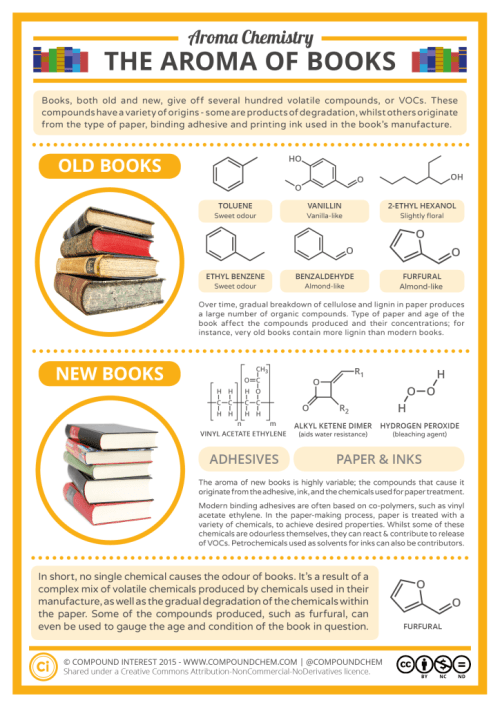
Everyone’s familiar with the smell of old books, the weirdly intoxicating scent that haunts libraries and second-hand book stores. Similarly, who doesn’t enjoy riffling through the pages of a newly purchased book and breathing in the crisp aroma of new paper and freshly printed ink? As with all aromas, the origins can be traced back to a number of chemical constituents, so we can examine the processes and compounds that can contribute to both.

As far as the smell of new books goes, it’s actually quite difficult to pinpoint specific compounds, for a number of reasons. Firstly, there seems to be a scarcity of scientific research that’s been carried out on the subject – to be fair, it’s understandable why it might not exactly be high up on the priority list. Secondly, the variation in the chemicals used to manufacture books also means that it’s an aroma that will vary from book to book. Add to this the fact that there are literally hundreds of compounds involved, and it becomes clearer why it evades attribution to a small selection of chemicals.

It’s likely that the bulk of ‘new book smell’ can be put down to three main sources: the paper itself (and the chemicals used in its manufacture), the inks used to print the book, and the adhesives used in the book-binding process.

The manufacture of paper requires the use of chemicals at several stages. Large amounts of paper are made from wood pulp (though it can also be made from cotton and textiles) – chemicals such as sodium hydroxide, often referred to in this context as ‘caustic soda’, can be added to increase pH and cause fibres in the pulp to swell. The fibres are then bleached with a number of other chemicals, including hydrogen peroxide; then, they are mixed with large amounts of water. This water will contain additives to modify the properties of the the paper – for example, AKD (alkyl ketene dimer) is commonly used as a ‘sizing agent’ to improve the water-resistance of the paper.

Many other chemicals are also used – this is just a very rough overview. The upshot of this is that some of these chemicals can contribute, through their reactions or otherwise, to the release of volatile organic compounds (VOCs) into the air, the odours of which we can detect. The same is true of chemicals used in the inks, and the adhesives used in the books. A number of different adhesives are used for book-binding, many of which are based on organic ‘co-polymers’ – large numbers of smaller molecules chemically chained together.

As stated, differences in paper, adhesives, and inks used will influence the ‘new book smell’, so not all new books will smell the same – perhaps the reason why no research has yet attempted to definitively define the aroma.

An aroma that has had much more research carried out around it, however, is that of old books. There’s a reason for this, as it’s been investigated as a potential method for assessing the condition of old books, by monitoring the concentrations of different organic compounds that they give off. As a result, we can be a little more certain on some of the many compounds that contribute to the smell.

Generally, it is the chemical breakdown of compounds within paper that leads to the production of ‘old book smell’. Paper contains, amongst other chemicals, cellulose, and smaller amounts of lignin – much less in more modern books than in books from more than one hundred years ago. Both of these originate from the trees the paper is made from; finer papers will contain much less lignin than, for example, newsprint. In trees, lignin helps bind cellulose fibres together, keeping the wood stiff; it’s also responsible for old paper’s yellowing with age, as oxidation reactions cause it to break down into acids, which then help break down cellulose.

‘Old book smell’ is derived from this chemical degradation. Modern, high quality papers will undergo chemical processing to remove lignin, but breakdown of cellulose in the paper can still occur (albeit at a much slower rate) due to the presence of acids in the surroundings. These reactions, referred to generally as ‘acid hydrolysis’, produce a wide range of volatile organic compounds, many of which are likely to contribute to the smell of old books. A selected number of compounds have had their contributions pinpointed: benzaldehyde adds an almond-like scent; vanillin adds a vanilla-like scent; ethyl benzene and toluene impart sweet odours; and 2-ethyl hexanol has a ‘slightly floral’ contribution. Other aldehydes and alcohols produced by these reactions have low odour thresholds and also contribute.

Other compounds given off have been marked as useful for determining…

Details at: http://www.compoundchem.com/2014/06/01/newoldbooksmell/

1 Comment

Filed under 2016, books

One book at a time

Japanese bookshop stocks only one book at a time

by Alison Flood

Owner of Morioka Shoten in Tokyo says the strategy adds up to a dedicated exhibition for each volume it sells

Source: http://www.theguardian.com/books/2015/dec/23/japanese-bookshop-stocks-only-one-book-at-a-time

Japanese bookshop

With hundreds of thousands of books published every year, the choice of what to stock can prove bewildering for booksellers. The owner of one small bookshop in Tokyo has taken an unusual approach to the problem: Morioka Shoten, located in the luxury shopping district of Ginza, offers just one title to its customers.

Owned by experienced bookseller Yoshiyuki Morioka, the store opened in May, stocking multiple copies of just one title, which changes weekly. Books to have featured in the shop include Finnish author Tove Jansson’s novel The True Deceiver, in which a young woman fakes a burglary of an elderly artist’s house to persuade her she cannot live alone, and Hans Christian Andersen’s Fairy Tales.

“Before opening this bookstore in Ginza, I had been running another one in Kayabacho for 10 years. There, I had around 200 books as stock, and used to organise several book launches per year. During such events, a lot of people visited the store for the sake of a single book. As I experienced this for some time, I started to believe that perhaps with only one book, a bookstore could be managed,” said Morioka.

“This bookstore that sells only one book could also be described as ‘a bookstore that organises an exhibition derived from a single book’. For instance, when selling a book on flowers, in the store could be exhibited a flower that actually appears in the book. Also, I ask the authors and editors to be at the bookstore for as much time as possible. This is an attempt to make the two-dimensional book into three-dimensional ambience and experience. I believe that the customers, or readers, should feel as though they are entering ‘inside a book’.”

Other titles to have featured in Morioka Shoten include Tsukiyo To Megane (Moon Night and Glasses) by Mimei Ogawa, Karachi No Moto (Source of Form) by Akito Akagi, Koichi Uchida and Takejiro Hasegawa, and Karl Blossfeldt: Working Collages, a collection of the artist’s photographs of plants. The first title to be sold next year will be Maseru Tatsuki’s photo anthology Fish-Man.

“The concept of this bookstore seems to have gained the sympathy of a lot of people, and I receive a number of guests from all over the globe,” said Morioka, who has sold 2,100 books so far.

The bookseller added that while “the current book market seems to be taking second billing to ebooks and other media such as social networking services”, he believes that “a book is a physical object with special attraction that has been, is and will always be the same, and that many will continue to utilise physical books, especially as a communication tool”.

Leave a comment

Filed under 2016, bookshop, bookstore

Banned book backfire

Parents call cops on teen for giving away banned book; it backfires predictably

Source: http://www.deathandtaxesmag.com/219767/parents-call-cops-on-teen-for-giving-away-banned-book-it-backfires-predictably/?utm_source=share-fb&utm_medium=button

Parents in Idaho called the cops last week on junior-high student Brady Kissel when she had the nerve to help distribute a book they’d succeeded in banning from the school curriculum.

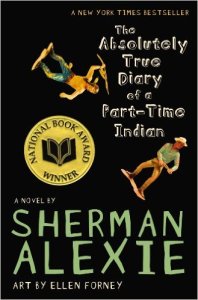
Absolute True DiaryThe book in question was Sherman Alexie’s young adult novel The Absolutely True Diary of a Part-Time Indian. Published in 2007, it won the National Book Award and has become popular with young teens, supposedly for its universal themes of fitting in, making sense of race, and sexual discovery.

The sex part (and let’s face it—probably the race part) led parents to lobby Junior Mountain High School to remove it from the syllabus, citing its sexual content (it discusses masturbation) and supposedly anti-Christian content.

Local teens then started a petition to have the book reinstated. They collected 350 signatures, which is an impressive number of kids to rally around a cause like reading.

In response, a local bookstore Rediscovered Books started a crowdfunding campaign to buy a book for each of the 350 kids who signed the petition. It worked—the campaign raised $3,400, enough for a book per kid.

Rediscovered Books worked with a student involved in the petition, Brady Kissel, to distribute the books on World Book Night, an initiative to turn reluctant young readers onto reading with free, super-readable books.

They distributed all but 20 books to kids who came in to claim them, but not before parents called the cops to shut down the operation. Police told local news channel KBOI they had been called by “someone concerned about teenagers picking up a copy of the book without having a parent’s permission.”

Even police seemed to have no idea what they were doing there, and let the book giveaway proceed as planned.

Not only did it go as planned, but when Alexie’s publisher Hachette got word of the incident, they sent Rediscovered an additional 350 copies on the house. So while the book may still be banned in the school curriculum, it’s available free of cost for any kid who wants to stop into Rediscovered and pick one up.

Leave a comment

Filed under 2016, books

Screenwriting course for $19: Limited time offer

Screenwriting course

Screenwriting course

Disclaimer 1: I know nothing about this course or teacher. It came through Groupon (links below) for $19. Price of a hardback book or even some trade paperbacks (or even some e-books). I thought I would give it a try. According to the company offering the course, it is normally $199.

I have posted a couple of links below to the same offer. It is for a limited time.

Disclaimer 2: There will be an offer to “Buy with David and save.” You can ignore that or use it as you wish. It come with the links, but I am not looking to make money on this. If you belong to Groupon, you can probably find this offering without the “Buy … and save” option. That’s okay with me.

If anybody had taken the class and wants to send me comments, I will see about posting them. If anybody takes the class and sends me comments, I will see about posting them.

Disclaimer 3: I do not know if this will work outside the United States.

Sources:
http://groupon.com/bwf/6c1342f4-011b-4b06-ae5d-b9b11f23e304?utm_campaign=OfferReferral&utm_source=bwf_link&utm_medium=bwf

https://www.groupon.com/deals/writing-academy-1-chicago?offerReferralId=6c1342f4-011b-4b06-ae5d-b9b11f23e304&utm_campaign=OfferReferral&utm_source=bwf_link&utm_medium=bwf#bwf-details-modal

Leave a comment

Filed under 2016, writing course

Star Trek stamps

Star Trek
For those writers who will be mailing out manuscripts in 2016, particularly science fiction manuscripts, these stamps may be just the item you’ll need. Who knows, since they are forever stamps, writers might be using them into the 23rd Century.

Celebrating the 50th anniversary of the television premiere, the new Star Trek Forever stamps showcase four digital illustrations inspired by classic elements of the television program:

Star Trek US postage stamps for 2016

Star Trek US postage stamps for 2016

  • the Starship Enterprise inside the outline of a Starfleet insignia against a gold background;
  • the silhouette of a crewman in a transporter against a red background;
  • the silhouette of the Enterprise from above against a green background; and,
  • the Enterprise inside the outline of the Vulcan salute (Spock’s iconic hand gesture) against a blue background.

The words “SPACE… THE FINAL FRONTIER,” from Captain Kirk’s famous voice-over appear beneath the stamps against a background of stars. The stamps were designed by Heads of State under the art direction of Antonio Alcalá.

Source: https://about.usps.com/news/national-releases/2015/pr15_069.htm

Leave a comment

Filed under 2016, Star Trek

“Holly’s Corner,” part 9

[Writer’s note: What began as a writing prompt — photo and first paragraph — has become at least the start of a story. I will endeavor to add short sections to it, at lest as long as there is some interest. It might be a little rough in parts, but that’s because it is coming “hot off the press,” which could be part of the fun of it. In the meantime, you are free to jump off from any part of this story thus far and write your own version. Click Holly’s Corner below to get Parts 1 – 8.]

by David E. Booker

I tossed the wet wipe in the trash and stepped through the curtain and behind door number one was the woman who had threatened me with her rolling pin. She was still gripping the deadly device.

#

“You heard her side of the story. You’re going to hear mine,” she said.

“I’m not the Dear Abby of the recipe world.”

She was sitting in my one good client chair. I decided not to sit down. Maybe she’d get the hint and stand up and step out.

It was a cool, rainy day down at Holly's Corner.

It was a cool, rainy day down at Holly’s Corner.

“That little trollop would spread lies about Christ himself if she thought it would advantage her.”

“Be careful what you say,” I said. “There’s a priest in the office.”

She sloshed her disheveled hairdo toward the other room. “Him? He’s harmless. We had a nice conversation waiting for you, we did.”

She was looking up at me. There seemed the hint of a foreign accent in her speech. English maybe. Either that or that’s the way she talked when she was inebriated. I once knew a Jewish guy who took on a Russian accent when he was drunk. He would also start referring to himself in the third person and how “that worthless Jew” needed a trip to a pogrom. In the past few years I had lost contact with him and hoped he wasn’t off somewhere punishing himself. I think he wanted to be comedy writer.

“Your half-sister is not my client, so you don’t have to stay,” I said, still standing near the doorway.

“Then I want to hire you.” She curled away from me and toward her purse, which was beside her on the chair. She popped it open, jammed her right hand inside, then pulled out a wad of bills and shook them at me like a rustling bouquet of flowers. Green flowers. Andrew Jackson and Benjamin Franklin flowers.

“Tea anyone?” Father Brown wriggled himself around me and walked into the room carrying a wicker service tray that was sagging slightly toward the center from the weight of the teapot.

(To be continued.)

Leave a comment

Filed under 2015, photo by David E. Booker, Story by author