Tag Archives: Sunday

10 Contemporary Novels By and About Muslims You Should Read | Literary Hub

What should you read when your president-elect is an unrepentant xenophobe who wants to ban Muslims from America? Well, lots of things, of course, but here’s a more pointed suggestion: read m…

Source: 10 Contemporary Novels By and About Muslims You Should Read | Literary Hub

What should you read when your president-elect (now president) is an unrepentant xenophobe who wants to ban Muslims from America? Well, lots of things, of course, but here’s a more pointed suggestion: read more books by and about Muslims, particularly books written in the last ten years. It’s a small way to understand and empathize with a group of your fellow Americans who desperately need the understanding and empathy of their countrymen and women. (Consider giving them as holiday gifts to relatives who voted for Trump.) It is also important, whenever we can, to amplify the voices of the oppressed. (Consider buying them and donating them to schools.) Oh, and another thing? These books are just good. They are good books, and you will enjoy them, all politics aside.

Leave a comment

Filed under 2017, book list

80 Best Books of All Time – The Greatest Books Ever Written

An unranked, incomplete, utterly biased list of the greatest works of literature ever published. How many have you read?

Source: 80 Best Books of All Time – The Greatest Books Ever Written

Some of the books on the list:

What We Talk About When We Talk About Love, by Raymond Carver

Collected Stories of John Cheever

Deliverance, by James Dickey

The Grapes of Wrath, by John Steinbeck

Blood Meridian, by Cormac McCarthy

The Brothers Karamazov, by Fyodor Dostoevsky

The Known World, by Edward P. Jones

The Good War, by Studs Terkel

American Pastoral, by Philip Roth
One of the few not about Roth. It’s about that guy you idolized in high school. And gloves. And you.

A Good Man Is Hard to Find and Other Stories, by Flannery O’Connor
“She would of been a good woman… if it had been somebody there to shoot her every minute of her life.” Wouldn’t we all.

The Things They Carried, by Tim O’Brien.
No one else has written so beautifully about human remains hanging from tree branches.

A Sport and a Pastime, by James Salter
Remember your college buddy’s girlfriend, the one you were in love with? Because of her.

The Call of the Wild, by Jack London
A book about dogs is equally a book about men.

Time’s Arrow, by Martin Amis
You’ve never seen the Holocaust from this angle and with this much ferocity. Backwards.

A Sense of Where You Are, by John McPhee
It’s about how two men can be made better just by sharing each other’s company.

Hell’s Angels, by Hunter S. Thompson
Because it’s his first book, and because he got his ass kicked for it, and because in the book and the beating were the seeds of all that came after, including the bullet in the head.

Invisible Man, by Ralph Ellison
Born in an epic fist-fight or forgotten in the sewers, no character is as clearly heard as the man who is never really seen by the world around him.

Dubliners, by James Joyce
Plain and simple: “The Dead”

Rabbit, Run, by John Updike
Because it’s one of the few not about Updike. It’s about that guy you idolized in high school. And kitchen gadgets. And you.

The Postman Always Rings Twice, by James M. Cain
Teaches men about women. Also, there’s not a single postman in the book.

Dog Soldiers, by Robert Stone
Begins in Saigon, ends in Death Valley. Somewhere in between you realize that profit is second only to survival.

Winter’s Bone, by Daniel Woodrell
The best book by a modern-day Twain, high on meth, drousy with whiskey.

Legends of the Fall, by Jim Harrison
Because of revenge. Because Harrison is as masculine and raw and unrelenting as they come.

Under the Volcano, by Malcolm Lowry
A terrifying riderless horse, mescaline, and this line: “Somebody threw a dead dog after him down the ravine.”

The Naked and the Dead, by Norman Mailer
His first book turned out to be his best book. The skulls of young men at war.

The Professional, by W.C. Heinz
It’s about fighting, but it’s also about watching and listening, and it’s about patience, and honing, and craft, and sparseness, and beauty, and crushing, awful defeat.

For Whom the Bell Tolls, by Ernest Hemingway
A lesson in manhood: Even when you’re damned, you press on.

Dispatches, by Michael Herr
“Vietnam Vietnam Vietnam, we’ve all been there.” You’ll never forget that line. You won’t forget what precedes it, either.

Tropic of Cancer, by Henry Miller.
Dirty, grotesque. Beautiful.

Revolutionary Road, by Richard Yates
The thousands of little compromises we make every day that eventually add up to the loss of ourselves.

As I Lay Dying, by William Faulkner
Because the man’s cold brilliance enabled him to make the line “My mother is a fish,” into a chapter in itself.

The Killer Angels, by Michael Shaara
Because the Battle of Gettysburg took place in that blue-gray area between black and white.

Slaughterhouse-Five, by Kurt Vonnegut
A mad hatter of an antiwar novel that understands how a smile, shaped like a sickle, can cut deeply. So it goes.

All the King’s Men, by Robert Penn Warren
Crooked judges, concealed paternity, deception, betrayal, and lots of whiskey.

One Flew Over the Cuckoo’s Nest, by Ken Kesey
Because sometimes you have to go crazy to stay sane.

Leave a comment

Filed under 2017, book list, books

30 Essential Crime Reads Written by Women in the Last 100 Years | Literary Hub

Undisputed Queen of Crime Agatha Christie died on this day in 1976. Crime fiction is a genre that has traditionally been dominated by men—but on the other hand, Christie is the best-selling author …

Source: 30 Essential Crime Reads Written by Women in the Last 100 Years | Literary Hub

Undisputed Queen of Crime Agatha Christie died on this day in 1976. Crime fiction is a genre that has traditionally been dominated by men—but on the other hand, Christie is the best-selling author of all time, so that should tell you something. In honor of her life (and her prolific publishing career) I’ve picked out a few great crime novels written by women from each of the last ten decades. Now, of course, there are more than three crime novels from each decade that you should read (and probably more than three novels in every genre that you should read), but one has to stop somewhere, so add your own recommendations with abandon. NB: This is not a definitive list by any means; genre is necessarily a bit fluid here, privilege has gone to important, groundbreaking or otherwise historically notable works where I’ve noted them, but taste has, as ever, played a factor.

More at the link listed above.

Leave a comment

Filed under 2017, women writers

American Short(er) Fiction Contest –

The American Short(er) Fiction Contest is now open for submissions. This year we are honored to have Justin Torres as our guest judge. Submit your entry online between October 25, 2016 – February 1, 2017. The first-place winner will receive a $1,000 prize and publication in a future issue of ASF. One runner-up will receive $250 and publication, and all entries will be considered for publication.

Source: American Short(er) Fiction Contest –

The American Short(er) Fiction Contest is open for submissions. This year we are honored to have Justin Torres as our guest judge. Submit your stories of 1,000 words or fewer now!

General Guidelines
Submit your entry online between October 25, 2016 – February 1, 2017.
– The first-place winner will receive a $1,000 prize and publication in a future issue of ASF. One runner-up will receive $250 and publication, and all entries will be considered for publication.
– Please submit your $17 entry fee and your work through Submittable. We no longer accept submissions by post. International submissions in English are eligible.
– Stories must be 1,000 words or fewer. You are allowed to include up to three stories per entry. Please submit all stories in one document. Each story must begin on a new page and be clearly titled. For the title of your submission list the story titles, separated by a comma. Please DO NOT include any identifying information on the manuscript itself.
– You may submit multiple entries. We accept only previously unpublished work. We do allow simultaneous submissions, but we ask that you notify us promptly of publication elsewhere.

Conflicts of Interest
Staff and volunteers currently affiliated with American Short Fiction are ineligible for consideration or publication. Additionally, students, former students, and colleagues of the judge are not eligible to enter. We ask that previous winners wait three years after their winning entry is published before entering again.

Justin Torres is the author of the novel We the Animals, winner of an Indies Choice Book Award. His work has appeared in The New Yorker, Harper’s, Granta, and other prestigious publications. A graduate of the Iowa Writers’ Workshop, he has received numerous awards, including a Rolón Fellowship in Literature from United States Artists, a Wallace Stegner Fellowship at Stanford, and a Radcliffe Fellowship at Harvard.

On his taste in fiction, Mr. Torres has said:
“I love voice; a deeply imagined and inventive voice does more for me than a fantastic plot or vivid setting. For me, the magic of fiction lies in the words chosen and the structure of the sentences. I could write about men on Mars or about a childhood similar to my own, but my goal would be the same: get the words right, cast a spell.”

We can’t wait for your submissions to cast their spells on us. Good luck!

Leave a comment

Filed under 2017, contest

Haruki Murakami to release new novel titled ‘Killing Commendatore’ – The Mainichi

Source: Haruki Murakami to release new novel titled ‘Killing Commendatore’ – The Mainichi

TOKYO (Kyodo) — Japanese novelist Haruki Murakami will release a new novel titled “Killing Commendatore” on Feb. 24, its publisher Shinchosha Publishing Co. said Tuesday, his first multivolume novel in seven years.

The novel, comprising two books, is priced at 1,944 yen ($16.77), tax included, said Shinchosha, via which Murakami, 67, released in 2009 and 2010 a long excerpt from “Book 1” through “Book 3” of his novel “1Q84.”

Murakami, one of Japan’s best-known contemporary novelists and often touted as a candidate for the Nobel Prize in literature, released the novel “Colorless Tsukuru Tazaki and His Years of Pilgrimage” in April 2013, and a collection of short stories entitled “Onna no Inai Otokotachi” (Men Without Women) in April 2014. The two books were published by Bungeishunju Ltd.

Shinchosha had announced in late November that Murakami will release a new novel in February. At that time the publisher did not disclose details including the title.

Leave a comment

Filed under 2017, author

Diagramming Sentences

A Picture Of Language: The Fading Art Of Diagramming Sentences

Source: http://www.npr.org/sections/ed/2014/08/22/341898975/a-picture-of-language-the-fading-art-of-diagramming-sentences?utm_source=facebook.com&utm_medium=social&utm_campaign=npr&utm_term=nprnews&utm_content=20170101

by Juana Summers

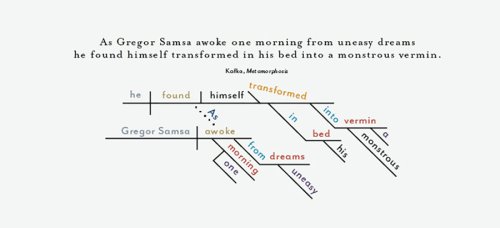
The design firm Pop Chart Lab has taken the first lines of famous novels and diagrammed those sentences. This one shows the opening of Franz Kafka's "Metamorphosis."

The design firm Pop Chart Lab has taken the first lines of famous novels and diagrammed those sentences. This one shows the opening of Franz Kafka’s “Metamorphosis.”

When you think about a sentence, you usually think about words — not lines. But sentence diagramming brings geometry into grammar.

If you weren’t taught to diagram a sentence, this might sound a little zany. But the practice has a long — and controversial — history in U.S. schools.

And while it was once commonplace, many people today don’t even know what it is.
So let’s start with the basics.

“It’s a fairly simple idea,” says Kitty Burns Florey, the author of Sister Bernadette’s Barking Dog: The Quirky History and Lost Art of Diagramming Sentences. “I like to call it a picture of language. It really does draw a picture of what language looks like.”

I asked her to show me, and for an example she used the first sentence she recalls diagramming: “The dog barked.”

“By drawing a line and writing ‘dog’ on the left side of the line and ‘barked’ on the right side of the line and separating them with a little vertical line, we could see that ‘dog’ was the subject of the sentence and ‘barked’ was the predicate or the verb,” she explains. “When you diagram a sentence, those things are always in that relation to each other. It always makes the same kind of picture. And supposedly, it makes it easier for kids who are learning to write, learning to use correct English.”

An Education ‘Phenomenon’

Burns Florey and other experts trace the origin of diagramming sentences back to 1877 and two professors at Brooklyn Polytechnic Institute. In their book, Higher Lessons in English, Alonzo Reed and Brainerd Kellogg made the case that students would learn better how to structure sentences if they could see them drawn as graphic structures.

After Reed and Kellogg published their book, the practice of diagramming sentences had something of a Golden Age in American schools.

“It was a purely American phenomenon,” Burns Florey says. “It was invented in Brooklyn, it swept across this country like crazy and became really popular for 50 or 60 years and then began to die away.”

By the 1960s, new research dumped criticism on the practice.

“Diagramming sentences … teaches nothing beyond the ability to diagram,” declared the 1960 Encyclopedia of Educational Research.

In 1985, the National Council of Teachers of English declared that “repetitive grammar drills and exercises” — like diagramming sentences — are “a deterrent to the improvement of students’ speaking and writing.”

Nevertheless, diagramming sentences is still taught — you can find it in textbooks and see it in lesson plans. My question is, why?

Burns Florey says it might still be a good tool for some students. “When you’re learning to write well, it helps to understand what the sentence is doing and why it’s doing it and how you can improve it.”

But does it deserve a place in English class today? (The Common Core doesn’t mention it.)

“There are two kinds of people in this world — the ones who loved diagramming, and the ones who hated it,” Burns Florey says.

She’s in the first camp. But she understands why, for some students, it never clicks.

“It’s like a middle man. You’ve got a sentence that you’re trying to write, so you have to learn to structure that, but also you have to learn to put it on these lines and angles and master that, on top of everything else.”

So many students ended up frustrated, viewing the technique “as an intrusion or as an absolutely confusing, crazy thing that they couldn’t understand.”

2 Comments

Filed under 2017, sentences

Harry Potter vs. Huckleberry Finn: Why the British Tell Better Children’s Stories Than Americans – The Atlantic

Their history informs fantastical myths and legends, while American tales tend to focus on moral realism.

Source: Harry Potter vs. Huckleberry Finn: Why the British Tell Better Children’s Stories Than Americans – The Atlantic

[Editor’s note: I found this an interesting article. I don’t agree with every assertion or conclusion in it, but thought it was worth passing along. You decide.]

By Colleen Gillard

If Harry Potter and Huckleberry Finn were each to represent British versus American children’s literature, a curious dynamic would emerge: In a literary duel for the hearts and minds of children, one is a wizard-in-training at a boarding school in the Scottish Highlands, while the other is a barefoot boy drifting down the Mississippi, beset by con artists, slave hunters, and thieves. One defeats evil with a wand, the other takes to a raft to right a social wrong. Both orphans took over the world of English-language children’s literature, but their stories unfold in noticeably different ways.

The small island of Great Britain is an undisputed powerhouse of children’s bestsellers: The Wind in the Willows, Alice in Wonderland, Winnie-the-Pooh, Peter Pan, The Hobbit, James and the Giant Peach, Harry Potter, and The Lion, the Witch, and the Wardrobe. Significantly, all are fantasies. Meanwhile, the United States, also a major player in the field of children’s classics, deals much less in magic. Stories like Little House in the Big Woods, The Call of the Wild, Charlotte’s Web, The Yearling, Little Women, and The Adventures of Tom Sawyer are more notable for their realistic portraits of day-to-day life in the towns and farmlands on the growing frontier. If British children gathered in the glow of the kitchen hearth to hear stories about magic swords and talking bears, American children sat at their mother’s knee listening to tales larded with moral messages about a world where life was hard, obedience emphasized, and Christian morality valued. Each style has its virtues, but the British approach undoubtedly yields the kinds of stories that appeal to the furthest reaches of children’s imagination.

It all goes back to each country’s distinct cultural heritage. For one, the British have always been in touch with their pagan folklore, says Maria Tatar, a Harvard professor of children’s literature and folklore. After all, the country’s very origin story is about a young king tutored by a wizard. Legends have always been embraced as history, from Merlin to Macbeth. “Even as Brits were digging into these enchanted worlds, Americans, much more pragmatic, always viewed their soil as something to exploit,” says Tatar. Americans are defined by a Protestant work ethic that can still be heard in stories like Pollyanna or The Little Engine That Could.

Americans write fantasies too, but nothing like the British, says Jerry Griswold, a San Diego State University emeritus professor of children’s literature. “American stories are rooted in realism; even our fantasies are rooted in realism,” he said, pointing to Dorothy who unmasks the great and powerful Wizard of Oz as a charlatan.

American fantasies differ in another way: They usually end with a moral lesson learned—such as, surprisingly, in the zany works by Dr. Seuss who has Horton the elephant intoning: “A person’s a person no matter how small,” and, “I meant what I said, and I said what I meant. An elephant’s faithful one hundred percent.” Even The Cat in the Hat restores order from chaos just before mother gets home. In Oz, Dorothy’s Technicolor quest ends with the realization: “There’s no place like home.” And Max in Where the Wild Things Are atones for the “wild rumpus” of his temper tantrum by calming down and sailing home.

Landscape matters: Britain’s antique countryside, strewn with moldering castles and cozy farms, lends itself to fairy-tale invention. As Tatar puts it, the British are tuned in to the charm of their pastoral fields: “Think about Beatrix Potter talking to bunnies in the hedgerows, or A.A. Milne’s Winnie-the-Pooh wandering the Hundred Acre Wood.” Not for nothing, J.K. Rowling set Harry Potter’s Hogwarts School of Witchcraft and Wizardry in the spooky wilds of the Scottish Highlands. Lewis Carroll drew on the ancient stonewalled gardens, sleepy rivers, and hidden hallways of Oxford University to breathe life into the whimsical prose of Alice in Wonderland.

America’s mighty vistas, by contrast, are less cozy, less human-scaled, and less haunted. The characters that populate its purple mountain majesties and fruited plains are decidedly real: There’s the burro Brighty of the Grand Canyon, the Boston cop who stops traffic in Make Way for Ducklings, and the mail-order bride in Sarah, Plain and Tall who brings love to lonely children on a Midwestern farm. No dragons, wands, or Mary Poppins umbrellas here.

Popular storytelling in the New World instead tended to celebrate in words and song the larger-than-life exploits of ordinary men and women.

Britain’s pagan religions and the stories that form their liturgy never really disappeared, the literature professor Meg Bateman told me in an interview on the Isle of Skye in the Scottish Highlands. Pagan Britain, Scotland in particular, survived the march of Christianity far longer than the rest of Europe. Monotheism had a harder time making inroads into Great Britain despite how quickly it swept away the continent’s nature religions, says Bateman, whose entire curriculum is taught in Gaelic. Isolated behind Hadrian’s Wall—built by the Romans to stem raids by the Northern barbarian hordes—Scotland endured as a place where pagan beliefs persisted; beliefs brewed from the religious cauldron of folklore donated by successive invasions of Picts, Celts, Romans, Anglo-Saxons, and Vikings.

Even well into the 19th and even 20th centuries, many believed they could be whisked away to a parallel universe. Shape shifters have long haunted the castles of clans claiming seals and bears as ancestors. “Gaelic culture teaches we needn’t fear the dark side,” Bateman says. Death is neither “a portal to heaven nor hell, but instead a continued life on earth where spirits are released to shadow the living.” A tear in this fabric is all it takes for a story to begin. Think Harry Potter, The Chronicles of Narnia, The Dark Is Rising, Peter Pan, The Golden Compass—all of which feature parallel worlds.

These were beliefs the Puritans firmly rejected as they fled Great Britain and religious persecution for the New World’s rocky shores. America is peculiar in its lack of indigenous folklore, Harvard’s Tatar says. Though African slaves brought folktales to Southern plantations, and Native Americans had a long tradition of mythology, little remains today of these rich worlds other than in small collections of Native American stories or the devalued vernacular of Uncle Remus, Uncle Tom, and the slave Jim in Huckleberry Finn.

Popular storytelling in the New World instead tended to celebrate in words and song the larger-than-life exploits of ordinary men and women: Daniel Boone, Davy Crockett, Calamity Jane, even a mule named Sal on the Erie Canal. Out of bragging contests in logging and mining camps came even greater exaggerations—Tall Tales—about the giant lumberjack Paul Bunyan, the twister-riding cowboy Pecos Bill, and that steel-driving man John Henry, who, born a slave, died with a hammer in his hand. All of these characters embodied the American promise: They earned their fame.

British children may read about royal destiny discovered when a young King Arthur pulls a sword from a stone. But immigrants to America who came to escape such unearned birthrights are much more interested in challenges to aristocracy, says Griswold. He points to Mark Twain’s The Prince and the Pauper, which reveals the two boys to be interchangeable: “We question castles here.”

In Scotland, Bateman in turn suggests the difference between the countries may be that Americans “lack the kind of ironic humor needed for questioning the reliability of reality”—very different from the wry, self-deprecating humor of the British. Which means American tales can come off a bit “preachy” to British ears. The award-winning Maurice Sendak-illustrated book of etiquette: What Do You Say, Dear? comes to mind. Even Little Women is described by Bateman as something of a Protestant “parable about doing your best in trying circumstances.”

Maybe a world not fixated on atonement and moral imperatives is more conducive to a rousing tale. In Edinburgh—an old town like Rome built on seven hills, where dark alleys drop from cobbled streets, dive under stone buildings, and descend crooked stairs to make their way to the sea—8-year-old Caleb Sansom is one kid who thinks so. Digging with his mum through the stacks of the downtown library, he said he likes stories with “naughty animals, doing people things.” Like Mr. Toad in The Wind in the Willows “who drives fast, gets in accidents, sings, and goes to jail.” As for American books such as The Little House in the Big Woods: “There’s a bit too much following the rules. ‘Do this. Stop doing that.’ Can get boring.”

Pagan folktales are less about morality and more about characters like the trickster who triumphs through wit and skill: Bilbo Baggins outwits Gollum with a guessing game; the mouse in The Gruffalo avoids being eaten by tricking a hungry owl and fox. Griswold calls tricksters the “Lords of Misrule” who appeal to a child’s natural desire to subvert authority and celebrate naughtiness: “Children embrace a logic more pagan than adult.” And yet Bateman says in pagan myth it’s the young who possess the qualities needed to confront evil. Further, each side has opposing views of naughtiness and children: Pagan babies are born innocent; Christian children are born in sin and need correcting. Like Jody in The Yearling who, forced to kill his pet deer, must understand life’s hard choices before he can forgive his mother and shoulder the responsibility of manhood.

It turns out that fantasy—the established domain of British children’s literature—is critical to childhood development.

Ever since Bruno Bettelheim wrote The Uses of Enchantment about the psychological meaning of fairy tales, child psychologists have looked at storytelling as an important tool children use to work through their anxieties about the adult world. Fairy-tale fantasies are now regarded as almost literal depictions of childhood fears about abandonment, powerlessness, and death.

Most successful children’s books address these common fears through visiting and revisiting the same emotional themes, says Griswold. In his book, Feeling Like a Kid: Childhood and Children’s Literature, he identifies five basic story mechanisms children find particularly compelling—snug spaces, small worlds, scary villains, lightness or flying, as well as animated toys and talking animals—all part of the serious business of make-believe.

“Kids think through their problems by creating fantasy worlds in ways adults don’t,” Griswold says. “Within these parallel universes, things can be solved, shaped and understood.” Just as children learn best through hands-on activities, they tend to process their feelings through metaphorical reenactments. “Stories,” Griswold noted, “serve a purpose beyond pleasure, a purpose encoded in analogies. Story arcs, like dreams, have an almost biological function.”

It turns out that fantasy—the established domain of British children’s literature—is critical to childhood development. With faeries as voices from the earth, from beyond human history, with a different take on the meaning of life and way of understanding death, Bateman says there’s wisdom in recognizing nature as a greater life force. “Pagan folklore keeps us humble by reminding us we are temporary guests on earth—a true parable for our time.”

Today there may be more reason than ever to find solace in fantasy. With post-9/11 terrorism fears and concern about a warming planet, Griswold says American authors are turning increasingly to fantasy of a darker kind—the dystopian fiction of The Hunger Games, The Giver, Divergent, and The Maze Runner. Like the collapse of the Twin Towers, these are sad and disturbing stories of post-apocalyptic worlds falling apart, of brains implanted with computer chips that reflect anxiety about the intrusion of a consumer society aided by social media. This is a future where hope is qualified, and whose deserted worlds are flat and impoverished. But maybe there’s purpose. If children use fairy tales to process their fears, such dystopian fantasies (and their heroes and heroines) may model the hope kids need today to address the scale of the problems ahead.

Source: http://www.theatlantic.com/entertainment/archive/2016/01/why-the-british-tell-better-childrens-stories/422859/

Leave a comment

Filed under 2017, books

Sadly, ‘Puppy’ Isn’t Merriam-Webster’s Word Of The Year | The Huffington Post

Source: Sadly, ‘Puppy’ Isn’t Merriam-Webster’s Word Of The Year | The Huffington Post

“Surreal” is Merriam-Webster’s (yes, the dictionary) word of the year.

“Surreal” won out over “puppy,” “flummadiddle,” and “fascism,” which were all trending earlier this month.

The announcement comes after Oxford Dictionaries’ choice of “post-truth” and Dictionary.com’s choice of “xenophobia” for their respective Word of the Year picks.

Merriam-Webster defines surreal as “marked by the intense irrational reality of a dream,” with its synonyms being unbelievable and fantastic.

dictionary publisher established their choice due to the high volume of lookups “surreal” received in 2016.

The word spiked after the Brussels terror attacks in March, the coup attempt in Turkey, the terrorist attack in Nice, and the U.S. election in November, according to the site.

Merriam-Webster editor at large Peter Sokolowski noted in a press release how unusual it was that the word had been so frequently searched.

“Historically, surreal has been one of the words most searched after tragedy, most notably in the days following 9/11, but it was associated with a wide variety of stories this year,” he said.

“Surreal” was an even more surprising winner for Word of the Year when you consider that both “puppy,” “flummadiddle,” and “fascism” were all trending this month. “Fascism” was leading the pack for a while, but in an effort to, you know, not have “fascism” be the Word of the Year, the folks at Merriam-Webster sent out a call to arms to ask people to search literally anything else.

But don’t worry: this election was not rigged. Merriam-Webster assured us all weeks ago that they’d select a winner appropriately.

“Our Word of the Year cannot be rigged. We encourage people to look up new words at all times, particularly if those words are strange 19th-century Americanisms or words for adorable doll-like creatures, but our Word of the Year is based on year-over-year increase in lookups,” they said on their site. “We look for a word which got a high number of lookups and increased dramatically in popularity when compared to previous years.”

Leave a comment

Filed under 2016, words

Dashiell Hammett: a hero for our time – San Francisco Chronicle

Source: Dashiell Hammett: a hero for our time – San Francisco Chronicle

Every Christmas season, my family indulges in the same movie-watching rituals as we trim the tree and string necklaces of twinkling lights around the living room. These movies serve as a comforting backdrop to our yuletide routines. Some of our favorite seasonal films are relative obscurities like “The Family Man” (2000), starring Nicolas Cage, Téa Leoni and Don Cheadle. But we also search out classics, including movies that seemingly have nothing to do with the holiday season. Inevitably, we end up watching at least one of the old “Thin Man” features, that durable Dashiell Hammett detective series starring the most adorable and effervescent married couple in cinematic history, Nick and Nora Charles (William Powell and Myrna Loy).
Why does “The Thin Man” series beckon us this time of year? Maybe it’s the lovely, icy clatter of a holiday martini shaker, that merry clinking sound Nora used to call Nick home to their New York hotel suite when he was relaxing far away in Central Park with their toddler. “Nicky,” the bibulous detective tells Junior, “something tells me that something important is happening somewhere and I think we should be there.”

Or maybe it’s the witty banter and teasing sexuality between Nick and Nora that every sophisticated relationship should aspire to. Nick (trying to divert his wife from an uncomfortably racy subject): “Did I ever tell you that you’re the most fascinating woman on this side of the Rockies?” Nora (signaling she’s no prude): “Wait till you see me on the other side.”
Or it could be the San Francisco aura that drifts through the “Thin Man” films, especially my favorite, “After the Thin Man” (1936), which is set in the city and features locations like the Coit Tower lawn, doubling as the grounds of the Charleses’ Telegraph Hill mansion. Foggy nights in San Francisco are still suffused with a Hammett-like mystery. And there is no better place to conjure the spirit of the founder of the hard-boiled mystery genre than John’s Grill on Ellis Street, where Hammett hero Sam Spade grabbed a quick meal of chops, baked potato and sliced tomato in “The Maltese Falcon.” Hammett himself pounded out his pulp masterpieces on his Underwood typewriter in his apartment nearby, at 891 Post St., after his TB-wracked lungs made it impossible for him to continue his career as a Pinkerton Agency gumshoe.

There is no better way to celebrate the holidays in San Francisco than taking a break from the tyranny of shopping at the legendary downtown grill, presided over by John Konstin, the city’s most charming Greek (besides Art Agnos). A recent lunch hour there was populated by the usual mix of jailhouse lawyers, newshounds, colorful barflies, and SFPD detectives with legendary names – including Lt. Dave Falzon and retired homicide inspector John Cleary Jr. In other words, old San Francisco at its best.

And there is no better lunch companion for such an occasion than fedora-wearing, dapper Eddie Muller — the “Czar of Noir” whose classic cinema festival at the Castro Theatre each January brings together a wildly diverse pageant of filmgoers, from schlumpy and frighteningly obsessive cineastes to elegantly dressed lounge-room lizards and femme fatales who have stepped right out of their own torrid dream. Muller is also a growing presence on the Turner Classic Movies channel, as the film noir host for the brilliantly curated network.

Muller has a familial affinity for the world of Hammett. His late father was the boxing reporter for the San Francisco Examiner for a half-century, a respected fixture in a demimonde filled with the palookas, promoters, and gangsters — the same types Nick and Nora liked to pal around with. And we both share an affection for the prototypical, if opposite, Hammett screen heroines, Loy and Mary Astor.

Astor was the sad-eyed, seductive screen siren who costarred with Bogart in “The Maltese Falcon” (and with my father, Lyle, in such lesser 1930s offerings as “Return of the Terror,” “Red Hot Tires” and “Trapped by Television,” a B-movie thriller that foresaw the scary aspects of the coming medium). Astor was a sexually liberated woman of her day; her erotic self-confidence surges through her performance as the masterfully manipulative Brigid O’Shaughnessy in the Hammett classic.

In 1936, Astor found herself on the pyre in the hottest Hollywood sex scandal of its day, when her estranged husband exposed her “Purple Diary” to the press — a lusty account of her sexual exploits, including the grades she assigned to her lovers’ performances. Playwright George S. Kaufman scored the highest, with Astor extolling his prowess. “Fits me perfectly,” she wrote. “Many exquisite moments … twenty — count them, diary, twenty … I don’t see how he does it … he’s perfect.”

Astor — whose Purple Diary is the subject of two recent books, including a sensually illustrated chronicle by the artist Edward Sorel — got Muller and me talking about Hammett and his view of women. “In some ways, the male-female dynamic is the most interesting thing about Hammett’s work,” said Muller, between sips from his Manhattan. “There’s an emotional complexity and tension that separates it from other detective fiction.” In his own life, Hammett cut himself off from his father and brother at a young age, but remained close to his mother and sister. His own formidable drinking and sparring partner, the writer Lillian Hellman, was the inspiration for Nora Charles.

“He was a tall, slim, well-dressed ladies’ man, who carried with him a sense of damage that women found attractive,” continued Muller. “His drinking, his illness. He made binge drinking heroic because he was so frail. Women would marvel at him — it’s 4 a.m. and he’s still going.”

Hammett had another kind of fortitude as well. A lifelong man of the Left, he was dragged before a federal tribunal during the Cold War and asked to reveal the names of those who had contributed to a bail fund he had overseen for jailed Communist Party leaders. He refused. Ratting on friends was not the kind of thing that the creator of Sam Spade would do. He was sentenced to six months in federal prison for contempt of court, and when he was released in December 1951, his health was more ruined than ever. In 1953, he was summoned again by the witch-hunters, this time by Sen. Joe McCarthy and his sidekick, the reptilian Roy Cohn — one of Donald Trump’s mentors. Again Hammett refused to cooperate. He was blacklisted by Hollywood and went broke. But he was unbroken.

As Trump adviser Newt Gingrich floats the idea of reviving the notorious House Un-American Activities Committee, it’s a good time for us to recall Hammett’s heroism. “People should read his testimony and look at the pictures of him as he underwent the inquisition; it’s so inspiring,” said Muller. “He was just so cool and unshakable. His attitude was like, ‘Do your worst, you can’t even make me angry.’ He was one of his own heroes come to life.”

San Francisco Chronicle columnist David Talbot appears Sundays, Tuesdays and Thursdays. Email: dtalbot@sfchronicle.com

Leave a comment

Filed under 2016, author tribute

Meet the 92-Year-Old Who Helped Recognize Edgar Allan Poe

Patricia Bartevian owns Bartevian’s on Boylston Street, around the corner from the newly installed Edgar Allan Poe statue.

Source: Meet the 92-Year-Old Who Helped Recognize Edgar Allan Poe

Patricia Bartevian sits at the counter of Bartevian’s on the first floor of 160 Boylston Street.

Glancing around the store, you almost miss her. She’s surrounded by the items she consigns—paintings, clothing, stacks of VHS tapes, jewelry, furniture, and porcelain dolls, to name a few. Her seat, in the corner of the store next to its window, has a perfect view of the sprawling display of Edgar Allan Poe souvenirs by the door. Poe is a poet who owes a thank you to the shop owner.

Bartevian, or Pat, as she’s known, has spent most of her life in this store.

“We’re a nonprofit family trust,” she explains to me. “We’ve been here over 105 years. My father started the business back in 1910 and we take things on consignment to help people.”

The 92-year-old clarifies: She was away from the store for part of her life.

“During the ’40s, my sister Priscilla and I went to Hollywood. We were in the movies for ten years,” she says. “The Hickory Sisters. We’re on Google and Yelp.”

Flipping through a large, black, three-ring binder filled with photos, Bartevian speaks affectionately of Old Hollywood.

Eventually, the sisters returned to Boston to help with the business as their father approached age 100. Bartevian has been at the store since, where she tries to make it feel “like a living room.” Her sister Priscilla painted cherubs on the store’s ceiling.

When they weren’t tending to customers or their upstairs tenants in the building, Pat and her sister realized there was nothing commemorating an author who’d once lived around the corner at 62 Carver Street. Born there on January 19, 1809, Edgar Allan Poe was never particularly fond of Boston, but was a Bostonian, nonetheless.

“We thought, ‘Well, there isn’t anything about Poe in town. We should have something,’” says Bartevian.

Poe’s home was torn down in 1959, so the Bartevians started by aiding in the installment of a plaque on a nearby building in 1989.

Though Priscilla passed away after a battle with cancer ten years ago, Pat continued to recognize Poe. In 2009, she helped in requesting that the city name the area Edgar Allan Poe Square. But most notably and most recently, she played an important role in the commissioning of the Edgar Allan Poe statue in October 2014.

The Edgar Allan Poe Foundation of Boston was formed in 2010 solely to fund the statue, and Bartevian promptly joined as its treasurer. She aided its president, John LaFleur, and chair, Paul Lewis, in fundraising efforts. As they applied for grants, Pat sold Poe baubles in her store. Poe playing cards, Poe buttons, Poe t-shirts, Poe bandages, Poe action figures, Poe bobbleheads, Poe mugs, Poe books, and even stuffed ravens sit on a few shelves.

Proceeds from the Poe gifts now go toward upkeep and maintenance of the statue.

“Without Bartevians’ physical promotion, it would have been a different project,” says LaFleur.

Bartevian put up posters and flyers for events, and gave the Poe Foundation a home in an office on the second floor of 160 Boylston.

“With everybody who came into her store, she was the person shilling for it day-to-day,” he says. “Without her, it would have been like a lot of things these days—they just unwind.”

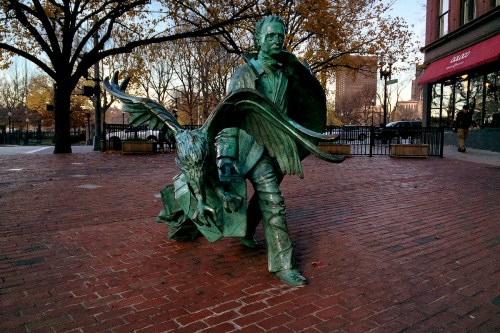
Bartevian sees the fruits of her labor each time she heads into work: the life-size bronze statue done by Stefanie Rocknak.

“Between the suitcase with all the stories falling out and him walking to his room, it’s a very clever statue,” says Bartevian. “[Rocknak] is extremely talented.”

And as Bartevian appreciates Rocknak, the artist behind the Poe statue nods to Bartevian.

“She’s always been terrific,” says Rocknak. “She had people come into her shop to check out the marquettes (small versions of the statue), and she’s selling postcards now. I usually stop in whenever I get the chance.”

Bartevian has made a commitment in writing for her store and building to be a perpetual nonprofit location. And while there is some flexibility, the building will always have a Poe theme to support the Poe legacy efforts as well as Edgar Allan Poe Square.

“It’ll be a perpetual ‘leave the light on for Poe,’” says LaFleur. “He’ll always have a place on the first floor of Bartevian’s.”

Leave a comment

Filed under 2016, author tribute