Tag Archives: Sunday

Danielle Steel Loves the Weather and Elmore Leonard Hates Exclamation Points: Literature by the Numbers

Source: Danielle Steel Loves the Weather and Elmore Leonard Hates Exclamation Points: Literature by the Numbers

by Ben Blatt

The first literary mystery to be solved by numbers was a 150-year-old whodunit finally put to rest in 1963. Two statistics professors learned of the long-running debate over a dozen contested essays from The Federalist Papers, and they saw that they might succeed where historians had failed. Both Alexander Hamilton and James Madison claimed to have written the same 12 essays, but who was right?

The answer lay in how each writer used hundreds of small words like but and what, which altogether formed a kind of literary fingerprint. The statisticians painstakingly cut up each essay and counted the words by hand—a process during which “a deep breath created a storm of confetti and a permanent enemy.” And by comparing hundreds of word frequencies, they came up with a clear answer after so many years of speculation: the contested essays were distinctly the work of James Madison.

Since 1963, similar methods have continued to yield major findings. Take, for instance, last year’s revelation that Shakespeare collaborated with Christopher Marlowe. And in the meantime, the technology involved has leapt from scissors and paper to computer and code, giving rise to a whole new field of study—the digital humanities.

In my new book, Nabokov’s Favorite Word is Mauve, I use simple data to whiz through hundreds of classics, bestsellers, and fan fiction novels to explore anew our favorite authors and how they write. I uncover everything from literary fingerprints and favorite words and tics, to the changing reading level of NYT bestsellers and how men and women write characters differently.

If you have a body of literature, stats can now serve as an x-ray. Here are a few fascinating examples from Nabokov’s Favorite Word is Mauve:

Writing Advice

There is a lot of writing advice out there. But it’s hard to test, and it’s often best to judge someone not by what they say but what they do. Novelists may tell their adoring fans to do one thing, but do they actually follow their own advice? With data, we can find out—looking at everything from the overuse of adverbs to Strunk and White’s advice against qualifiers like “very” or “pretty.”

One of my favorite examples comes from Elmore Leonard’s 10 Rules of Writing, where Leonard offers the following rule about exclamation points: “You are allowed no more than two or three per 100,000 words of prose.” A writing rule in the form of a ratio is a blessing for a statistician, so I ran with it. Does Leonard practice what he preaches?

From a strict numerical view, no. Leonard wrote over 40 novels which totaled 3.4 million words. If he were to follow his own advice he should have been allowed only 102 exclamation points his entire career. In practice, he used 1,651—which is 16 times as many as he recommends.

But looking deeper, we find that Leonard did follow the spirit of his own rule. Below are 50 novelists, representing a range of classic authors and bestselling authors. Elmore Leonard beats out everyone.

And the picture gets even more interesting when we look at how Leonard’s use changes over time. The chart below shows the number of exclamation points that Leonard used in each one of his novels from the start of the career. He loved the exclamation point as a novice, but he slowly weaned off of it over time.
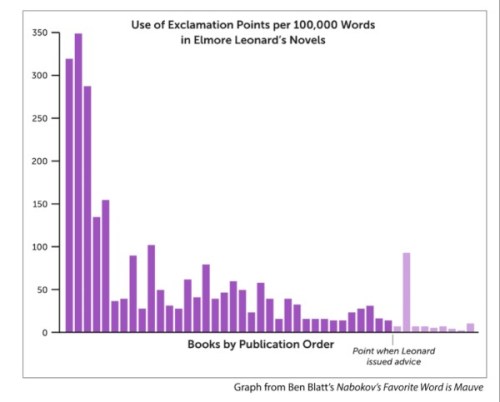
Interestingly, after he delivered his exclamation point rule in 10 Rules for Writing, his use decreased even further (the one exception was Leonard’s sole children’s novel). He may have been a zealot: no one I looked at uses exclamation points at a rate lower than two or three per 100,000. But Leonard practiced what he preached: he got closer to his magic ratio than any other writer, especially in his final stretch of novels.

He was also on to something. I parsed through thousands of amateur fan-fiction stories online and found they were not only enthusiastic about their story universes, but for exclamation points as well. The average published author relies on about 1/4th as many exclamation points as the average amateur writer.

How Cliché

The book world loves a good list: bestsellers, award winners, “best of the year” lists. But what other superlative lists are there to uncover out there in the literary world? In Nabokov’s Favorite Word is Mauve, I decided to ask: who uses the shortest sentences, the most adverbs, writes at the lowest grade level or relies on the most clichés?

I took all expressions mentioned in the 2013 book by Christine Ammer titled The Dictionary of Clichés. These are phrases like “fish out of water,” “dressed to kill,” and “not one’s cup of tea”—4,000 phrases in total. To my knowledge, Ammer’s book is the largest collection of English language clichés. I then scanned through the complete bibliographies of the same 50 authors mentioned above to see who used the most clichés.

The answer: James Patterson.

You’d expect some recency bias in the dictionary of clichés (Jane Austen’s characters, unfortunately, weren’t ever described as “dressed to kill”). So I also looked at every single book that ranked on Publishers Weekly’s bestselling books of the year since 2000. James Patterson can’t blame his time period alone. Even compared to his contemporaries in genre and time, Patterson comes in with five of the 10 most clichéd books. He’s clearly making it work, though. Of those PW lists, Patterson has 16 books, more titles than any other writer.

Start with a Bang

In response to a question on Twitter about her favorite first sentence in literature, novelist Margaret Atwood answered: Call me Ishmael. “Three words. Power-packed. Why Ishmael? It’s not his real name. Who’s he speaking to? Eh?”

Atwood emphasized the brevity of the Moby-Dick opener, and she is similarly concise in her own work. I compared the median length of her opening sentence to that of the 50 authors in the exclamation point chart above. Only one author, Toni Morrison, beats her out.

Opening sentences are far from an exact science, but keeping them short and powerful by rule of thumb is a smart place to start. Drawing from a range of sources, I assembled a list of the consensus top 20 opening sentences in literature. And of that list, 60% of the openers are short when compared to the book’s average sentence length.

But when you look a much wider sample of literature, most authors in practice opt for long openers. In 69% of all of the books I looked at, the opening sentence is longer than the average sentence throughout the rest of the book. It might be that authors like Toni Morrison and Margaret Atwood are on to something as they keep their openers “power-packed.”

Beach Weather

In one last example, let’s return to Elmore Leonard’s 10 Rules of Writing. His first rule (#1!) is “Never open a book with weather.” Apparently Leonard had strong feelings about this trope, but anyone who’s ever heard too many plays on the old saw, “it was a dark and stormy night,” will know where he’s coming from.

Leonard again lives up to his own advice. But there’s one author who completely flouts it, and it’s an example I love.

Danielle Steel, known for selling hundreds of millions of books, should also be known for talking about the weather. She started her first book off “It was a gloriously sunny day and the call from Carson Advertising came at nine-fifteen.” She’s never looked back.

Nearly half her of introductions involve weather—mostly benign, positive weather (“perfect deliciously warm Saturday afternoons,” “perfect balmy May evening”, “absolutely perfect June day,” or simply: “The weather was magnificent.”). But like Patterson she has made her rule-breaking choice work. It’s a distinctive style that’s all her own—and it’s a quirk that at least this reader would never have been able to pin down without having been able to run the numbers first.


Leave a comment

Filed under 2017, tendencies

Oxford Comma Decides Court Case in Maine Labor Dispute

Never underestimate the power of good grammar.

Source: Oxford Comma Decides Court Case in Maine Labor Dispute

By Kyle Scott Clauss

Vampire Weekend and the AP Stylebook be damned! The Oxford comma—or rather, the lack of one—helped decide a Maine court case over overtime pay for dairy workers earlier this week.

Also known as the serial comma, the Oxford comma is used before a conjunction like “and” or “or” in a series of three or more items. (For example: “I’m going to buy some eggs, milk, and bread.”) Critics feel it’s clunky and superfluous, while diehard supporters believe it’s absolutely essential for clarity. (For what it’s worth, Boston magazine’s official style uses the Oxford comma.)

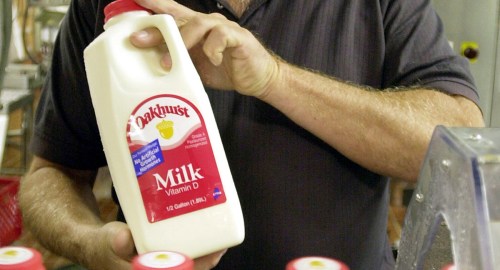
Delivery drivers for Oakhurst Dairy won their suit against the Portland milk and cream company, after a U.S. court of appeals found that the wording of Maine’s overtime rules were written ambiguously. Per state law, the following activities are not eligible for overtime pay:

The canning, processing, preserving,
freezing, drying, marketing, storing,
packing for shipment or distribution of:
(1) Agricultural produce;
(2) Meat and fish products; and
(3) Perishable foods.

Oakhurst argued that “distribution of” was separate from “packing for shipment,” which would allow the company to claim exemption from paying its delivery drivers over time. In trying to prove lawmakers’ intent, Oakhurst even pointed to Maine’s legislative style guide, which advises against using the Oxford comma.

“For want of a comma, we have this case,” U.S. appeals judge David J. Barron wrote.

The appeals court ruled in favor of the five delivery drivers Monday, citing the “remedial purpose” of the state’s overtime laws as reason to interpret them liberally. So rejoice, grammar nerds, and know that the law is on your side.


Leave a comment

Filed under 2017, syntax

Margaret Atwood on What It’s Like To Watch Her Own Dystopia Come True

It seems like everyone I know is reading—or re-reading—The Handmaid’s Tale nowadays. With good reason, of course—the land of Gilead has never felt closer (plus, there’s going to be a bi…

Source: Margaret Atwood on What It’s Like To Watch Her Own Dystopia Come True

by Emily Temple

It seems like everyone I know is reading—or re-reading—The Handmaid’s Tale nowadays. With good reason, of course—the land of Gilead has never felt closer (plus, there’s going to be a big Hulu adaptation, so, you know). To be quite fair, same goes for her eco-speculative trilogy, which begins with Oryx & Crake. For International Women’s Day, author, environmentalist, and (apparently) Canada’s premier seer Margaret Atwood gave an AMA at Reddit, in which she answered questions about feminism, guilty pleasures, and what our political priorities should be in this time of crisis. See some of the highlights from her answers below, and catch the whole thing on Reddit.

On the evolution of her feminism and her advice for women now:

I am so shrieking old that my formative years (the 40s and 50s) took place before 2nd wave late-60’s feminist/women’s movement. But since I grew up largely in the backwoods and had strong female relatives and parents who read a lot and never told me I couldn’t do such and such because of being a girl, I avoided the agit-prop of the 50s that said women should be in bungalows with washing machines to make room for men coming back from the war. So I was always just very puzzled by some of the stuff said and done by/around women. I was probably a danger to myself and others! (joke) My interest was in women of all kinds—and they are of all kinds. They are interesting in and of themselves, and they do not always behave well. But then I learned more about things like laws and other parts of the world, and history… try Marilyn French’s From Eve to Dawn, pretty massive. We are now in what is being called the 3rd wave—seeing a lot of pushback against women, and also a lot of women pushing back in their turn.

I’d say in general: be informed, be aware. The priorities in the US are roughly trying to prevent the roll-back that is taking place especially in the area of women’s health. Who knew that this would ever have to be defended? Childbirth care, pre-natal care, early childhood care—many people will not even be able to afford any of it. Dead bodies on the floor will result. It is frightful. Then there is the whole issue of sexual violence being used as control—it is such an old motif. For a theory of why now, see Eve’s Seed. It’s an unsettled time. If I were a younger woman I’d be taking a self-defense course. I did once take Judo, in the days of the Boston Strangler, but it was very lady-like then and I don’t think it would have availed. There’s something called Wen-Do. It’s good, I am told.

On her inspiration for The Handmaid’s Tale:
Ooo, three main things: 1) What some people said they would do re: women if they had the power (they have it now and they are); 2) 17th C Puritan New England, plus history through the ages—nothing in the book that didn’t happen, somewhere and 3) the dystopian spec fics of my youth, such as 1984, Ray Bradbury’s Fahrenheit 451, etc. I wanted to see if I could write one of those, too.

On the books she returns to again and again:
This is going to sound corny but Shakespeare is my return read. He knew so much about human nature (+ and minus) and also was an amazing experimenter with language. But there are many other favourites. Wuthering Heights recently. In moments of crisis I go back to (don’t laugh) Lord of the Rings, b/c despite the EVIL EYE OF MORDOR it comes out all right in the end. Whew.

On her guilty pleasures:
Haha there are so many of them! Just saw Miss Congeniality again on a plane—very funny! Also The Producers and Young Frankenstein. Also Singing in the Rain when depressed. In the World O Vampires, I am a Christopher Lee fan; but also Let The Right One In, Swedish version. Night of the Living Dead, first one… a classy low budget horror film I could go on…

On getting questions about being a female writer and/or a Canadian writer:
I have got asked about both a great deal over time. But nobody ever asks me what it’s like to be a canoe-paddling writer, or a writer who gardens, or even a knitting writer. Neglected fields! (I’m going to wish I hadn’t said that.)

On where she gets her ideas:
Ideas… never a shortage! I think my brain just works that way. Not all of my ideas have been amazing. Some have not, NOT worked out! As they say (I think it was Beckett): try, fail. Try again, fail better. Or something like that. We have all had projects that have ended up as smashed eggs on the floor.

On advice for struggling writers:
Check out Chuck Wendig’s blogsite/website. He has SO MANY tips and encouragements! He saves me a lot of time b/c I would say much the same things myself. He’s a freelancer, like me. If you have a day job (as I did for I dunno 16 years or something) the advice just has to cover a more challenging time period (i.e. 12 midnite). No one said this would be easy!

On whether she’d rather fight one horse-sized duck or a hundred duck-sized horses:
Are the ducks dead ducks, or are they alive? Are they Zombie Ducks? Is the horse a Pale Horse? Maybe not enough information here. I think I’d pick the hundred duck-sized horses. Easy to stampede, no? (“Scram, ducks!” Opens and closes an umbrella very fast. That’s worked for me in the past, against those weeny ducks.)

On what kids should be reading:
I think kids find books that call out to them if given half a chance. What IS vital is to have a school library + access to a librarian (marks go up by 20% on average) and a home with books in it, even public library books if possible. I don’t like to tell people what they Have to read because it is a very individual thing. I would have to have a [conversation] with a person. Then I might begin to be able to make a [recommendation].

On how it feels to know that America is on its way to becoming Gilead:
I cannot tell you how strange this feels. I wrote the book hoping to fend it off, and I believe it will be fended off: America is very diverse, a lot of people have been jolted out of political slumber and are paying attention, and the Constitution still stands. The upcoming Hulu TV series of which I’ve seen 3 episodes is even more up-to-date and chilling than the book, so let’s see how that may impact. Support your leaders who are standing against unconstitutional laws; keep informed, as best as possible. Everything is “as best as possible” right now.

Leave a comment

Filed under 2017, author interview

The Past, Present And Future Of Sci Fi With N.K. Jemisin | WBEZ

Hugo Award-winning author N.K. Jemisin tells us how she builds fantastical worlds and why science fiction is evolving for the better.

Source: The Past, Present And Future Of Sci Fi With N.K. Jemisin | WBEZ

N.K. Jemisin is the author of a number of books, including The Broken Earth trilogy, the first of which won the Hugo Award for best novel in 2016. She spoke with Nerdette’s Greta Johnsen about being the first black person to win a Hugo, how she comes up with her book ideas, and why diversity is essential to the future of science fiction. Here are some highlights from their conversation.

Greta Johnsen: You say you write speculative fiction, not science fiction. For people who don’t know the difference, can you explain what that means?

N.K. Jemisin: Well, there’s a lot of different definitions of speculative fiction. I used it as a catchall for science fiction, fantasy, horror, interstitial and the occasional comic book. A lot of people use “speculative fiction” to specifically delineate that branch of the literary field that’s willing to toss in some unreal or secondary worldish elements in order to test characters in interesting ways. It’s not science fiction; it’s literative stuff that goes “what if?” It speculates.

Johnsen: So what you’re saying is, it’s not necessarily aliens, but things that could potentially, theoretically happen in a world like ours.

Jemisin: In my case, it simply means that I’m not just a fantasy writer. With other people, it can mean different things, too. It’s a term that everyone adapts in their own particular way.

Johnsen: Recently, friends have asked me for recommendations of things to read or watch. They’re like, “I’ll check out anything, except sci fi.” And that drives me crazy. Because to me, that’s like saying, “Oh, I like anything except imagination.” Can you help me make the sell to the haters? Because that’s ridiculous.

Jemisin: It is ridiculous. It’s because science fiction is terrible at marketing, I think. Science fiction has, for years, allowed a fairly vocal subset of its readership to declare that the only true science fiction is stuff that was written 50 or 60 years ago, that the pulps of the ’40s is what the genre is all about. The plain fact of the matter is that it’s an art form like any other. It has evolved. It has grown. It has expanded in ways that I think it hasn’t done the best job of revealing to the mainstream.

So I would test anybody who says they don’t read science fiction or fantasy. I’d say, “OK, what was the last science fiction or fantasy that you read? Where is this coming from? Did you just watch an episode of old school Star Trek and call it a day, or are you doing this with some real information here?”

And then, there’s multiple places that I would direct them. I would take them to the Nebula list and have them look at a few years’ worth of Nebula nominees and novels. I would show them some current science fiction on television, quite a bit of which is getting critical acclaim. I’m very excited that Stranger Things season two is coming. I just watched the first season of Westworld. I had some questions and thoughts, but it’s an example of something that you can shoot to people to say, “Hey, we’ve moved on a little from Star Trek.”

And even in something like Stranger Things, which is recursively looking at the science fiction of the ’80s, you will see some fascinating ways in which it’s playing with the idea of what science fiction has evolved from and is becoming. In the ’80s, you didn’t usually see a girl as the focus of a story about boys. If you did, she was a prize to be won. She wasn’t the protagonist and the person doing the most awesome things in it.

Johnsen: What makes sci fi so remarkable — and what I love about your books as well — is there’s the actual consumption of the thing, which is satisfying in and of itself, but then the conversation that arises around that, and the interaction with people who are also engaging with the same material, is just … it’s just so much more rewarding than, “Wasn’t that book fun?”

Jemisin: I mean, I’m not doing anything that science fiction and fantasy haven’t done in their own ways for decades. It’s simply that because I’m coming from a different perspective and different things interest me, I’m engaging with politics that are not easily camouflaged by the mainstream.

When you’ve got a slew of stories that are set in a version of medieval England that’s curiously devoid of people of color, and poor people, and queer people, and women, you’ve got this strange secondary world where it’s a bunch of white guys running around poking things at each other and having empowerment fantasies, that’s political. That’s communicating a political message. That’s just communicating a political message that’s fairly commonly seen in our society, and which we don’t necessarily think is weird.

There’s nothing wrong with it — the catch is that some of the rest of us like to get out there and have our empowerment fantasies too. We want to poke stuff with sticks. This is really the thing. When you change something as simple as who it is who pokes a stick at things, people get their backs up. I don’t know why, but they do.

Johnsen: I love that that in and of itself is subversive.

Jemisin: It shouldn’t be. And should our society ever become a place where everybody gets to poke a stick at stuff, then it’ll stop being so subversive. If enough people, and enough of a breadth of people, get to explore the speculative what-ifs, then the stuff that I do will stop being novel. At least in the sense of identity.

I sure hope the stories stand the test of time, but I guess we’ll see.

Leave a comment

Filed under 2017, author interview

Protect Your Library the Medieval Way, With Horrifying Book Curses | Atlas Obscura

Medieval scribes protected their work by threatening death, or worse.

Source: Protect Your Library the Medieval Way, With Horrifying Book Curses | Atlas Obscura

by Sarah Laskow

In the Middle Ages, creating a book could take years. A scribe would bend over his copy table, illuminated only by natural light—candles were too big a risk to the books—and spend hours each day forming letters, by hand, careful never to make an error. To be a copyist, wrote one scribe, was painful: “It extinguishes the light from the eyes, it bends the back, it crushes the viscera and the ribs, it brings forth pain to the kidneys, and weariness to the whole body.”

Given the extreme effort that went into creating books, scribes and book owners had a real incentive to protect their work. They used the only power they had: words. At the beginning or the end of books, scribes and book owners would write dramatic curses threatening thieves with pain and suffering if they were to steal or damage these treasures.

They did not hesitate to use the worst punishments they knew—excommunication from the church and horrible, painful death. Steal a book, and you might be cleft by a demon sword, forced to sacrifice your hands, have your eyes gouged out, or end in the “fires of hell and brimstone.”

“These curses were the only things that protected the books,” says Marc Drogin, author of Anathema! Medieval Scribes and the History of Book Curses. “Luckily, it was in a time where people believed in them. If you ripped out a page, you were going to die in agony. You didn’t want to take the chance.”

Drogin’s book, published in 1983, is the most thorough compendium of book curses ever compiled. A cartoonist and business card designer, Drogin had taken an adult-education class in Gothic letters and became entranced with medieval calligraphy. While researching his first book, he came across a short book curse; as he found more and more, hidden in footnotes of history books written in the 19th century, his collection grew to include curses from ancient Greece and the library of Babylon, up to the Renaissance.

To those historians, the curses were curiosities, but to Drogin they were evidence of just how valuable books were to medieval scribes and scholars, at a time when even the most elite institutions might have libraries of only a few dozen books.

The curse of excommunication—anathema—could be simple. Drogin found many examples of short curses that made quick work of this ultimate threat. For example:

May the sword of anathema slay
If anyone steals this book away.

Si quis furetur,
Anathematis ense necetur.

If a scribe really wanted to get serious, he might threaten “anathema-maranatha”—maranatha indicating “Our Lord has Come” and serving as an intensifier to the basic threat of excommunication. But the curses could also be much, much more elaborate. “The best threat is one that really lets you know, in specific detail, what physical anguish is all about. The more creative the scribe, the more delicate the detail,” Drogin wrote. A scribe might imagine a terrible death for the thief:

“If anyone take away this book, let him die the death; let him be fried in a pan; let the falling sickness and fever size him; let him be broken on the wheel, and hanged. Amen.”

Or even more detailed:

“For him that stealeth, or borroweth and returneth not, this book from its owner, let it change into a serpent in his hand & rend him. Let him be struck with palsy & all his members blasted. Let him languish in pain crying aloud for mercy, & let there be no surcease to his agony till he sing in dissolution. Let bookworms gnaw his entrails in token of the Worm that dieth not, & when at last he goeth to his final punishment, let the flames of Hell consume him for ever.”

Drogin’s book had dozens of such curses in it, and he had collected at least a dozen more to include in the second edition, which was never published. Inside his copy of the book, he still has a baggie of antique file cards, full of book curses.

As Drogin collected curses, he started to find repeats. Not all scribes were creative enough to write their own curses. If you’re looking for a good, solid book curse, one that will serve in all sorts of situations, try this popular one out. It covers lots of bases, and while it’s not quite as threatening as bookworms gnawing at entrails, it’ll get the job done:

“May whoever steals or alienates this book, or mutilates it, be cut off from the body of the church and held as a thing accursed.”

Leave a comment

Filed under 2017, books, library

Ted Chiang’s Soulful Science Fiction – The New Yorker

With just fourteen short stories and a novella, the author behind the recent film “Arrival” has gained a rapturous following within the genre and beyond.

Source: Ted Chiang’s Soulful Science Fiction – The New Yorker

by Joshua Rothman

In the early nineteen-nineties, a few occurrences sparked something in Ted Chiang’s mind. He attended a one-man show in Seattle, where he lives, about a woman’s death from cancer. A little later, a friend had a baby and told Chiang about recognizing her son from his movements in the womb. Chiang thought back to certain physical principles he had learned about in high school, in Port Jefferson, New York, having to do with the nature of time. The idea for a story emerged, about accepting the arrival of the inevitable. A linguist, Chiang thought, might learn such acceptance by deciphering the language of an alien race with a different conception of time. For five years, when he wasn’t working as a technical writer in the software industry, Chiang read books about linguistics. In 1998, he published “Story of Your Life,” in a science-fiction anthology series called Starlight. It was around sixty pages long and won three major science-fiction prizes: the Nebula, the Theodore Sturgeon, and the Seiun, which is bestowed by the Federation of Science Fiction Fan Groups of Japan. Last year, “Arrival” was released, an adaptation of “Story of Your Life,” in which Amy Adams plays a linguist who learns, decades in advance, that her daughter will die, as a young woman, of a terminal illness, but goes ahead with the pregnancy anyway.

Chiang is now forty-nine, with streaks of gray in his ponytail. He started writing science fiction in high school. Since then, he has published fourteen short stories and a novella. By this means, he has become one of the most influential science-fiction writers of his generation. He has won twenty-seven major sci-fi awards; he might have won a twenty-eighth if, a few years ago, he hadn’t declined a nomination because he felt that the nominated story, “Liking What You See: A Documentary,” was unfinished. (It imagines using neuroscience to eliminate “lookism,” or the preference for beautiful faces.) Many of Chiang’s stories take place in the past, not the future. His first published story, “Tower of Babylon,” which appeared in 1990 and won a Nebula Award, follows Hillalum, a Babylonian stonecutter tasked with climbing to the top of the world and carving a doorway into its granite ceiling. It has the structure of a parable and an uncanny and uncompromising material concreteness. At the top of the tower, Hillalum finds that the roof of the world is cold and smooth to the touch. The stonecutters are eager to find out what lies on the other side of the sky, but they are also afraid, and, in a prayer service, Chiang writes, “they gave thanks that they were permitted to see so much, and begged forgiveness for their desire to see more.” Chiang goes to great lengths to show how ancient stonecutting techniques might actually be used to breach the floor of Heaven. He writes the science fiction that would have existed in an earlier era, had science existed then.

Chiang’s stories conjure a celestial feeling of atemporality. “Hell Is the Absence of God” is set in a version of the present in which Old Testament religion is tangible, rather than imaginary: Hell is visible through cracks in the ground, angels appear amid lightning storms, and the souls of the good are plainly visible as they ascend to Heaven. Neil, the protagonist, had a wife who was killed during an angelic visitation—a curtain of flame surrounding the angel Nathanael shattered a café window, showering her with glass. (Other, luckier bystanders were cured of cancer or inspired by God’s love.) Attending a support group for people who have lost loved ones in similar circumstances, he finds that, although they are all angry at God, some still yearn to love him so that they can join their dead spouses and children in Heaven. To write this retelling of the Book of Job, in which one might predict an angel’s movements using a kind of meteorology, Chiang immersed himself in the literature of angels and the problem of innocent suffering; he read C. S. Lewis and the evangelical author Joni Eareckson Tada. Since the story was published, in 2001, readers have argued about the meaning of Chiang’s vision of a world without faith, in which the certain and proven existence of God is troubling, rather than reassuring.

Earlier this winter, I began talking with Chiang about his work, first through Skype, then over the phone and via e-mail. He still works as a technical writer—he creates reference materials for programmers—and lives in Bellevue, near Seattle. “I’m curious about what you might call discredited world views,” he told me, during a phone conversation. “It can be tempting to dismiss people from the past—to say, ‘Weren’t they foolish for thinking things worked that way?’ But they weren’t dummies. They came up with theories as to how the universe worked based on the observations available to them at the time. They thought about the implications of things in the ways that we do now. Sometimes I think, What if further observation had confirmed their initial theories instead of disproving them? What if the universe had really worked that way?”

Chiang has been described as a writer of “humanist” sci-fi; many readers feel that his stories are unusually moving and wonder, given their matter-of-fact tone, where their emotional power comes from. His story “The Great Silence” was included in last year’s edition of “The Best American Short Stories,” and Junot Díaz, who edited that volume, has said that Chiang’s “Stories of Your Life and Others” is “as perfect a collection of stories as I’ve ever read.” Chiang himself seems to find this kind of praise bewildering. When, after about a month of long-distance conversation—he is a slow, careful speaker, and so I had asked to interview him again and again—we met for lunch at a ramen restaurant in Bellevue, I asked Chiang why he thought his stories were beloved. He threw up his hands and laughed with genuine incredulity. He had “no idea” how to account for his own success, he said. He seems almost to regard his stories as research projects pursued for their own sake. When I asked him to speculate—surely all writers have some sense of why they are valued?—he blushed and declined.

Chiang was born on Long Island in 1967. He went to Brown and majored in computer science. In 1989, he attended the Clarion Workshop, a kind of Bread Loaf for sci-fi and fantasy writers. Around that time, he moved to Seattle, where he met Marcia Glover, his long-term partner, during a stint at Microsoft (“I was documenting class libraries or A.P.I.s,” he said); she’s an interface designer turned photographer. He admires the writing of Annie Dillard and enjoyed “The Last Samurai,” by Helen DeWitt.

Beyond this narrow Wikipedian territory, Chiang is reluctant to venture. Although he is amiable and warm, he is also reticent and does not riff. Over several conversations, I learned, in addition, that he owns four cats, goes to the gym three times a week, and regards a small cylindrical seal made of hematite sometime around 1200 B.C. as one of his most treasured possessions—it was a gift from his sister, a reference to “Tower of Babylon.” He told me that, when he was a child, his family celebrated Christmas but wasn’t religious. When I asked Chiang if he had hobbies, he said no, and then, after a long pause, admitted that he plays video games. He refused to say what he eats for breakfast. Eventually, I sent him an e-mail with twenty-four questions that, I hoped, might elicit more personal details:

Do you have a favorite novel?
There isn’t one that I would want to single out as a favorite. I’m wary of the idea of a favorite anything.

You’ve spent many years living near the water. Do you like the sea?
Not particularly. I don’t actually spend much time on the coast; it’s just chance that I happened to move here.

What was the last work of art that made you cry?
Don’t know.

Do you consider yourself a sensitive person?
Yes.

What Chiang really wanted to talk about was science fiction. We spoke about free will (“I believe that the universe is deterministic, but that the most meaningful definition of free will is compatible with determinism”), the literary tradition of naturalism (“a fundamentally science-fictional approach of trying to work out the logical consequences of an idea”), time travel (he thinks of “A Christmas Carol” as the first time-travel story), and the metaphorical and political incoherence of Neill Blomkamp’s aliens-under-apartheid movie “District 9” (he believes that “Alien Nation,” in which the aliens are framed as immigrants, is more rigorously thought through). Chiang reframes questions before answering them, making fine philosophical distinctions. He talks more about concepts than he does about people. “I do want there to be a depth of human feeling in my work, but that’s not my primary goal as a writer,” he said, over lunch. “My primary goal has to do with engaging in philosophical questions and thought experiments, trying to work out the consequences of certain ideas.”

Chiang’s novella, “The Lifecycle of Software Objects,” grew, he said, out of his intellectual skepticism about how artificial intelligence is imagined in science fiction. Often, such computers are super-competent servants born in a lab and preprogrammed by engineers. “But what makes any human being a good, reliable worker?” he asked me. “A hundred thousand hours of good parenting, of unpaid emotional labor. That’s the kind of investment on which the business world places no value; it’s an investment made by people who do it out of love.” “Lifecycle” tells of Ana and Derek, two friends who, almost by accident, become the loving and protective parents of artificially intelligent computer programs. Ana and Derek spend decades raising their virtual children, and, by means of a “slow, difficult, and very fraught process”—playing, teaching, chiding, comforting—succeed in creating artificial beings with fully realized selves. Having done so, they are loath to sell their children, or copies of them, to the Silicon Valley startups that are eager to monetize them. They face, instead, the unexpected challenges of virtual parenthood: What do you do when the operating system on which your child runs becomes obsolete? How can you understand the needs and wants of a child so different from yourself?

In an e-mail, I asked Chiang to tell me about his own parents. (He has no children.) Did they inspire the ones in his novella? “I’m not going to try to describe their personalities,” he wrote, “but here are some basic facts”:

Both of my parents were born in mainland China. Their families fled to Taiwan during the Communist Revolution. They went to college in Taiwan and came to the U.S. for their graduate studies; they met here. They’re divorced. My father still works as a professor in the engineering department at SUNY Stony Brook. My mother is retired, but used to be a librarian. I didn’t have them in mind when writing “Lifecycle.”

Perhaps there’s something contrarian in Chiang’s refusal to acknowledge, or even describe, the role that his life plays in the construction of his fiction. Alternatively, he may be being accurate. Contemplating his e-mail, I found myself thinking, in a Chiangian way, about the nature of ethics. According to one theory, a system of ethics flows from the bottom up, emerging from the network of agreements we make in everyday life. According to another, it flows from the top down, and consists of absolute moral truths that are discoverable through rigorous analysis. The feelings in Chiang’s stories are discovered from the top down. “The Lifecycle of Software Objects” isn’t a story about Chiang’s parents disguised as a thought experiment. It’s a thought experiment so thorough that it tells us something about the feeling of parenthood. That kind of thoroughness is unusual. It is, in itself, a labor of love.

“I don’t get that many ideas for stories,” Chiang said, around a decade ago, in an interview with the sci-fi magazine Interzone. “If I had more ideas, I would write them, but unfortunately they only come at long intervals. I’m probably best described as an occasional writer.” That is still more or less true. Chiang continues to make ends meet through technical writing; it’s unclear whether the success of “Arrival” could change that, or even whether he would desire such a change. A script based on another of his stories, “Understand,” is also in development. “I don’t want to try to force myself to write novels in order to make a living,” Chiang wrote, in an e-mail. “I’m perfectly happy writing short stories at my own pace.”

In the course of our conversations, he and I discussed various theories about his writing—about what, in general, his project might be. At lunch, he proffered one theory—that his stories were an attempt to resist “the identification of materialism with nihilism.” Over the phone, I suggested another, perhaps related theory—that Chiang’s stories are about the costs and uses of knowledge. I pointed out that some of his stories are about the pain of knowing too much, while others are about the long path to knowing, which permits of no shortcuts. In “Story of Your Life,” Chiang’s linguist, Louise, finds that knowing your life story in advance doesn’t make you want to change it; if anything, it makes you more determined to live it out in full. Knowledge alone is flat and lifeless; it becomes meaningful through the accumulation of experience over time.

Chiang, in his precise and affable way, questioned my idea that his stories were “about” knowledge. “Is that really a useful way to characterize my stories, as opposed to other people’s stories?” he asked. He laughed—and then suggested a different subject that, he’d noticed, was a “recurring concern” in his work. “There’s a book by Umberto Eco called ‘The Search for the Perfect Language,’ ” he said. “It’s a history of the idea that there could be a language which is perfectly unambiguous and can perfectly describe everything. At one point, it was believed that this was the language spoken by angels in Heaven, or the language spoken by Adam in Eden. Later on, there were attempts by philosophers to create a perfect language.” There’s no such thing, Chiang said, but the idea appealed to him in an abstract way. In “Understand,” he pointed out, the protagonist learns to reprogram his own mind. He knits together the vocabularies of science and art, memory and prediction, literature and math, physics and emotion. “He’s searching for the perfect language, a cognitive language in which he can think,” Chiang said. “A language that will let him think the kinds of thoughts he wants.”

Leave a comment

Filed under 2017, author profile

Librarians take up arms against fake news | Family | herald-review.com

Source: Librarians take up arms against fake news | Family | herald-review.com

SEATTLE — Janelle Hagen is a school librarian whose job goes far beyond checking out books. She and many other librarians are equipping students to fight through lies, distortion and trickery to find their way to truth.
Helping students become smarter evaluators of the information that floods into their lives has become increasingly necessary in an era in which fake news is a constant.

Two University of Washington professors recently announced a new class that will focus on the ways data are misused to mislead the public. Younger students may need guidance even more.

Hagen, the middle-school librarian at Lakeside School in Seattle, said the students she serves are online every day, and they need to be able to figure out what’s trustworthy and what isn’t.

Besides running the library, Hagen said, she teaches a class called “digital life.” She meets with fifth-graders twice a week and with eighth-graders once a week. The classes are a mix of technology and information-literacy skills, but since the presidential election, she’s increased the focus on the latter.”It was because of all of the buzz (about fake news). You can look at the Google analytics, and the search for ‘fake news’ was unprecedented.” she said. “It’s our job as teachers to address what’s going on in the world.”

One Monday morning, her eighth-graders took a group quiz in which they were asked to identify different kinds of information — advertising, publicity, propaganda, news, opinion pieces. They worked on their laptops choosing from multiple options, and their choices showed up on a big screen at the front of the classroom. There was discussion after each question, especially when not everyone got the answer right.

Hagen introduced the new focus to students by showing them the results of a Stanford History Education Group study in which students from college, high school and middle school were tested on their understanding of various types of information.

Most middle-school students were able to distinguish advertisements from news stories, but more than 80 percent confused native advertisements with news stories. Native advertisements are designed to look like news stories, but they carry a label that sets them apart, usually “sponsored content.” That wasn’t enough.

There is a great need for more education in the critical-thinking skills that are part of information literacy.

Remember when many people thought librarians were going to become obsolete because the world of information was migrating to the web? But then we became enthralled by the possibilities of big data, and library schools became information schools, turning out people who could help navigate vast troves of online data. That’s where the discipline was when Hagen graduated from the University of Washington Information School in 2011.

Librarians and libraries are still with us, and those new data skills are increasingly valuable, but an older skill is now rising in importance. Hagen said librarians have always helped people sort fact from fiction, reliable sources from deceptive ones. Usually that happened as students worked on research papers, but now those lessons need to cover daily life.

“It’s a difficult time to work in education because we are seeing what’s happening in the world and how opinions are really first and foremost rather than facts,” Hagen said.

Lakeside’s high-school librarians put up a display in the entrance to their building that offers several tips for spotting fake news. One says: “What’s the evidence?” Underneath a flap there’s more detail: “As you read an article, make sure to see if they have any evidence to back up their claims. Furthermore, research the evidence to see if it is real, made up, or used in a way not intended by its creators.”

Are claims in an article backed up by verifiable facts? Check the authors’ backgrounds to see if they have credibility on the topic they are writing about.

Hagen likes The News Literacy Project, a collaboration between journalists and educators to improve students’ information literacy through lessons in the classroom and its online program Checkology.

Hagen’s eighth-graders use AllSides, a website that rates the bias of news stories and other articles, labeling them according to where they fit on a political spectrum from left to center to right. And it posts multiple versions of major stories and their ratings. Readers can test their own biases on the site.

As the site says, “if you have a pulse, you have a bias.” And Hagen tells her students that even the most honest media have biases, but they also try hard to be fair, and articles must past muster with layers of editors, so a reader or viewer is more likely to get a more reliable version of a given story.
Awareness is the key, she said. And it is. Read, listen, watch with an active, questioning mind.

Leave a comment

Filed under 2017, library

J.K. Rowling’s Twitter feud with Trump supporters is so bad she’s now fighting some of her fans – The Washington Post

Rowling’s brushes with political controversy are nothing new. She’s just more open about her views now.

Source: J.K. Rowling’s Twitter feud with Trump supporters is so bad she’s now fighting some of her fans – The Washington Post

If there’s any doubt left that we live in divisive political times, know this: Some fans of Harry Potter are burning their copies of the books to protest author J.K. Rowling’s views of the U.S. president. And she’s fighting back on Twitter, insulting those very fans.

That’s right, one of the most beloved series of books in modern history has now become a political prop. Is nothing safe?

Rowling has been vocal about her feelings concerning President Trump for some time. She has mostly used Trump’s favorite platform, Twitter, to share her criticisms.

These tweets have generated a Facebook page’s worth of headlines. But Rowling’s brushes with political controversy are nothing new.

Rowling is a dedicated progressive. She’s a strong believer in welfare, which she relied on during a particularly rough period in her life. As she said during a 2008 Harvard commencement speech, “An exceptionally short-lived marriage had imploded, and I was jobless, a lone parent, and as poor as it is possible to be in modern Britain, without being homeless … By every usual standard, I was the biggest failure I knew.”

More recently, Rowling found herself in the midst of a Twitter battle surrounding Britain’s decision to leave the European Union, referred to as Brexit, which she staunchly opposed.

Much of this now seemingly endless debate was absent during the height of the Harry Potter craze because the author didn’t publicly discuss her views until the publication of the final book in the series. In 2008, a year after “Harry Potter and the Deathly Hallows” hit bookshelves, Rowling gave 1 million pounds to Britain’s Labour Party.

That same year, speaking to El Pais, she said of the U.S. presidential campaign in which Hillary Clinton and Barack Obama were battling for the Democratic nomination: “I want a Democrat in the White House. It seems a pity that Clinton and Obama have to be rivals, because both are extraordinary.”
Anyone who gave the Harry Potter books a close reading likely wouldn’t have been surprised by Rowling’s politics.

Most of the subplots involve the triumph of marginalized peoples, be it the mixed-heritage Hermione, a “mudbl–d,” the poverty-stricken Weasleys, the stigmatized Hagrid (essentially an ex-offender reintroduced to society who can no longer practice magic as a result) or the “lower class” house elf named Dobby (the most obvious analogue to American slavery).

Harry himself, after all, was an orphan and survivor of attempted infanticide.

In his book “Harry Potter and the Millennials,” Anthony Gierzynski wrote that, “the evidence indicates that Harry Potter fans are more open to diversity and are more politically tolerant than nonfans; fans are also less authoritarian, less likely to support the use of deadly force or torture, more politically active, and more likely to have had a negative view of the Bush administration.”

Rowling invites anyone to challenge her.

Once Rowling opened up about her beliefs, it has been a steady stream ever since. And while attacking her own fans might seem like a poor marketing choice, it’s important to note one of the values that Rowling holds most dear: freedom of speech.

“Intolerance of alternative viewpoints is spreading to places that make me, a moderate and a liberal, most uncomfortable. Only last year, we saw an online petition to ban Donald Trump from entry to the U.K. It garnered half a million signatures,” she said during the 2016 PEN America Literary Gala at the American Museum of Natural History in New York City. “I find almost everything that Mr. Trump says objectionable. I consider him offensive and bigoted. But he has my full support to come to my country and be offensive and bigoted there. His freedom to speak protects my freedom to call him a bigot. His freedom guarantees mine.”

Rowling had already faced some conflict before she publicly expressed her political views. Her Harry Potter books were maligned by some Christian groups, making it one of the most challenged books in 2000, as tracked by the American Library Association’s Office for Intellectual Freedom, according to the New York Times.

“The challenges seem to be objecting to occult or supernatural content in the books and are being made largely by traditional Christians who believe the Bible is a literal document,” Virginia Walter, president of the ALA’s Association for Library Service to Children, told the newspaper. “Any exposure to witches or wizards shown in a positive light is anathema to them. Many of these people feel that the books are door-openers to topics that desensitize children to very real evils in the world.”

The outcry didn’t come only from fringe, radical sects of Christianity, either. As noted in the Christian Post, when Pope Benedict XVI was still Cardinal Joseph Ratzinger he condemned the books for their “subtle seductions, which act unnoticed … deeply distort Christianity in the soul before it can grow properly.”

There’s a certain irony to this, considering Rowling has said that Christianity was a great inspiration for the books.

“To me [the religious parallels have] always been obvious,” she said at a 2007 news conference. “But I never wanted to talk too openly about it because I thought it might show people who just wanted the story where we were going.”

There were Christian references throughout the series. When Harry visits his parents’ graves in one book, the headstone reads, “The last enemy that shall be destroyed is death” — an abridged version of 1 Corinthians 15:26.

The graveyard is also the final resting place of headmaster Albus Dumbledore’s mother and sister, whose tombstone bears the inscription, “Where your treasure is, there your heart be also” — a direct quote from Matthew 6:19.

“I think those two particular quotations he finds on the tombstones at Godric’s Hollow, they sum up — they almost epitomize the whole series,” Rowling said at the news conference.

Leave a comment

Filed under 2017, author commentary

The 11 Most Anticipated Book-to-Film Adaptations of 2017

Leave a comment

Filed under 2017, books to film

How ‘Sherlock of the library’ cracked the case of Shakespeare’s identity | Culture | The Guardian

Literary detective Heather Wolfe reveals how her passion for manuscripts helped unravel mystery of who the bard really was

heather-wolfe

By Robert McCrum

https://www.theguardian.com/culture/2017/jan/08/sherlock-holmes-of-the-library-cracks-shakespeare-identity?CMP=share_btn_link

Deep in the Folger Library, in Washington DC, Heather Wolfe says that studying Shakespeare makes an ideal preparation for the onset of Trump’s America. You can see her point: Shakespeare would have revelled in the mad excesses, the sinister vanities and the pervasive stench of cronyism and corruption surrounding the president-elect as America makes the painful transition from Barack Obama.

Dr Wolfe is a willowy, bright-eyed manuscript scholar, a paleographer specialising in Elizabethan England who in certain moods of candour might put you in mind of Portia or perhaps Cordelia. She’s also a Shakespeare detective who, last year, made the career-defining discovery that is going to transform our understanding of Shakespeare’s biography. In the simplest terms, Wolfe delivered the coup de grace to the wild-eyed army of conspiracy theorists, including Vanessa Redgrave and Derek Jacobi, who contest the authenticity, even the existence, of the playwright known to contemporaries as Master Will Shakespeare.

Wolfe is an accidental sleuth. Her scholar’s passion is as much for old manuscripts as for the obscurities surrounding our national poet. Project Dustbunny, for example, one of her initiatives at the Folger Shakespeare Library, has made some extraordinary discoveries based on microscopic fragments of hair and skin accumulated in the crevices and gutters of 17th-century books.

DNA forensics aside, Wolfe’s role as a curator at the Folger is to bring her expertise to bear on the tantalising mass of documents that survives from the late 16th century. And yet, despite a heap of legal, commercial and matrimonial evidence, Shakespeare the man continues to slip through scholars’ fingers. Four centuries after his death, apart from a handful of crabbed signatures, there is not one manuscript, letter or diary we can definitively attribute to the poet, sponsoring the pervasive air of mystery that surrounds his genius. Indeed, the most intimate surviving Shakespeare document remains that notorious will, in which he bequeathed his wife his “second best bed”.

Before Wolfe arrived on the scene, all that scholars could be certain about was that a man named Shaxpere, Shaxberd or Shakespear was born in Stratford in 1564, and that he was an actor whose name is printed in the collected edition of his work published in 1623. We also know that he married Anne Hathaway, and died in 1616, according to legend, on his birthday, St George’s Day. The so-called “Stratfordian” case for Shakespeare rested on these, and a few other facts, but basically, that was it.

Into this vacuum, a bizarre fraternity, including Mark Twain, Charlie Chaplin and Sigmund Freud, have projected a “Shakespeare” written by a more obviously accomplished writer: Edward de Vere (the 17th earl of Oxford), Sir Francis Bacon and the playwright Christopher Marlowe, to name the leading contenders in a field that includes Sir Walter Raleigh, and even Elizabeth, the Virgin Queen herself.

In the absence of reliable data, a mountain of speculation has morphed into the weirdest fantasy, notably the 2011 film, Anonymous. Wolfe has no time for this. Speaking exclusively for the first time to the Observer, she says: “Without the evidence for other contenders, it’s hard for me to engage with this line of inquiry.”

Wolfe’s appetite for manuscript corroboration has led her into many dusty corners of the Elizabethan archives. It was this research instinct that first led her to reopen the file on the coat of arms granted to Shakespeare’s father, the small-town glover, in 1596.

John Shakespeare, from Stratford-upon-Avon, was ambitious to rise in the world. He was certainly not the first Englishman keen to put his origins as a provincial tradesman behind him. Among his contemporaries in Stratford, he was a figure of fun for his social climbing. English class snobbery has a long pedigree. His son, who would continue the quest for official recognition after his father’s death, also attracted metropolitan disdain as “an upstart crow beautified with our feathers”. In 1601, after his father’s death, Shakespeare the upstart returned to the college of arms to renew the family application for a coat of arms. He had made a small fortune in the theatre, and was buying property in and around Stratford. Now he set out to consolidate his reputation as a “Gentleman”. Under the rules that governed life at the court of Elizabeth I, only the Queen’s heralds could grant this wish.

A much-reproduced sketch for a coat of arms crystallised Shakespeare’s hopes for legitimacy in the antique jargon of heraldry: “Gould, on a Bend Sables, a Speare of the first steeled argent. And for his Crest, a falcon, his winges displayed Argent, supporting a Speare Gould …” The needy applicant also attached a motto: Non Sanz Droit (“Not Without Right”). All this, and much more, is buried in the archives of the college of arms in London.

Wolfe’s fascination with Shakespeare’s quest for a family crest grew out of her immersion in the manners and customs of late Elizabethan England, in particular the College of Heralds. These court officials were required to administer the complex rituals governing the lives of the knights, barons and earls surrounding Queen Elizabeth.

An adjunct to the court, the College of Heralds was not exempt from its own secret feuds. In 1602, the internecine rivalry between Sir William Dethick, the Garter King of Arms, and another herald, Ralph Brooke, burst into the open when Brooke released a list of 23 “mean persons” whose applications for crests (he claimed) had been wrongfully preferred by Dethick. When “Shakespeare the Player” found himself on this list, his campaign for social advancement seemed in jeopardy. A bitter row broke out at court between two factions. Shakespeare himself became an object of ridicule. Another rival, Ben Jonson, in his satire Every Man out of his Humour, poked fun at him as a rustic buffoon who pays £30 for a ridiculous coat of arms with the humiliating motto “Not Without Mustard”.

It’s at this point in the story that Wolfe discovered “the smoking gun”. In the Brooke-Dethick feud, it becomes clear that “Shakespeare, Gent. from Stratford” and “Shakespeare the Player” are the same man. In other words, “the man from Stratford” is indeed the playwright. Crucially, in the long-running “authorship” debate, this has been a fiercely contested point. But Wolfe’s research nails any lingering ambiguity in which the Shakespeare deniers can take refuge.

Wolfe is circumspect about making extravagant claims. Speaking carefully, she says that her manuscript discoveries fill in gaps, illuminating Shakespeare’s character. “They point to someone actively involved in defining and defending his legacy in 1602, shortly after his father’s death.”

For Wolfe, it’s Shakespeare the man who breaks cover here. “He’s defending his legacy not only as a playwright but, most importantly to him, as a gentleman.” The derogatory references to arms belonging to “Shakespeare ye player”, she says, show that “he’s playing the same game as everyone else in the period, purchasing land in Stratford to support his case to ‘ancient’ gentility, rather than through his astonishing professional success”.

James Shapiro, bestselling author of 1599, who is persuaded by Wolfe’s discoveries, compares her to “a Sherlock Holmes of the archives”. Shapiro says that Wolfe “has had the intellectual independence to see what others have overlooked, the skills to make sense of what she has stumbled upon and the modesty not to trumpet the larger implications of those finds. But make no mistake: they are enormously consequential.”

For Shapiro, Wolfe’s work suggests future breakthroughs. “I doubt that these are the last archival treasures she will unearth. Her recent finds sharpen our sense of Shakespeare’s dogged pursuit of upward mobility. And it is one more nail in the coffin of those who can’t bring themselves to acknowledge that the glover’s son from Stratford was also the successful man of the theatre who left us so many extraordinary plays.”

Wolfe says she looks forward to “poking about” in the archives, and is convinced that Shakespeare’s identity no longer needs re-confirmation. “There is such a wealth of evidence out there that he’s the playwright.” She adds: “I’m sure there’s more untapped material waiting to be uncovered. Additional finds will certainly help us understand his life – as much as we can understand anyone’s life from 400 years ago.”

Leave a comment

Filed under 2017, author tribute, author write up