Tag Archives: story

Writing Tip: Drama is conflict

My writing is distinctly middle brow. Just ask anybody who has suffered through it. Still, I like to think that even in my middling way, I can offer some helpful advice when I stumble across it. Therefore, from time to time, I will post some writing advice, but not from me. The advice will come from established sources. I will endeavor not to make it overlong or overreaching, and sometimes it will simply be reminders of what we all probably already know, but it will be some tips I have picked up from reading, from attending writing conferences, or it may even come from you.

Writing with paperclips in ears and nose

Darma is conflict, sometimes even self-inflicted

The first bit of advice comes from a writing course the Knoxville Writers’ Guild sponsored way back in 1993. The teacher was Joseph Gunnels and the cost was $75. It was two-day event, May 15 and 16, and we spent part of a pleasant afternoon sitting on the grass outside the Candy Factory, on The 1982 World’s Fair site. I took over 30 pages of notes, but rather than bore you with details, here is the essence of what I took away from the seminar:

Drama is conflict;
Without conflict no action;
Without action no character;
Without character no story;
Without story, who cares?

In a future entry, I’ll give you a short, crisp definition for conflict that I learned at a more recent one-day writing seminar. It comes from a very highly regarded script doctor in Hollywood, but applies just as well to other forms of fiction writing. Stay turned.

Leave a comment

Filed under advice, building a better story, character, conflict, drama, story, tension, words, writing, writing conference, writing tip

The blathering idiot launders his own heart

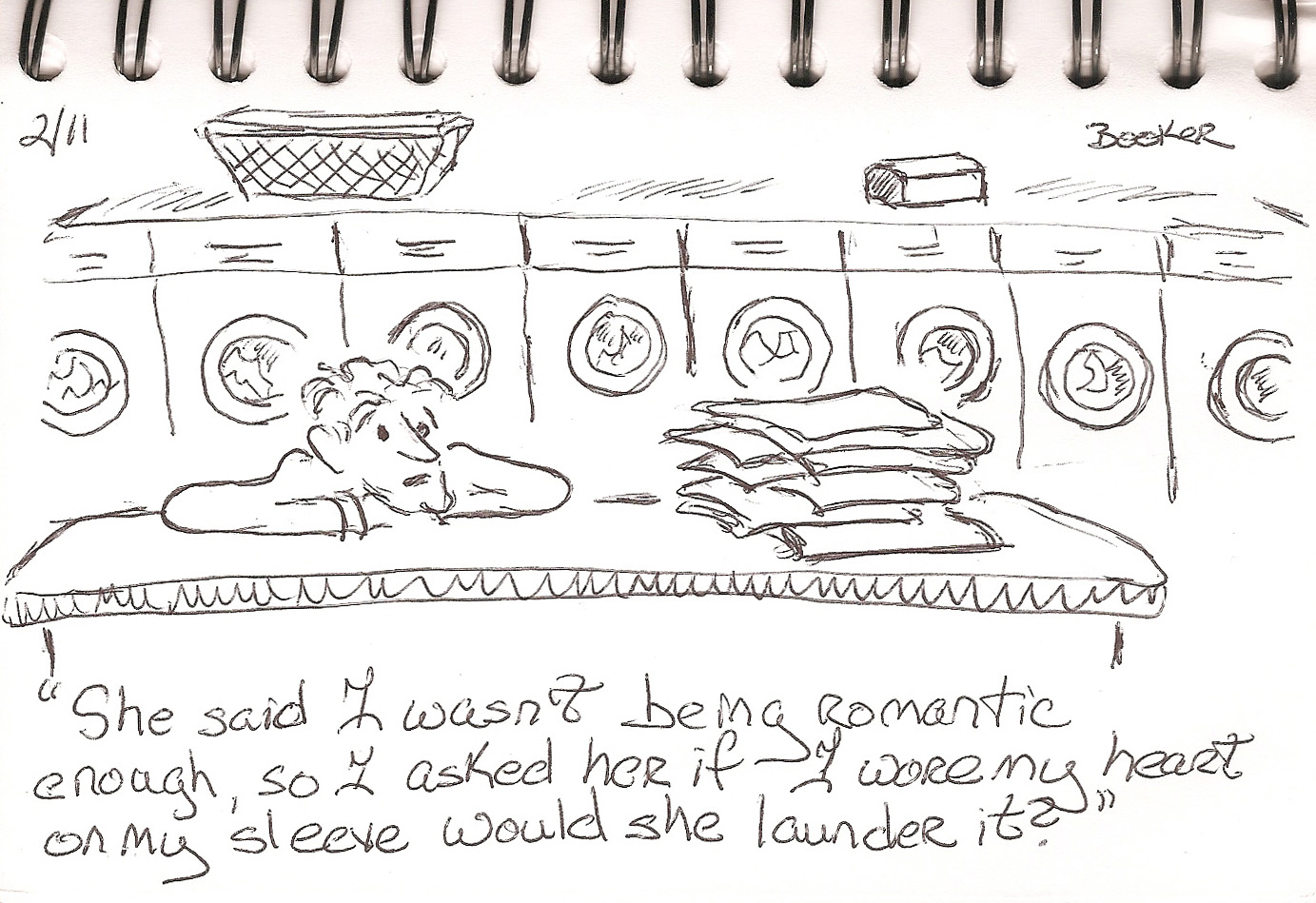
The blathering idiot sat in the coin-operated launder mat watching his clothes dry. It had been a tough time since Valentine’s Day. He had forgotten to get his girl friend anything: no card, no flowers, no gift no matter how inexpensive, and though she was willing to forgive him, she said they needed to talk, and they would do so on the day he brought his laundry over.

The blathering idiot knew what talk meant. It meant that he, the blathering idiot, would need to make amends. He came prepared to offer everything: two-dozen flowers, three cards, an expensive dinner, an entire weekend watching “chick flicks.” Only thing she had to do was tell him what she wanted.

What she wanted from him was something he hadn’t anticipated. She simply said he wasn’t being romantic enough in the relationship and what did he intend to do about it?

The blathering idiot thought about it.

His girl friend waited.

Blathering Idiot at the launder mat

“If I wore my heart on my sleeve, would you launder it?”

The blathering idiot thought some more. He was prepared to give her what she asked for, what she said she deserved, even what she demanded. She only had to say it. He wasn’t, however, prepared to give her an answer.

He stared at his pile of dirty laundry, hoping for inspiration.

Finally, he remembered that she’d often told him that while she wore her heart on her sleeve, he seemed to keep his tucked away somewhere, so he said something he thought was witty, something he thought would break the tension, something that might make her laugh and then they would forget about the question.

He said, “If I wore my heart on my sleeve, would you launder it?”

For the foreseeable future, the blathering idiot was laundering his own heart at a coin-operated place of his choosing.

He found no inspiration as he watched his shirts tumble dry.

Leave a comment

Filed under blathering idiot, Cartoon, humor, observation, satire, story, words, writing

The Blathering Idiot and the Box of Everlasting Life

The blathering idiot saw the ad on the Internet, click on it, and was transported to a web site where the promoted product promised to…

Build a new, high-efficiency body:
Say NO to Memory loss
Say NO to Arthritis
Say NO to Pain
Say NO to short lives of 75 years max
Say NO to Ugliness.

Activate your dormant codes for advanced human ability and appearance.
Override the death code based on the carbon grid.
Make dominant your crystalline grid.
Make your DNA perfect again.

“I will show you how to self-heal,” Dr. Ben T. Err said. “My secret product formula, Dunthat, helps you create a new advanced physical form!”

Err then went on to talk about his advanced studies as an, Iridologist, Nutritionist, and Herbologist.

Best If Used By label on bottle

Best If Used By...


“Order today and learn how to upgrade your cellular character by releasing density, carbon congestion, primitive DNA, and by moving to crystalline dominance the natural way.”

The blathering idiot placed an order, which eventually arrived. When he opened the box, it contained a DVD, an instruction booklet, and a series of containers containing a series of products, all very herbal looking. And on the bottom of each container there was a sticker that read: “Best if used by” and a date. They all had the same date and that date had already passed.

1 Comment

Filed under blathering idiot, Cartoon, humor, story, the perils of writing, words, writing

The zipper and the preacher

Some things are better left “un-done.”

Leave a comment

Filed under humor, story

And you know something…

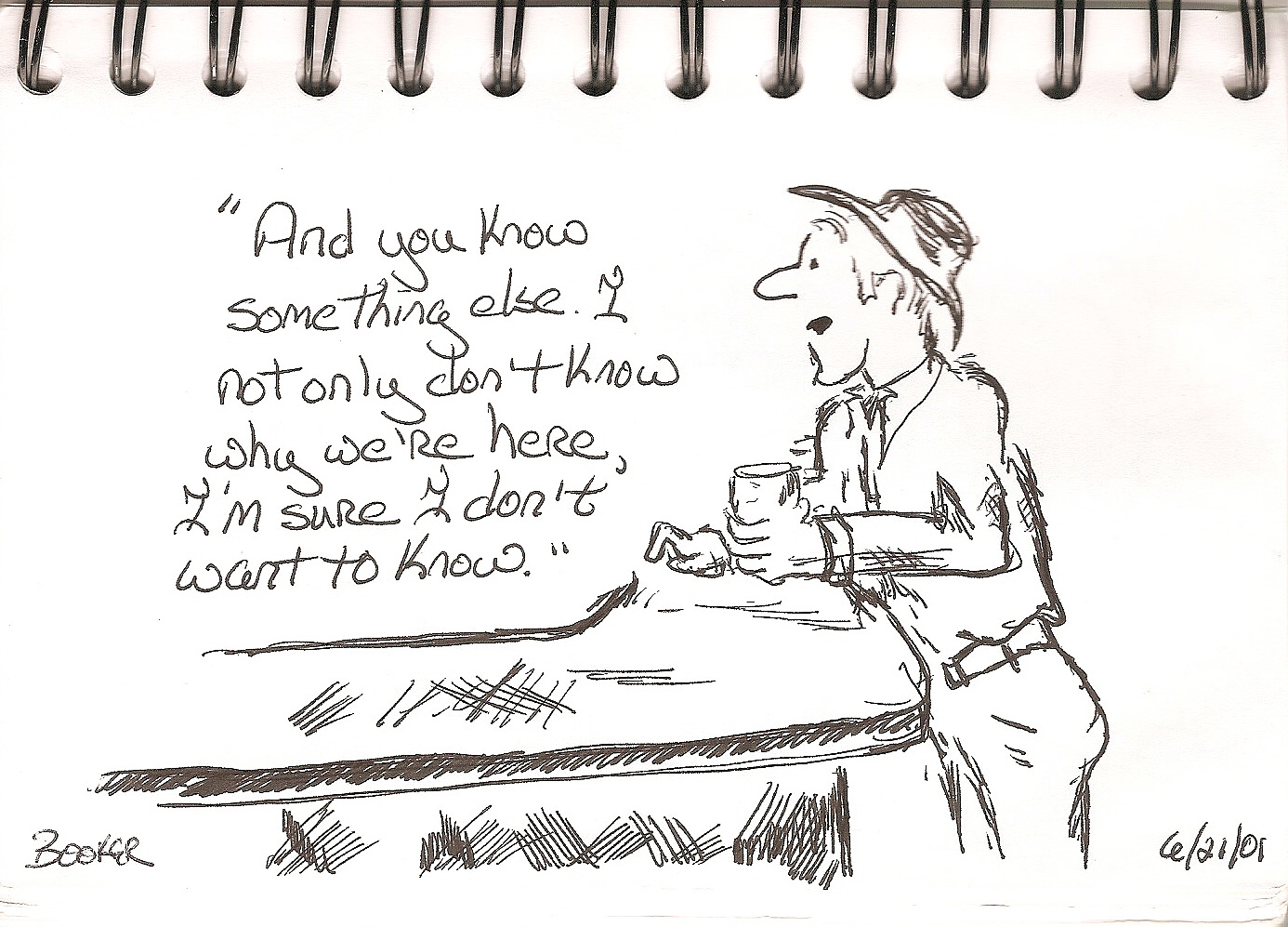
There were things the blathering idiot understood and there were things he didn’t. Sometimes, he tried to understand the things he didn’t. One day, he tried to understand why man was here. What was human kinds purpose on this earth? Were we here to glorify a god or gods? Were we here to glorify gold? Were we here to learn all we could learn and then leave it behind when we die? Were we here to love and laugh, or suffer and cry?

I not only don't know why we're here

"And you know something else. I not only don't know why we're here, I'm sure I don't want to know."

He even asked the bartender, who offered him one or two words, but mostly grinned and grunted noncommittally. The bartender tried changing the subject by asking a sports question or two, but the blathering idiot would not change the subject, even when the bartender changed the channel on the TV and turned up the sound.

The blathering idiot tried and tried to tease an answer out of the question. Finally, after having written for an hour on bar napkins and then thrown away all the answers he’d come up with, he picked up his root beer, took a swig, and proclaimed to the bartender while tapping on the bar, “And you know something else. I not only don’t know why we’re here, I’m sure I don’t want to know.”

He wasn’t sure, but the blathering idiot thought the bartender was happy with that answer.

Leave a comment

Filed under blathering idiot, Cartoon, humor, Random Access Thoughts, satire, words, writing

So, you want to be a writer? Watch and learn

Leave a comment

Filed under agents, editor, humor, novel, Perils of writing, pitches, publishers, Random Access Thoughts, words, writing, writing tip

Pictures at an exhibition

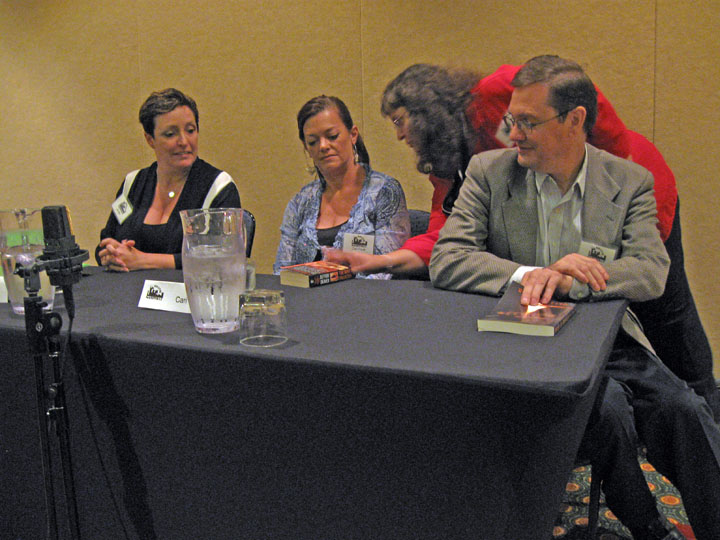
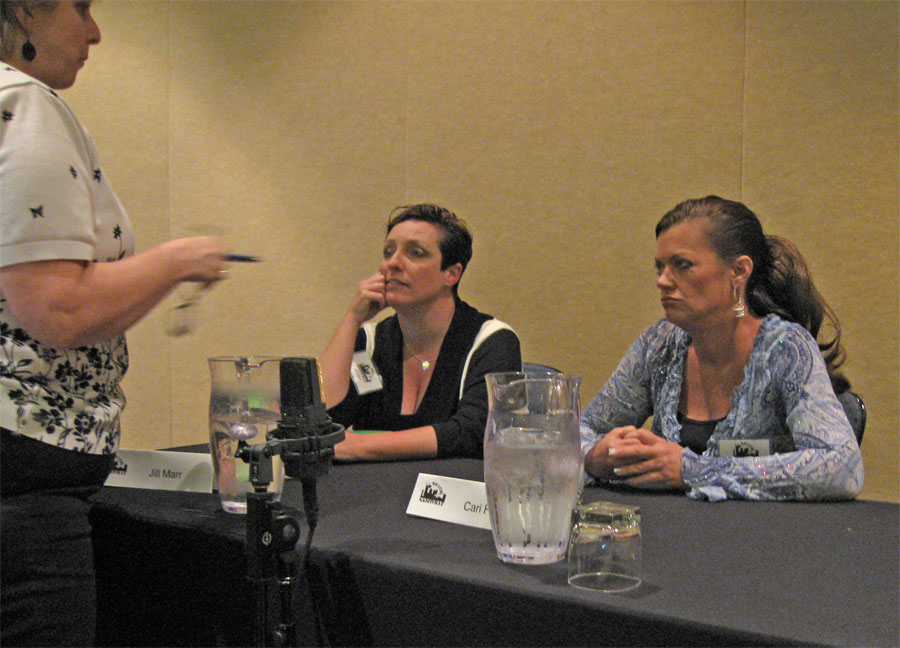
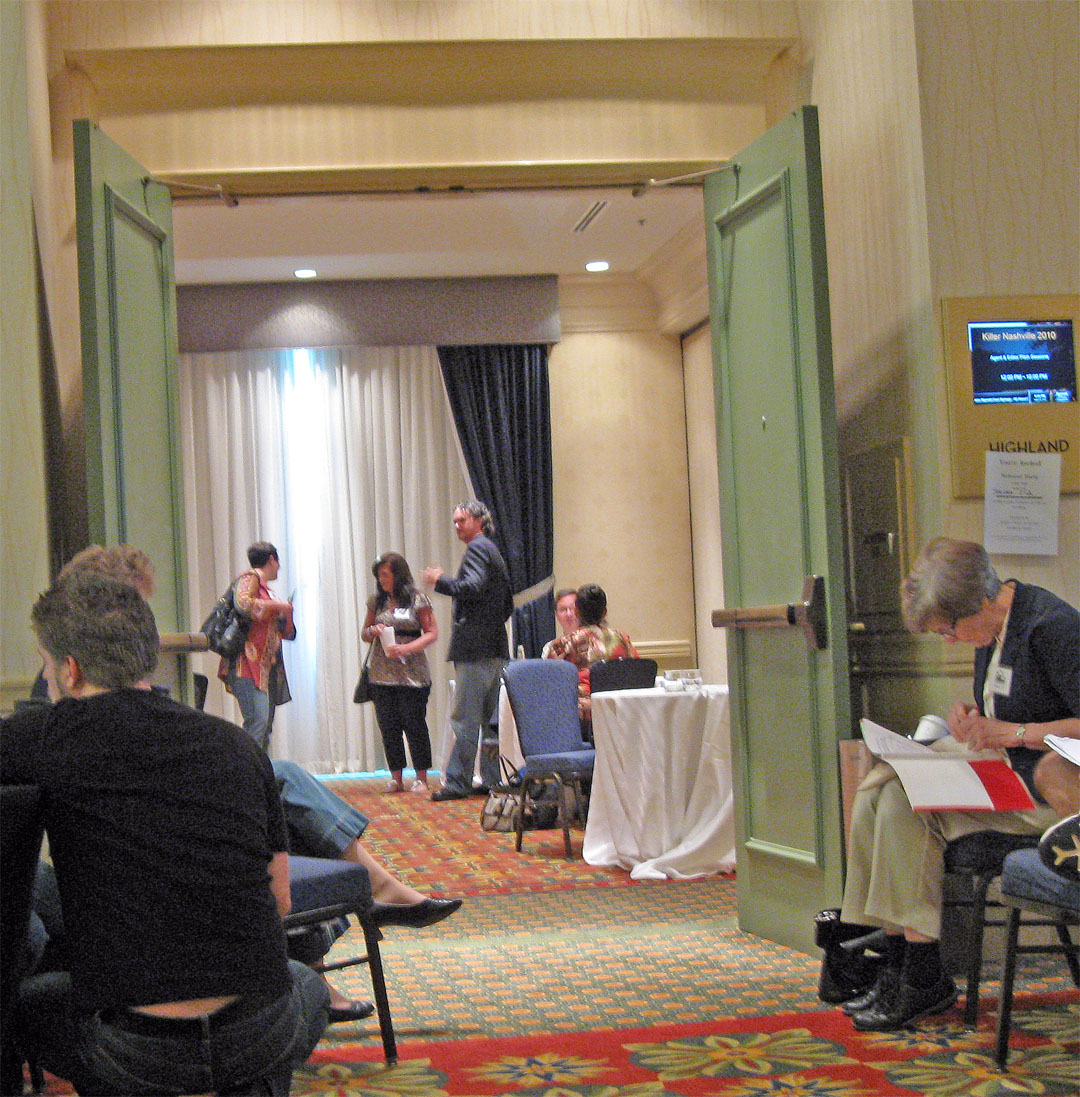
Below are a few photos of agents and editors taken while at Killer Nashville this past August 20 – 22, 2010. Consider this visual reference for the names of people mentioned in some of my earlier posts on pitching your novel to editors or agents.

From left, agents Jill Marr, Cari Foulk, and Jeff Gerecke. Beth Terrell, author and Killer Nashville Executive Driector, leaning over behind them.

Jill Marr (seated left) and Cari Foulk listening to a question at Killer Nashville 2010.

Jill Marr (seated left) and Cari Foulk listening to a question at Killer Nashville 2010.

Agents Jill Marr (left) and Cari Foulk standing for a few moments after listening to pitches.

Agents Jill Marr (left) and Cari Foulk standing for a few moments after listening to pitches.

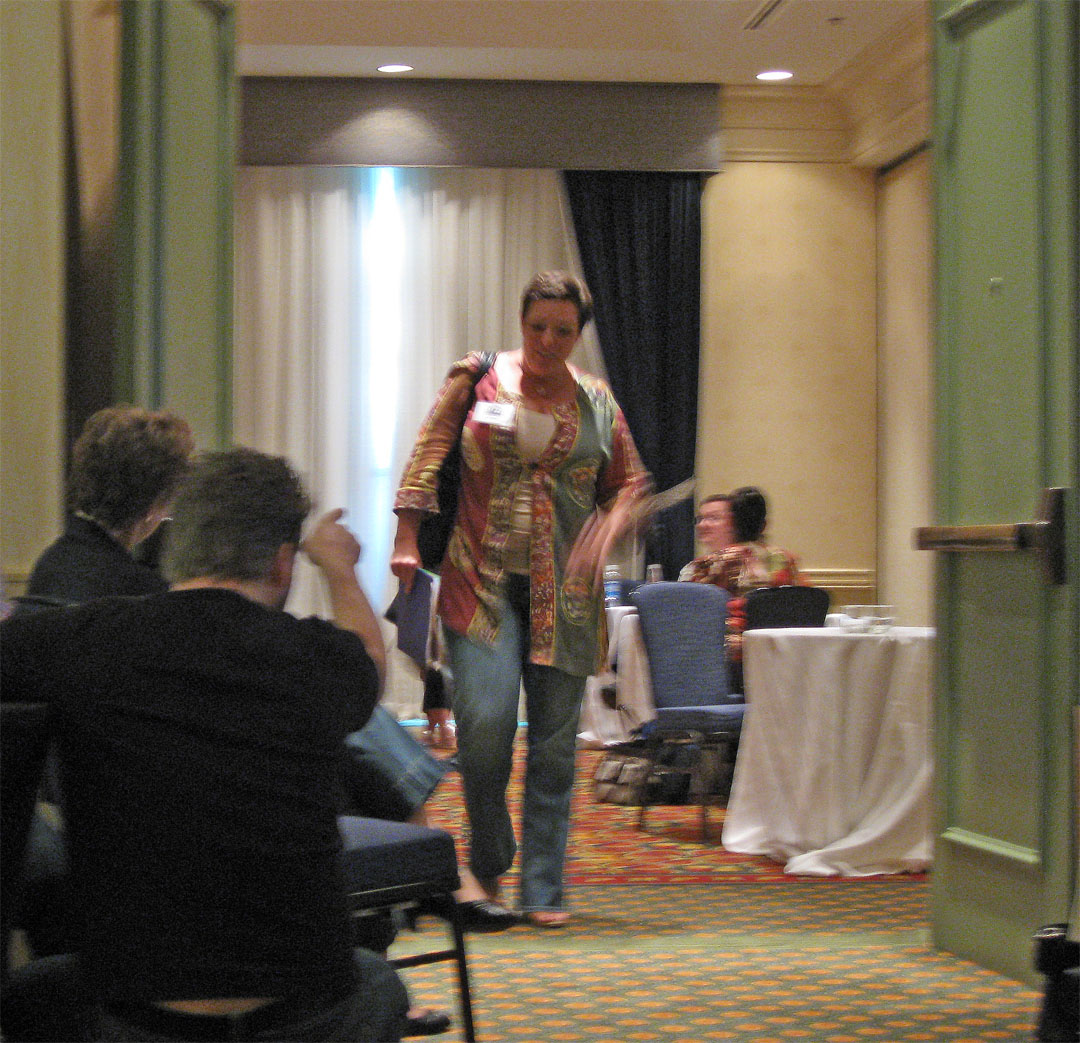
Agent Jill Marr walking out of the Pitch Room.

Agent Jill Marr walking out of the Pitch Room at Killer Nashville 2010.

Leave a comment

Filed under agents, editor, Killer Nashville, Perils of writing, publishers, Random Access Thoughts, the perils of writing, writing, writing conference, writing tip

What makes for a good pitch? The thou shalts.

Killer Nashville badge

Killer Nashville badge


By now you may (or maybe not) be wondering what makes for a good pitch to agents or editors when you approach them at conferences such as Killer Nashville.

1) Sincerity. Even with your nervousness, if you don’t believe in what you’ve written, don’t expect the agent or editor to. I once had a published author answer the question of how do you know when you’ve finished writing and editing a novel by saying, when you’re tired of looking at it. You may have reached that stage with the mechanics of your novel, but if you’ve also edited out the sincerity, then you’ve probably gone too far and it will show in your pitch.

man on books

Believe in what you've written

2) Passion. In his book, Selling Your Story in 60 Seconds: The Guaranteed Way to Get Your Screenplay or Novel Read by Michael Hauge, one of the things mentioned is passion, i.e. belief in your novel. If you don’t believe in it, nobody else will. Now, maybe you are like me, and when you are nervous, you can slip into talking in a flat, almost monotonous tone. At such times, an old-fashioned metronome has more passion in its back and forth swing than my voice does. It also happens when I am trying to remember to get everything in my pitch that I believe should be there and keep out the things I’ve decided shouldn’t be.

How do you overcome that? A friend of mine who was also pitching at Killer Nashville said he was going to add passion to his pitches by being sure to move his arms. Physical gestures can be effective in loosening you up to allow some of the passion to come through. After all, many passionate people are often moving their arms for emphasis. Another thing you can do is remember to breath and realize that while you don’t have a lot of time, you do have enough time if you’re prepared, if you’ve practiced your pitch. You may also want to practice varying the delivery pace of your sentences. Pause a little longer between some sentences than others. Think of what you’re doing more as a conversation.

3) Be prepared. That means having written out or in some other way constructed your pitch and have practiced it. A few of us who were going to Killer Nashville practiced our pitches. I facilitate a writing group. We meet once a month to review each others’ works. During part of a couple of those sessions, a few of us practiced pitches for the novels we had written, and we let the other members of the group offer their comments. Even after that, I practiced a few more times, often going through my pitch as I was driving to work. (I’m sure people the cars around me wondered what crazy song I was singing to or what medication I had failed to take that morning.)

I even practiced once with my wife, and once with the friend I rode over with to Killer Nashville. He did his pitch and I listened and offered comments. And I did mine. (Actually, I did two, because I had one for a second novel I have written.) Both my wife and my friend said I needed to convey a little more passion in my pitch. That’s when I asked my friend, “How are you going to convey passion in yours?”

“I’m going to wave my arms,” he said.

I did do some hand gestures with my pitches (all three of them), and I hoped it helped. Since there is no copyright on arm waving or hand gestures, I don’t think I owe him more than a thank you. As I said in an earlier post, I also admitted to my nervousness up front with the first agent. Sometimes it helps to make things a little easier to do that. And somehow our conversation lead to my getting to do a partial version of the pitch for my other novel as well as the one I had sat down to pitch.

4) Be prepared to be interrupted. The person on the other side of the table will probably have questions for you, particularly if she or he is interested. So be prepared for that. The questions may come at the end. If so, then you’ll have little or no interruptions. Or the questions may come during your pitch. I experienced both. If interrupted, you’ll have to do your best to remember where you were in your pitch and get back to it as naturally as possible.

5) The best pitches are not the longest ones. I had the times for my second and third pitches eaten into because the persons before me when a longer than the ten minutes allotted. If your pitch session is scheduled for 10 minutes, don’t have a pitch over five minutes in length. And if you can have one even shorter, probably better. Remember point number 4, be prepared to be interrupted. That interruption might even occur before you get to sit down.

The agents and editors are hearing these pitches back to back to back. Filling your presentation with wall to wall sound won’t necessarily make your book more memorable. If you’re done before your ten minutes is up, great. Even if the editor or agent doesn’t bite and want to see all or part of your manuscript, you could still leave a favorable impression by being polite and precise in your presentation. The editor or agent might not be interested in this novel, but who knows about the next one. Besides, if he or she didn’t want to read a sample of the novel, there is no need to waste your time or the agent’s or the editor’s. There could be a multitude of reasons why the editor or agent isn’t interested. For example, one agent my friend pitched to told him she wasn’t interest because her agency was already representing a book with a similar structure to it. Literary agencies and publishers generally don’t want to handle books that they believe are similar to ones they already have in hand. Unfortunately, there is not much you can do about that, other than move on.

I have written enough for now. Next time, a few “Thou Shalt Nots” in terms of pitches.

1 Comment

Filed under agents, conference, editor, humor, Killer Nashville, Perils of writing, publishers, Random Access Thoughts, story, writing, writing tip

The Perils of Writing: Tension

Writing tip: Building a better story: tension

Bookends to death

Tension, what is it, how to get it.

In the last installment, I said there was a difference between conflict and tension. Conflict, as Bob McKey pointed out, is the gap between expectation and result. The gap can be small, such as being overcharged a dime or great, such as losing a loved one when you thought he would survive.

The best way to explain tension is to refer to a small book on writing by the writer and editor Algis Budrys, Lithuanian for “Gordon John Sentry, more or less.” His book, Writing to The Point: A complete guide to selling fiction is only 64 pages long, and may be hard to get. But this Strunk and White-sized guide to writing is worth your time (and it even covers manuscript formatting).

For Gordon John Sentry, more or less, a story consists of seven parts: 1) a character 2) in a context with a 3) problem, who 4) makes an intelligent attempt to solve the problem and 5) fails, tries a second time and fails, tries a third time and finally 6) succeeds or completely fails, and whose actions are then 7) validated by another character in the story.

Sounds simple, doesn’t it? That is the allure of telling a good story. But the execution is often more difficult, for writer as well as story character. Step 4 – 6 above is where in a story you find tension. The key is that the character makes an intelligent attempt and fails. With increased knowledge, he or she tries again, and fails. The increased knowledge increases the stakes in the attempt and thus increases the tension. After all, it should succeed, right? Then there is a third and final attempt. This is, in essence, all or nothing, so the tension should be at its highest here.

Tension, then, is something that builds over the life of the story, fueled by and feeding into the conflict. A well known love story may provide the clearest example. Romeo and Juliet loved each other. Their families, however, were adversaries. Romeo and Juliet attempted to find a way to manifest their love in the midst of this conflict, each time failing until each makes one last effort that leads to both their deaths. In this example, the tension builds in opposition to the conflict, which is fairly clever if you think about, and because of that opposition, the conflict works to heighten the tension.

Leave a comment

Filed under humor, story, the perils of writing, words, writing, writing tip

The Supercilious Door

Didn’t you know, there’s a secret marketing department office called SuDoo? Their job is to make things super-silly-to-us, or supercilious when said fast enough. They once had a sign that hung on their door that said “Supercilious Department.” Others called it “the SD door” for short. The sign was so heavy that it kept falling off. At first, people walking by would pick it up, knock on the door, and give the sign to whomever answered. Eventually, people got tired of this, especially since the people inside never said thank you. Finally, the sign fell down and nobody picked it up or knocked on the door to tell the SD their sign was down. The work day ended and as the first SD member stepped through the door, he stepped on the sign. It shattered under his weight and shot out in different directions, one piece wedging under the door to the Supercilious Department, preventing them from closing it. Because he had shattered the sign and the door couldn’t be fixed for several weeks, the sign breaker was stationed at the door to keep people out. He became known as the Supercilious Department Door Keeper, which was too long for people in the office to say, so it became shorted to the Supercilious Door Keeper, and eventually SDK. But the head of the Supercilious Department didn’t like that and insisted that the first time people greeted the door keeper, they had to refer to him as the Supercilious Department Door Keeper. Subsequent references during the day could be shorted to Supercilious Door Keeper. One day, a new employee from another department had a package that needed to go immediately to the Supercilious Department Head, but when he got to the door, he found the Supercilious Department Door Keeper would not let him in. The Door Keeper told him he could send a note inside the department, and the person for whom the package was addressed, could come forward and get it. The new employee pulled and pen and a scrap piece of paper out of his pocket and began his note. Unfortunately, the pen ran out of ink, and so the employee couldn’t finish his note, and since this employee was late for another meeting, he left the package outside the door. The Door Keeper forgot about the package, and eventually it was time to leave work. As the head of the department left, he saw the package, picked it up, recognized its importance, and looked around. When he spotted the Door Keeper making his way to the elevator, he yelled out, “Hey, you, Supercilious Door K—.” It was then that the package exploded. The Department head lost his, and as it turned out, the package was not what he thought it was, but in loving tribute to the Department head who lost his, the rest of the department and eventually those throughout the building referred to the Supercilious Door Keeper as the Supercilious Dork. Over time, the Supercilious Dork rose to be head of the department and because he was so stigmatized and traumatized by what happened that day, he has forever more made it his mission to shorten the names of things. And he never picks up strange packages, especially ones addressed to Supercilious Dork.

Leave a comment

Filed under story, words, writing