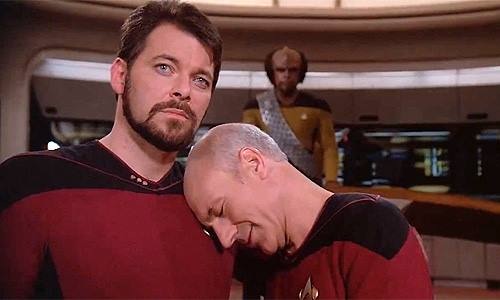
In the next installment of the Star Trek re-boot, a very young Captain Kirk battles a giant Marshmallow Monster in a sailor suit, only to defeat it by kicking the air out of its sails. Barely escaping with his boats still intact, Kirk then faces the giant Balloon Entity of Tritium Two. The title of this movie, Star Trek: Air Apparent, features fifty aliens blown in from all corners of the Milky Way. The exact release date hasn’t been established, but plans are to release it on a Winds-day.
Tag Archives: Star Trek
Will fan fiction be the next target?
‘Star Trek’ Copyright Battle Pits Paramount and CBS Against ‘Professional’ Fan Film
Enterprising producer raised over $1.2 million, and promised a ‘feature-quality’ movie
by Mark Perton
Source: http://www.newsweek.com/star-trek-fan-fiction-451320
Star Trek, the venerable sci-fi franchise that turns 50 this year, has long been known for the dedication of its fans. In the late 1960s, when the original TV series was threatened with cancellation after two seasons, a letter-writing campaign brought the show back for a third year. After the show was canceled the following year, fan conventions kept the Trek dream alive, screening rare clips and “blooper reels” which, in that pre-VCR, pre-YouTube era, allowed them to explore the frontiers of their favorite show.
Fans at those conventions also shared fan fiction: mostly mimeographed stories that created new adventures for the characters that left TV two years shy of completing their “five year mission.” Over time, fan fiction evolved and became a multimedia genre, and even as Star Trek was revived and developed as a major media property encompassing a dozen motion pictures and hundreds of TV episodes, fan-produced films became a mainstay of YouTube and other video sites.
Today’s fan films, like written fan fiction, occupy a legal gray zone. While some can potentially be considered satire or commentary, and therefore, legally permitted works, many can easily be classified as unauthorized exploitation of copyrighted material—and could be shut down by the copyright’s owners.
For the most part, Paramount Pictures and CBS, which jointly own the copyrights associated with Star Trek, have turned a blind eye to non-commercial fan productions, and have even seemed to encourage them. James Cawley, a fan producer who built detailed reproductions of original Star Trek sets in his upstate New York studio, had a cameo in J.J. Abrams’ 2009 Star Trek film. Paramount also borrowed props from Cawley’s studio for use in the series Star Trek: Enterprise, and named a ship in one episode the Ticonderoga, a reference to the fan producer’s hometown.
Fan efforts have also been embraced by many in the “official” Star Trek creative community; fan films have featured dozens of cast members from Paramount’s productions, including original series stars Walter Koenig, Nichelle Nichols and George Takei, and actors from many other Trek outings, ranging from Star Trek: Voyager’s Tim Russ to Alan Ruck, who played hapless starship captain John Harriman in Star Trek: Generations (but is, of course, best known for playing hapless teenager Cameron Frye in Ferris Bueller’s Day Off). One fan series includes Chris Doohan, the son of the actor who played Scotty in the original series, taking over his father’s role. Even Majel Barrett Roddenberry, wife of Star Trek creator Gene Roddenberry, reprised her role as the voice of the U.S.S. Enterprise’s computer in a fan production. Writers like original series legends D.C. Fontana and David Gerrold (best known for the classic episode “The Trouble With Tribbles”) have contributed scripts to fan films.
For years, fan producers formed a close community, trading tips and cast members, sharing props and studios, and engaging in friendly competition over things like the accuracy of their sets, their interpretations of classic characters and the quality of their productions. And their productions became increasingly more polished as digital technology allowed them to create CGI space battles and elaborate green screen sets, and do sophisticated editing and post-production work on affordable computers. To produce these ever-more sophisticated films, fans turned to crowdfunding, in some cases raising hundreds of thousands of dollars through platforms like Kickstarter and Indiegogo.
As the fan films began working with budgets that rivaled those of some independent movies, and successfully recruited cast and crew members who had worked on commercial Trek properties, one nagging question kept coming up: When will someone go too far and draw the ire of Paramount and CBS? As Hollywood news site The Wrap put it last August, after the fan film Star Trek: Axanar—which its producer said would be as good as something “coming out of the studio”—raised over $1 million through its crowdfunding campaigns, “the seven-figure bankroll raises questions about just how ‘fan’ the project is and at what point it poses a threat to the authorized franchise.”
Axanar’s budget and boasts may have been too much for Paramount and CBS, and in December, the two companies sued Axanar Productions, claiming that its work “infringe[s] Plaintiffs’ works by using innumerable copyrighted elements of Star Trek, including its settings, characters, species, and themes.” The suit named the production company, studio head Alec Peters, and “Does 1-20,” an unnamed group that could expand to include personnel such as director Robert Meyer Burnett, an industry professional who had previously produced featurettes for CBS’ Star Trek Blu-ray releases.
In its lawsuit, Paramount and CBS cited the fact that the Axanar team referred to their project as a “fully professional, independent Star Trek film” that raised over $1 million, adding that the producers “enjoy a direct financial benefit from the preparation, duplication and distribution of the infringing Axanar Works.”
Indeed, Axanar Productions boasted of plans to use its studio to produce other films and actively defended its broader ambitions. Unlike other fan producers, who largely volunteer their time, Axanar’s Peters paid himself a salary of $38,000 in 2015. Axanar also built a merchandising business, offering everything from scale models of ships featured in its films to Axanar-branded coffee on a “donor” website.
Rather than fold up his tent, Peters fought back, and brought on pro bono lawyers to defend his right to produce the film, saying that it’s a non-commercial production, is covered under fair use doctrines, and that the suit is too vague and broad, claiming ownership of things like the fictitious Klingon language. In the meantime, production on Axanar was halted, leaving a 20-minute teaser, Prelude to Axanar (which is also a subject of the lawsuit), as the nascent studio’s only product.
Paramount and CBS may be particularly sensitive at the moment to unauthorized works designed, as the Axanar team put it, to “look and feel like a true Star Trek movie.” The studios are gearing up for the July release of the latest film in the series, Star Trek: Beyond, along with a major merchandising blitz in conjunction with the film and the franchise’s 50th anniversary. Based on the combination of ticket sales and licensing, Star Trek properties could bring in close to $1 billion this year. And in 2017, CBS will launch the sixth live-action Star Trek TV series, with a risky online-only model designed to anchor the network’s CBS All Access streaming service; if successful, the new series could add over $400 million to CBS’s bottom line next year.
As the suit has progressed, it has has split the once tight-knit fan film community. Some fans believe that Peters is going too far.
“There is no question in my mind that CBS owns Star Trek,” fan film producer James Cawley recently commented in a popular Star Trek forum. “They have been very gracious to allow us to play in their sandbox for many years,” he wrote, adding that “if CBS says, stop making fan films, we would abide by their wishes and say thank you.” In a seeming comparison between Axanar’s ambitions and more traditional fan fiction, he commented: “I don’t rent my sets, I don’t charge for anything, and I certainly have never gotten any salary for playing Trek with my friends” and, “I did it for nothing but the love of the game, if and when it ends at least I can say I played by the rules I was given when I cross the finish line.”
Meanwhile, Peters has taken on his erstwhile compatriots, pointing out to the Trek news site 1701News that he’s built a professional team: “They’re not fans who are voice actors, or Elvis impersonators who have a hobby and have always wanted to play Capt. Kirk.” (Cawley, who played Kirk in several of his own productions, is also an Elvis impersonator, while another fan producer and Kirk actor, Vic Mignogna, is a voice actor.)
The suit has also highlighted rifts among those affiliated with the official Star Trek productions. Star Trek: Beyond director Justin Lin took to Twitter to defend Axanar, writing: “This is getting ridiculous! I support the fans. Star Trek belongs to all of us.” However, Rod Roddenberry, son of Trek creator Gene Roddenberry, and an executive producer on CBS’ forthcoming Star Trek series, commented to an interviewer that, while he’s “a fan of fans keeping Star Trek alive,” fan producers have to “follow the rules and do it right,” or “there’s going to be prices and penalties to pay.”
Fallout from the case has already hurt other fan productions. Mignogna’s latest installment of his Star Trek Continues series is far behind in its crowdfunding goals, and the producer told fan site The Bronze Review, “there are a lot of scared folks out there, afraid to donate to a fan production due to the climate now.” In late April, another fan project, Star Trek: Federation Rising, was canceled, after its producer said he was contacted by CBS executives, who “advised me that their legal team strongly suggested that we do not move forward.” In a Facebook posting, producer Tommy Kraft thanked CBS “for reaching out to me, rather than including us in their ongoing lawsuit against Axanar.”
Kraft also announced plans to produce an original science fiction film, completely devoid of any Star Trek intellectual property. If there’s a silver lining to the current situation, it may well be based on plans like Kraft’s. One only need look at the history of fan-fiction author Erika Mitchell. After writing a set of stories featuring characters from the popular Twilight books, Mitchell, under the pen-name E.L. James, reworked her tales and removed all references to Twilight. The resulting work, the Fifty Shades of Grey series, has since sold more than 125 million copies worldwide, has been adapted as a major motion picture and has earned Mitchell over $100 million.
Perhaps freedom from Paramount and CBS’s properties, could, in the end, allow former Trek projects to boldly go where no fan film has gone before.
Source: http://www.newsweek.com/star-trek-fan-fiction-451320
Star Trek stamps
Star Trek
For those writers who will be mailing out manuscripts in 2016, particularly science fiction manuscripts, these stamps may be just the item you’ll need. Who knows, since they are forever stamps, writers might be using them into the 23rd Century.
Celebrating the 50th anniversary of the television premiere, the new Star Trek Forever stamps showcase four digital illustrations inspired by classic elements of the television program:
- the Starship Enterprise inside the outline of a Starfleet insignia against a gold background;
- the silhouette of a crewman in a transporter against a red background;
- the silhouette of the Enterprise from above against a green background; and,
- the Enterprise inside the outline of the Vulcan salute (Spock’s iconic hand gesture) against a blue background.
The words “SPACE… THE FINAL FRONTIER,” from Captain Kirk’s famous voice-over appear beneath the stamps against a background of stars. The stamps were designed by Heads of State under the art direction of Antonio Alcalá.
Source: https://about.usps.com/news/national-releases/2015/pr15_069.htm
Writing tip Wednesday: “Star Trek Strange New Worlds story contest”
The deadline for entry is 11:59 PM EST January 15, 2016.
In celebration of Star Trek’s 50th anniversary in 2016, publisher Simon & Schuster is bringing back the popular fan fiction writing contest, Strange New Worlds! Here is your unique opportunity to present to this world and beyond that special Star Trek story that has never been told.
Ten winning selections will be published as part of an all-new official anthology, coming from Simon & Schuster in 2016. Plus, two first prize winners will receive a free, self-publishing package from Archway Publishing!
Editorial Guidelines
Stories must focus on past and present Star Trek main characters or familiar guest characters from the live-action TV series or the first ten feature films released prior to 2009.
- Stories must be between 7,500 and 10,000 words.
- Stories must contain no explicit sexual activity or graphic depictions of violence or sadism.
- Stories may not contain the previously unestablished death of a Star Trek character or make significant changes in the life of a major character.
- No illustrated or graphic submissions will be accepted.
- The Submission must be an original story based on the established Star Trek universe and or characters from the following Television series or Motion Pictures:
Television
The Original Series, Seasons 1-3
The Next Generation, Seasons 1-7
Deep Space Nine, Seasons 1-7
Voyager, Seasons 1-7
Enterprise, Seasons 1-4Motion Pictures
The Motion Picture (1979)
The Wrath of Khan (1982)
The Search for Spock (1984)
The Voyage Home (1986)
The Final Frontier (1989)
The Undiscovered Country (1991)
Generations (1994)
First Contact (1996)
Insurrection (1998)
Nemesis (2002) - See complete list of story qualifications/disqualifications in the Rules at http://www.startrekbooks.com/contest_rules.
Filed under 2015, contest, writing tip, Writing Tip Wednesday
Vader Meets Kirk in Awesome “Star Wars” and “Star Trek” Trailer Mashup (Video)
A new video mashes up clips from “Star Wars” and “Star Trek” into a trailer for a fake 1985 film whose release would have been the sci-fi event of the century.
by MIKE WALL, Space.com Senior Writer
“Trapped in a galaxy far, far away, Captain James T. Kirk and the crew of the famous starship Enterprise are left to the mercy of an evil galactic empire and caught in the middle of an interstellar war,” the narrator of the fake movie, called “The Carbonite Maneuver,” intones as the Enterprise is captured by a “Star Wars” Imperial Star Destroyer.
Details at: http://www.space.com/29404-star-wars-star-trek-mashup-video.html?cmpid=NL_SP_weekly_2015-05-15
“Legends will unite and galaxies will clash as your imagination embarks upon a fantastic flight into fantasy-film history,” the narrator adds in the 85-second video, which was posted to YouTube on May 6. “‘The Carbonite Maneuver:’ a cosmic spectacle unlike anything you’ve seen before.”
The fake film’s title is, appropriately enough, a nod to both sci-fi franchises. Han Solo was flash-frozen in carbonite in “The Empire Strikes Back,” and one episode in the first season of the original “Star Trek” TV series was called “The Corbomite Maneuver.” (In the episode, Captain Kirk bluffs away a potential attacker by claiming that the Enterprise is protected by an imaginary substance called corbomite.)
The trailer shows multiple meldings of the “Star Wars” and “Star Trek” universes. For example, Captain Kirk comes face to face with the humanoid robot C-3PO, TIE fighters fire at the Enterprise during a deep-space chase, and the iconic “Star Trek” vessel zooms down the trench of the planet-destroying Death Star.
There are some nice touches in the credits as well. “The Carbonite Maneuver” was supposedly written by Lawrence Kasdan, who co-wrote two of the first three “Star Wars” films (“The Empire Strikes Back” and “Return of the Jedi”), and the music is attributed to the English composer Gustav Holst. (The works of Holst, who died in 1934, reportedly served as inspiration to John Williams, who has written the music for all “Star Wars” films to date.)
“The Carbonite Maneuver” is rated PG. It opens June 5, 1985; a related video game is available now from Atari.
[Editor’s note: Build your own captain’s chair and join along.]
MythBuster Adam Savage builds “Star Trek” captain’s chair
Watch the co-host of the “Mythbusters” science show make a functional “Star Trek” chair worthy of Captain Kirk, with help from his friend Jeremy Williams.
Source: http://www.cnet.com/news/mythbuster-adam-savage-builds-star-trek-captains-chair/
Adam Savage, co-host of the Discovery channel’s “MythBusters” science show, never shies away from a challenge. When he acquired a disappointing replica of a “Star Trek” captain’s chair, instead of being content with it, the longtime prop maker decided to make a brand-new and better chair.
n the latest video from Tested.com, Savage shows off his impressive captain’s chair, and then with help from his friend Jeremy Williams does some electronics magic to wire the chair’s lighting system and implement sound effects. After some troubleshooting, the duo add various LED lights, light strips, power sources, speakers and of course, many wires.
“As I was building it, I’d like it to have a feature that no other chair has,” Savage said in the video. “So I ended up adding a couple of features like a viewer, which is in ‘The Cage,’ which is the unaired pilot of ‘Star Trek.’ [And] I added one other feature so I made a drawer (in the base) for the props.”
The handcrafted chair has five interface panels, which include the switch bank of rocker switches, the lights display, five push buttons and the intercom.
The result is the ultimate, one-of-a-kind “Star Trek” captain’s chair with details that would impress even Scotty. Check out this photo gallery to see behind-the-scenes shots of the build process.
Indignation and hope
Physicist, inventor, bestselling author, and futurist David Brin talks about how problems are solved in today’s society, how we should approach things that frustrate us, and why and when we should speak up. How do we combat the cynicism that prevents us from acting to solve our problems? And how do we handle the anger that comes with them?
Published June 20, 2014
Leonard Nimoy obituary: “Star Trek’s” Spock, dies at 83 – LA Times
Source: http://www.latimes.com/local/obituaries/la-me-leonard-nimoy-20150227-story.html#page=1.
When Leonard Nimoy was approached about acting in a new TV series called “Star Trek,” he was, like any good Vulcan contemplating a risky mission in a chaotic universe, dispassionate.
“I really didn’t give it a lot of thought,” he later recalled. “The chance of this becoming anything meaningful was slim.”
By the time “Star Trek” finished its three-year run in 1969, Nimoy was a cultural touchstone — a living representative of the scientific method, a voice of pure reason in a time of social turmoil, the unflappable and impeccably logical Mr. Spock.
He was, as The Times described him in 2009, “the most iconic alien since Superman” – a quantum leap for a character actor who had appeared in plenty of shows but never worked a single job longer than two weeks.
Nimoy, who became so identified with his TV and film role that he titled his two memoirs, somewhat illogically, “I Am Not Spock” (1975) and “I Am Spock” (1995), died Friday at his home in Bel-Air. He was 83.
The cause was end-stage chronic obstructive pulmonary disease, said his son, Adam.
Nimoy revealed last year that he had the disease, a condition he attributed to the smoking he gave up 30 years earlier.
While he was best known for his portrayal of the green-tinted Spock, Nimoy more recently made his mark with art photography, focusing on plus-sized nude women in a volume called “The Full Body Project” and on nude women juxtaposed with Old Testament tales and quotes from Jewish thinkers in “Shekhina.”
He also directed films, wrote poetry and acted on the stage.
As Spock, he was the pointy-eared, half-Vulcan, 23rd-Century science officer whose vaulted eyebrows seemed to express perpetual surprise at the utterly illogical ways of the humans who served with him on the starship Enterprise.
Spock could barely wrap his mind around feelings. He was the son of a human mother and a father from Vulcan – a planet whose inhabitants had chosen pure reason as the only way they could survive. When he thwarted deep-space evil-doers, it was with logic simple enough for a Vulcan but dizzying for everyone else, including his commanding officer, Capt. James T. Kirk, played by William Shatner.
While worlds apart from the racial strife and war protests of the 1960s, “Star Trek” explored such issues by setting up parallel situations in space, “the final frontier.”
“Spock was a character whose time had come,” Nimoy later wrote. “He represented a practical, reasoning voice in a period of dissension and chaos.”
He also turned Nimoy into an unlikely sex symbol.
More at: http://www.latimes.com/local/obituaries/la-me-leonard-nimoy-20150227-story.html#page=1
Writing tip Wednesday: “No excuses”
Read and write and do both regularly
by Joe R. Lansdale
Source: https://www.facebook.com/JoeRLansdale/posts/753873058055046
A major rule of writing. Stop making excuses. You do have time if you want to do it. Sure, there are those rare exceptions. But nearly everyone has time. I worked two jobs and had time. Not a lot of time, but enough to get something done daily. If you have time to plop down in front of the TV to watch a Star Trek rerun, or what have you, you have time. If you can go to a job you hate, or at best tolerate, be on time and do it right, you should be able to find a few minutes a day to do something you really want to do. Even if you love your job and want to write, you can find time.
If you are going to take time off, read. That’s the most important tool to a writer. If you read you put fuel in the tank and you begin to better understand how stories are constructed. Once you lean how it works, or as best as anyone can learn how it works, then you can lose the rule book and do it anyway you like. You can make something new best when you understand something old. In other words, don’t mess with the structure of storytelling until you understand how it works, then you can successfully subvert it if you need to. A hard thing to grasp, but it’s true.
Put your ass in a chair in front of the world processor, typewriter, writing tablet, papyrus pages, what have you, and write.
Finish what you start. Sure, you can switch over and work on other things from time to time, but don’t end up with partials of this and pieces of that. Have a major project and finish it. When that’s done, start something new. While you’re marketing a novel, or if you’re far enough along to have an agent do it for you, start a new project to keep you from waiting by the telephone, mail box, email, for a response.
Work daily and at the same time if possible. If not, work when you can, but make it a habit. It takes a lot of hours before something kicks in as a habit. Set a time each day when you can work, and do it. It can be for whatever length of time you have available. If you can’t work every day of the week, try and work as many days as possible. Plan on four or five days at the least, seven if you can. Get up early on holidays and write a bit as a gift to yourself. Don’t let holidays spoil your momentum. Okay, you can take holidays off if you must, but be careful to stay in the zone.
Having a word count or page count can be useful.
Read the rest at: https://www.facebook.com/JoeRLansdale/posts/753873058055046
Filed under Writers on writing, writing tip, Writing Tip Wednesday